
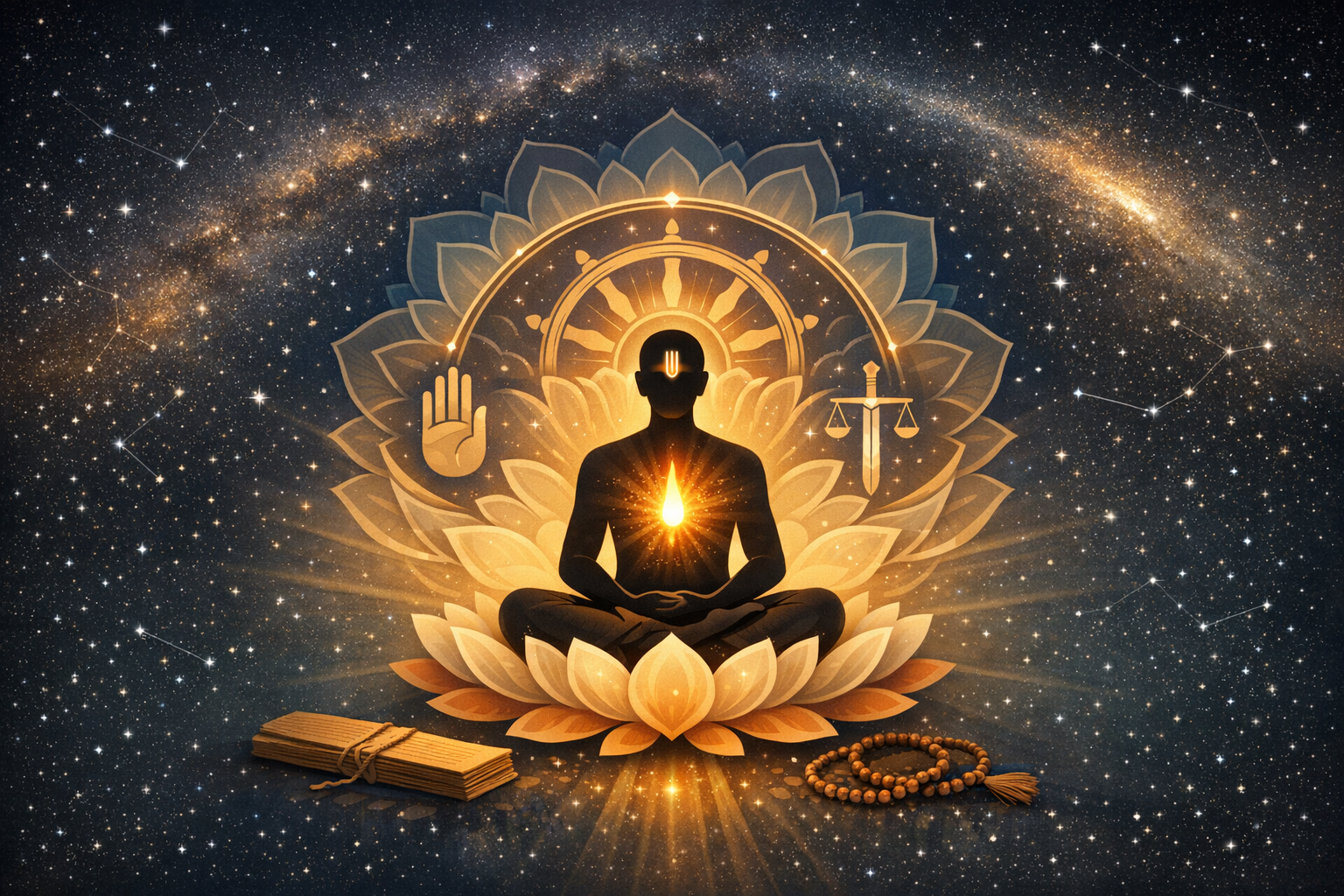
Across contemporary life, it can appear that many remain deeply attached to material pursuits, resistant to spiritual reflection, and incapable of transformation. Dharmic philosophy offers a strikingly different horizon: freedom is not an exception reserved for a few, but the eventual destiny of all conscious beings. Within this panoramic view, hope is not wishful thinking; it is a metaphysical commitment grounded in the nature of reality and the intrinsic dignity of the jīva (individual self).
Paramatma Sandarbha, one of the six foundational Sandarbhas of Śrī Jīva Goswami, articulates this commitment with rigorous clarity. The text situates the jīva in relation to Paramatma—the indwelling witness, regulator, and benefactor present in all beings—and shows how the arc of existence bends toward spiritual freedom (moksha). Read alongside the Bhagavad-Gita, the Upanishads, and the broader Vedanta tradition, it advances a coherent account of why no one is permanently excluded from liberation.
Philosophically, Paramatma Sandarbha clarifies three interlocking realities: Bhagavan (the Supreme), Paramatma (the immanent aspect permeating the cosmos and residing within every heart), and jīva (the finite self). The text argues that Paramatma’s omnipresence ensures moral order, karmic continuity, and the ongoing possibility of grace. Because the jīva is ontologically distinct yet inseparably dependent, its ultimate well-being is guaranteed in principle, even if temporally deferred by ignorance (avidyā) and the long residue of impressions (vāsanā) carried through karma and reincarnation.
Bondage, in this framework, has no first moment; it is anādi—beginningless—but, crucially, not endless. The perpetuation of suffering rests on misidentification with the body-mind complex and the chronic reactivity of the senses. As long as awareness is outward-turned, the jīva reenacts its history across lifetimes, conditioning itself further. Yet Paramatma remains the intimate witness and inner guide, the steady axis around which the cycles of change revolve, enabling the very recognition that makes freedom possible.
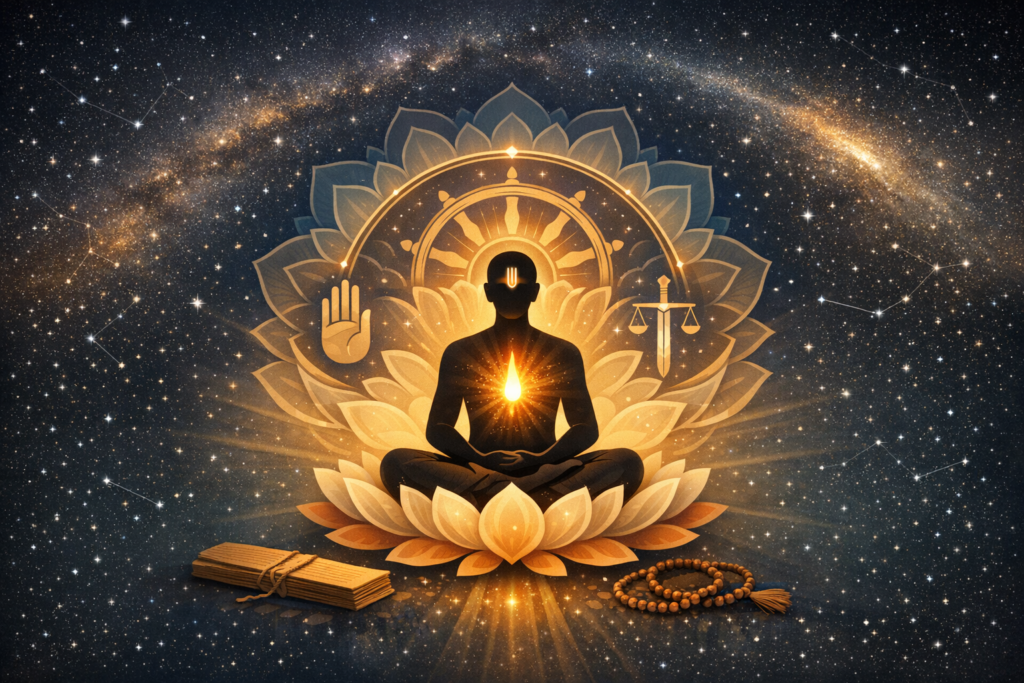
Release (moksha) unfolds when right knowledge (jnana), devotion (bhakti), ethical clarity (dharma), and contemplative steadiness (yoga) realign the jīva with its source. Far from being a merely intellectual resolution, liberation integrates love, wisdom, and conduct. Paramatma Sandarbha repeatedly underscores bhakti’s transformative primacy: devotion accelerates the dissolution of ignorance by reorienting desire toward the Absolute, softening the heart, and awakening direct experience of the indwelling divine.
From this vantage, the claim that “everyone will eventually reach freedom” is not an optimistic add-on but a structural conclusion. If Paramatma is universally present, if the jīva’s nature is to know and to love, and if karmic chains are contingent rather than essential, then no being is ontologically disqualified from realization. Cosmic time may be vast and the journey arduous, but the metaphysical end remains the same: the restoration of conscious harmony with the whole.
This conclusion does not excuse passivity. Precisely because liberation is assured in principle, effort becomes the natural expression of alignment in practice. The Bhagavad-Gita enjoins yoga—skill in action—grounded in devotion and discernment. Paramatma Sandarbha reframes sādhanā (discipline) as participation in a process already moving in one’s favor. Practice does not create grace; it prepares the ground for its recognition.
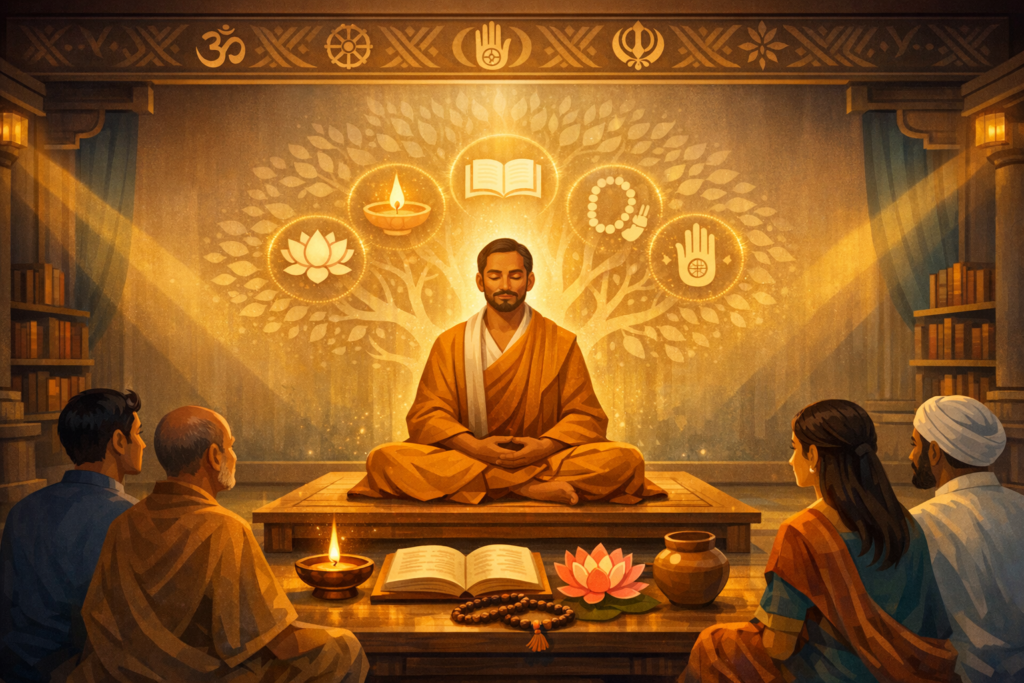
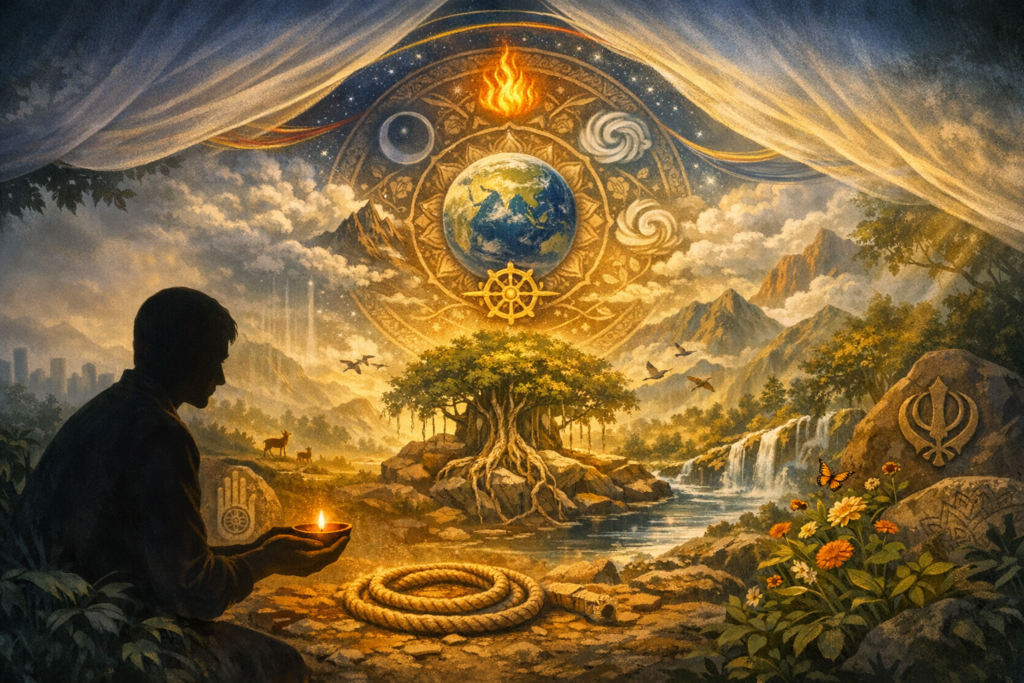
Dharmic traditions converge powerfully on this universalist horizon. In Buddhism, the luminosity of mind and the potential for awakening (nirvana) are available to all sentient beings, with Mahayana emphasizing Buddha-nature as a basis for universal enlightenment. In Jainism, each jīva possesses the inherent capacity for kevala-jñāna (complete knowledge), with Anekantavada affirming that truth is many-sided and accessible through multiple valid perspectives. Sikh teachings emphasize the primacy of Hukam (cosmic order) and Nadar (grace), where the remembrance of the Name and selfless seva open the way to liberation for everyone. In Hinduism, the plurality of mārga (paths)—bhakti, jnana, karma, and raja yoga—reflects the inclusivity of Ishta (chosen form or approach) and the civilizational ethos of Vasudhaiva Kutumbakam.
These resonances reveal a shared civilizational grammar: unity in spiritual diversity is not a slogan but a soteriological principle. Different philosophical emphases—devotion, inquiry, contemplation, nonviolence, service—are complementary modalities of the human ascent. Where Paramatma Sandarbha stresses the immanent guide within, other traditions name the same guiding presence as awakened awareness, the jewel-like nature of the soul, or divine grace. The metaphors vary; the promise does not.
Contemporary expositions—such as those by Sri Nandanandana dasa (Stephen Knapp)—translate Paramatma Sandarbha’s insights into accessible language without compromising its depth. This modern presentation is valuable for practitioners navigating the pressures of technological saturation, information overload, and fragmented attention. It shows how ancient categories—Paramatma, jīva, avidyā, and bhakti—can illuminate the psychology of distraction and the disciplines that restore wholeness.
Practical implications follow naturally. Daily remembrance (japa, kīrtana), study (svādhyāya) of the Bhagavad-Gita and the Upanishads, ethical observances (yama–niyama), breathwork (pranayama), and selfless service (seva) cultivate the interior stability required for insight to ripen. In Buddhist idioms, mindfulness and compassion practices retrain attention and intention; in Jain idioms, ahimsa and aparigraha refine conduct and purify karmic inflows; in Sikh idioms, simran and kirtan soften egoic rigidity and align life with Hukam. Each path operationalizes hope through disciplined compassion and contemplative presence.
Philosophically, the Sandarbha’s assurance rests on three pillars: scriptural testimony (shruti–smriti), reasoning (yukti), and lived realization (anubhava). Upanishadic verses that witness to the Self’s universality, the Bhagavad-Gita’s pedagogy of integrated action and devotion, and cross-traditional accounts of direct awakening supply a triangulated warrant. This triangulation resists both fideism and skepticism: it asks reason to interpret revelation and asks experience to confirm both.
In pluralistic societies, the Ishta principle—honoring the right of each seeker to approach the Divine through a chosen form or method—provides a durable basis for interfaith dialogue. Jain Anekantavada complements this ethos by discouraging absolutist claims and encouraging perspectival humility. Together, they uphold an environment in which Hindus, Buddhists, Jains, and Sikhs can pursue their practices vigorously while recognizing a shared moral and spiritual destination.
This pluralism contrasts with approaches that insist on a single salvific route and, at times, seek to delegitimize alternative paths. Dharmic thought, by emphasizing Unity in spiritual diversity, resists such narrowing. The goal is not to win arguments but to deepen realization and expand compassion. When communities protect the freedom of practice and the dignity of difference, they enact Vasudhaiva Kutumbakam—not as rhetoric, but as lived policy and culture.
For seekers asking “What should be done today?” a concise regimen proves effective: a few minutes of silent or audible mantra japa; one passage from the Bhagavad-Gita or Upanishads; a commitment to one concrete act of seva; and a brief diary of gratitude and self-observation. Over time, these practices reduce reactivity, clarify intention, and make perceptible the quiet guidance of Paramatma within the heart.
Ethically, the doctrine that every soul is destined for freedom dissolves grounds for contempt, fatalism, or spiritual elitism. If each being carries the same ultimate promise, then compassion is both rational and obligatory. Social service, environmental stewardship, and solidarity with the vulnerable cease to be optional projects; they are the natural expressions of a metaphysics of hope.
Objections typically focus on the persistence of evil and the apparent intractability of human folly. Paramatma Sandarbha answers by distinguishing between ontological ends and historical means. Karmic entanglement explains why progress can be slow and uneven; grace explains why it is never impossible. The pace may vary with effort, intention, and conditioning, but the direction remains assured.
Psychologically, the language of samskara and vāsanā aligns with contemporary accounts of habit-formation and trauma-informed growth. Breath regulation (pranayama), mantra-based attention, and contemplative pauses engage the nervous system, lowering arousal and widening the window for wise response. Spiritual discipline here functions as applied neuroscience, gently rewiring attention in the service of freedom.
In the Gaudiya Vaishnava lineage, devotion (bhakti) integrates and elevates all disciplines. Bhakti does not reject reason or silence the mind; it orders both around love. In Buddhist and Jain frames, love appears as boundless compassion and non-harm; in Sikh practice, as humility and seva. Different grammars, one heart: action, insight, and devotion converge on the same liberating recognition.
To say that hope is for everyone, then, is to make a precise philosophical statement: because Paramatma resides in all beings, because the jīva is luminous by nature, and because ignorance is contingent rather than essential, liberation is universally available. The civilizational wisdom of Hinduism, Buddhism, Jainism, and Sikhism amplifies this assurance, each tradition contributing methods that honor human diversity while securing a common destiny.
The invitation is simple and demanding: practice with steadiness, honor the plurality of paths, and trust the immanent guidance that never abandons any soul. In this shared endeavor, society becomes a field for mutual uplift, and personal discipline becomes a public good. Over lifetimes if necessary—but beginning now—the promise stands: every being can, and ultimately will, awaken to freedom.
Inspired by this post on Dandavats.



Leave a Reply
You must be logged in to post a comment.