
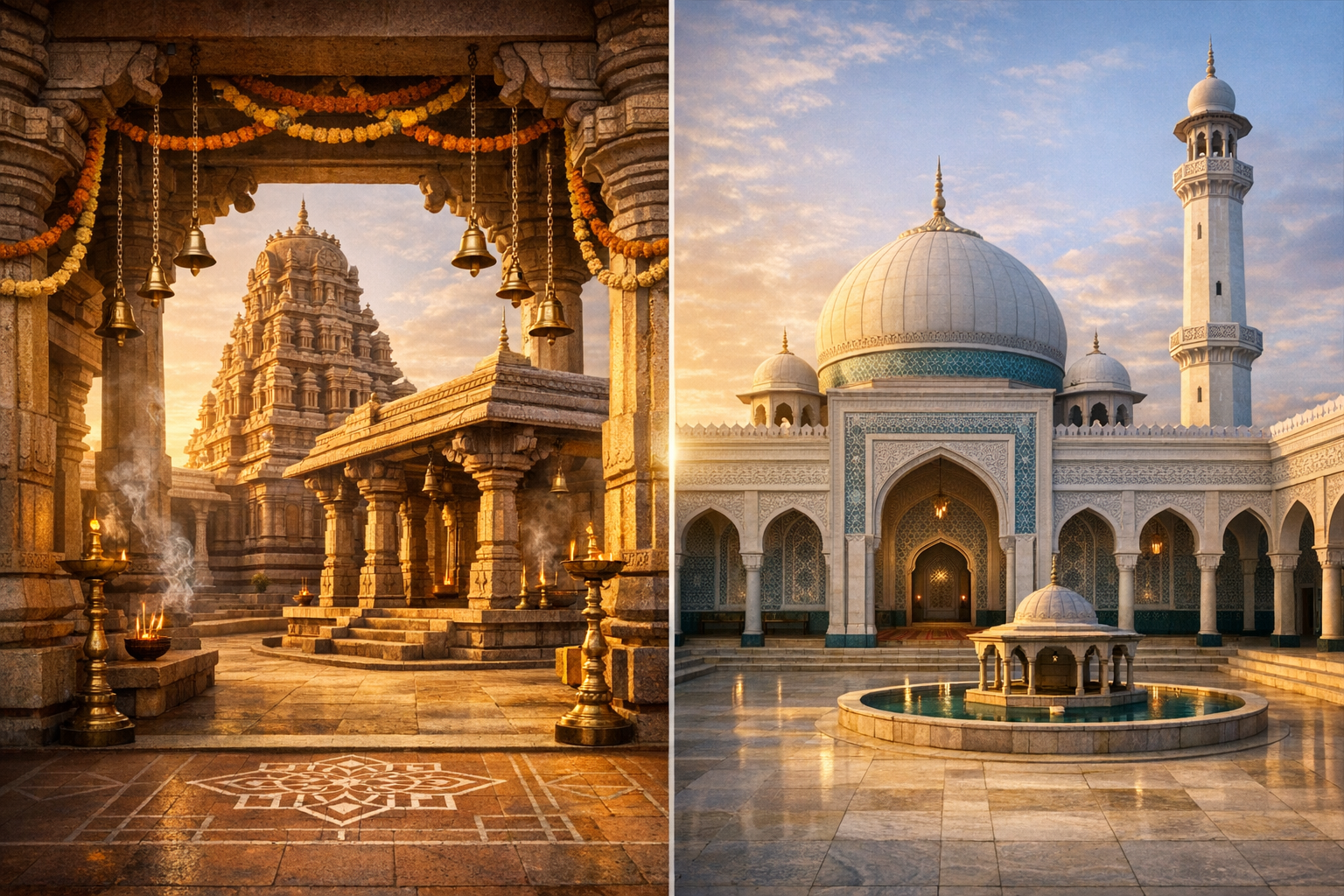
Sacred architecture encodes theology in stone, brick, sound, and space. In South Asia and beyond, the Hindu temple and the mosque stand as fully developed models of how communities approach the Divine. Comparing them respectfully clarifies how different religious philosophies shape design, ritual, and communal life, while also revealing convergences in ethics, devotion, and service. This analysis highlights the difference between a Hindu temple and a mosque in a way that supports interfaith understanding and the unity of dharmic traditions alongside broader religious coexistence.
Theological orientation forms the master key to both typologies. In Hindu thought, the Divine is simultaneously transcendent and immanent; a consecrated image or symbol, the murti or linga, becomes a living presence through prana pratishtha. Worship centers on darshan, a mutual seeing in which devotees behold the deity and feel seen in return. In Islam, tawhid affirms the absolute oneness and transcendence of God. Aniconism follows from this principle: no images of the Divine are used, and the mosque organizes communal space for direct, image-free submission to Allah through salah oriented toward the qibla.
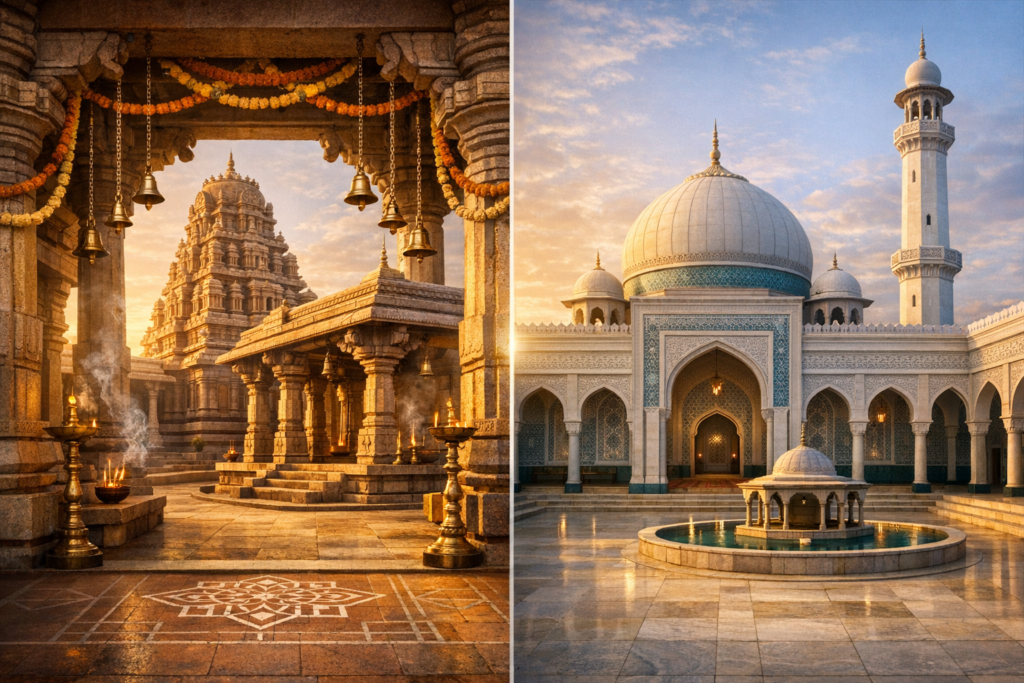
Hindu temple plans often follow Vastu Shastra and the Vastu Purusha Mandala, a cosmogram that maps cosmic order into a geometric grid. The plan acts as a spiritual itinerary, guiding movement from the outer world to the sanctum where the presence resides. The temple’s spatial sequence is intentionally layered, drawing the mind inward.
Key components typically include the garbhagriha or sanctum, an antarala or vestibule, one or more mandapas or pillared halls, and circumambulatory paths for pradakshina. Vertical markers vary by regional style: shikhara in Nagara temples of the north and vimana in Dravida temples of the south. Walled enclosures, or prakaras, with monumental gopurams in the south, stage thresholds that signal ascent from the ordinary to the sacred.
Mosque planning is organized by orientation and congregation. The qibla wall aligns worshipers toward Mecca; a niche called the mihrab marks this direction and focuses the sightline. The minbar, a stepped pulpit, supports the Friday khutbah. Many mosques incorporate a sahn or courtyard with shaded riwaqs, a prayer hall that may be hypostyle or domed, and one or more minarets that historically aided the adhan. Ablution facilities for wudu adjoin or are integrated into circulation.
The Hindu temple’s processional movement, thresholds, and circumambulatory paths cultivate gradual interiorization and the felt nearness of a living presence. In contrast, the mosque’s emphasis on clear alignment and parallel rows embodies unity in congregation; each worshiper stands equidistantly before the qibla, reinforcing equality and shared submission.
Iconography distinguishes the two as well. Hindu temples employ figurative images and symbols, from anthropomorphic murtis to aniconic forms like the linga or yantras, all adorned through alankara. Sculpted narratives and mythic scenes animate walls and pillars. By contrast, mosques favor calligraphy of Quranic verses, geometric tessellations, and vegetal arabesques. Ornament becomes theology in pattern: infinite, non-figurative repetition mirrors divine unity and transcendence.
Ritual cycles in Hindu temples are agamic and richly textured. Nitya puja includes upacharas or offerings, abhisheka or ritual bathing, alankara or decoration, naivedya or food offering, and aarti or lamp offering. Festivals animate the calendar with rath yatras, Brahmotsavams, and processions of utsava murtis. Prasad distribution ties devotion to nourishment and community.
Mosque ritual life centers on time-bound prayer and remembrance. The adhan calls the faithful to the five daily prayers; the iqama cues commencement. Jumuah brings a congregational sermon and prayer each Friday. In Ramadan, tarawih deepens nightly remembrance, and Eid prayers mark feasts that unite large communities, sometimes at dedicated Eidgah grounds. Recitation of the Qur’an, personal supplication or du’a, and spiritual retreat or i’tikaf sustain interiority without intermediaries.
The sensory environment reflects distinct ritual grammars. Hindu temples activate sight, scent, and sound through lamps, incense, bells, the shankha or conch, and often live music such as nagaswaram and mridangam. Mosques cultivate a soundscape of human voice: the adhan across the neighborhood, melodious Qur’anic recitation in the hall, and the deliberate silences that frame them. Musical instruments are typically absent, underscoring concentration and sobriety.
Timekeeping and calendars also diverge. Hindu temples coordinate daily and festival observances using tithis and planetary transits, often determined by traditional panchang computations. In Islam, prayer times track the sun’s position, while the Hijri lunar calendar governs Ramadan, Hajj, and Eids. Both traditions exemplify sophisticated astronomical awareness translated into devotional rhythm.
Religious office and participation reinforce theology. In Hindu temples, archakas or priests perform ritual per agamic or tantrasastra guidelines, frequently within hereditary lineages but also through modern training pathways. In mosques, an imam leads prayer and a khatib delivers sermons, yet the structure is non-sacerdotal: any adult Muslim male may technically lead prayer if qualified, and each worshiper prays as an equal in the row. Governance likewise varies, from devasthanam or trust management in temples to waqf boards and community committees in mosques.
Community service threads through both institutions. Many temples host annadanam kitchens, dharmashalas, charitable clinics, and education initiatives. Mosques facilitate zakat and sadaqah distribution, maintain madrasas, support iftar gatherings, and provide funeral services. As anchors of Cultural Heritage, they operate not only as places of worship but as social infrastructure that sustains neighborhoods.
Questions of access and gender display regional diversity and ongoing conversations. Some temples restrict entrance to the garbhagriha while ensuring darshan for all; others allow wider access, and many have moved toward greater inclusion. Mosques often provide dedicated spaces for women or separate galleries, with growing efforts toward improved access and safety. Across traditions, trends point toward inclusion while respecting doctrinal boundaries.
Materials and structural systems express regional craft lineages. Many Hindu temples, especially in Dravidian regions, employ heavy stone, trabeated systems, and corbelled towers with intricate reliefs. Nagara temples feature curvilinear shikharas and complex jangha articulation. Mosques across South Asia often use brick and stone with arches, vaults, and domes, finished in stucco, lime plaster, or glazed tile depending on climate and craft. Both reveal advanced geometry, proportion, and climate-responsive design refined over centuries.
Circulation patterns deepen the experiential difference. Temple movement tends to be centripetal and spiralic, with layered thresholds that reduce distraction. Mosque space, by contrast, privileges clarity and simultaneity: the moment the rows align, the many become one body in synchronized bowing and prostration. One typology articulates a journey of approach to presence; the other choreographs a shared act of remembrance before the One.
Pilgrimage and festival also frame differing emphases. Hindu tirtha-yatra connects vast networks of shrines, river confluences, and sacred geographies, with moving processions that carry the deity’s utsava murti beyond the sanctum into the city. In Islam, Hajj and Umrah are global pilgrimages to Mecca and Medina rather than to local mosques; local mosque life intensifies during Ramadan and on Eids, sometimes expanding to large open-air Eidgahs to accommodate crowds.
Artisanship preserves intellectual traditions in craft. Temple building invokes the shilpa shastras, Vastu Shastra, and paramparas of sthapatis who master proportion, iconometry, and carving. Mosque artisans deploy geometry, calligraphy, stucco, brick bonding, and tilework in visual theologies of unity and infinity. Comparative Religion scholarship increasingly recognizes these as parallel knowledge systems translating metaphysics into matter.
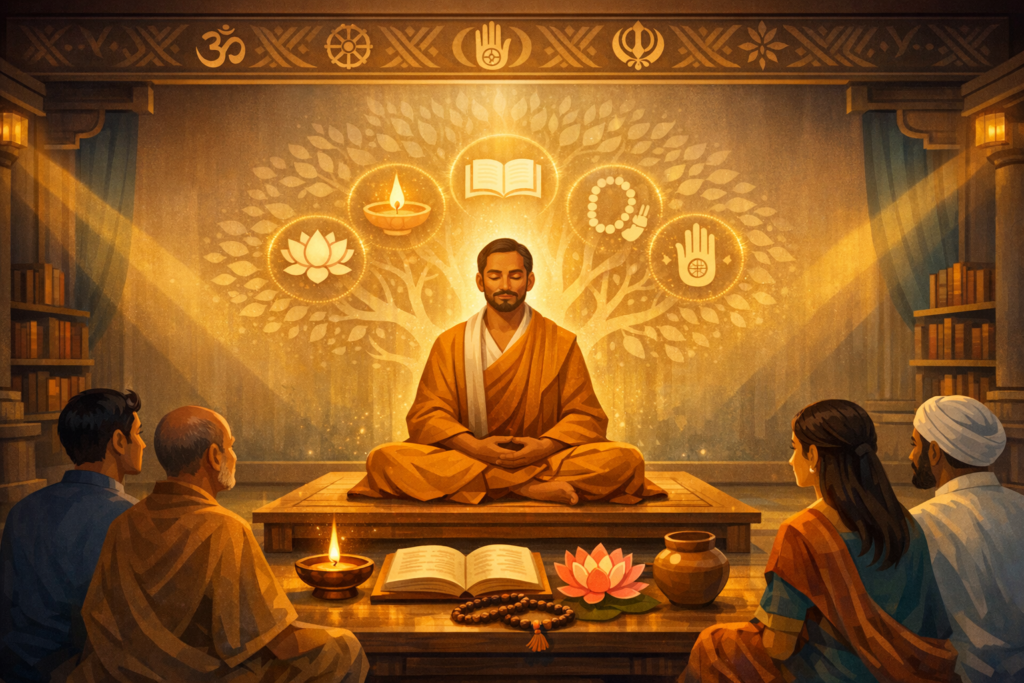
Seen through a dharmic unity lens, these contrasts enrich rather than divide. Dharmic traditions themselves display internal variety: Jain temples perform elaborate abhishekas while cultivating profound ahiṃsa; early Buddhist art often favored aniconic symbols around the stupa before later anthropomorphic images appeared; Sikh gurdwaras prioritize shabad kirtan and seva through the langar. Appreciating such pluralism within Hinduism, Buddhism, Jainism, and Sikhism helps contextualize how a mosque’s aniconism and congregational focus reflect a different, yet equally coherent, theological vision. Mutual understanding strengthens Religious Tolerance and genuine Interfaith Dialogue.
Visitor etiquette makes these spaces more accessible to all. In temples, remove footwear, dress modestly, follow posted queues, and avoid crossing directly before someone engaged in darshan or aarti. Do not touch the murti or sanctum thresholds unless explicitly permitted. In mosques, remove footwear, dress modestly, observe silence during the adhan and salah, and use wudu facilities where appropriate; non-Muslim visitors in many places are welcome to observe respectfully outside prayer times. Always follow local guidance.
A shared ethical horizon is unmistakable. Compassion, humility, truthfulness, charity, self-discipline, and service recur across sermon, scripture, and song. Temple annadanam and mosque zakat both transform devotion into care for the vulnerable. Differences in imagery, acoustics, and procession do not obscure convergences in moral aspiration.
In synthesis, a Hindu temple ritualizes the living presence of the Divine within the sanctum and extends that presence into the life of the town through festivals, music, and darshan. A mosque gathers the living community in aligned rows to remember the transcendent One through recitation and prostration. Both forms orchestrate attention, orient the body, and cultivate reverence. Understanding the difference between a Hindu temple and a mosque in architectural, ritual, and theological terms encourages deeper respect across traditions and reinforces the broader ideal of unity in diversity that has long characterized the subcontinent’s cultural fabric.
Approached with care, this respectful deep dive into sacred architecture and practice serves a practical goal: it equips visitors, students, and communities to see more clearly, listen more closely, and participate more compassionately. In doing so, it advances Religious coexistence and the shared work of nurturing peaceful, life-giving cultural ecologies.
Inspired by this post on Hindu Blog.





Leave a Reply
You must be logged in to post a comment.