Vibhuti—consecrated sacred ash in Shaivism—compresses an expansive philosophy into a tactile symbol. In a few grains of ash, the teaching of Shiva on transformation, impermanence, and liberation becomes immediate and intimate. Within Hindu philosophy and Vedic thought, this ash does not merely mark the body; it maps the sadhaka’s journey from form to freedom, from limitation to boundless awareness.
In Hindu traditions, fire (Agni) is less a destroyer than a transmuter. It is the energy of tapas, the concentrated heat of discipline, insight, and striving that purifies rather than annihilates. Shaivism presents Shiva as the supreme ascetic whose tapas burns away avidya (ignorance), limitation, and clinging. When the fire of realization has consumed the superfluous—whether understood as the three worlds (bhūr, bhuvaḥ, svaḥ) or the three bodies (sthūla, sūkṣma, kāraṇa)—what remains is ash. In this philosophical register, ash is not a negation of value but a revelation of essence: it is matter acknowledged in its final, stable state, freed of pretense.
This is why ash functions as a pedagogy. Vibhuti reminds practitioners that all compounded forms are transient; the teaching is not nihilistic but liberative. By accepting impermanence in the realm of names and forms (nāma-rūpa), one can discern what is not subject to decay—pure awareness. The fire that reveals the eternal does so by completing the work of time in a moment of insight. Vibhuti, therefore, becomes a concise grammar of moksha (liberation) expressed through the syntax of ritual, symbol, and remembrance.
The three horizontal lines of tripuṇḍra drawn with vibhuti on the forehead encode this grammar with remarkable depth. Classical Shaiva exegesis reads these lines as the overcoming of three impurities (mala): āṇava (the sense of separateness), māyā (misapprehension through multiplicity), and karma (residual impressions that bind). They also correspond to the three guṇas—tamas, rajas, sattva—whose dynamics shape experience, as well as to the three fires (gārhapatya, āhavanīya, dakṣiṇa) that sustain sacrificial order. Where a bindu (dot) accompanies the lines, it often signifies the unconditioned center—Śiva-consciousness—beyond triadic constraints.
Etymology offers a complementary layer. The term vibhūti in Sanskrit denotes excellence, power, and distinguished manifestation (as in the Bhagavad-Gītā’s Vibhūti Yoga), while bhasma refers specifically to ash. In temple and household practice, vibhuti commonly names the consecrated ash applied as tripuṇḍra. An interplay emerges: that which is reduced to ash is precisely what can be offered back as glory—renunciation itself becomes the practitioner’s radiance.
Scriptural and liturgical sources anchor this symbolism. Early Upanishadic literature elevates Agni as the transmuter and identifies Rudra as a principle of ultimate sovereignty; later texts in the Shaiva puranic and āgamic corpora codify bhasma-dhāraṇa (wearing ash) in daily worship. Minor Upanishads such as the Bhasmajābāla Upanishad detail the sanctification and application of ash, linking mantra, ritual heat (tapas), and insight (jñāna). While exegesis varies across schools, the consensus is stable: vibhuti is both protective and pedagogic, a sacrament that trains vision as much as it marks the body.
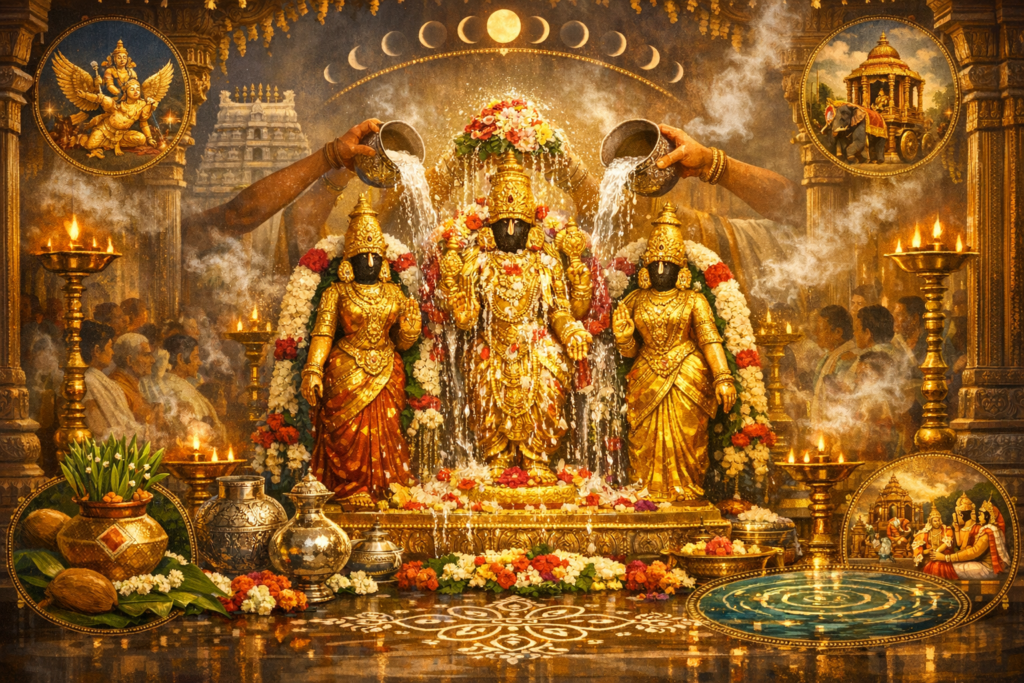
Ritually, vibhuti is prepared from sanctified fire remains—often from homa (fire offerings) conducted with prescribed herbs, wood, or cow-derived fuels—then further consecrated through mantras. In many Shaiva temples and households, this ash participates in abhiṣekam to the liṅga before it is distributed, inhering the sakti of recitation and offering. When touched to the skin at dawn and dusk, or before meditation, it frames the day with remembrance and clarity. The act is simple and exacting: sacred ash on the forehead, the chest, and the upper arms; mind steadied in the mantra “ॐ नमः शिवाय.”
Philosophically, this rite is a soteriological diagram. By marking and immediately re-absorbing the triadic lines into awareness, the practitioner rehearses the dissolution of difference while living in the world. It is not escapism; it is training in lucid participation. Over time, the gesture conditions attention toward equanimity and the ethical steadiness required for yoga. The visible sign becomes an internalized discipline, translating Shaiva metaphysics into practical cognition and conduct.
The tripuṇḍra’s triads interface with other Shaiva frameworks that chart the ascent of consciousness. Where texts speak of the ascent through tattvas (principles of manifestation) or the piercing of granthis (knots) in kundalini-yoga, the ash lines make the same movement immediately apprehensible. The “coolness” of ash—what remains after the heat—symbolizes passions burnt and the mind settled. In this way, vibhuti aligns with prāṇāyāma and dhyāna as complementary technologies of clearing, centering, and insight.
Psychologically, such symbols work because they are materially minimal and semantically dense. Touching ash to skin, smelling the faint trace of the homa fire, and feeling the cool powder on the brow anchor attention in the present. Memory and intention couple through a repeatable cue, reducing reactivity and rumination. In the language of contemplative science, one might say the rite scaffolds metacognitive awareness: the practitioner witnesses sensation, thought, and emotion as passing phenomena. In Shaiva terms, the ashes absorb the last residues of clinging so that Shiva’s stillness can be recognized as one’s own ground.
Resonances extend across dharmic traditions, underscoring a shared civilizational intuition. Buddhism trains insight into impermanence (anicca) and non-clinging through mindfulness and ethical discipline; vibhuti’s reminder of transience harmonizes with this emphasis on direct seeing. Jainism elevates aparigraha (non-possession) and tapas; ash as a sign of what remains after burning away excess mirrors the ethic of simplicity and self-restraint. Sikh teachings repeatedly call attention to humility and the fleeting nature of worldly show; the image of dust and the call to inner detachment parallel what vibhuti signals on the Shaiva path. Each tradition retains its distinct methods and theology while converging on a shared orientation: transform the self to be free for truth and compassion.
The ethical horizon follows naturally. If all forms culminate in ash, pride loses its footing. Sectarian superiority appears baseless in the light of a symbol that declares the common fate of bodies and the equal dignity of seekers. Vibhuti thus becomes an instrument of pluralism grounded in sādhanā rather than mere sentiment: it invites mutual respect among Hindus, Buddhists, Jains, and Sikhs by foregrounding disciplined inner work over outward marks of difference. In this way, the ash participates in the unity-in-diversity (Vasudhaiva Kutumbakam) that animates the dharmic imagination.
For practitioners, the procedural clarity of vibhuti supports day-to-day stability. A considered approach includes sourcing ash from a trusted temple or homa, or preparing it in accordance with tradition; setting intention before application; tracing tripuṇḍra with steady breath; and allowing a few moments of silent mantra repetition after the mark is made. These steps align body, breath, and meaning, turning a symbol into a micro-practice of awakening. Over time, even casual touch of the forehead can serve as a gentle recall to steadiness and compassion.
Timing adds depth. Dawn and dusk are classical sandhyā moments when sattva predominates and practices take easy root. Amāvasyā (new moon) and Mahāśivarātri intensify the contemplative field, with many communities incorporating bhasma-dhāraṇa alongside japa of the Pañcākṣarī (“ॐ नमः शिवाय”). Temple contexts may add abhiṣekam to the liṅga with ash-infused waters, blending tactile and sonic purification in a single arc. Whether at a pilgrimage center or in a quiet room at home, the atmosphere generated by vibhuti is one of still heat transformed into clear coolness.
Care and discernment remain part of the ethic. Only consecrated ash suitable for skin contact should be used; industrial or synthetic residues are inappropriate. Those with sensitive skin may test a small area first. The symbol’s value lies in its contemplative integrity, not in aesthetic thickness or public display. Indeed, the subtlest application may be the most powerful, since it invites inwardness and steady attention rather than outward approval.
Seen historically, vibhuti also marks continuities between Vedic sacrificial fire, puranic Shaiva devotion, and āgamic temple liturgy. Agni as the “mouth of the gods” in early texts becomes the internal fire of yoga; the external homa coevolves with interior tapas. The ash that once signified the successful completion of a rite now equally signifies the completion of a mental burning: opinions, cravings, and fears offered into the blaze of inquiry. In this continuum, the practitioner’s life becomes a moving altar, with vibhuti as its portable seal.
Practitioners often report an affective arc that mirrors the doctrine. An anxious heart steadies as the cool ash is applied; breath lengthens during recitation; a sense of moral clarity follows. Such accounts are not appeals to authority but evidence that symbol and psyche are built to meet each other. The simplicity of ash is not simplistic; it is refined minimalism, functioning like an axiomatic statement in mathematics from which a broad system of practice follows.
At a theoretical level, vibhuti can be read as a concise soteriological model: ignition (tapas) initiates purification; combustion (insight) converts; residuum (ash) witnesses the non-return of what was false. The sequence applies as much to a troubling habit as to metaphysical misapprehension. It is scalable: the same grammar governs small ethical victories and the culminating intuition of nonduality (advaita) in which Shiva and the seeker are not-two.
Contemporary life benefits from this portable clarity. In high-pressure environments, a brief ritualized pause with vibhuti can delineate transitions—before work, after conflict, prior to sleep—each marked by the logic of letting-go and returning to the center. In plural urban spaces, the ash can be a private covenant to act with dignity and respect for other paths, resonating with the broader dharmic value of harmonious coexistence.
Ultimately, vibhuti is a teaching that can be held between finger and thumb. It does not demand elaborate equipment, only sincerity and steadiness. By reminding body and mind of what truly lasts, it frees energy for what truly matters: truthful seeing, compassionate action, and the shared work of upholding a civilized, plural, and spiritually rigorous society. In the glow and the coolness of Shiva’s fire, sacred ash becomes a quiet, inexhaustible guide.
Inspired by this post on Hindu Blog.