
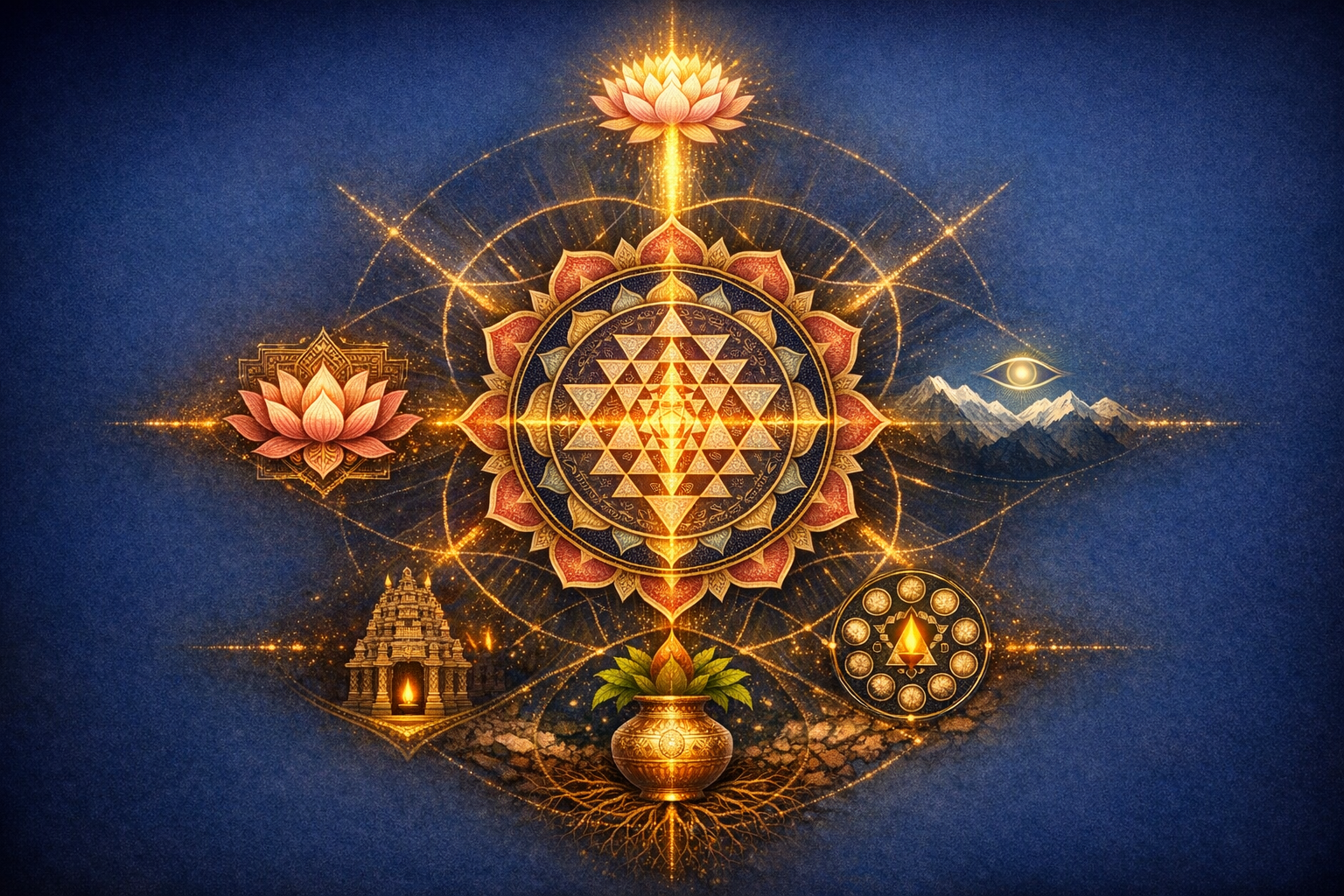
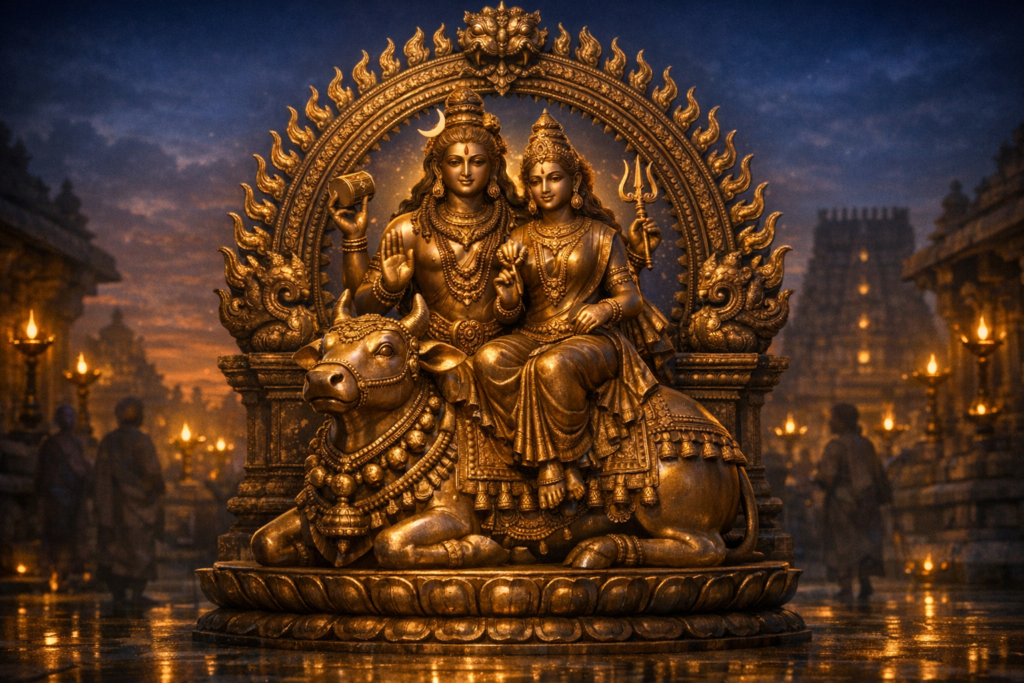
In Shakta doctrine, the Ultimate Divine is honored as Shakti, the dynamic power that animates consciousness and cosmos. Within this worldview, teaching descends as a living transmission rather than a fixed proposition. The term Shatprakara—also known as Shadamnaya—names a sixfold pattern of sacred transmissions attributed in Shaiva–Shakta sources to Shiva revealing the paths through six faces, each corresponding to a distinct stream of Tantrism. Together these transmissions articulate unity-in-diversity: a single luminosity refracted into complementary ways of knowing, worshiping, and realizing.
Amnaya, in its primary sense of “canonical transmission” or “lineage-recitation,” identifies how mantras, rites, philosophical insights, and guru-disciple instruction are handed down. Shadamnaya extends this into a sixfold cartography, typically mapping the four cardinal directions (purvamnaya, dakshinamnaya, paschimamnaya, uttaramnaya) and the vertical axis (urdhvamnaya and adhomanaya or, in some enumerations, anuttaramnaya). The language of directions is simultaneously geographical, ritual, and metaphysical: each stream anchors a textual corpus, priestly praxis, pitha or sacred seat(s), and a characteristic soteriological emphasis.
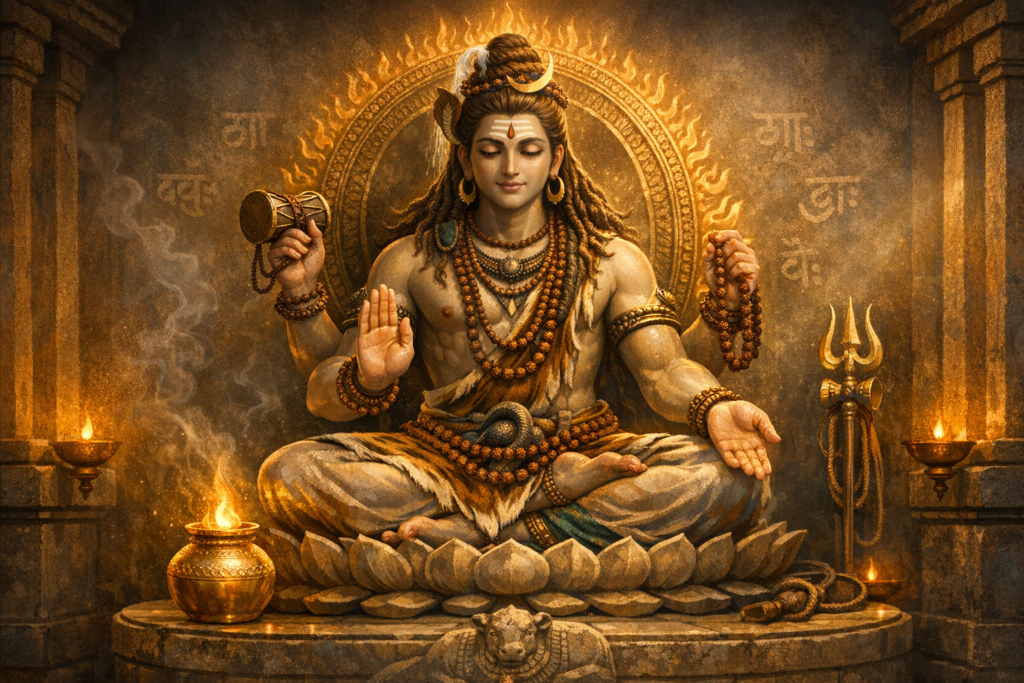
Tantric narratives present Shiva as revealing these amnayas through six faces, a symbolic pedagogy that associates each face with a horizon of mantra and meaning. While the familiar five faces—Tatpurusha (east), Aghora (south), Vamadeva (north), Sadyojata (west), and Ishana (zenith)—belong to Shivology, Tantric sources extend the schema to a sixth revelatory aspect to articulate the total compass of transmission. The point is not iconographic arithmetic but the doctrinal claim: revelation addresses multiple temperaments and contexts without losing the thread of nondual awareness.
The sixfold model also encodes a method. The cardinal amnayas commonly frame outward-facing, temple-anchored forms—public liturgy, pilgrimage, communal festivals—while the vertical axis highlights interior yogic ascent and descent—subtle-body work, mantra-japa, kundalini, nyasa, and contemplative recognition (pratyabhijna). Across texts and regions, precise attributions vary, a flexibility that has allowed Shakta traditions to travel, integrate, and renew while remaining recognizably themselves.
Purvamnaya (Eastern stream): Often linked to Kamarupa and the broader Srikula current, this stream privileges Tripurasundari, the Sri Chakra, and the refined mantra architecture of Sri Vidya (including kadi, hadi, and sadi sequences; pancadasi and shodashi). Ritual grammar emphasizes beauty (saundarya), order (samhita), and the inseparability of bliss and awareness. Pilgrimage to eastern Shakti Peethas, recitation of Lalita Sahasranama, and Sri Chakra puja are salient expressions.
Dakshinamnaya (Southern stream): Post-medieval praxis in peninsular India frequently identifies the southern transmission with Sri Vidya lineages flourishing around Kanchipuram and related centers. Some textual traditions, however, keep Sri Vidya in the eastern stream and read the southern emphasis as a bridge-current integrating Shaiva and Shakta liturgies through temple festivals and guru-parampara. In practice, dakshinamnaya consolidates the devotional, liturgical, and philosophical heart of Srikula for vast communities in the south.
Pachimamnaya (Western stream): Associated with Kaula transmissions that highlight yogini circuits, bhairava-bhairavi worship, and the subtle alchemy of body and mantra. Historically resonant in the western and central subcontinent, this stream accents the transformative fire of practice: consecrated mantra-japa, chakra-puja, and, in some older strata, the debated “panchamakara” lexicon—progressively interiorized in many contemporary lineages as sattvic substitutions that retain the symbolic functions of offering, embodiment, and transcendence.
Uttaramnaya (Northern stream): In many accounts, the northern transmission affiliates with Kashmir’s Trika and Krama currents and their allied Kaula expressions. The textual backbone includes works such as Malinivijayottara, Svacchandatantra, and the Pratyabhijna tradition. Philosophically, uttaramnaya accents recognition (pratyabhijna) of one’s identity with universal consciousness, employing upayas (means) from ritual to direct insight. It provides rigorous metaphysical articulation for the experiential claims of Shakta practice.
Urdhvamnaya (Upper or zenith stream): This vertical strand symbolizes the ascent of kundalini-shakti, the blooming of sahasrara, and the transmutation of speech (vak) through bija-mantras into awakened awareness. Here, nyasa, pranayama, and internal homa (antaryaga) complement or even replace outer ceremony. The “upper” does not reject the world; it re-reads embodiment as a corridor for realizing Shakti as the pulsation (spanda) of the Absolute.
Adhomanaya (Lower or nadir stream, sometimes replaced by anuttaramnaya in alternative enumerations): When described as “lower,” this axis points to grounding—stabilizing the awakened current in daily life, ethical action, and the sanctification of earth, food, and community. When named anuttaramnaya (the unexcelled), the same current is read as the nonlocal summit that pervades all streams, erasing any literal hierarchy. In either phrasing, the axis expresses completion: transcendence and immanence sealed in lived wisdom.
Textual mappings differ by school. Kubjikamata Tantra foregrounds a northern (uttara) stream centered on Kubjika in the Nepal Valley; Yogini Tantras highlight goddess circuits across the subcontinent; Kularnava Tantra provides a Kaula handbook of initiation, ethics, and ritual craft; Sri Vidya literature (e.g., Tripura Rahasya, Bhavanopanishad, and commentarial traditions) refines inward ritual. This diversity, far from being an inconsistency, exemplifies the Shakta intuition that revelation adapts—without loss of essence—to place, capacity, and time (desha, adhikara, and kala).
Mantra architecture is a common language across the six amnayas. Seed-syllables such as aim, hrim, srim, krim, and hum function as concentrated carriers of cosmology, devotion, and method. In Sri Vidya, the pancadasi (fifteen-syllable) and shodashi (sixteen-syllable) mantras are not mere recitations but living diagrams that align mind, subtle body, and cosmic rhythm. In Kaula and Trika, mantras disclose the spanda of consciousness, where utterance and meaning co-emerge.
Ritual grammar follows from mantra. Nyasa installs deity-consciousness in the body’s loci; avahana (invocation), upachara (honorings), and homa (offering into fire) configure an intentional ecology that affirms the sacredness of sense, space, and society. Many lineages today emphasize ahimsa, purity, and substitutional offerings, reflecting the ethical maturation of Tantrism in dialogue with broader Hindu philosophy and contemporary life.
Yoga in the Shakta frame integrates posture, breath, and contemplation with the subtle-body map of nadis and chakras. The kundalini metaphor is experiential: energy ascends and descends, dissolving the split between meditator and mantra. Urdhva and adho currents complement each other—expansion without grounding risks abstraction; grounding without ascent risks enclosure. The sixfold schema encodes this complementarity.
Initiation (diksha) remains the safeguarding hinge. Across the amnayas, authentic transmission depends on guru-shishya relationship, scriptural literacy, and ethical accountability. Reputable traditions stress yama-niyama, discernment (viveka), and gradual assimilation. This is not gatekeeping; it is stewardship—ensuring that profound techniques unfold as liberation (moksha) and compassionate participation (lokasangraha), not as sensationalism.
Soteriologically, Shakta Tantrism speaks of simultaneous fulfillment: bhoga and apavarga—enjoyment transformed into freedom. The world is not denied but re-read as Shakti’s play (lila). The six transmissions model how ritual beauty, philosophical clarity, yogic precision, ethical steadiness, and communal celebration can converge as one path seen from many angles.
Pilgrimage and sacred geography anchor these abstractions. Shakti Peethas across east, south, west, and north—together with yogini seats, Trika sites in Kashmir, and Sri Vidya centers in the south—interlink devotees in a living network. For many practitioners, experiences such as Navaratri celebrations in community, quiet Sri Chakra puja at home, or meditative recitation before dawn evoke a shared recognition: the same Devi speaks in different accents.
Convergence across Hindu traditions is longstanding. Shaiva, Shakta, and Vaishnava practices have braided for centuries—evident in temple iconography, festival calendars, and commentarial cross-citations. The Shadamnaya framework stabilized this weaving by legitimizing multiple modes without erasing their specificity. In contemporary practice, many households honor Shiva, Vishnu, and Devi side by side, intuitively living the sixfold insight.
This plural ethos resonates with broader dharmic wisdom. Jain anekantavada affirms many-sided truth; Buddhist upaya (skillful means) recognizes teaching must meet capacity; Sikh remembrance of Ik Onkar centers unity while honoring diverse expression. Read in this light, Shatprakara is not sectarian taxonomy but a bridge—illustrating how Hinduism, Buddhism, Jainism, and Sikhism can converse in mutual respect while each remains faithful to its own path.
Scholarly treatments provide helpful scaffolding. Studies by Alexis Sanderson, André Padoux, Teun Goudriaan and S. Gupta, and Gavin Flood trace how the amnayas crystallized in early medieval South Asia, traveled with guru lineages, and adapted to new linguistic and ritual ecologies. Texts such as Kubjikamata Tantra, Kularnava Tantra, Svacchandatantra, and Sri Vidya corpora exhibit the dialogical formation of tradition—authority emerging through commentary, practice, and lived sanctity.
For the contemporary seeker, the sixfold map offers practical clarity. Those drawn to temple worship and communal devotion may find orientation in the cardinal streams; those inclined toward inward mantra and meditation may resonate with the vertical axis. The point is neither to collect lineages nor to rank them, but to locate a harmonious fit—Ishta—within a larger mandala of shared aspiration and responsibility.
In summary, Shatprakara or Shadamnaya names an elegant solution to a perennial problem: how to honor diversity without dissolving unity. By rooting varied practices—Sri Vidya, Kaula, Trika, Krama, yogini cults, temple liturgy, and contemplative yoga—in a single field of Shakti, the six transmissions keep Tantrism intellectually rigorous, ritually alive, ethically attentive, and socially integrative. It is a model of religious pluralism grounded not in compromise but in realization.
Inspired by this post on Hindu Blog.






Leave a Reply
You must be logged in to post a comment.