
Mrityunjaya Murti—Shiva in the aspect that conquers death—embodies one of the most profound theological and iconographic ideas in the Indic tradition. The name fuses two Sanskrit roots: mrityu (death) and jaya (victory), situating the deity not merely as a destroyer of mortality but as the revealer of that which outlives it. As an image, a mantra, and a ritual focus, Mrityunjaya articulates a Shaiva synthesis of philosophy, practice, and aesthetics that continues to resonate with contemporary seekers across the dharmic world.
Etymologically, Mrityunjaya signals a victory that is not merely episodic but ontological. In Shaiva understanding, “conquering death” points beyond the prolongation of bodily lifespan to an awakening into amṛtatva—immortality as spiritual freedom. This freedom, the tradition holds, is won through knowledge (jnana), devotion (bhakti), disciplined practice (sadhana), and grace (anugraha). Iconography, mantra, and liturgy converge to communicate this multi-layered teaching with technical precision and emotional immediacy.
The Vedic root of this form is the celebrated Mahamrityunjaya (Tryambaka) mantra. Preserved in Rig Veda 7.59.12 and echoed in Yajurveda recensions (e.g., Taittiriya Samhita 1.8.6; Vajasneyi Samhita 3.60), the mantra reads: “Tryambakaṁ yajāmahe sugandhiṁ puṣṭivardhanam | urvārukamiva bandhanān mṛtyormukṣīya mā’mṛtāt ||”. Semantically, it invokes the “three-eyed” (tryambaka) Shiva, the fragrance of whose presence suffuses and nourishes life, seeking a release from bondage as effortless and natural as a ripe cucumber detaching from its vine—freedom from death, not away from immortality, but into it.
Philosophically, this verse reframes mortality: death is not refuted but transfigured. In many Shaiva schools, especially non-dual expositions, mṛtyu symbolizes constricted awareness bound by fear and forgetting. Mrityunjaya thus becomes the luminous antidote—knowledge, compassion, and power that restore wholeness. The icon is a pedagogy: what the mantra whispers in sound, the murti declares in form.
Purāṇic narrative situates this theology in the legend of Mārkaṇḍeya, where Shiva intervenes as Yama (Death) approaches the young sage. Two related but distinct iconographic types emerge from this narrative matrix. Kalāntaka (Kalāntakanātha) depicts Shiva subduing or trampling Yama to protect the devotee clasping a liṅga; it dramatizes divine intercession against the imminence of death. Mrityunjaya, by contrast, emphasizes the conferment of amṛta (immortality) and fearlessness, often with a gentler, boon-bestowing mood. Skanda Purāṇa (notably in Kāśī Khaṇḍa), Linga Purāṇa, and Shiva Purāṇa preserve variations of these episodes and their devotional ramifications.
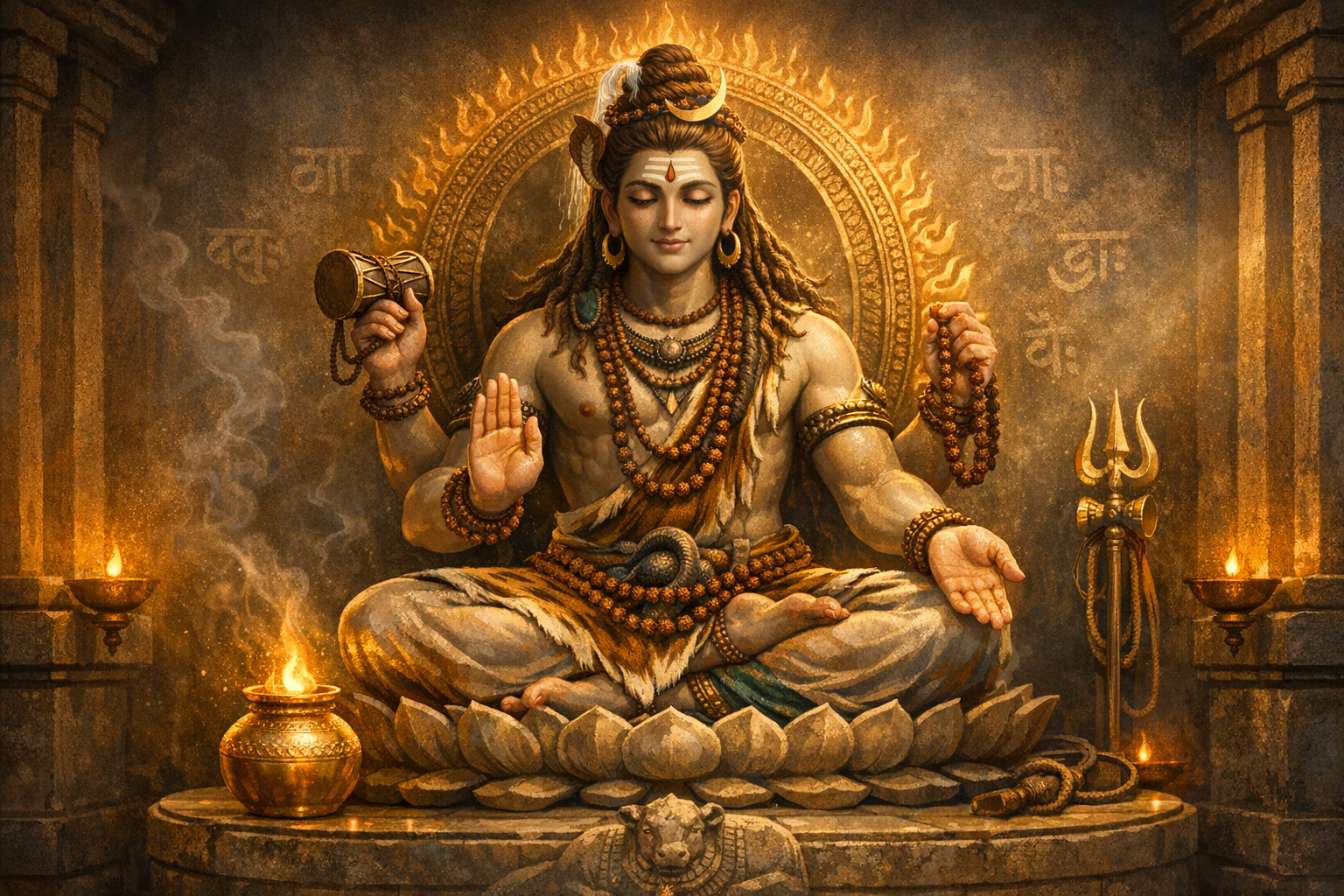
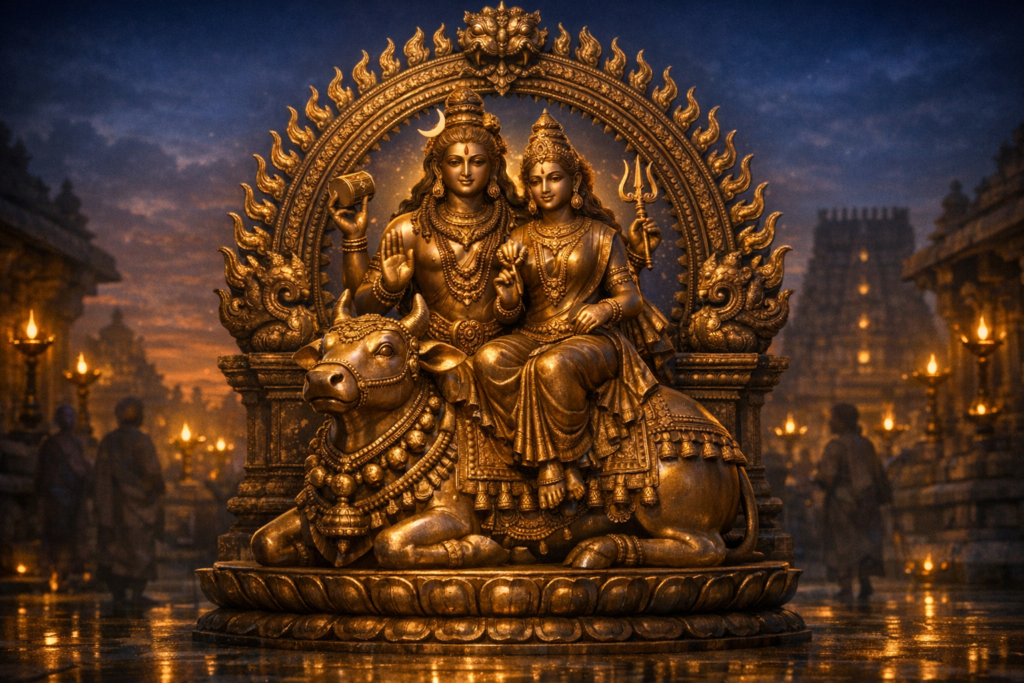
Mrityunjaya iconography in sculpture and painting varies across regional lineages yet follows core Shaiva canons. Commonly four-armed (occasionally more), the murti features the trinetra (third eye), jata-makuṭa (matted locks piled as a crown), the crescent moon, and Gaṅgā issuing from the hair. Serpent ornaments (nāga-bhūṣaṇa), the tiger-skin garment, and the tripuṇḍra (three horizontal ash-stripes) emphasize ascetic sovereignty. The face bears serenity rather than wrath, aligning this form with protection and renewal rather than fierce dissolution.
Attributes (āyudha and upalakṣaṇa) articulate theological nuance. The triśūla (trident) communicates mastery over the three guṇas and three temporal dimensions; the ḍamaru (hourglass drum) signifies the pulse of creation and mantra; the akṣamālā (rosary) encodes continuous japa and time redeemed in remembrance. In many Mrityunjaya representations, an amṛta-kalaśa (pot of nectar) appears either held or placed adjacent to the deity, thematizing the gift of immortality; the pasha (noose) and aṅkuśa (goad), when present, allegorize restraint and guidance of the senses. Hand gestures frequently include abhaya (fearlessness) and varada (boon), underscoring compassion and refuge.
Posture typically follows samabhanga (balanced stance) or a seated yoga-asana (padmāsana or vīrāsana), with Nandi sometimes indicated on the pedestal. A prabhāvali (flame-arch) may surround the icon, but unlike Naṭarāja’s cosmic dance of dissolution and re-creation, Mrityunjaya’s register is quieter, contemplative, and life-affirming. When Yama appears in the composition, the form trends toward Kalāntaka; where a nectar vessel or yogic stillness dominates, it trends toward Mrityunjaya. Such discriminations are standard in temple identification and museum curation.
Shilpa-śāstra texts such as Mayamata and Manasara, along with Shaiva Āgamas (e.g., Kāmikāgama, Suprabhedāgama), supply the iconometric backbone: tala-based measurement systems, canonical proportions of limbs, coiffure types, and ornament families. While prescriptions differ by sthapati (artisan) lineage and region, Mrityunjaya generally follows madhyama-tāla (medium proportion), with harmonized head–torso ratios to convey equipoise rather than ferocity. The amṛta-kalaśa and abhaya-mudrā, where mandated, anchor the form’s salvific character.
In the broader Shaiva gallery, Mrityunjaya is distinct from Dakṣiṇāmūrti (the guru-icon under the banyan), Ardhanārīśvara (the androgynous synthesis of Shiva–Shakti), and Naṭarāja (the dancing lord). It is thematically adjacent to Apattodharana (Apattuddhāraka) Murti—Shiva as savior in distress—yet the latter signifies all-purpose rescue, whereas Mrityunjaya is focused on mortality-transcendence and longevity-blessing. Recognizing these boundaries clarifies textual references and ensures accurate temple labeling and ritual assignment.
Ritual life around Mrityunjaya blends Vedic recitation, Agamic worship, and Tantric praxis. Daily japa of the Mahamrityunjaya mantra (commonly in counts of 108) is paired with rudrābhiṣeka (water, milk, or pañcāmṛta libations) over the liṅga. In more elaborate observances, a Mrityunjaya homa employs ghee oblations synchronized to mantra counts (often 1008), culminating in kalaśa-prasāda distribution. Mondays, Pradosha, the month of Śrāvaṇa, and Maha Shivaratri are favored timings; yet the form’s pastoral use has always extended beyond festival calendars to moments of illness, crisis, and grief.
Traditional practice emphasizes guidance. Mantra-dīkṣā from a competent guru, adherence to niyamas (ethical restraints), and care with pronunciation protect the rite’s integrity. Contemporary communities often complement ritual with service (seva), counseling, and collective singing, translating the mantra’s metaphysics into palpable solidarity. For many families, the soft cadence of Tryambakaṁ yajāmahe at a hospital bedside functions less as a transaction with fate and more as a pedagogy of courage and letting go.
Temples and images of Mrityunjaya appear across the subcontinent and its cultural orbit. Kāśī’s Mrityunjay Mahadev is a prominent pilgrimage focus, where the fusion of Vedic recitation and local Kāśī-kalpa traditions is especially vibrant. Urban shrines in Maharashtra and notable representations in the Kathmandu Valley testify to the form’s wide geographic diffusion. Museum holdings (stone and bronze) from medieval South India (e.g., Chola-period bronzes) preserve exquisite Mrityunjaya exemplars, frequently highlighting the amṛta-kalaśa, serene visage, and canonical proportions.
From a comparative dharmic perspective, Mrityunjaya’s teaching harmonizes with a shared civilizational intuition: that fear of death is eased not merely by extending life but by deepening meaning. In Buddhism, the cults of Amitāyus and Uṣṇīṣa-Vijayā elevate longevity and liberation; in Jain thought, kevala-jñāna frames emancipation beyond birth–death cycles; in Sikh tradition, the remembrance of the Divine Name nurtures fearlessness and chardi kala (ever-ascending spirit). Without collapsing distinctions, these convergences underscore a Dharmic consensus: compassion, wisdom, and disciplined practice transmute mortality’s sting.
For art historians and conservators, Mrityunjaya offers a case study in how theology animates form. The amṛta-kalaśa or abhaya hand is not decorative; it is doctrine in bronze and stone. For ritual specialists, the form integrates Veda and Āgama, mantra and murti, ablution and offering, shaping a whole ecology of worship. For lay communities, it provides a language for love and loss that neither denies suffering nor enthrones it, but guides it toward trust.
A practical identification summary follows from the foregoing: look for the trinetra, jata-makuṭa with crescent and Gaṅgā, serpent ornaments, calm expression, and either amṛta-kalaśa or boon–fearlessness gestures. Where Yama is shown subdued or trampled, the image aligns with Kalāntaka; where nectar, rosary, and meditative stillness dominate, the image aligns with Mrityunjaya. Such careful reading respects both the shilpa-śāstra and the living ritual grammar of temples.
In sum, Mrityunjaya Murti represents an integrated vision—Vedic sound-body, Puranic narrative-body, Agamic image-body—through which Shiva is approached as healer, protector, and revealer of immortality. Its iconography is precise, its mantra ancient, its rituals living, and its message capacious enough to support unity-in-diversity across Hinduism, Buddhism, Jainism, and Sikhism. By contemplating the form and practicing the mantra with understanding, communities today inherit a timeless technology of courage, clarity, and compassion.
Inspired by this post on Hindu Blog.



Leave a Reply
You must be logged in to post a comment.