
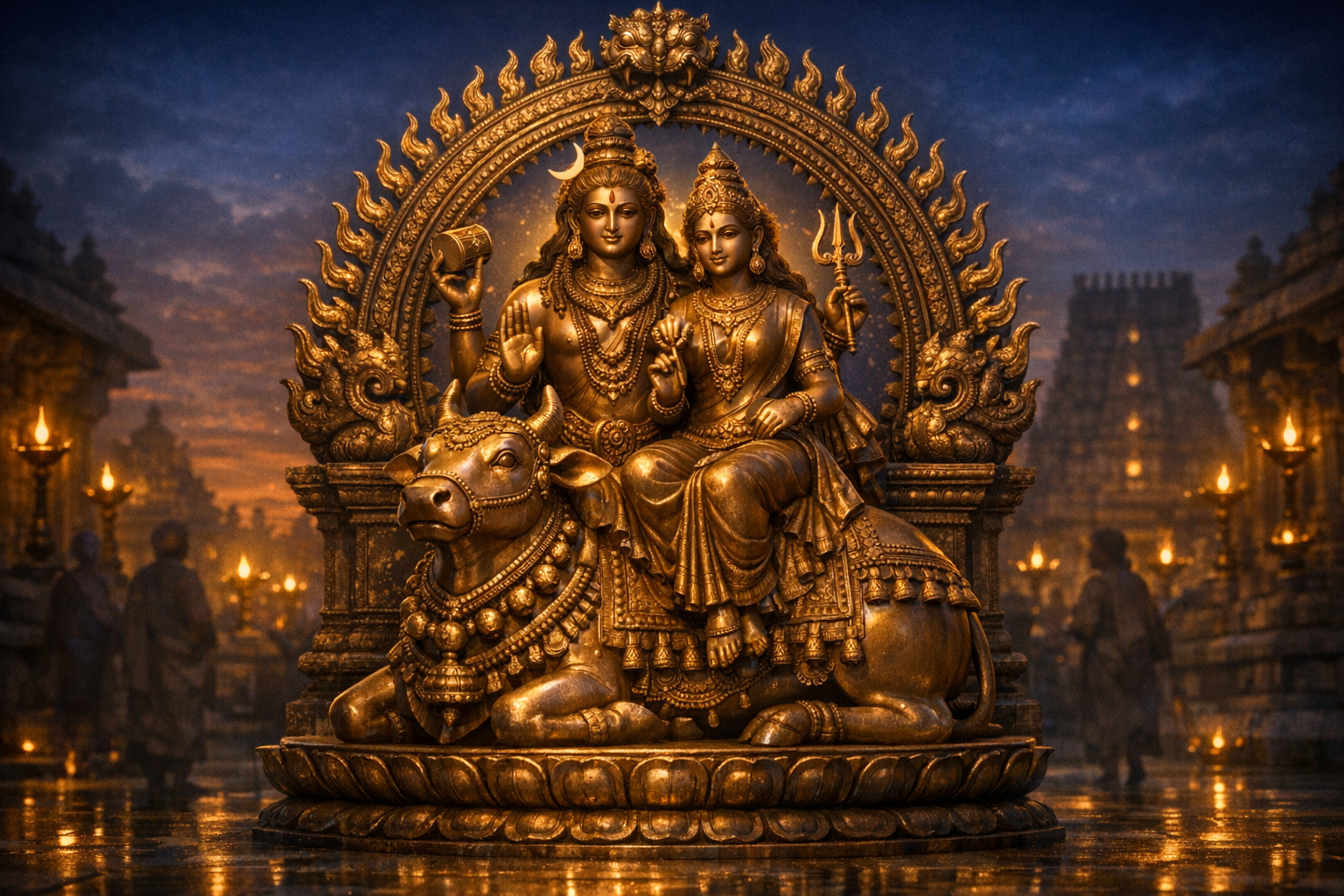
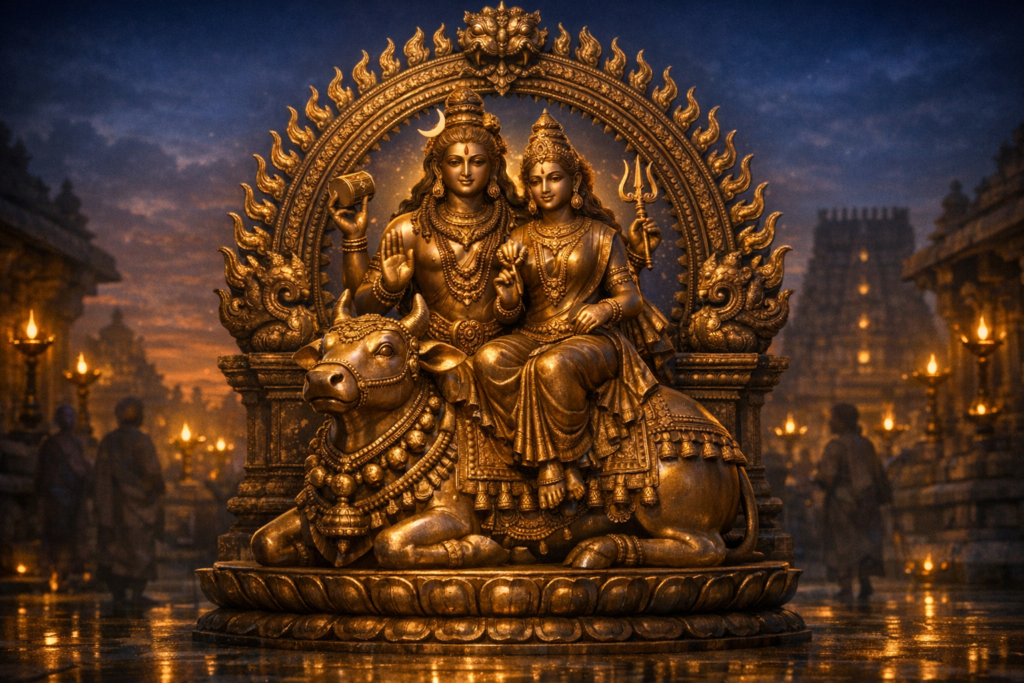
Within the living tradition of Shaivism, the Pradosha Murti—also known as Vrishabharuda Murti—encapsulates a luminous moment of divine grace. This iconographic form presents Shiva with Pārvatī upon Nandi, the sacred bull, at pradoṣa, the liminal twilight that bridges day and night. Across temples and collections, this image functions not only as an exquisite example of Hindu sculptures and sacred art but also as a precise visualization of theology, ritual time, yogic symbolism, and community devotion.
The word pradoṣa denotes the twilight period, traditionally revered as optimal for inner stillness and worship. Vrishabharuda (vr̥ṣabha + ārūḍha) means “mounted on the bull,” signaling Shiva’s vahana and the dharmic steadiness Nandi embodies. In the Pradosha Murti, the union of Shiva and Pārvatī is central, foregrounding the indivisible interplay of consciousness (Shiva) and energy (Śakti) in a form that devotees recognize instantly by the presence of the bull and the grace-filled, auspicious moment it signifies.
Core iconography typically shows Shiva and Pārvatī seated or enthroned on Nandi, with Shiva rendered in serene composure and Pārvatī reflecting gentle benevolence. Shiva is often four-armed, his right hands conveying protection (abhaya) and assurance (varada), while the upper arms carry attributes such as the trident (triśūla), the drum (ḍamaru), the axe (paraśu), or the antelope (mṛga), depending on local āgamic or śilpa prescriptions. Pārvatī may hold a lotus (padma) or show kataka-hasta, mirroring auspicious grace (śrī). The pair exudes a poised balance of power and compassion that devotees intuitively read as reassurance in the midst of transition—the essence of twilight itself.
Nandi in this murti is more than a mount; he is a theological axis. Sculptors frequently model the bull with powerful shoulders, a lifted head, and a subtly dynamic stance to evoke life and readiness, or a tranquil, recumbent posture to evoke stillness and inwardness. Ornamented bells, a decorative yoke, and a flowing tail accentuate sanctity and service. The entire composite is often framed by a prabhāvali (aureole), sometimes with stylized flames or a makara-toraṇa arch—visual cues that the scene unfolds in a sacral cosmos.
Textual moorings for this iconography are found across the Āgamas and Śilpaśāstras, which specify pose, attributes, and proportions in tala-based measures. References in works studied by scholars—such as the Kāmikāgama, Suprabhedāgama, Mayamata, Śilparatna, and discussions in modern compilations like T. A. Gopinatha Rao’s Elements of Hindu Iconography—affirm Vrishabharuda as a canonical Shaiva form. While prescriptions vary by regional āgama and sthapatis’ lineages, the consistent intent is to communicate pradoṣa’s theological heart: the descent of compassion when dharma is steady and the mind is poised.
Purāṇic memory and temple ritual reinforce this imagery. In many tellings, pradoṣa is the hour when the devas approached Shiva, and when Shiva’s dance or presence blessed the three worlds after calamities such as the churning of the ocean. The Pradosha Murti commemorates this cosmic reconciliation, with Nandi as the constant devotee, bearing the weight of grace. Devotees experience the scene as a promise: when approached with disciplined devotion, transition yields clarity rather than uncertainty.
Ritually, pradoṣa is observed on Trayodaśī tithi in both the waning (Kṛṣṇa) and waxing (Śukla) lunar fortnights as Pradosha Vrat. Temple praxis generally includes abhiṣeka to the Śivaliṅga, elaborate ālāṅkāra, nāma-japa, deepa-āratī, and circumambulation. In many South Indian temples, the Vrishabharuda Murti becomes the utsava-mūrti for a twilight procession, often termed Vrishabha Vāhana Seva. The atmosphere—conch calls, lamps, and veda-mantra recitation—offers a multisensory theology: sight, sound, and scent all converge to make twilight tangible.
Observers frequently note that the procession at pradoṣa lends the icon a kinetic charge. Even when the bronze or stone figure is perfectly still, the slow, rhythmic pace of the bearers and the gentle swing of lamps convey the murti’s message of controlled motion—movement without agitation, devotion without frenzy. Many visitors, regardless of background, describe a felt hush at the moment Shiva and Pārvatī on Nandi face the sanctum: a brief, deep stillness that seems to outlast the duration of the ritual itself.
Regional idioms refine the visualization without changing its meaning. Chola bronzes present Vrishabharuda with exquisite anatomical detailing, crisply chased jewelry, and prabhāvalis with elegant tongues of flame. Hoysala stone reliefs may emphasize ornate textile patterns and dynamic curves in Nandi’s body, carving shadow and light into rhythmic bands. Kerala ateliers, drawing on local śilpa canons such as the Tāntra-samuccaya tradition, often favor a balanced gravity and calm in posture and glance. Across these schools, artisans preserve the core: Shiva and Pārvatī atop Nandi at twilight, bestowing assurance.
Iconographic variations include the presence of attendant gaṇas, musicians, or celestial beings who recognize the sanctity of the hour; in some ensembles, Gaṇeśa and Skanda appear as flankers, locating the scene within a broader Somāskanda sensibility familiar to Tamil temple ritual. Attribute sets for Shiva can alternate between triśūla and mṛga, paraśu and ḍamaru, depending on āgamic lineage, while Pārvatī’s hand-gestures consistently communicate auspicious grant and compassion. None of these shifts alter the pradoṣa essence; they merely tune the visual language to local rhythm and memory.
From the perspective of Śilpaśāstra, proportions (tāla-māna), canon of hands (hastalakṣaṇa), and pedestal typologies are not decorative trivia but pedagogy. The viewer is trained—consciously or not—to read alignment, balance, and direction. Nandi’s steady chest becomes a syllable in the sentence of dharma; Shiva’s raised hand a punctuation of fearlessness; Pārvatī’s gentle gaze a clause of compassion. Together, they inscribe a grammar of sacred assurance over the shifting syntax of twilight.
Symbolically, Nandi stands for steadfast dharma, patient service, and a mind yoked to the highest aim. Shiva represents pure awareness, while Pārvatī embodies the manifold energy that animates life. Their shared seat upon the bull presents a theology of integration: consciousness and energy, insight and action, grace and effort. Dusk, the time of pradoṣa, is the meeting of opposites—light and dark, activity and rest—mirroring the inner junctions described in yogic anatomy when iḍā and piṅgalā nadīs settle into suṣumṇā, restoring balance.
Practical familiarity deepens appreciation. In many temples, devotees gaze through Nandi’s ears to the liṅga, a simple ritual act that communicates a subtle teaching: the devotee (Nandi) is the lens through which divinity is realized. During Pradosha Vrat, circumambulating Nandi and offering bilva leaves to the liṅga harmonize discipline with surrender. Those gestures are not isolated rules but embodied metaphors—steadiness makes grace visible, and twilight makes transitions navigable.
The resonance of pradoṣa extends beyond Shaivism into the wider dharmic family. Evening-time remembrance is cherished across traditions: Rehras Sahib in Sikhism is recited at sunset to steady the mind; Jaina communities undertake pratikraman and sāmayika in the evening to return to equanimity; many Buddhist lineages close the day with chanting and meditation. These parallel rhythms show a shared civilizational intuition: twilight is uniquely suited to re-center awareness, refine conduct, and cultivate compassion. The Pradosha Murti stands as a visual invitation to that pan-dharmic practice of balance.
Authenticity in depiction can be recognized through anatomical proportion, iconographic fidelity, and ritual context. Works that follow āgamic canons ensure the placement of hands, attributes, and seating posture are coherent; Nandi’s modeling reflects strength without aggression; prabhāvali elements harmonize rather than distract. When the murti functions within temple liturgy—especially during Vrishabha Vāhana Seva—its meaning is fully realized: sacred images do not merely illustrate doctrine; they enact it.
Conservation and heritage care are equally integral to meaning. Bronze mūrtis benefit from stable humidity, gentle cleaning free of abrasive agents, and ritual handling by trained personnel; stone images require attention to biological growth and structural integrity. Yet preservation is not only material. Safeguarding the oral instructions of archakas, the musical traditions of twilight liturgy, and the processional routes that communities have walked for generations—all constitute the living heritage of Pradosha Murti.
For scholars and seekers alike, primary sources such as the Śiva Purāṇa and regional Āgamas frame pradoṣa as a time of intensified grace. Epigraphs and temple manuals from Tamil Nadu, Karnataka, and Andhra Pradesh record Vrishabharuda’s role in festival calendars, offering valuable data on historical practice. Museum catalogs and field studies trace stylistic vocabularies from Chola bronzes and Hoysala carvings to later revival pieces, underscoring continuity amid regional distinction.
Experientially, the image communicates with clarity. Many temple-goers, including first-time visitors, report that the quiet concentration of pradoṣa allows them to grasp the form intuitively. The lifting of lamps before the murti, the cadence of mantras, and the steady presence of Nandi encourage a calm that modern life often fragments. The icon’s grammar of assurance—abhaya, varada, the serene glance—translates across languages without losing theological depth.
Theologically, the Pradosha Murti invites one to cultivate poised responsiveness. Twilight does not ask the world to stop; it asks the heart to listen. When consciousness and energy sit together upon dharma—Shiva and Pārvatī on Nandi—movement is guided by insight, and strength is tempered by care. That is why the image speaks with equal urgency in moments of personal transition and collective uncertainty.
In summary, Pradosha Murti (Vrishabharuda) binds iconography, ritual, and metaphysics into a singular, intelligible whole. It is a sculpture to be studied, a theology to be contemplated, and a liturgy to be lived. By honoring pradoṣa across temples and communities—and by recognizing kindred twilight practices in Jainism, Buddhism, and Sikhism—contemporary seekers participate in a shared civilizational wisdom: balance is cultivated daily, grace arrives reliably, and dharma holds steady like Nandi beneath the divine pair.
Inspired by this post on Hindu Blog.




Leave a Reply
You must be logged in to post a comment.