
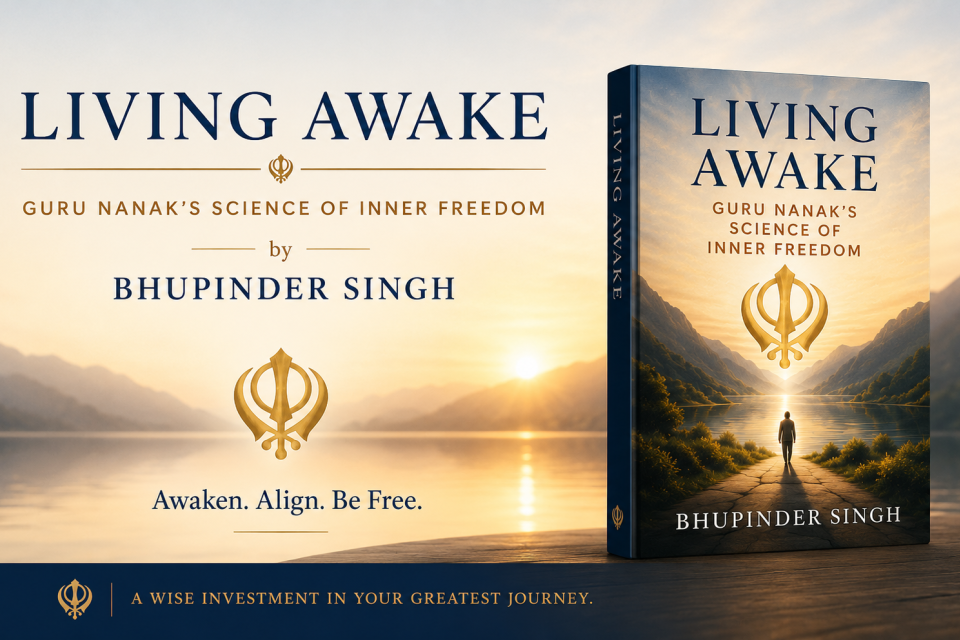
Living Awake can be read as a focused meditation on Guru Nanak’s science of inner freedom: a disciplined way of seeing, living, working, remembering, serving, and becoming inwardly free while remaining fully engaged with the world. Its central concern is not escape from life but awakened participation in it. The phrase Guru Nanak’s Science of Inner Freedom is therefore especially apt, because the Sikh path presented here is not merely devotional sentiment or moral instruction. It is a coherent spiritual anthropology, a psychology of ego, a discipline of attention, and a social ethic rooted in the remembrance of the Divine.
Guru Nanak’s teachings emerged in fifteenth-century Punjab, a region shaped by intense social, political, linguistic, and religious encounter. Hindu, Buddhist, Jain, Nath, Sufi, and Islamic currents all formed part of the wider intellectual atmosphere of the time. Yet Guru Nanak did not simply synthesize existing systems. He articulated a distinct vision centered on Ik Oankar, the One Reality, and on the possibility that human beings can awaken from ego-centered living into truthful, compassionate, fearless participation in hukam, the Divine order.
The strength of Living Awake lies in presenting this vision as practical and experiential rather than abstract. Inner freedom is not defined as withdrawal, indifference, or mystical self-absorption. It is the gradual loosening of bondage to haumai, the self-enclosed ego that mistakes itself for the center of existence. In Guru Nanak’s thought, bondage begins when the individual forgets the Divine ground of life and becomes trapped in possessiveness, pride, anxiety, anger, and fear. Freedom begins when awareness is reoriented through naam, truthful living, seva, humility, and spiritual discernment.
From an academic perspective, this makes Guru Nanak’s spirituality unusually integrated. It refuses the artificial separation between contemplation and conduct. Meditation without ethics remains incomplete; ethics without remembrance becomes fragile; social service without humility can become another form of ego. The Sikh path holds these dimensions together. The awakened person is not merely one who thinks profound thoughts, but one who eats honestly, speaks truthfully, serves without vanity, and sees the same Divine light in all beings.
The reviewable value of the work is its insistence that awakening is not theatrical. There is no need for spiritual exhibition, ritual superiority, or sectarian self-importance. Guru Nanak’s science of inner freedom is measured by the transformation of consciousness and conduct. A person may perform outward observances and still remain inwardly restless; another may live quietly, earn honestly, remember the Divine, and radiate peace. This distinction gives the subject contemporary relevance in an age of spiritual branding, distraction, and performative identity.
A technical reading of Guru Nanak’s teaching begins with the problem of perception. The human being does not merely suffer because of external circumstances; suffering is intensified by misperception. The ego divides reality into absolute self and absolute other, mine and not mine, superior and inferior. This distorted perception produces comparison, resentment, domination, and fear. Guru Nanak’s remedy is not denial of the world but a disciplined correction of vision. To live awake is to see the world as pervaded by the One, sustained by hukam, and entrusted to human responsibility.
This is where the language of science becomes meaningful. Science, in its broadest sense, involves observation, method, verification, and transformation of understanding. Guru Nanak’s path asks the seeker to observe the mind, recognize the patterns of haumai, apply the discipline of naam simran, engage in truthful action, and verify the fruit through greater compassion, stability, courage, and freedom from compulsive self-concern. The laboratory is the human heart; the evidence is a life less governed by fear and more available to truth.

Naam is often reduced in casual discussion to repetition of a sacred name, but its meaning is deeper. Naam refers to the living remembrance of Divine Reality, the interior orientation by which consciousness becomes aligned with truth. In Guru Nanak’s teaching, remembrance is not mechanical recitation alone. It is a re-patterning of attention. The mind that habitually clings to status, injury, desire, and insecurity is slowly trained to rest in the awareness of the One. This is why naam becomes both metaphysical insight and psychological discipline.
Hukam, similarly, is not fatalism. It does not ask the individual to become passive before injustice or indifferent to suffering. Hukam is the recognition that reality is ordered beyond the ego’s limited control. To understand hukam is to act with courage while surrendering arrogance, to accept what cannot be controlled without abandoning moral responsibility, and to participate in the world without pretending to own it. This balance is central to Sikh spirituality and gives Living Awake its ethical seriousness.
The psychological clarity of Guru Nanak’s teaching is especially visible in the treatment of haumai. Ego is not simply confidence, personality, or individuality. It is the false absolutization of the separate self. It turns knowledge into pride, devotion into display, wealth into domination, and suffering into self-obsession. The ego can even hide inside spiritual practice. For this reason, inner freedom requires more than belief. It requires repeated self-examination, humility, and the willingness to let the Divine center replace the anxious self-center.
In this sense, Guru Nanak’s path resonates with wider dharmic traditions while preserving its own distinctive Sikh vocabulary and discipline. Hindu Vedanta examines avidya and the misidentification of the self; Buddhism analyzes craving, impermanence, and the constructed ego; Jainism emphasizes purification, restraint, and liberation from karmic bondage. Sikhism places the transformation of ego within devotion to the One, remembrance of naam, acceptance of hukam, and active service in the world. These traditions need not be flattened into sameness. Their unity is deeper when their differences are respected.
This dharmic harmony is one of the most important implications of the subject. Guru Nanak’s message does not encourage hostility toward other sincere paths. It challenges hypocrisy, caste arrogance, empty ritualism, exploitation, and religious vanity wherever they appear. At the same time, it honors the Divine presence that exceeds narrow identity. Such a position can strengthen unity among Hinduism, Buddhism, Jainism, and Sikhism by encouraging shared ethical seriousness, reverence for spiritual practice, and resistance to sectarian contempt.
Living Awake also invites reflection on the relationship between spirituality and social equality. Guru Nanak’s teachings challenged social hierarchy not merely as a political issue but as a spiritual error. If the same Divine light pervades all, then contempt for another human being becomes a failure of perception. The langar tradition, the emphasis on honest labor, and the rejection of ritualized superiority all express this metaphysical equality in practical form. Inner freedom therefore has public consequences.

This point is crucial because modern spirituality often becomes privatized. It is treated as a technique for personal calm, productivity, or emotional regulation. Guru Nanak’s vision includes inner peace, but it does not end there. A calm mind that ignores injustice is not fully awake. A refined spiritual vocabulary that leaves greed untouched is incomplete. A devotional identity that produces contempt for others contradicts the very insight it claims to honor. The awakened life is inwardly free and outwardly responsible.
The book’s implied framework can be understood through three interdependent disciplines: remembrance, ethical labor, and service. Naam simran trains attention toward the Divine. Kirat karo, honest work, grounds spirituality in daily responsibility. Vand chhako, sharing with others, prevents wealth and achievement from hardening into possessiveness. Together, these principles form a practical science of freedom. They address the mind, the body, the household, the economy, and the community.
Such a framework has particular relevance for contemporary readers facing anxiety, isolation, overwork, and digital distraction. Modern life often fragments attention and rewards constant self-display. Guru Nanak’s teaching reverses this movement. It asks consciousness to become simpler, steadier, and more truthful. The awakened person does not need to win every argument, advertise every virtue, or control every outcome. Freedom appears as a disciplined ease: the capacity to act firmly without hatred, to serve without self-importance, and to accept without collapse.
There is also a subtle but important distinction between awareness and awakening. Awareness can be momentary; awakening must become embodied. A person may experience insight during prayer, meditation, kirtan, or study, yet return quickly to anger, vanity, or fear. Guru Nanak’s science demands continuity between insight and life. This continuity is cultivated through daily remembrance, satsang, ethical restraint, and practical compassion. The measure of awakening is not intensity of experience but stability of transformation.
The literary and devotional center of this vision is the Guru Granth Sahib, whose hymns do not present philosophy as detached speculation. They sing philosophy into consciousness. The musical, poetic, and contemplative form matters because the human being is not transformed by argument alone. Sound, rhythm, repetition, and devotion shape attention at a deeper level. Guru Nanak’s science is therefore not cold rationalism; it is disciplined wisdom carried through poetry, song, memory, and practice.
This gives Sikh spirituality a distinctive epistemology. Truth is known through hearing, reflection, practice, and grace. Intellectual study has value, but it is not sufficient by itself. Emotional sincerity has value, but it also requires discernment. Ritual has value when it deepens remembrance, but it becomes hollow when separated from truth. The complete path integrates head, heart, hand, and community. That integration is one reason Guru Nanak’s teachings remain powerful across centuries.

A careful review of Living Awake should also recognize the danger of oversimplifying Guru Nanak for modern self-help language. Inner freedom is not merely stress reduction. It is not merely positive thinking. It is not a technique for personal success. Its aim is liberation from egoic bondage and alignment with Divine truth. Stress may reduce as a result, but the deeper goal is truthful living. Peace is not manufactured; it arises when consciousness becomes less divided from reality.
The ethical implications are demanding. If all beings are held within the One Reality, then exploitation becomes spiritual ignorance. If honest work is sacred, then deceitful gain cannot be justified by outward religiosity. If service is central, then spiritual maturity must be visible in how one treats the vulnerable, the stranger, the poor, and even the opponent. Guru Nanak’s teaching does not allow devotion to become an escape from accountability.
At the same time, the path is not harshly moralistic. It understands human weakness with great realism. The mind wanders. The ego returns. Desire reappears. Fear contracts the heart. The discipline is therefore not based on despair but on repeated return. Naam becomes the axis of return. The seeker remembers, forgets, recognizes the forgetting, and returns again. This rhythm makes the path humane and accessible without making it shallow.
The emotional force of the subject comes from this realism. Many readers can recognize the fatigue of living defensively, measuring themselves against others, carrying old injuries, and trying to control what cannot be controlled. Guru Nanak’s wisdom speaks directly to that condition. It does not deny pain, but it refuses to make pain the final identity. It opens a way from contraction to trust, from self-importance to humility, from fragmentation to remembrance.
In interfaith and dharmic contexts, this teaching is especially valuable because it combines conviction with humility. Guru Nanak does not offer a vague relativism in which all practices are treated as identical. He offers a rigorous devotion to truth that exposes falsehood in every community, including one’s own. Such a stance is necessary for genuine unity. Unity is not achieved by ignoring differences or suppressing critique; it is achieved when traditions meet in sincerity, self-discipline, and reverence for the Divine.
The phrase inner freedom can also be misunderstood as individual autonomy alone. In Guru Nanak’s framework, freedom is relational. The individual becomes free by awakening to dependence on the Divine, interdependence with creation, and responsibility toward others. This is a paradox only from the standpoint of ego. The ego imagines freedom as isolation and control. The awakened consciousness discovers freedom in alignment, service, and love.
This relational view has implications for family, work, society, and public life. Honest labor becomes a spiritual act. Speech becomes a site of discipline. Food becomes an opportunity for sharing. Wealth becomes a trust rather than an idol. Community becomes a field for humility rather than status. In this way, Guru Nanak’s science does not divide sacred and secular life. It sanctifies ordinary life by reorienting intention.
Another important element is fearlessness. In Sikh tradition, spiritual awakening is closely connected with courage. Fearlessness does not mean aggression, recklessness, or contempt for danger. It means that the self no longer depends entirely on social approval, material security, or bodily comfort for its sense of meaning. The person rooted in naam can act with moral clarity even under pressure. This is why Sikh history later gives such importance to saint-soldier ideals, dignity, and resistance to oppression.
Yet courage must remain joined to compassion. Without compassion, courage becomes hardness. Without courage, compassion can become sentiment without power. Guru Nanak’s teaching holds both together. The awakened life is tender without being weak, strong without being cruel, humble without being passive, and devotional without being narrow. This balance is one of the most profound contributions of Sikh philosophy to Indian spirituality and global religious thought.
The contemporary relevance of Living Awake is therefore substantial. In a world shaped by polarization, religious misunderstanding, consumer anxiety, and technological distraction, Guru Nanak’s teachings offer a disciplined alternative. They do not require rejection of the modern world. They require awakened participation in it. The mind must learn to remember while working, serve while earning, and remain truthful while navigating complexity.
For readers interested in Sikhism, Hinduism, Buddhism, Jainism, and the broader dharmic landscape, this review points to a shared concern: the liberation of consciousness from ignorance, ego, and compulsive craving. The methods and metaphysical languages differ, but the ethical fruits often converge in compassion, restraint, wisdom, and service. Guru Nanak’s path contributes to this civilizational conversation with a luminous emphasis on naam, hukam, equality, and fearless love.
Living Awake is best approached not as a conventional book title alone but as a spiritual imperative. To live awake is to refuse mechanical existence. It is to notice when ego speaks in the language of virtue, when fear disguises itself as control, when devotion becomes identity, and when knowledge becomes pride. It is also to return again and again to the Divine center that makes humility possible.
The final significance of Guru Nanak’s science of inner freedom is that it is both inwardly subtle and socially concrete. It begins in awareness, matures through remembrance, expresses itself in truthful labor, and becomes credible through service. It can comfort the anxious mind, but it can also challenge the complacent conscience. It gives spiritual seekers a path that is devotional, ethical, communal, disciplined, and profoundly humane.
As a review, the strongest conclusion is that Living Awake succeeds when it presents Guru Nanak not merely as a revered religious founder, but as a master of liberated living. His science of inner freedom remains urgently relevant because the central human problem has not changed. The restless ego still seeks security in possession, superiority, and control. Guru Nanak’s answer remains clear: remember the One, live truthfully, serve humbly, accept hukam, and awaken into freedom.
Inspired by this post on SikhNet – News.








Leave a Reply
You must be logged in to post a comment.