
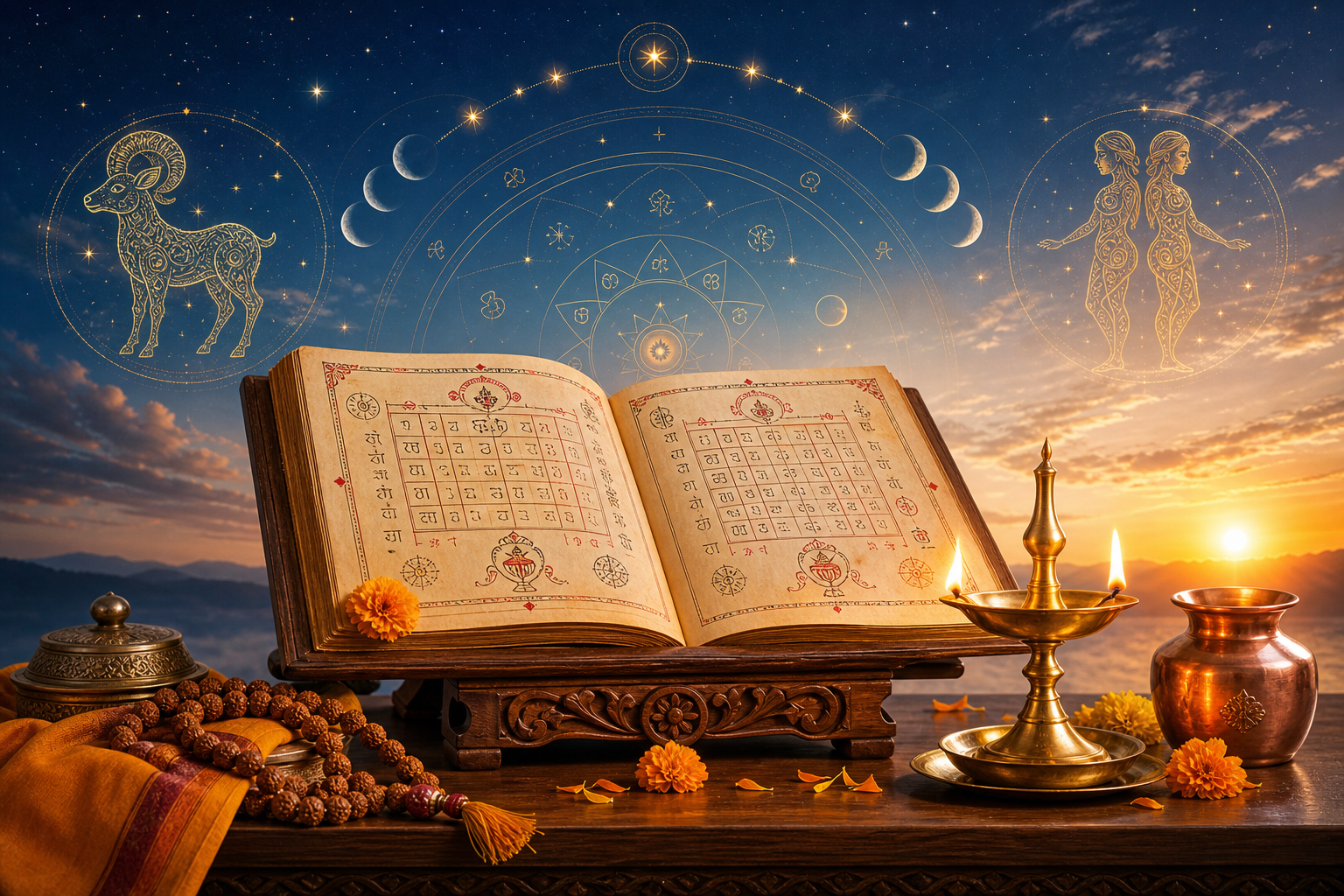
Thursday, July 9, 2026, is marked in the Hindu Panchang by Krishna Paksha Navami transitioning into Krishna Paksha Dashami. In the traditional lunar calendar, this places the day in the waning or dark phase of the Moon, a period often associated with reflection, restraint, disciplined worship, and inward correction rather than outward display.
The essential tithi note for July 9, 2026 is that Krishna Paksha Navami, the ninth lunar day of the waning fortnight, continues in the early part of the day, after which Krishna Paksha Dashami, the tenth lunar day, begins. The source tradition records Navami until 5:35 AM on July 9 in most regions, followed by Dashami. Because Panchang calculations are location-sensitive, readers should always confirm the exact local timing for their city before performing time-bound rituals, vratas, sankalpa, or muhurat-based activities.
In expanded city-based Panchang calculations for New Delhi, July 9, 2026 falls in Ashadha Krishna Paksha, with Navami shown up to 10:37 AM and Dashami following thereafter. This difference is not unusual in Panchang practice, because tithi, nakshatra, yoga, karana, sunrise, and moonrise are calculated from astronomical positions and then interpreted for a specific geographical location. A Panchang is therefore not merely a printed calendar; it is a location-aware sacred timekeeping system.
The weekday is Guruwara, or Thursday, traditionally associated with Guru, Brihaspati, wisdom, teaching, counsel, and dharmic learning. For many households, Thursday carries a quiet devotional quality: prayers to Vishnu, Dattatreya, Sai Baba, Guru, or one’s chosen deity are often performed with additional reverence. In academic terms, this reflects how the Hindu calendar integrates astronomy, ritual culture, social habit, and ethical memory into a single daily framework.
The Moon sign, or Chandra Rashi, for the day is Mesha Rashi, while the Sun is in Mithuna Rashi in the referenced Panchang calculation. Mesha brings a sharper, more active lunar tone, while Mithuna emphasizes communication, exchange, study, and intellectual movement. Such combinations are interpreted carefully in Jyotish, not as deterministic commands, but as symbolic indicators that help practitioners plan the day with awareness.
The nakshatra for July 9, 2026 is Ashwini until the afternoon in the New Delhi calculation, followed by Bharani. Ashwini Nakshatra is traditionally linked with quick movement, healing, beginnings, assistance, and restoration, while Bharani is associated with discipline, responsibility, endurance, and the power to carry a burden to completion. This transition gives the day a notable movement from speed and recovery toward accountability and inner steadiness.
The Panchang yoga begins with Sukarma and then moves into Dhriti. Sukarma is generally read as supportive for constructive action, service, ordered effort, and disciplined work. Dhriti carries the sense of firmness, steadiness, and perseverance. Together, these yogas make the day especially meaningful for routine duties, study, spiritual discipline, family responsibilities, and tasks requiring patience rather than impulsive expansion.
The karana sequence is also significant. Garaja is followed by Vanija, and later by Vishti, also known as Bhadra. Garaja and Vanija are generally workable for ordinary duties and practical engagements, while Vishti or Bhadra is traditionally avoided for many auspicious beginnings. This is why Panchang readers do not look only at the tithi; they examine the combined pattern of tithi, nakshatra, yoga, karana, and vara before deciding whether a period is suitable.
For New Delhi, the sunrise on July 9, 2026 is approximately 5:30 AM and sunset is approximately 7:22 PM. Moonrise is late, around 1:06 AM on July 10, while moonset is around 2:01 PM on July 9. These timings matter because many Hindu observances are tied not simply to a civil date, but to the relationship between sunrise, tithi, and lunar visibility.
The commonly noted good times for the day include Brahma Muhurta from about 4:09 AM to 4:50 AM, Pratah Sandhya from about 4:29 AM to 5:30 AM, Abhijit Muhurta from about 11:59 AM to 12:54 PM, Vijaya Muhurta from about 2:45 PM to 3:40 PM, Godhuli Muhurta from about 7:21 PM to 7:41 PM, and Sayahna Sandhya from about 7:22 PM to 8:23 PM. Amrit Kalam is noted from about 8:03 AM to 9:35 AM, and Sarvartha Siddhi Yoga is present from sunrise until the Ashwini Nakshatra period ends in the afternoon.
The inauspicious periods require equal attention. Rahu Kaal for New Delhi is approximately 2:10 PM to 3:54 PM, Yamaganda is about 5:30 AM to 7:14 AM, and Gulikai Kalam is about 8:58 AM to 10:42 AM. Dur Muhurtam is listed in two windows, around 10:08 AM to 11:03 AM and 3:40 PM to 4:36 PM. Varjyam appears around 11:06 AM to 12:38 PM and again late at night from about 11:51 PM to 1:21 AM on July 10.
Rahu Kaal is especially important in popular practice because it is traditionally avoided for beginning new ventures, signing major agreements, entering a new house, conducting marriage-related ceremonies, or launching significant undertakings. It does not mean that all ordinary work must stop. Rather, the principle is selective: routine duties continue, while fresh auspicious beginnings are postponed when possible.
The presence of Krishna Paksha Navami and Dashami gives the day a more inward tone. Krishna Paksha is the waning half of the lunar month, and its symbolism often points toward reduction, simplification, introspection, ancestral remembrance, correction of habits, and devotional steadiness. In lived Hindu practice, such days are often used for japa, scriptural reading, quiet puja, charity, restraint in speech, and self-examination.
Navami, as the ninth tithi, is often read as a powerful and somewhat intense lunar day. It can be appropriate for courage, discipline, worship of protective deities, and the resolution of difficult emotional or practical matters. Dashami, the tenth tithi, brings a more structured tone and is often linked with completion, order, and the continuation of purposeful work after the intensity of Navami has passed.
For spiritual practice, the most meaningful use of this Panchang is not superstition but mindful alignment. A person may choose Brahma Muhurta for meditation, Pratah Sandhya for morning prayers, Abhijit Muhurta for an important act when no other muhurat is available, and Godhuli Muhurta for evening worship. These timings create rhythm, and rhythm gives ordinary life a sacred structure.
The July 9, 2026 Hindu Calendar also reflects the unity of Dharmic time consciousness. Hindu, Buddhist, Jain, and Sikh traditions have distinct theological and ritual identities, yet they share a civilizational respect for disciplined time, ethical action, remembrance, self-cultivation, and reverence for sacred cycles. A Panchang entry, when read with maturity, can therefore become more than a sectarian schedule; it becomes a reminder that dharma is lived through awareness, responsibility, and harmony.
From a technical standpoint, the five limbs of Panchang are tithi, vara, nakshatra, yoga, and karana. Tithi measures the angular relationship between the Sun and Moon. Vara is the weekday. Nakshatra identifies the lunar mansion occupied by the Moon. Yoga is calculated from the combined longitudes of the Sun and Moon. Karana is half of a tithi and is used in fine-grained muhurat analysis. The strength of Panchang lies in this layered reading rather than in a single isolated factor.
For those planning rituals on July 9, 2026, the safest approach is to treat the early morning Navami-Dashami transition carefully, check the local tithi at sunrise, and then match the planned activity to the appropriate muhurat. Daily puja, study, mantra japa, seva, charity, and family duties remain suitable when performed with sincerity. Major new beginnings should be scheduled after reviewing local Rahu Kaal, Dur Muhurtam, Varjyam, Bhadra, and the exact tithi applicable to the place of observance.
In practical terms, this day is best approached with clarity rather than anxiety. The Panchang does not remove human judgment; it refines it. A householder checking the July 9, 2026 Tithi, Nakshatra, Rashi, and good time is participating in a long tradition of aligning action with cosmic order while still acting responsibly in the world.
The overall reading of July 9, 2026 is therefore balanced: Krishna Paksha Navami gives way to Dashami, Ashwini gives way to Bharani, Sukarma gives way to Dhriti, and the day moves from quick restorative energy toward disciplined continuity. The most beneficial use of this Panchang is to begin the day with prayer, avoid avoidable new beginnings during difficult windows, perform duties with steadiness, and carry the quiet intelligence of the Hindu calendar into ordinary decisions.
Inspired by this post on Hindu Blog.




Leave a Reply
You must be logged in to post a comment.