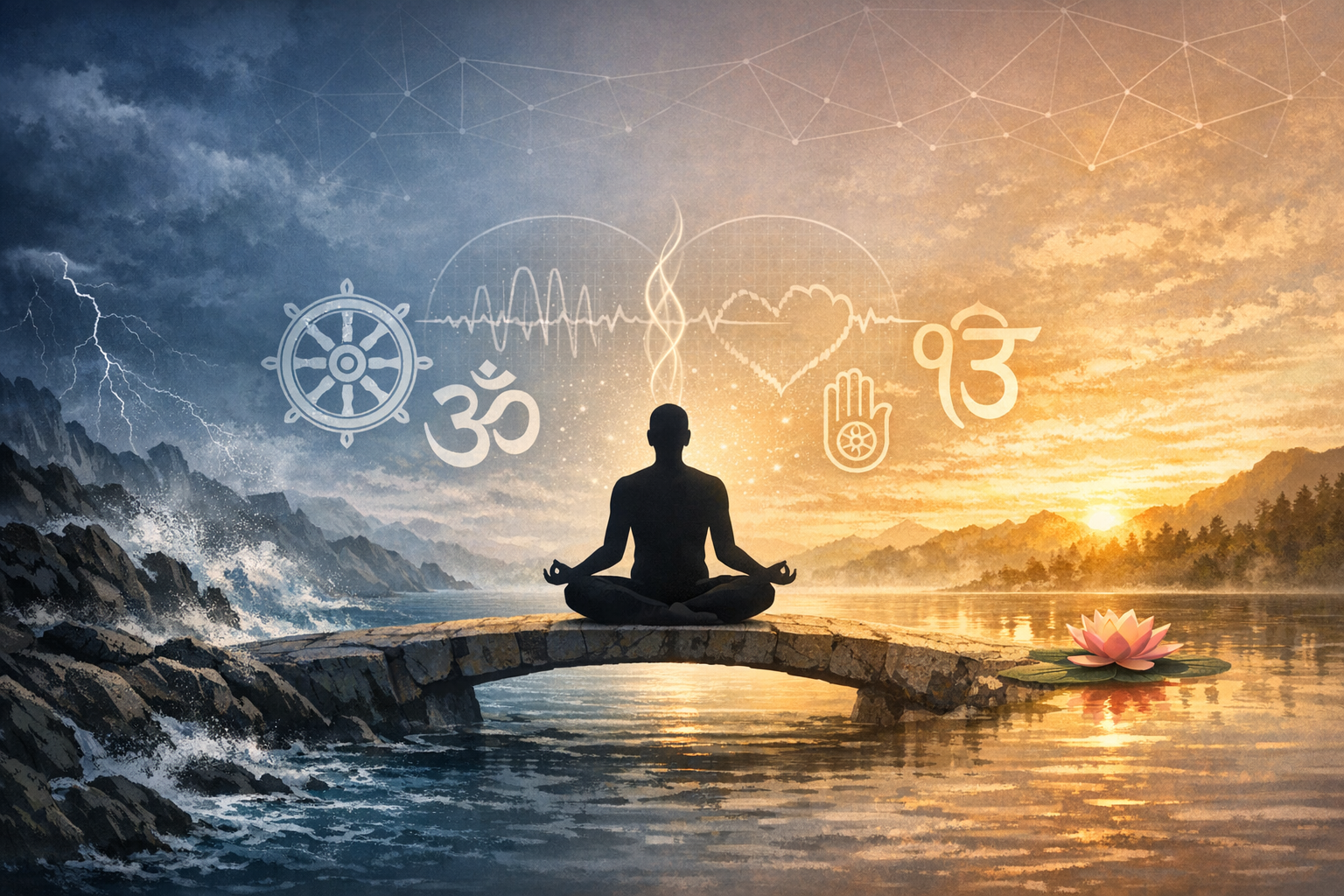
Is life easy or difficult? This perennial question appears repeatedly across the dharmic traditions of Hinduism, Buddhism, Jainism, and Sikhism. On one hand, a contemporary Hindu perspective, echoed by spiritual teachers such as Sri Sri Ravi Shankar, emphasizes that life, at its essence, is joy (ananda). On the other, Buddhism begins with a stark diagnostic: the First Noble Truth states that ordinary life is characterized by dukkha, often translated as suffering, stress, or unsatisfactoriness. A careful, academic reading of these positions shows not a contradiction but a multilevel account of human experience, where surface-level difficulty and innate joy are understood as complementary realities within a single soteriological path.
The apparent tension dissolves when placing each statement within its proper frame. At the conventional level, human life is demandingbodies age, minds fluctuate, relationships strain, and conditions change. At the ultimate level, dharmic traditions converge on an insight about the luminous, blissful, or indestructible nature of awareness or the purified soul. This two-level hermeneutic is explicit in classical Indian philosophy: Advaita Vedanta distinguishes vyavaharika (empirical) from paramarthika (ultimate) truth; Mahayana Buddhism articulates conventional and ultimate truths; Jainism advances anekantavada (non-one-sidedness) and syadvada (the logic of conditional predication) to reconcile apparently opposing viewpoints; Sikh thought expresses resilient optimismChardi Kalarooted in remembrance of the Divine (simran) and alignment with hukam (cosmic order).
To understand the assertion that “life is difficult,” Buddhism offers a rigorous phenomenology. The First Noble Truth catalogues dukkha as a structural feature of ordinary, conditioned existence. Classical analyses distinguish immediate pain, the suffering of change (viparinama-dukkha), and the pervasive unsatisfactoriness of compounded processes (sankhara-dukkha). These insights map closely onto contemporary psychological science: the brain’s negativity bias, hedonic adaptation, and predictive processing yield a mind primed to anticipate threats and to grasp after fleeting pleasures, thereby amplifying frustration and stress when conditions inevitably shift.
From a dharmic ethics perspective, acknowledging difficulty is not pessimism but clarity. It motivates disciplined cultivation of the path: the Noble Eightfold Path in Buddhism; yama–niyama, asana, pranayama, pratyahara, dharana, dhyana, and samadhi in Yoga; ahimsa, aparigraha, and tapasya in Jainism; and simran, seva, and santokh (contentment) in Sikhism. Each tradition moves from honest diagnosis to practical transformation, transmuting reactivity into freedom and compassion.
The statement “life is joy,” articulated within Hindu strands of Vedanta and Bhakti, points to the ontological core of experience. The Taittiriya Upanishad’s ananda-mimamsa explores bliss as the intrinsic nature of reality; many Vedantic expositions describe Atman–Brahman as sat–chit–ananda (being–consciousness–bliss). The Bhagavad Gita advances a psychology of equanimity in which the realized adept remains steady in sukha and duhkha alike, not as a denial of pain but as stabilization in a substratum of awareness that is inherently whole. Jainism likewise understands the purified jiva as possessing knowledge and bliss; Sikh liturgy (e.g., Anand Sahib) situates abiding joy in living remembrance of the Divine Name.
Seen through these established hermeneutics, the “difficulty” of life describes conditioned processes; the “joy” of life describes unconditioned being. They are different analytic registers. One cannot be apprehended without the other’s preparatory work: the deeper the acceptance of dukkha and impermanence (anicca), the more accessible the recognition of innate clarity and peace; the more one abides in ananda or stable presence, the less compulsive the reactivity to changing conditions.
Contemporary mind–brain science helps clarify why these complementary claims co-exist. Stress physiology shows that unchecked sympathetic arousal narrows perception and fuels avoidance or aggression. Yet contemplative training shifts autonomic balance, improving vagal tone and enhancing emotion regulation. Likewise, the hedonic treadmill explains why repeated external gains fail to secure lasting satisfaction, while eudaimonic well-being correlates with meaning, virtue, and self-transcendenceprecisely the goals emphasized in dharmic sadhana.
The Four Noble Truths establish a diagnostic–etiological–prognostic–therapeutic arc: recognize dukkha; identify craving and ignorance as causes; affirm cessation (nirvana) as possible; and follow a method (the Eightfold Path). In parallel, the Yoga Sutra presents a structural psychology: suffering stems from avidya (misapprehension) generating identification with vrittis (fluctuations). Its methodethical purification, somatic stability, breath regulation, sense-withdrawal, concentration, and meditative absorptionculminates in nirodha (stilling), through which the seer abides in itself. Jain discipline refines conduct and cognition to unveil the soul’s innate purity; Sikh practice anchors daily life in simran and seva, generating resilient optimism without denial of hardship.
In this light, the practical question shifts from abstract metaphysics to trainable capacities. Difficulty is not eliminated by assertion; it is metabolized through ethical restraint, attentional training, devotional surrender, and insight. Joy is not manufactured by will; it is recognized as a property of unobstructed awareness or a purified soul, naturally expressed as compassion, courage, and clarity.
Empirical research aligns with these classical claims. Mindfulness-based programs consistently reduce stress, anxiety, and depressive relapse risk while improving attention and emotion regulation. Slow, diaphragmatic pranayama near six breaths per minute enhances heart rate variability and baroreflex sensitivity, correlating with improved resilience and cognitive flexibility. Compassion training increases prosocial behavior and modulates neural circuits related to empathy and caregiving. These outcomes show how dharmic protocols translate into measurable biopsychological benefits.
Breath-centered methods offer a particularly clear bridge between scriptural guidance and physiology. Pranayama harmonizes respiration with autonomic function, providing an accessible lever to downshift arousal and stabilize attention. In Buddhism, anapanasati (mindfulness of breathing) becomes a complete path when integrated with insight; in Sikh practice, remembrance of the Name rhythmically synchronized with the breath deepens presence; in Jainism, breath awareness supports self-restraint and non-violence by interrupting impulsive reactions. Across traditions, breath is both a diagnostic of reactivity and a portal to equanimity.
Anekantavada, Jainism’s doctrine of non-one-sidedness, formalizes the integrative logic needed here. Statements about life’s difficulty and life’s joy are true within their respective conditions. From the perspective of conditioned processes, unsatisfactoriness is evident; from the standpoint of ultimate realization, bliss and peace are equally evident. This multi-perspectival framework prevents premature absolutism and invites humility, dialogue, and methodological rigor across the dharmic family.
Ethical discipline is the first stabilizer. The yamas and niyamas in Yoga (ahimsa, satya, asteya, brahmacharya, aparigraha; saucha, santosha, tapas, svadhyaya, Ishvara-pranidhana) reduce friction with self and others. Buddhist sila undercuts guilt and agitation; Jain vows minimize harm and attachment; Sikh seva (selfless service) and honest livelihood foster dignity and connectedness. Ethics converts chaotic living into a tractable training ground, making both suffering and joy intelligible rather than random.
Attention training is the second stabilizer. Consistent meditation cultivates sustained, flexible concentration and non-reactive awareness. Yoga’s dharana and dhyana, Buddhist samatha and vipassana, Jain dhyana, and Sikh simran each refine perception so that the mind can observe pain without compounding it, and notice joy without clinging. The capacity to remain present with changing sensations and thoughts reduces dukkha at its root: compulsive identification and resistance.
Wisdom training is the third stabilizer. Insight into impermanence (anicca), non-self (anatta), dependent origination (pratityasamutpada), and the distinction between witness-consciousness and mental modifications dissolves the cognitive distortions that produce unnecessary struggle. The Bhagavad Gita’s teaching on even-mindedness in gain and loss, pleasure and pain, and success and failure enacts the same correction. When perception becomes accurate and panoramic, difficulty is experienced as manageable information rather than an existential verdict.
Devotion and community are the fourth stabilizer. Bhakti practiceskirtan, mantra, pujaor Sikh sangat nurture meaning, courage, and relational warmth. Buddhist sangha and Jain fellowship provide accountability and shared aspiration. Social baseline theory suggests that supportive relationships reduce perceived effort and threat; dharmic communities operationalize this effect, allowing practitioners to carry the weight of difficulty without collapse, and to share the lightness of joy without self-absorption.
Consider a concrete stressor such as job loss. Through a Buddhist lens, it is recognized as dukkha; mindfulness prevents spirals of catastrophic thinking; right effort and livelihood guide skillful response. Through a Vedantic–Yogic lens, breath and posture regulate the nervous system; inquiry separates the unchanging witness from changing roles; disciplined action (karma yoga) continues without attachment to immediate outcomes. Through Jain ethics, non-violence in speech and thought checks blame and resentment; aparigraha reframes identity beyond possessions. Through Sikh practice, simran anchors trust in hukam, while seva keeps the heart open and dignified in adversity. In each case, difficulty becomes a training opportunity, and joy remains available as background strength.
Two pitfalls warrant caution. The first is nihilism: overemphasizing difficulty can lead to despair or moral disengagement. The second is spiritual bypassing: overemphasizing joy can become denial that avoids necessary work on trauma, ethics, and relationship repair. Dharmic frameworks steer between these extremes by coupling insight with compassion, equanimity with courageous action.
Thus, “life is difficult” and “life is joy” are not rival proclamations but phase-appropriate insights within a single transformational arc. At the outset, acknowledging difficulty cultivates humility, diligence, and clarity. As practice matures, the discovery of abiding joy grounds resilient engagement with the world. The two views interpenetrate: recognizing difficulty protects joy from naivety; recognizing joy protects difficulty from despair.
In sum, the unity of dharmic traditions becomes most evident precisely where this question cuts deepest. Buddhism’s realism, Hinduism’s ontology of bliss, Jainism’s non-one-sided logic, and Sikhism’s resilient optimism collectively provide a robust, evidence-aligned path. With ethics as foundation, meditation and pranayama as instruments, wisdom as compass, and community as context, the human being can meet difficulty without collapse and access joy without clinging. The mature synthesis is not a compromise but a comprehensive account of mind, meaning, and liberation (nirvana or moksha) that renders the question itself a gateway to mastery.
Inspired by this post on Hindu Pad.