Tag: Personal growth

  • The Banana Trap: A Powerful Sadhana for Letting Go and Reclaiming Inner Freedom

    The Banana Trap: A Powerful Sadhana for Letting Go and Reclaiming Inner Freedom

    The banana trap is a powerful metaphor for the way desire can become captivity when a person refuses to release what is causing harm. This expanded reflection examines attachment through the Bhagavad Gita, Bhakti Yoga, aparigraha, contemporary habit research, and the psychology of reward. It explains why “wanting” may persist even when an object or…

  • How Releasing Expectations Transforms Love, Boundaries, and Inner Peace

    How Releasing Expectations Transforms Love, Boundaries, and Inner Peace

    This long-form reflection examines how unmet expectations, rather than other people’s actions alone, often create deep emotional pain in relationships. It explains how childhood patterns, silent emotional contracts, attachment needs, and unequal emotional capacity shape disappointment. The article offers a practical and dharmic perspective on love, boundaries, self-awareness, and inner peace. It shows why people…

  • Book Distribution: Powerful Lessons from Expectation, Reality, and Seva

    Book Distribution: Powerful Lessons from Expectation, Reality, and Seva

    This article expands the theme of “Book distribution: Expectation vs. Reality” into a comprehensive reflection on seva, communication, and dharmic knowledge-sharing. It explains why spiritual book distribution is not merely a transaction, but a disciplined practice involving humility, ethics, logistics, and emotional resilience. The piece highlights the gap between idealistic expectations and real public outreach,…

  • Breaking Codependency: Powerful Lessons for Healthy Love and Inner Freedom

    Breaking Codependency: Powerful Lessons for Healthy Love and Inner Freedom

    Codependency is a relational pattern in which self-worth, emotional safety, and identity become excessively dependent on another person’s behavior. This expanded reflection explains how childhood insecurity, family instability, addiction, abuse, people-pleasing, and fear of abandonment can create unhealthy relationship cycles. It clarifies that codependency is not a formal DSM diagnosis, while still recognizing its serious…

  • Powerful Anatomy of Autonomy: Sensitive Leadership in Hindu Spiritual Wisdom

    Powerful Anatomy of Autonomy: Sensitive Leadership in Hindu Spiritual Wisdom

    This long-form reflection examines autonomy through the lens of Hindu philosophy, spiritual leadership, and the guru-shishya tradition. It explains why correction is sometimes necessary, yet must be offered with sensitivity, restraint, and respect for the dignity of the person being guided. Scriptural examples from Srimad-Bhagavatam and the Ramayana show how Lord Visnu and Lord Krsna…

  • Own the Present: Hindu Dharma’s Powerful Path from Regret to Responsible Action

    Own the Present: Hindu Dharma’s Powerful Path from Regret to Responsible Action

    This article explores how Hindu Dharma transforms regret into responsible action through the living practice of present dharma. It explains that while past choices, inherited conditions, and social influences may partly shape a person, the present moment remains the true field of ethical freedom. The discussion clarifies karma as moral continuity rather than fatalistic punishment,…

  • Saturn, Discipline, and Dharma: A Powerful Path to Inner Mastery

    Saturn, Discipline, and Dharma: A Powerful Path to Inner Mastery

    Saturn becomes a profound symbol of discipline, maturity, responsibility, and spiritual mastery when viewed through the lens of dharma. This rewritten essay explains how Saturn’s placement in a chart can be used as a contemplative tool for understanding limitation, authority, and inner work without falling into fatalism. It connects AstroDharma with wider dharmic principles such…

  • Integral Evolution: A Powerful Dharmic Map for 21st-Century Awakening

    Integral Evolution: A Powerful Dharmic Map for 21st-Century Awakening

    Integral Evolution presents a contemporary framework for spiritual awakening that joins meditation, maturity, shadow integration, service, and systemic responsibility. It argues that 21st-century awakening cannot remain confined to private mystical experience, because modern seekers live amid ecological, technological, social, and psychological complexity. The article explains how waking up, growing up, cleaning up, showing up, opening…

  • How Hindu Wisdom Transforms Self-Criticism Into Powerful Inner Growth Today

    How Hindu Wisdom Transforms Self-Criticism Into Powerful Inner Growth Today

    Self-criticism can support growth when it remains balanced, but excessive self-judgment often produces shame, fear, and stagnation. Hindu philosophy offers a practical and spiritual framework for transforming the inner critic into a wiser guide. Concepts such as dharma, karma, viveka, ahimsa, svadhyaya, and karma yoga show how responsibility can coexist with self-compassion. The Bhagavad Gita’s…

  • Slow Growth That Sticks: Evidence-Based Habits and Dharmic Wisdom for Real Change

    Slow Growth That Sticks: Evidence-Based Habits and Dharmic Wisdom for Real Change

    This article reframes personal growth as disciplined maintenance rather than dramatic reinvention. It follows a decade-long arc in which small, repeatable habits compound into durable change while anxiety gradually loses influence. Readers gain evidence-based methodshabit design, implementation intentions, boundary-setting, and emotion regulationintegrated with dharmic wisdom from Hinduism, Buddhism, Jainism, and Sikhism. The piece explains how…

  • From Self-Consciousness to True Belonging: Evidence-Based Shifts in Presence and Self-Acceptance

    From Self-Consciousness to True Belonging: Evidence-Based Shifts in Presence and Self-Acceptance

    This evidence-based reflection traces a shift from strategic blending to authentic belonging, showing how small, repeatable choices can transform chronic self-consciousness into grounded presence. It explains the psychological mechanisms involvedsocial comparison, high self-monitoring, rejection sensitivity, and the spotlight effectand how to dismantle them with practice. The narrative integrates dharmic insights from Hinduism, Buddhism, Jainism, and…

  • Transform Harsh Self-Judgment into Self-Compassion: Research-Backed Steps to Quiet the Inner Critic

    Transform Harsh Self-Judgment into Self-Compassion: Research-Backed Steps to Quiet the Inner Critic

    Many extend compassion to others yet reserve harsh self-judgment for themselves. This research-grounded exploration explains why the inner critic gains powerthrough negativity bias, perfectionism, conditional approval, and traumaand how to counter it without weakening accountability. Drawing on psychology, neuroscience, and dharmic wisdom from Hinduism, Buddhism, Jainism, and Sikhism, it presents seven trainable steps to cultivate…

  • Escaping the ‘Good Enough’ Trap: Why Fitting In Breeds Emptiness and How to Reclaim Self‑Worth

    Escaping the ‘Good Enough’ Trap: Why Fitting In Breeds Emptiness and How to Reclaim Self‑Worth

    This long-form reflection analyzes how a lifelong drive to be “good enough” evolved into approval-seeking, identity foreclosure, and inner emptinessand how reframing belonging versus fitting in changed the trajectory. It traces a concrete journey through shifting personas, numbing cycles, therapy, relationship stress, and collapse, culminating in a pivotal realization: life had been optimized for an…

  • Beyond Diagnosis: A Surgeon’s Evidence-Informed Journey into the Human Side of Healing

    Beyond Diagnosis: A Surgeon’s Evidence-Informed Journey into the Human Side of Healing

    A seasoned foot and ankle surgeon discovered that the most stubborn wounds are often invisibleshaped by grief, loneliness, and fear. Evidence-informed care improved when clinical routines made room for empathy, listening, and psychological safety. A pivotal case revealed how appointments can meet a human need for connection and thereby influence healing. Slowing down to ask,…

  • The Quiet Power of Listening: Patience and Presence that Transform a Barbershopand Life

    The Quiet Power of Listening: Patience and Presence that Transform a Barbershopand Life

    This piece demonstrates how active listening, patience, and mindful presence can outperform advice in creating trust and emotional safety. Through real barbershop encounters, it shows how attention to nonverbal cues, calm silence, and empathy can de-escalate frustration and invite genuine connection. The narrative highlights how allowing learners to struggle productively fosters ownership and confidence. It…

  • Break Free from ‘Should’: A Compassionate, Practical Framework for an Authentic, Values‑Aligned Life

    Break Free from ‘Should’: A Compassionate, Practical Framework for an Authentic, Values‑Aligned Life

    This essay presents a clear, values-aligned alternative to societal scripts by showing how authentic living supports emotional well-being, integrity, and sustainable personal growth. It analyzes the power of “should,” the role of curiosity in challenging assumptions, and the practical use of somatic signals as decision data. It models a nontraditional lifesingle, child-free, contentand argues for…

  • From Brain Fog to a Midlife Roar: Transforming Perimenopause into Grounded, Wise Power

    From Brain Fog to a Midlife Roar: Transforming Perimenopause into Grounded, Wise Power

    Perimenopause can feel like an existential stormbrain fog, insomnia, and mood swings woven into caregiving pressures and shifting identities. Framed as a rite of passage, midlife becomes a portal to grounded power, embodied truth, and fierce compassion. This narrative shows how symptoms often mirror unspoken burdens and how the body signals when responsibilities grow too…

  • The Essential Breakthrough on Projection: Discover Proven Shadow Work to Master Boundaries

    The Essential Breakthrough on Projection: Discover Proven Shadow Work to Master Boundaries

    This article examines projection psychology through a precise, compassionate lens. It traces how a person labeled “too much” learned, through therapy and shadow work, that intense reactions often reflect another’s unprocessed fear or history. The shift from self-blame to reflective inquiry enabled stronger boundaries, reduced over-explaining, and greater self-trust. Practices such as pausing, asking clarifying…

  • The Complete, Compassionate Path to Transforming Regret: Proven Practices for Mindful Growth

    The Complete, Compassionate Path to Transforming Regret: Proven Practices for Mindful Growth

    This reflective essay reframes regret as a disciplined teacher rather than a permanent burden. It offers a mindful, dharmic approach to mistakes by emphasizing agency over victimhood, compassion over judgment, and presence over performance. Readers discover how to integrate the Four Noble Truths and allied principles of non-attachment with broader dharmic values like ahimsa, satya,…

  • Proven Dharmic Wisdom: Master the Art of Using Wealth and Power to Transform Character

    Proven Dharmic Wisdom: Master the Art of Using Wealth and Power to Transform Character

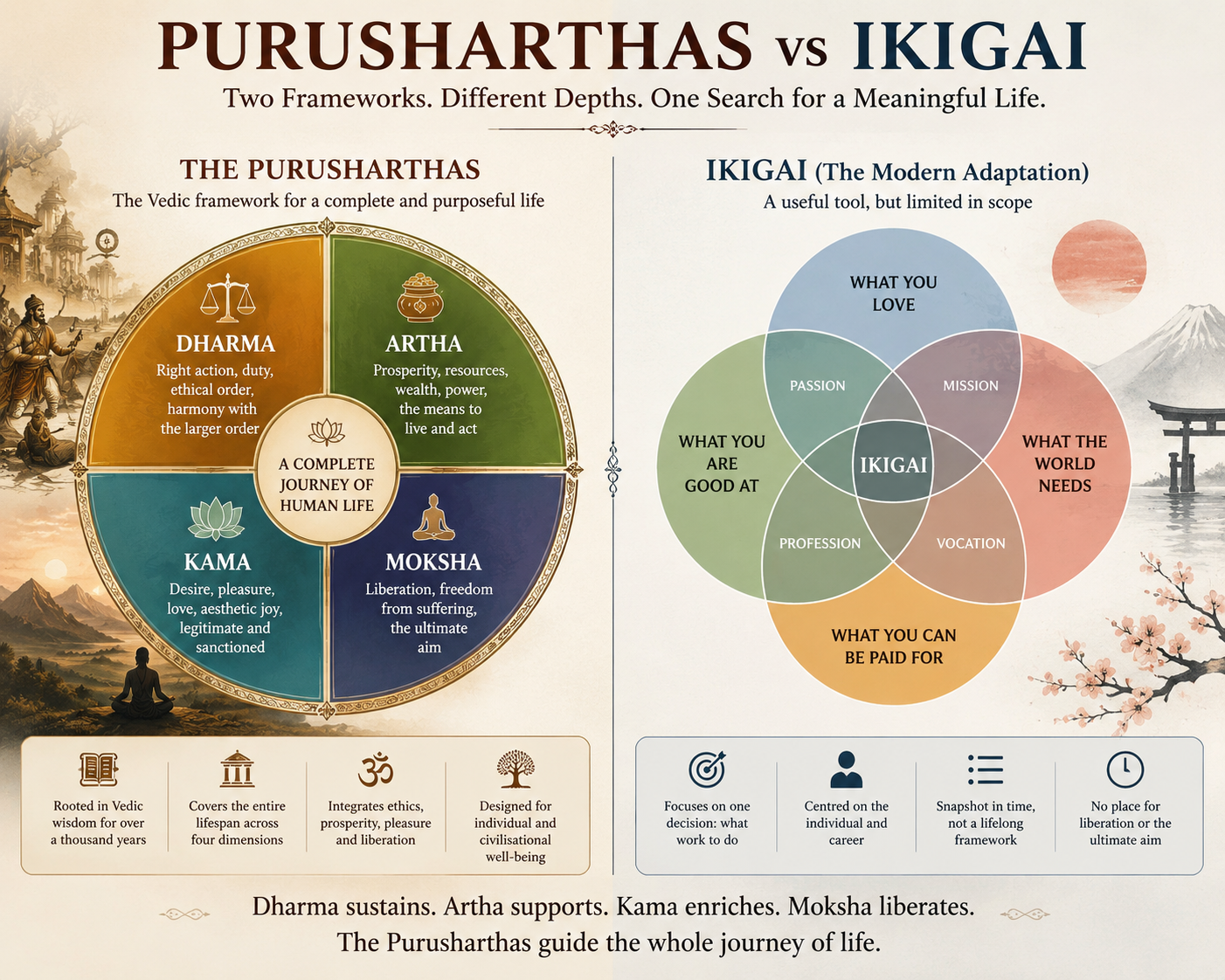
    This article explains a core dharmic principle with modern relevance: wealth (artha), status, and authority are instruments for character formation, service to society, and spiritual progress. Framed within the puruṣārthas, it shows how artha gains meaning when guided by dharma and ethical leadership. Drawing parallels across Hinduism, Buddhism, Jainism, and Sikhismthrough practices like dāna, aparigraha,…