The enduring tragedy of the present era is simple to name yet complex to untangle: religions have grown larger than the human beings they were meant to uplift. Headlines amplify doctrinal disputes, ritual perfection, and institutional prestige, while the quiet needs of ordinary peopleand especially childrenfade into the background. This inversion of priorities transforms sacred traditions into ends in themselves, rather than living pathways toward dignity, compassion, and freedom from suffering.
Seen through an academic lens, the problem can be framed as a drift from lived dharma to institutional religion. Lived dharma centers ethical action, compassion, and responsibility, while institutional religion emphasizes rules, rites, and authority. Both are necessary in moderation, but imbalance can obscure the very humanity that the dharmic traditions of Hinduism, Buddhism, Jainism, and Sikhism sought to protect.
Dharmic sources consistently affirm human primacy. The Hindu articulation of Sanatana Dharma prioritizes the welfare of all as an organizing principle of life. Buddhism grounds practice in karuna and dana as antidotes to suffering. Jainism advances Ahimsa and Anekantavada to resist violence and dogmatism. Sikhism centers seva and sarbat da bhala as the moral horizon of community life. Across these paths, the ethical core is unmistakable: the measure of sacredness is the safeguarding of human dignity.
In sociological terms, Emile Durkheim’s insight into the social function of the sacred and Max Weber’s analysis of the routinization of charisma offer useful diagnostics. As movements institutionalize, rules and roles proliferate; the gravitational pull of structure can eclipse the animating impulse of compassion. The result is ritual abundance and ethical scarcityvisible in excessive expenditures on spectacle relative to investment in education, healthcare, and child welfare.
Consider the image of the “forgotten children.” Ceremonies flourish, festivals dazzle, and theological debates intensify, yet many children remain hungry, under-educated, or unprotected. When sacred institutions do not allocate sufficient attention and resources to these lives, religious grandeur masks a civic deficit. Re-centering human needs is not a retreat from tradition; it is fidelity to dharma.
The Dharmic intellectual heritage offers robust resources for course correction. Anekantavada cautions against absolutism and encourages epistemic humilitycritical for plural societies. The Ishta principle in Hindu thought recognizes that diverse temperaments require diverse paths to the divine. Sikh praxis demonstrates how seva operationalizes compassion at scale through langar and community health initiatives. Buddhist Sangha models show how disciplined community life can nurture ethical clarity. These are not abstract ideals; they are design principles for institutions that serve people first.
The civilizational motto Vasudhaiva Kutumbakam aligns with contemporary needs by naming the world as one family. Operationalizing this ideal implies that religious institutions function as human development enginesreducing suffering (dukha), enhancing capability (shakti), and expanding freedom (moksha in a broad, humanistic sense). In policy terms, this translates to measurable service outcomes and transparent stewardship.
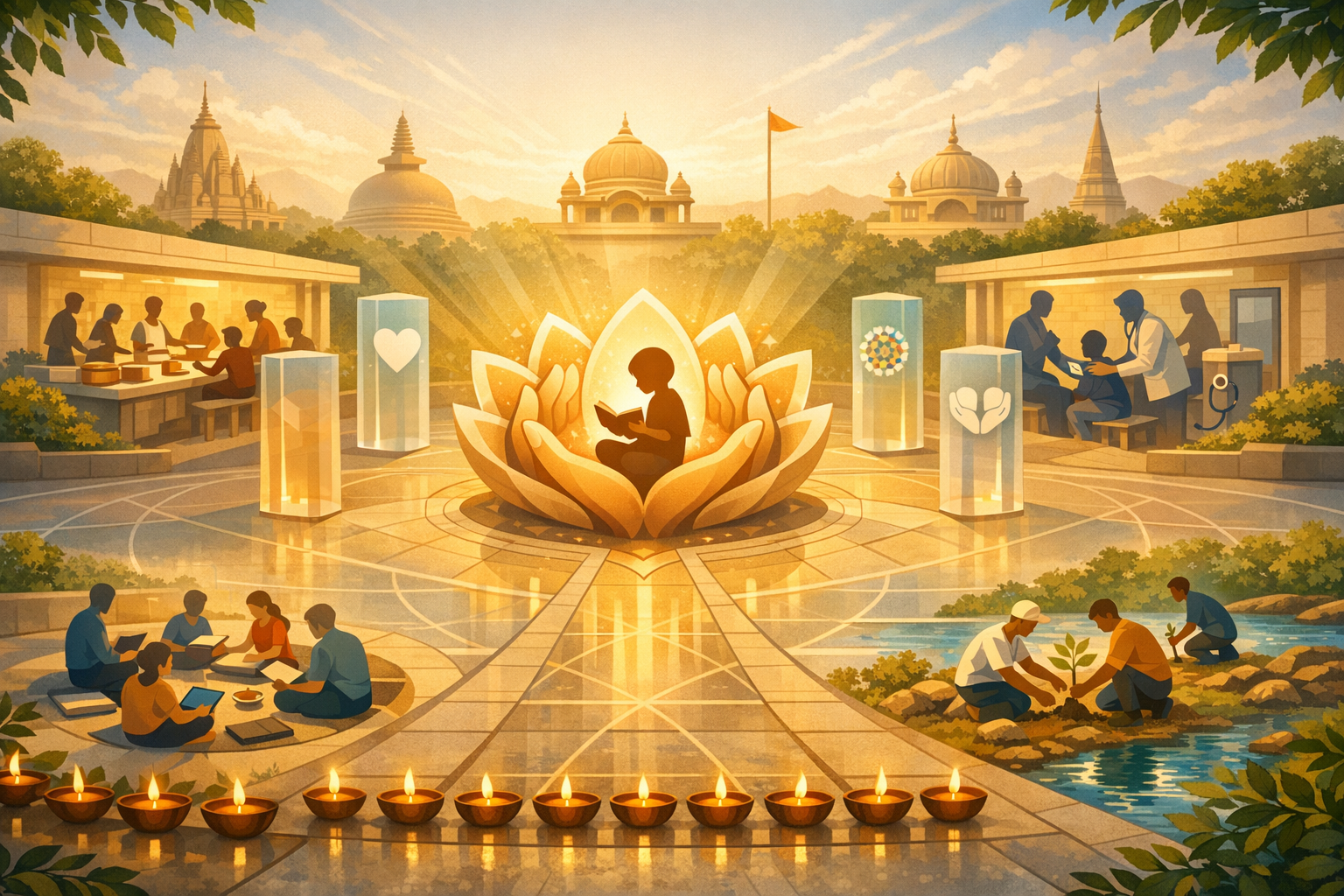
To move from aspiration to implementation, a Human-Centered Dharma Framework (HCDF) can be articulated around four pillars: ethical priority, pluralist inclusion, service design, and transparent governance. Ethical priority requires that budget, attention, and time flow first to alleviating immediate human needs. Pluralist inclusion integrates Anekantavada and Ishta to honor multiple valid approaches within and across traditions. Service design uses proven community practiceslangar, free clinics, scholarships, and sheltersas default institutional functions. Transparent governance ensures accountability through public reporting and participatory oversight.
Ethical Priority: Establish minimum service thresholds for all major institutionstemples, monasteries, mathas, viharas, derasars, and gurdwarassuch as dedicating a defined percentage of annual resources to education, nutrition, and healthcare. This aligns ritual excellence with social responsibility and demonstrates that devotion and duty are complementary.
Pluralist Inclusion: Normalize inter-dharmic learning and collaboration without erasing distinct identities. Anekantavada offers a conceptual tool for navigating complexity; Ishta ensures that personal and communal diversity in worship and practice is not merely tolerated but structurally supported. Religious pluralism in India is thus reaffirmed as a strength, not a concession.
Service Design: Scale what already works. Sikh langar exemplifies efficient mass nourishment and social equality. Jain animal shelters demonstrate comprehensive Ahimsa in action. Hindu temple-run schools and clinics show how sacred endowments can uplift local communities. Buddhist meditation centers that integrate mental health outreach advance holistic well-being. Each tradition contributes proven models; shared learning multiplies impact.
Transparent Governance: Adopt annual Human Dignity Reports for religious bodies, detailing service metrics, budgets, and community outcomes. Public dashboards and independent audits elevate trust. Community councilsrepresenting women, youth, elders, and local civic expertscan co-design priorities, widening the circle of stewardship.
From a policy perspective, measurable outcomes matter. Suggested indicators include: number of children educated and retained in school; meals served and nutritional improvements tracked; preventive health coverage and clinic visits; shelter and rehabilitation outcomes; livelihood training completion and employment rates; and reductions in local violence or substance abuse. Data should not displace compassion; it should discipline it toward durable results.
Festivals, when aligned to seva, become community renewal cycles. For example, dedicating the days surrounding major utsavas to blood donation drives, eye camps, scholarship distributions, river clean-ups, and food security initiatives reframes celebration as collective uplift. Ritual beauty then amplifies moral beauty.
Education requires special emphasis. A twenty-first century “gurukula 2.0” can integrate moral philosophy, critical thinking, digital literacy, environmental stewardship, and arts educationguided by dharmic ethics and delivered through inclusive pedagogy. Scholarships should explicitly protect the most vulnerable, with safeguards to prevent dropout due to economic stress or early marriage.
Healthcare delivery is equally vital. Religious trusts can host mobile clinics, maternal care programs, and mental health counseling aligned with compassionate listening and confidentiality. Partnerships with qualified medical practitioners ensure quality, while volunteer networks extend reach. Ayurveda, Yoga, and mindfulness-based stress reduction may complement, but not replace, evidence-based care.
Gender equity strengthens every pillar. Institutional charters should articulate equal access and leadership pathways for women across program design, fiscal oversight, and ritual administration where applicable. Protecting the girl childthrough nutrition, safety, and educationbecomes a non-negotiable institutional duty, reflecting Ahimsa and sarbat da bhala in practice.
Digital Public Infrastructure can improve service targeting and reduce leakage, provided privacy and consent are safeguarded. Lightweight beneficiary registries, grievance redressal portals, and transparent procurement systems can increase efficiency without bureaucratizing compassion.
Environmental stewardship is embedded within dharmic ethics. Programs for river rejuvenation, tree planting, waste reduction, and animal welfare can be woven into temple and gurdwara routines, monastery schedules, and derasar commitments. This is dharma directed toward intergenerational justice.
Contemporary challengespolarization, misinformation, identity anxietyrequire calm moral authority. Institutions that model respectful dialogue, resist sensationalism, and foreground common human concerns defuse conflict before it ignites. Unity in Diversity is not a slogan but a skill, learnable and teachable through shared projects and reflective study.
Importantly, “Hinduism Answers” must remain inseparable from “human answers.” The most authentic reply to cynicism is visible compassion. When a child is educated, a family is healed, or a neighborhood is fed, theology becomes tangible and tradition regains moral credibility.
Case sketches illustrate feasibility: a network of temples funds a district-wide nutrition program alongside midday meals; a gurdwara coalition expands langar logistics to support disaster relief; a Buddhist community center runs weekend mental wellness groups with mindfulness training; a Jain trust integrates animal care with organic farming and school nutrition. Each effort is distinctive; together, they compose an ecosystem of care.
To sustain momentum, inter-dharmic seva compacts can be formalized at city and district levelsshared principles, pooled logistics for emergencies, coordinated calendars to avoid resource clashes, and periodic joint audits. Such cooperation respects doctrinal boundaries while maximizing human benefit.
Ethically, the shift can be summarized as a return to first principles. Dharma is action ordered toward the good. Ahimsa is the refusal to harm when one can help. Anekantavada is humility in the face of complexity. Ishta is personalization without parochialism. Seva is the will to serve as the form of worship. These are not merely ideas; they are operating instructions.
Children remain the compass. Assess every budget, festival, renovation, and discourse against one question: will this reduce a child’s suffering, increase a child’s opportunity, or protect a child’s future? If not, recalibrate.
In conclusion, when religions remember humanity, institutions become schools of compassion rather than theaters of prestige. By aligning resources with need, pluralism with humility, devotion with service, and ritual with responsibility, the dharmic traditions can model a path that is ancient in wisdom and modern in effectiveness. From dogma to dignity is not a break with the past; it is fidelity to its highest promise.
Inspired by this post on Hindu Blog.