On Wednesday, April 8, 2026, the Hindu calendar (Panchang) marks Krishna Paksha Sashti tithi—the sixth lunar day of the waning phase—until 4:09 PM (IST) in most regions. From 4:09 PM onward, the day transitions into Krishna Paksha Saptami tithi, the seventh lunar day of the dark fortnight. As with all Panchang data, local variations may occur depending on longitude, latitude, and time zone; therefore, practitioners planning time-sensitive rituals are advised to confirm with a location-specific Panchang.
Krishna Paksha, the dark half of the lunar month, traditionally supports introspection, consolidation, and completion. The tithi change on April 8, 2026—from Sashti to Saptami—shapes the energetic tenor of the day: the morning and early afternoon favor steady effort and protective observances, while the late afternoon and evening incline toward clarity, revitalization, and focused undertakings aligned with Saptami’s solar symbolism.
In calendrical context, this date falls in Chaitra for most North Indian Purnimanta and Amanta traditions, while corresponding to Meena (Malayalam), Panguni (Tamil), and Chaitra (Bengali) in regional solar-lunar harmonizations. The weekday is Budhavara (Wednesday), ruled by Budha (Mercury), traditionally considered supportive of study, commerce, correspondence, and analytical work—an influence that interacts meaningfully with the tithis’ qualities noted below.
Sashti tithi (the sixth) belongs to the Nanda class of tithis in classical muhurta taxonomy (Nanda: 1, 6, 11), a grouping associated with growth, nourishment, and pleasing undertakings. Across many regions, Sashti is linked with reverence for Shashthi Devi and with Kartikeya/Subrahmanya, inspiring child-welfare prayers, protective vratas, and disciplined sadhana. During the Sashti portion of April 8 (until 4:09 PM IST), households often find value in family-centric puja, mantra-japa, and acts of care, aligning with the tithi’s protective and nurturing ethos.
Upon the shift to Saptami tithi after 4:09 PM (IST), the day’s quality moves toward Surya (the solar principle). While the well-known Ratha Saptami occurs in Magha Shukla, every Saptami—Shukla or Krishna—carries a traditional association with vitality, illumination, and health. Classical muhurta texts often regard Saptami as conducive to commencing health remedies, travel arrangements, and initiatives requiring clarity and steady progress. Many families leverage this Saptami window for planning, organizing, or beginning wellness routines in alignment with Surya’s purifying symbolism.
Nakshatra and Chandra Rashi (the Moon’s nakshatra and sign) are crucial for fine-tuning daily observances; however, they vary by locality and time. Practitioners should consult a reliable, location-specific Panchang to determine the precise nakshatra ruling at sunrise and during the tithi transition. Notably, with Mesha Sankranti approaching mid-April, Surya remains in Meena Rashi (sidereal) on April 8, 2026, an interval traditionally favorable for contemplative, compassionate, and restorative efforts.
Shubh Muhurats (auspicious windows) on any date are refined by local sunrise and the day’s nakshatra-yoga-karana framework. A practical guideline is the Abhijit Muhurat centered around local solar noon (approximately 24 minutes before and after true noon), considered broadly auspicious for general undertakings when other specific muhurats are unavailable. Because true noon and day length vary by location and season, one should calculate Abhijit from the local ephemeris rather than assume fixed clock times.
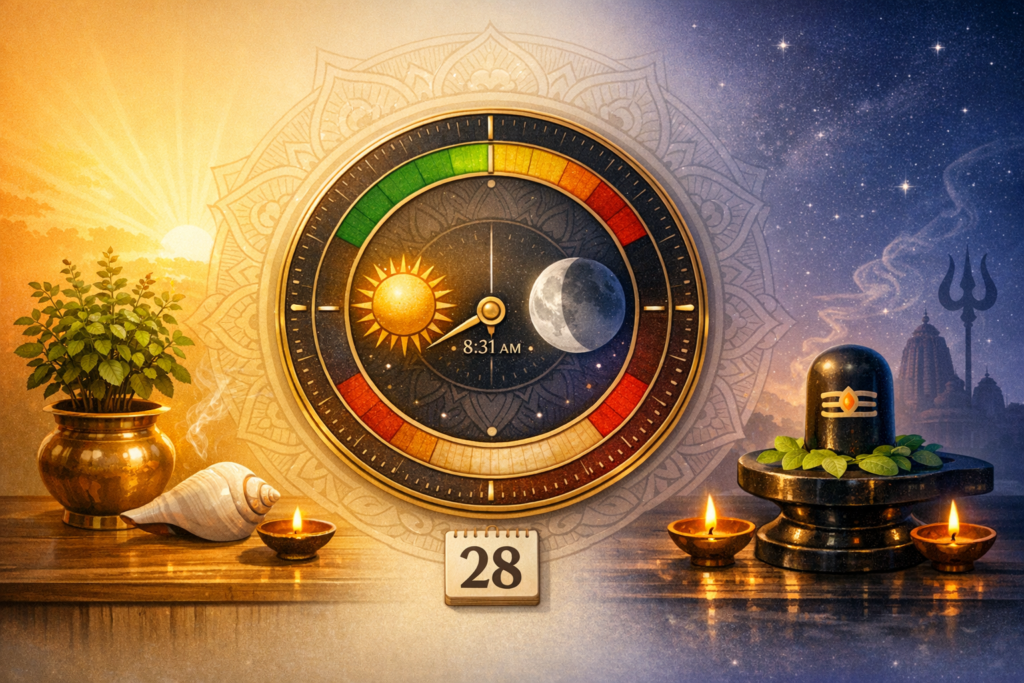
For day-to-day planning, households frequently consider Rahu Kalam, Gulika Kalam, and Yamaganda—cautionary spans avoided for new beginnings. On Wednesdays, a widely taught rule-of-thumb (assuming a 12-hour daylight beginning around 6:00 AM) places Rahu Kalam near 12:00–1:30 PM, Gulika Kalam near 10:30–12:00, and Yamaganda near 7:30–9:00 AM. These are proportional segments of daylight and thus shift with actual sunrise and day length; accurate determination requires adjusting each segment to local sunrise and sunset.
Choghadiya provides another accessible day/night planning tool, especially in western and northern India. The favorable Choghadiyas are Amrit, Shubh, and Labh; the cautionary ones are Rog, Kaal, and Udveg (Char is generally neutral-to-favorable depending on context). Since each Choghadiya roll follows local day and night partitions, it is advisable to generate the day’s sequence based on the local sunrise and sunset to identify the most supportive windows for travel, transactions, or family rites.
In practice, Krishna Paksha days such as this often encourage inward steadiness and mindful action. Many families experience the morning’s Krishna Paksha Sashti as conducive to quiet sankalpa, protective prayers for children and elders, and grateful reflection. With the arrival of Saptami later in the day, the same households may transition toward health-promoting habits: Surya-arched salutations, beginning a balanced routine, or setting intentions for clarity in learning and work—harmonizing seamlessly with Budhavara’s communicative character.
Unity across dharmic traditions naturally appears in this shared lunar rhythm. Hindu households may observe tithi-based puja and vratas; Buddhist communities mark uposatha cycles close to quarter and half-moons; Jain traditions follow tithi-guided austerities and pratikraman; Sikh families often align personal reflection, seva, and disciplined living with seasonal rhythms even when employing the Nanakshahi solar framework. The common thread is an ethic of compassion, self-discipline, and community well-being grounded in time-awareness.
Practical guidance for April 8, 2026: use the Sashti portion (until 4:09 PM IST) for protection-oriented worship and family care, and the Saptami portion (post 4:09 PM IST) for health routines, planning, and measured new starts. Anchor significant actions in locally computed Shubh Muhurats (including Abhijit) and avoid new ventures during locally adjusted Rahu Kalam, Gulika Kalam, and Yamaganda. When in doubt—especially for samskaras, temple ceremonies, or major life events—seek confirmation from a trusted priest or a high-quality, location-aware Panchang.
Key takeaways for search and reference: April 8 2026 tithi (Krishna Paksha Sashti to Saptami), April 8 2026 Panchang essentials, Nakshatra today (consult local ephemeris), Rashi today (Surya in Meena; Chandra to be verified), and Shubh muhurat selection via Abhijit and Choghadiya. This approach balances textual tradition with practical, region-specific accuracy for householders, students, and professionals alike.
Inspired by this post on Hindu Blog.