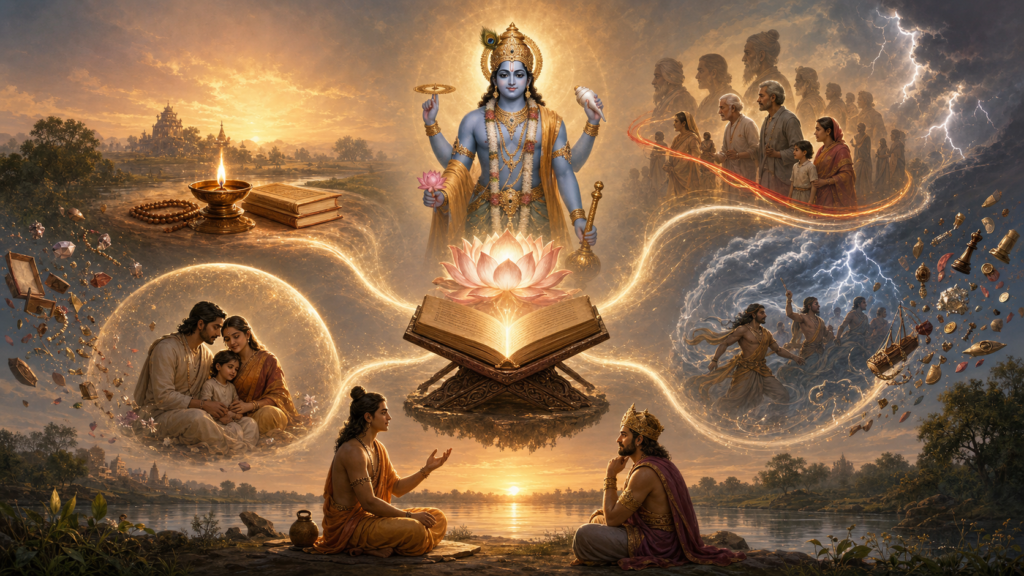
Spiritual evolution, within the Hindu way of life and allied Dharmic traditions, often begins with a deliberate step away from herd mentality and toward authentic self-understanding. The central insight is clear: the path to self-realization is inherently personal, grounded in discernment (viveka) and responsibility (dharma), and supported by the wisdom of Hindu scriptures. The Bhagavad Gita (3.35) underscores this principle by affirming that it is better to perform one’s own duty, even imperfectly, than to perform another’s perfectly.
The courage to stand apart from collective conditioning is not an act of rebellion for its own sake; rather, it is a disciplined turning inward. This turning cultivates clarity about one’s svadharmaone’s unique nature and obligationsand reorients the seeker from external validation to inner authenticity. In this framing, “walking alone” signifies intellectual and moral independence, not social withdrawal. It enables a practitioner to participate in society with deeper integrity, aligning personal conduct with enduring principles of dharma.
Hindu philosophy, alongside Buddhism, Jainism, and Sikhism, converges on this insight. The Buddha’s renunciation, the Jain Tirthankaras’ austere pursuit of truth, and the Sikh Gurus’ emphasis on steadfast inner devotion demonstrate a shared Dharmic emphasis on self-mastery over conformity. This unity in spiritual diversity exemplifies a civilizational commitment to pluralism: diverse methods, common ethical aims, and a collective aspiration for liberation that enriches the broader community.
Crucially, breaking from conformity is not an endorsement of isolation or superiority. The Gita’s ethic of lokasangrahaacting for the welfare and cohesion of societyremains central. Authenticity and compassion are mutually reinforcing: clarity in one’s path reduces performative religiosity while increasing humility, empathy, and service (seva). In this manner, the solitary courage of the seeker translates into social harmony rather than division.
Across Hindu scriptures and the Upanishads, self-inquiry (svadhyaya), meditation (dhyana), and disciplined action (karma yoga) are presented as proven means to refine attention and character. Many practitioners describe pivotal momentschoosing contemplation over crowd-pleasing ritual, aligning vocation with ethical service, or deepening practice under a compassionate guruwhere they discovered that the most transformative progress occurred when they dared to be inwardly independent while remaining outwardly kind.
The concept of Ishta in Hinduism further supports individualized practice without compromising unity. By honoring a chosen ideal or form that resonates with one’s temperament, a seeker cultivates devotion and focus while respecting others’ paths. This framework normalizes diversity as a spiritual strength: what fits one practitioner may not fit another, yet all are guided toward the same inner realization of the atman.
Read through this lens, the solitary path is not a rejection of community but a refinement of participation within it. When individuals act from self-knowledge rather than crowd pressure, they build resilient communities grounded in trust, truthfulness, and shared purpose. Such integrity enables unity across Hinduism, Buddhism, Jainism, and Sikhism, strengthening a common Dharmic fabric that celebrates many practices while affirming one ultimate quest for freedom and wisdom.
In sum, the willingness to “break from the herd” is a disciplined, compassionate stance that advances both inner freedom and collective well-being. It is a call to deepen study, refine practice, and embody values that uplift societyan approach fully consistent with the spirit of the Bhagavad Gita (3.35) and the broader Dharmic traditions’ commitment to unity in spiritual diversity.