Human communities repeatedly identify and amplify differences where none fundamentally exist. Hindu philosophy names this pattern the play of avidyā and ahaṅkāra—misapprehension and egoic selfing—that fragments perceivers from the unified ground of being. Contemporary psychology similarly observes that even arbitrary group assignments yield in‑group favoritism, suggesting that separation is a habit of mind rather than a property of reality.
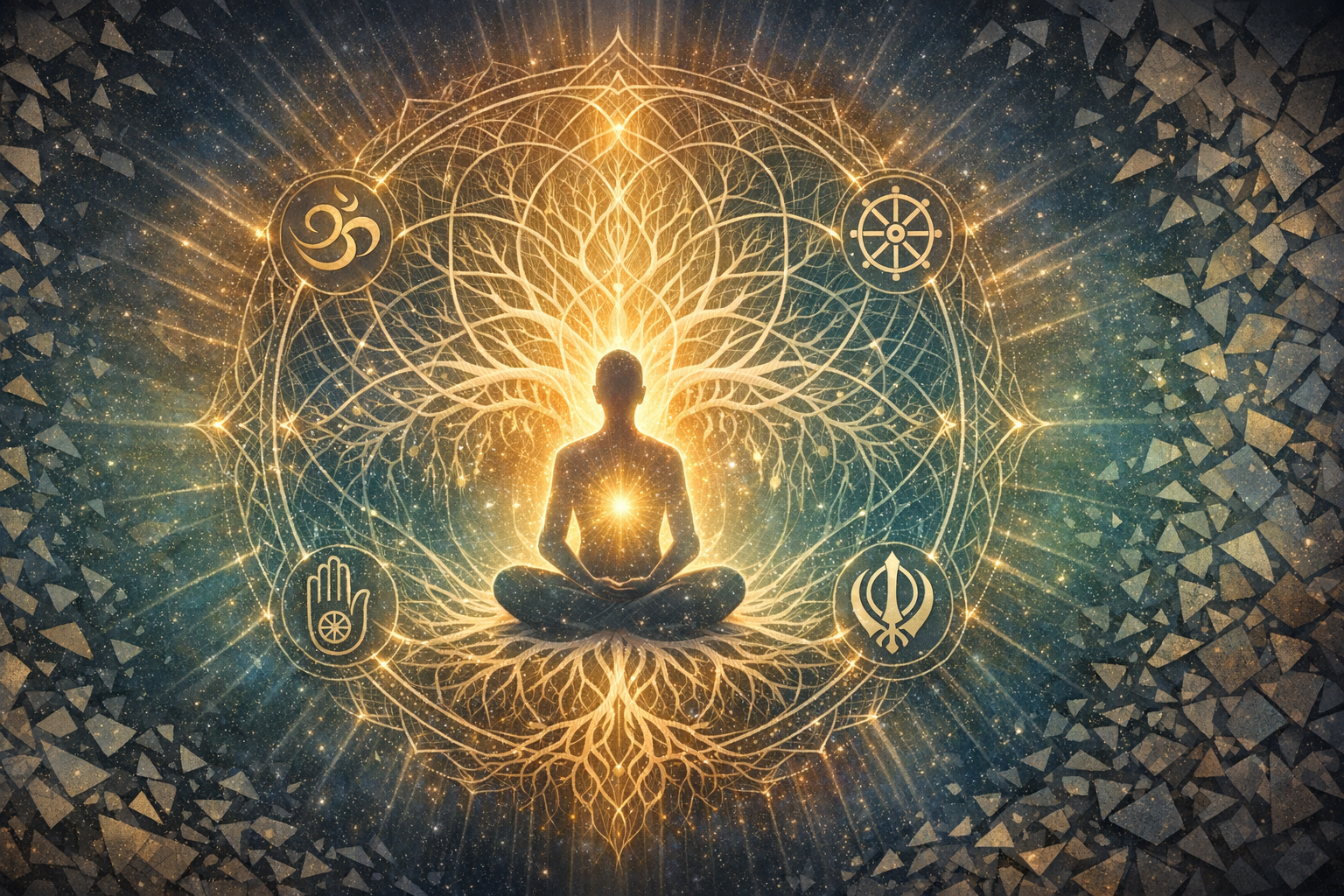
In dharmic traditions—Hinduism, Buddhism, Jainism, and Sikhism—this tendency is examined not to condemn human nature but to reveal methods for transformation. Their shared aim is Unity in Diversity, a vision crystallized in the civilizational ideal Vasudhaiva Kutumbakam, the world as one family. The following synthesis situates the problem of manufactured differences within classical sources such as the Upanishads, the Bhagavad Gita, and Anekāntavāda, while outlining practical disciplines capable of healing division in homes, workplaces, and public life.
Yoga’s analytical map describes the kleśas—root afflictions that distort perception. A concise sūtra states: avidyā-asmitā-rāga-dveṣa-abhiniveśāḥ kleśāḥ. Mis-knowing (avidyā) gives rise to I-ness (asmitā), attraction (rāga), aversion (dveṣa), and clinging to continuity (abhiniveśa). The cycle transforms fluid difference into hardened identity, then defends that identity through partial perception.
Advait articulates the corrective: the nondual ground, Brahman, underlies and pervades multiplicity. Upanishadic mahāvākyas summarize this ontological unity: sarvaṃ khalvidaṃ brahma, tat tvam asi, and īśāvāsyam idaṃ sarvam. Differences appear as nāma-rūpa—name-form configurations—useful for navigation but not ultimate. Confusing provisional distinctions for absolute reality is the philosophical root of sectarianism.
The Bhagavad Gita translates this insight into ethical vision. Verse 5.18 affirms sama-darśana, equal seeing: vidyā-vinaya-sampanne brāhmaṇe gavi hastini śuni caiva śva-pāke ca paṇḍitāḥ sama-darśinaḥ. Verse 6.29 deepens the praxis by locating the Self in all beings and all beings in the Self: sarva-bhūtastham ātmānaṃ sarva-bhūtāni cātmani. The seer who stabilizes in this recognition becomes constitutionally resistant to manufactured difference.
Classical Indian logic further clarifies how difference solidifies. Nyāya–Vaiśeṣika distinguishes universals (sāmānya) and particulars (viśeṣa). Conceptual errors arise when provisional classifications—caste, creed, class, or clan—are reified beyond their pragmatic scope. Philosophically, this amounts to mistaking viśeṣa for svabhāva, attributing inherent essence to what are contingent relational properties.
Jain epistemology offers a precision instrument against absolutism: Anekāntavāda, the doctrine of many-sidedness, complemented by Syādvāda, the logic of conditional predication. Any object or event can be affirmed as true from one standpoint, false from another, and indescribable from yet a third, depending on conditions. Cultivating this discipline loosens ego’s claim to finality and replaces it with structured intellectual humility.
Buddhist analysis converges on the same therapeutic arc. Anatta or anatma denies an independent, enduring self; pratītya-samutpāda frames phenomena as dependently co-arisen. When moha (delusion) and dveṣa (aversion) coalesce with grasping, categorical identities become fossilized and suffering escalates. Training in sati (mindfulness), vipassanā (insight), and the brahmavihāras—mettā, karuṇā, muditā, upekkhā—dissolves rigid boundaries by stabilizing non-reactive, compassionate awareness.
Sikh thought names the alienating principle haumai, the self-centrism that veils Ik Onkar, the indivisible One. Seva (selfless service) and simran (remembrance) operationalize the recognition that the same Light pervades all. The aspiration sarbat da bhala—welfare of all—translates metaphysical unity into social responsibility, rendering prejudice ethically incoherent.
Within the Hindu way of life, the Ishta in Hinduism provides a lived grammar for pluralism. Each practitioner approaches the Absolute through a chosen form or ideal—Ishta—without denying others’ access through different forms. Hinduism’s inclusiveness is therefore principled, not merely strategic, because Ishta recognizes one Reality approached through many gates. As Swami Vivekananda emphasized in teachings on Ishta, such personalization safeguards unity by honoring psychological diversity and cultural context while pointing to the same summit.
Another shared map, the pañca-kośa (Pancha Kosha Viveka), allocates human experience into concentric sheaths: annamaya, prāṇamaya, manomaya, vijñānamaya, and ānandamaya. Differences are most pronounced in the outer sheaths—body, energy, and thought. As attention refines from gross to subtle (sthula to sukshma) toward vijñāna and ānanda, perception de-emphasizes surface variation and intuits an underlying sameness.
The guṇa model—sattva, rajas, and tamas—helps explain why difference-manufacture spikes under certain conditions. Tamas obscures, rajas agitates, and together they magnify partial truths into polarized certainties. Sattva, by contrast, clarifies and harmonizes, enabling nuanced, compassionate discernment rather than binary judgment.
Across dharmic frameworks, the ethical corollary is unambiguous: ahimsā is not merely nonviolence in action but non-aggression in perception. When sama-darśana stabilizes, Lokasangraha—acting for the cohesion of the social whole—becomes a natural expression of insight. Religious tolerance in Hinduism, Jain vows, Buddhist compassion, and Sikh seva align as practical commitments to reduce harm rooted in misperception.
Modern research reinforces these classical claims. Minimal-group experiments demonstrate that humans will favor an in-group even when group membership is assigned randomly. Cognitive essentialism and categorical perception then attribute fixed essences to transient labels. Dharmic disciplines can therefore be read as expertly engineered antidotes to well-documented cognitive biases.
Language participates in the illusion through nāma-rūpa. Labels enable coordination but can also imprison perception when treated as exhaustive descriptions. The solution is not to abandon language but to qualify it—syāt, from a certain standpoint—thereby holding speech as a provisional tool rather than an ontological verdict.
Neuroscientific accounts add texture: self-referential processing, associated with default-mode network activity, correlates with rumination and affective reactivity. Practices that quiet habitual selfing—dhyana, pranayama, simran, and mindfulness—reduce reactivity and increase integrative awareness, echoing the contemplative claim that clarity weakens the compulsion to divide.
Because the tendency to create differences is habitual, training must be systematic. A cross-traditional sādhanā may include: silent japa to soften asmitā; metta phrases to counteract dveṣa; samayik from Jainism to stabilize equanimity; vipassanā to perceive anicca; seva to reorient action toward sarbat da bhala; and study of the Upanishads, Bhagavad Gita, and Dhamma to align understanding.
Ethical pre-commitments enhance traction. Yamas and niyamas—satya, ahimsā, aparigraha, svādhyāya—create a moral ecology for insight to stabilize. In Buddhism, the pañca-sīla perform a similar function; in Sikhism, daily nitnem, and in Jainism, anuvratas shape conduct. Conduct disciplines perception, and refined perception, in turn, refines conduct.
Community-facing applications translate unity into policy and practice. Inter-tradition kirtan and satsang, shared service projects, and study circles on Anekāntavāda and Ishta philosophy reduce social distance and cultivate trust. When households and neighborhoods organize around Vasudhaiva Kutumbakam, difference loses its emotional charge and becomes a resource for collective intelligence. This is religious pluralism in India at work, rooted in philosophy and expressed in daily life.
Education is decisive. Curricula that juxtapose Advait nonduality, Jain many-sidedness, Buddhist dependent origination, and Sikh Ik Onkar teach students to reason across perspectives without collapsing them. Case-based learning—ethical dilemmas analyzed through multiple dharmic lenses—builds the muscle of discerning unity without erasing diversity.
Digital ecosystems require special care because algorithms reward outrage and categorical certainty. Mindful consumption, slow sharing, and deliberate exposure to diverse voices act as pratyāhāra for the attention economy. The aim is neither relativism nor homogenization, but resilient, evidence-guided discernment grounded in compassion.
Simple heuristics help daily life. Before labeling a person, append a silent clause: from one standpoint. Before forwarding a divisive message, pause for three breaths and consult sama-darśana: would this communication enhance Lokasangraha. Before reacting to disagreement, test the Anekāntavāda move: what partial truth might the other standpoint reveal.
In family settings, value conflicts often masquerade as absolute differences. Applying Ishta wisdom, each member’s temperament is honored while orienting the household toward shared dharma—care, honesty, restraint, and generosity. Differences then enrich the commons rather than threaten it.
In workplaces, rigid departmental identities can impede flow. Teams that adopt a sāmānya-first mindset—seeking shared goals before discussing viśeṣa-level methods—resolve friction faster. Regular reflection sessions that practice mettā and constructive dissent create cultures where creativity outcompetes polarization.
At the level of civic culture, rituals of encounter matter. Festivals that invite multiple dharmic traditions to co-host, joint conservation projects framed as seva, and public readings from the Upanishads alongside the Dhammapada, Jain āgamas, and the Guru Granth Sahib enact Unity in spiritual diversity in embodied, repeatable ways.
The philosophical horizon remains steady: difference as expression, unity as essence. When avidyā lifts, nāma-rūpa regains its rightful place as a functional map rather than a prison. The civilizational promise of Hindu philosophy of unity—fully consonant with Buddhist compassion, Jain many-sidedness, and Sikh oneness—then becomes lived reality rather than slogan.
In this light, the habit of manufacturing differences is not a moral failure so much as a training problem. The dharmic toolkit is clear, time-tested, and internally coherent. Practiced with patience and rigor, it turns the mind from the ego’s game toward the shared work of healing, wisdom, and Lokasangraha.
Inspired by this post on Hindu Blog.