The Reva Khanda, transmitted within the expansive Purana traditionmost visibly in the Skanda Purana and in Narmada-focused sections affiliated with the Vayu Puranaoffers one of the most detailed sacred geographies of the River Narmada, also known as Reva. It synthesizes mythic origins, tirtha-mahātmya (praise of sacred places), ritual disciplines, and topographical memory into a cohesive guide for pilgrims, scholars, and cultural historians. As a living text, it continues to shape devotional practice and regional identity along the Narmada’s long westward course from the Maikal Hills to the Arabian Sea.
Within the Skanda Purana’s later tirtha-mahātmya strata, the Reva Khanda serves as an encyclopedic manual for encountering Narmada as sacred presence. It identifies the river’s origin at Amarkantak, maps key confluences and ghats, prescribes vows (vrata) and offerings, and situates Narmada within the classical Saptanadī (Ganga, Yamuna, Sarasvati, Godavari, Narmada, Sindhu, Kaveri). The Khanda thus fuses cosmology with cartography, construing the river as both a theological current and a navigable itinerary of sanctity.
In the Vayu Purana tradition, Reva-centric praise appears in chapters and associated mahātmyas, varying by manuscript lineage and regional redaction. These passages typically converge with the Skanda Purana’s goalscelebrating Narmada’s purificatory powerwhile preserving distinctive narrative details, lists of sages and shrines, and regionally inflected ritual notes. Such intertextual resonance typifies the Purana genre, where praise of tirthas circulates across texts, reinforcing shared devotional maps while registering local memory.
The names themselves anchor the hermeneutic. “Narmadā” commonly derives from the Sanskrit root for delight, connoting “the giver of joy,” while “Revā” is glossed as “the leaping one,” a poetic image for a river celebrated for its undulating course and pebbled banks. Both names, prevalent throughout the Reva Khanda, sustain a theology of sacred flow: the river is mother, guide, purifier, and witness to dharma across ages.
Origin narratives in the Reva Khanda variously link Narmada to Shiva’s ascetic powerarising from penance, divine perspiration, or cosmic dancebefore appearing terrestrially at Amarkantak. This cosmogeny is not merely mythopoetic; it instructs ritual conduct. The river’s westward flow, unusual among India’s great rivers, becomes an axis connecting the Vindhya and Satpura ranges to the sea, mirroring a movement from interior ascent to oceanic release. The text repeatedly frames this geography as soteriological terrain: to move along Reva is to move through time, merit, and memory.
Liturgical language deepens this cartography. A verse widely recited across the Indic world encapsulates the seven rivers’ presence in a single invocation: “Gange cha Yamune chaiva Godavari Sarasvati Narmade Sindhu Kaveri jalesmin sannidhim kuru.” Such mantric condensationalso reflected in the Reva Khandalocates Narmada in a network of sanctity, encouraging devotees to recognize interconnected holiness rather than competitive hierarchies among rivers.
Purificatory claims in the Reva Khanda are emphatic yet integrative. While extolling the potency of Narmada’s darśana (sacred sight), sparśa (touch), and snāna (bath), the text positions Reva alongside, not above, sister rivers praised elsewhere in the Puranas. In doing so, it reaffirms a dharmic grammar of plurality: diverse paths, vows, and waters lead toward a shared horizon of ethical conduct, devotion, and liberation.
Geographically, the Khanda’s itinerary begins at Amarkantak, where springs and kunds ritualize the very idea of emergence. Downstream, it delineates sacred nodes through story and practice: Omkareshwar (Mandhata) as a jyotirlinga and island-shrine shaped like the syllable Om; Maheshwar with its ancient ghats and temples on serene bends; Narmadapuram (Hoshangabad) as a ritual crossing; and Bharuch at the Reva-sagara saṅgama, the river’s meeting with the sea. Each site interlaces mythic episodes with local ritual calendars, forming a palimpsest of worship spanning centuries.
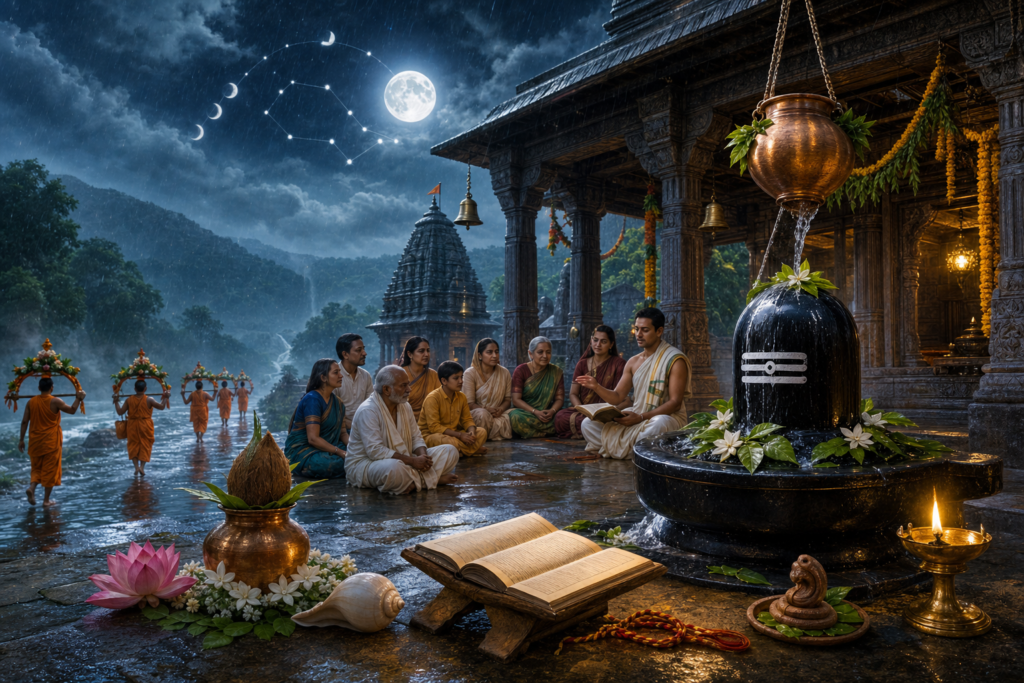
Omkareshwar embodies the Reva Khanda’s theological north star: Shiva’s light (jyoti) mirrored in flowing water. Here, the Purana’s language fuses mantra and landscapedevotees circumambulate the island, offer bilva leaves, and chant Shiva-namas to align personal rhythm with Reva’s current. The Khanda’s narrative thus becomes performative: reading leads to walking; walking turns into worship; worship returns to reading as commentary on experience.
Maheshwar, celebrated in the Reva Khanda’s shrine lists and later royal inscriptions, exemplifies how scripture, polity, and place converge. The Ahalyeshvara Mahadeva Temple and the ghats patronized by Maharani Ahilyabai Holkar articulate a continuity between Puranic sanctity and historical stewardship. Pilgrims commonly report a contemplative stillness at dusk aarti here, an affective consonance that the Khanda anticipates by linking merit (puṇya) to the cadence of daily worship and service (seva).
Narmada Parikramacircumambulation of the river from source to sea and back along the opposite bankderives much of its normativity from Reva Khanda injunctions and allied mahatmya literature. In traditional observance, pilgrims avoid crossing the river except at the estuary, maintain disciplined austerities, and adopt a rhythm of walking, resting, and worship that aligns with lunar calendars. While durations vary, a classical vow often cited is three years, three months, and thirteen days, though many undertake shorter, responsibly paced pilgrimages shaped by capacity and season.
The Khanda’s detailed prescriptions emphasize ethical comportment as integral to sacred travel: non-harm (ahiṃsā), honesty (satya), purity (śauca), hospitality, and care for fellow pilgrims. The text foregrounds pilgrim etiquette at tirthas, from avoiding sacrilege of natural features to offering alms mindfully. In this respect, Reva Khanda functions as a manual for community life as much as an atlas for spiritual movement.
Ritual calendars attached to the riveramāvasyā and pūrṇimā baths, festival-specific snānas, and vows observed at particular confluencesrender time itself as sanctified current. The Khanda often appends phalaśruti (statements of merit) to these observances, not as transactional reward but as mnemonic device, embedding memory and motivation for sustained practice. Such framing promotes steady devotion rather than episodic enthusiasm.
The Reva Khanda also encodes a sacred ecology. Its reverence for riverine life, riparian forests, and stones (notably the smooth, naturally elliptical śālagrāma-like pebbles found along certain stretches) encourages a culture of restraint and care. Contemporary readers readily translate these cues into environmental stewardshipclean banks, responsible offerings, and collaborative river protectionaligning scriptural ethos with modern sustainability goals.
This ecological and devotional grammar resonates across the broader dharmic family. Hindu, Buddhist, Jain, and Sikh traditions all sustain practices that honor water as purifier, healer, and teacherwhether through sarovars at gurdwaras, monastic regulations mindful of river use, or Jain tirthas established near springs and hill-streams (as in the Narmada valley’s broader cultural sphere). The Reva Khanda’s inclusive spirithonoring multiple vows, rhythms, and modes of contemplationsupports unity in diversity across these traditions without collapsing their doctrinal distinctiveness.
From a textual-critical perspective, the Reva Khanda exemplifies how Puranas accrued layers over centuries. Modern scholarship often distinguishes an earlier Skanda Purana core from later regional expansions that produced detailed tirtha-mahātmyas such as Reva and Kashi Khandas. Similarly, Vayu Purana recensions vary in how Narmada praise is integrated or transmitted. Such variation does not diminish authority; rather, it documents a living canon adapting to communities of practice along the river’s banks.
Epigraphic and historical materials corroborate this living canon. Inscriptions and architectural programs along the NarmadaParamara-era remains, Holkar patronage, and local endowmentsillustrate how textual reverence translated into sustained temple-building, ghat maintenance, and community kitchens for pilgrims. The Reva Khanda’s shrine lists thus align with demonstrable cultural investment across a millennium.
Comparatively, the Reva Khanda complements other Puranic mahātmyasKashi (Ganga), Avantya (Ujjain), and Prabhasa (Somanath)to articulate a subcontinental network of sanctity. Each text celebrates a locus of grace while acknowledging kindred centers. The result is a federated map of dharma: distinct yet interconnected sacred regions enabling practitioners to pursue vows suited to temperament, time, and place.
For contemporary readers, the Reva Khanda provides three enduring insights. First, it models a practice of placelearning, walking, and servingthat binds scripture to landscape. Second, it teaches ethical pilgrimage, where personal merit is inseparable from collective care. Third, it gestures toward dharmic unity, inviting mutual respect and shared stewardship among Hindu, Buddhist, Jain, and Sikh communities for whom rivers remain teachers and lifelines.
Engagement with the Reva Khanda can be both scholarly and experiential. Critical editions and translations clarify structure, terminology, and cross-references; field visits to Amarkantak, Omkareshwar, Maheshwar, Narmadapuram, and Bharuch reveal how text animates practice. Devotees often report that the first sight of Narmada at dawnmist lifting over still water, bells marking the dayrenders the Khanda’s claims palpably true, transforming study into gratitude.
In sum, the Reva Khanda in the Skanda Purana and the Narmada-focused traditions aligned with the Vayu Purana preserve a luminous archive of devotion, geography, and ethical travel. By honoring Reva as both river and revelation, these texts continue to inspire pilgrim paths, conservation efforts, and inter-traditional harmonyan enduring testament to the power of sacred waters in the dharmic imagination.
Inspired by this post on Hindu Blog.