At first encounter, a striking paradox appears: popular scientific discourse is often summarized as claiming that time changes while space stands still, whereas many ancient dharmic texts seem to suggest the reversetime as constant and space as changing. Properly framed, this is not a contradiction but a cue to refine definitions. The apparent clash dissolves once contemporary physics and classical Indic philosophies are read with precision, on their own terms, and then brought into dialogue.
Modern physics does not, in fact, uphold a static picture of space. Since Einstein, space and time are fused into a single geometric entityspacetimewhose curvature and structure depend on matter and energy. Under general relativity, the metric that measures spatial distances and temporal intervals is dynamic; it responds to mass-energy through Einstein’s field equations. On cosmological scales, this is encoded by the Friedmann–Lemaître–Robertson–Walker (FLRW) metric, where the scale factor a(t) changes with cosmic time, meaning the universe’s spatial geometry evolves. Far from being constant, space is an active participant in cosmic history.
Time, too, is subtler than everyday intuition. In special and general relativity, there is no single, universal “now.” Temporal intervals depend on the observer’s motion and gravitational potential. Proper time (the time measured by a clock following a worldline) differs between observers due to time dilation; coordinate time depends on the chosen reference frame. Moreover, physics entertains several “arrows” of time: the thermodynamic arrow (entropy increase), the cosmological arrow (expansion of the universe), and the psychological arrow (the felt passage of moments). None of these implies an absolute, observer-independent time that is the same everywhere.
Against that background, the scientific consensus is best summarized this way: spacetime is dynamic; spatial geometry expands, curves, and evolves; and time is locally measured and frame-dependent, with no universal ticking shared by all observers. The invariant in relativity is not space or time separately, but the spacetime interval. Confusion arises when older, Newtonian intuitionsabsolute time flowing uniformly and absolute Euclidean spaceare mistaken for “what science says” today.
Ancient dharmic sources are equally nuanced, though they use different categories. In the classical Vaiśeṣika schema, both kāla (time) and dik or ākāśa (space) are real dravyas (substances) that condition experience; they are beginningless and not produced by other entities. Nyāya and Vaiśeṣika typically treat kāla and ākāśa as pervasive and eternal, providing the frameworks within which objects and events are related. Sāṅkhya and Yoga focus on the transformations (pariṇāma) of prakṛti while affirming puruṣa as timeless and changeless; in this lens, experiential time is entangled with the mind’s vṛttis (modifications), whereas the witnessing awareness is akālikabeyond time.
Vedānta adds a powerful two-level analysis. On the vyāvahārika (empirical) level, cycles of creation and dissolution unfold through yugas, manvantaras, and kalpasvast measures of time that clearly “change.” On the pāramārthika (ultimate) level, Brahman or ātman is nitya (eternal), beyond kāla and ākāśa. Thus one can speak coherently of time’s change and time’s changelessness, but at different levels of description. What is changing is the phenomenal procession of events; what is constant is the timeless ground of being that underlies and illumines all change.
Buddhist Abhidharma literature advances momentariness (kṣaṇika-vāda): conditioned phenomena arise and cease in discrete kṣaṇas (moments). In this analysis, time is not a static backdrop; it is inferred from the succession of dharmas. Some traditions treat ākāśa-dhātu (space element) as unconditioned, yet Nāgārjuna’s Madhyamaka emphasizes śūnyatā (emptiness), denying inherent existence to both time and space except as dependently arisen designations. The Kalacakra (Wheel of Time) tradition intertwines cosmological cycles with inner yogic processes, reinforcing the sense that temporality and spatial extension are, at the very least, relational and experientially conditioned.
Jaina cosmology offers another rigorous framework through its six dravyas: jīva (souls), pudgala (matter), dharma (medium of motion), adharma (medium of rest), ākāśa (space), and kāla (time). Both ākāśa and kāla are beginningless. Yet every dravya undergoes paryāya (modes or states). This yields a refined stance: the substrates are eternal, while their modes change. Time is indispensable for change to be cognized, but it is not a mere illusion; rather, it is a real dravya that enables transformation, even as its own fundamental status is unwavering across cycles.
Sikh teachings speak of Akal Purakh“Akaal,” the Timeless Oneaffirming a divine reality beyond temporal succession. Creation unfolds in hukam (cosmic order), which sustains and governs processes in time and space. In this view, temporality and spatiality are meaningful within creation, yet the Ultimate is nirbhau, nirvair, and akālafree of fear, enmity, and time. The resulting philosophical posture harmonizes with other dharmic insights: a timeless ground coexists with a relational flow of events.
When ancient sources are parsed with care, several patterns emerge. First, many texts distinguish between an ultimate, changeless ground and a changing empirical domain. Second, what appears as “space” in daily discourse is often read as ākāśa or dik in classical schools, which can be either an eternal accommodating substrate (as in Jaina and Vaiśeṣika) or, experientially, a construct that shifts with mental and yogic states (as in Yoga’s citta-vṛtti analysis). Third, time may be treated as real and eternal at the level of dravya while its experienced modes change; or time may be approached as a conceptual imputation tracking causal succession, rather than a self-standing, absolute flow.
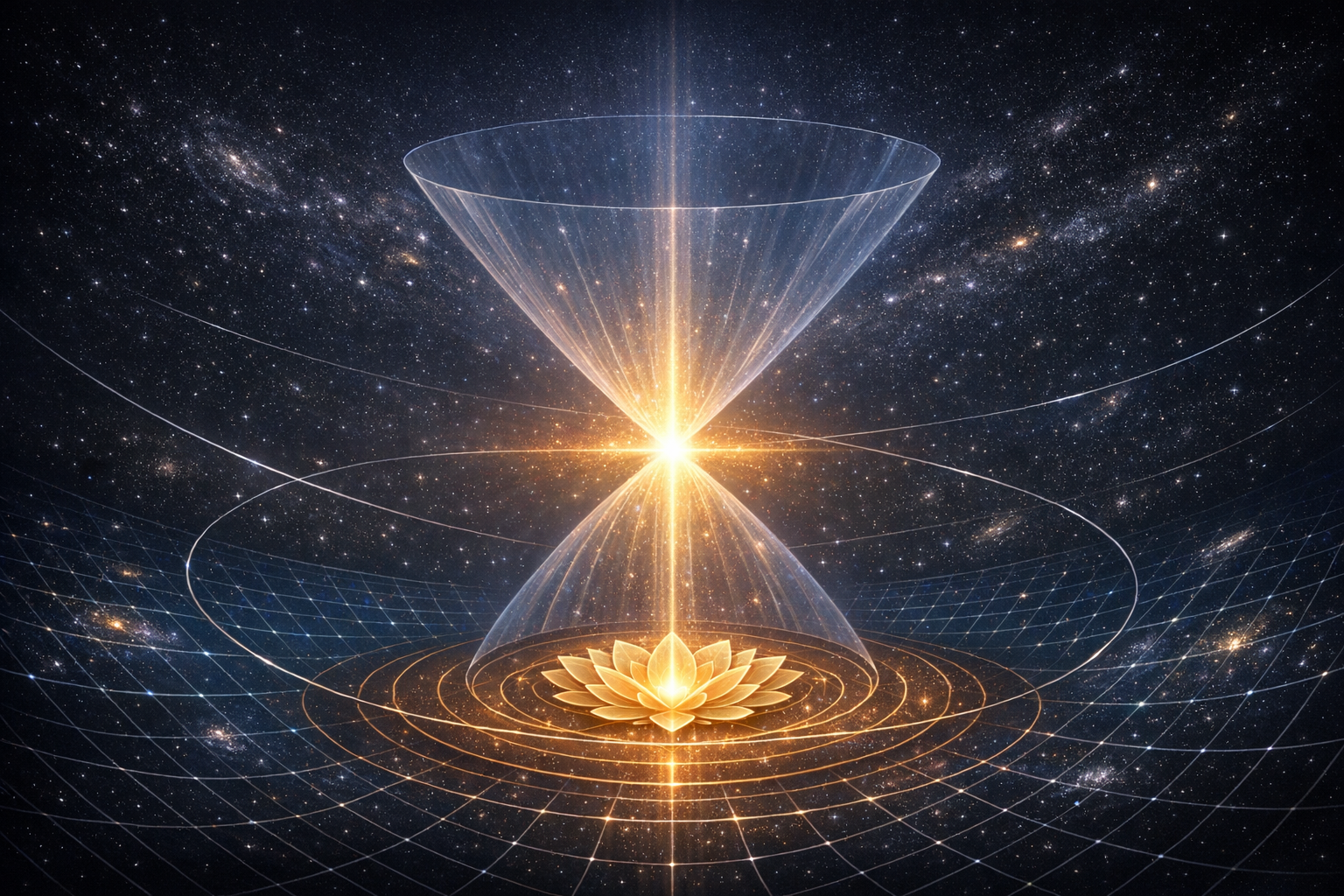
A helpful reconciliation therefore uses a two-tier model. On the empirical or relational tier (paralleled by physics), space “evolves” because the metric evolves, and time “varies” because rates and intervals are observer- and gravity-dependent. On the ultimate or contemplative tier (paralleled by dharmic metaphysics), the ground is timeless (Akaal; nitya ātman; the emptiness that resists all reification). In that sense, time can be said to be “constant” not because clocks do not dilate, but because the ultimate reality does not participate in temporal succession at all.
This framing helps decode a common teaching trope in contemporary discourseat times articulated by teachers such as Sri Sri Ravi Shankarthat there are “two types of time”: one that changes (linked to events, memory, and becoming) and one that is changeless (the ever-present nowness or the timeless witness). Read charitably and philosophically, this maps onto the empirical–ultimate distinction across dharmic traditions. It is not a claim about the physics of atomic clocks; it is a pointer to a different register of inquiryphenomenology and metaphysicswhere the criterion of “constant” is freedom from succession, not invariance of measured rates.
How does this compare, technically, with relativity? In relativity, invariance belongs to the spacetime interval and the speed of light c, not to space or time independently. Spatial distances and temporal intervals are sliced from spacetime in observer-dependent ways. Gravitational curvature couples to the stress–energy tensor, making space dynamic. Time-dilation effects, gravitational redshift, and the relativity of simultaneity mean there is no universal clock. Thus, a scientifically faithful summary is: spacetime is dynamic; time measurements are relational; and space is not constant.
Conversely, in contemplative practice and philosophical analysis, the accent falls on the stability of the witnessing ground. A practitioner in dhyāna may observe that the felt fieldsometimes described as citta-ākāśa or cid-ākāśaseems to widen or contract with fluctuations in attention and affect. In that experiential register, “space” is indeed plastic; meanwhile, the luminous awareness that knows these changes is experienced as unchanging. This is a statement about phenomenology and soteriology, not cosmological tensors.
Several common confusions can now be cleared. First, “science says time changes and space is constant” is inaccurate for modern physics; both are folded into a dynamic spacetime. Second, “ancient texts say time is constant and space changes” risks oversimplification; different schools offer sophisticated and sometimes divergent accounts. The shared throughline is a two-level vision: empirical change within a deeper, changeless ground. Recognizing the level at which a statement is made prevents category mistakes.
A cross-dharmic synthesis highlights this unity-in-diversity. Vedānta’s nitya Brahman, Buddhism’s insight into emptiness beyond reification, Jainism’s eternal dravyas with changing paryāyas, and Sikhism’s Akaal converge on a vision where the ultimate is not subject to temporal succession. Simultaneously, all acknowledge patterned changecyclical, momentary, or modalwithin the manifest domain. These are not contradictions but complementary modes of understanding reality.
Practically, this synthesis can guide dialogue between science and spirituality. In scientific work, precise models quantify the dynamics of spacetime, from gravitational waves to cosmological expansion. In contemplative disciplines, rigorous methods cultivate direct acquaintance with the timeless ground and the malleability of the experiential field. When these registers are kept distinct yet allowed to illuminate one another, a richer and more coherent worldview emerges.
The emotional resonance of this inquiry is not merely intellectual. Many readers will recognize the lived sense that minutes can feel long in anxiety and short in joythe psychological arrow bending subjective time. Meditative composure, by contrast, often carries a taste of stillness in which thoughts, sensations, and even the felt scope of inner space arise and subside without disturbing a stable clarity. This juxtaposition directly enacts the empirical–ultimate distinction in daily life.
In conclusion, the oft-posed riddledoes science affirm changing time and constant space while ancient texts affirm constant time and changing space?dissolves under careful analysis. Physics presents a dynamic spacetime with relational time measurements; dharmic philosophies present a dynamic manifest order grounded in a timeless ultimate. Framed this way, both perspectives can be held together without confusion, advancing an integrative understanding that honors the depth of Einstein’s relativity and the subtlety of ancient dharmic wisdom.
The result is an invitation to unity across Hindu, Buddhist, Jain, and Sikh traditions: a shared recognition that ultimate reality is beyond temporal succession, alongside a respect for the many ways change is patterned and known. Rather than opposing science and scripture, or one dharmic school to another, this approach aligns them in a single, coherent arcfrom dynamic spacetime to timeless groundsupporting both rigorous inquiry and contemplative realization.
Inspired by this post on Hindu Pad.