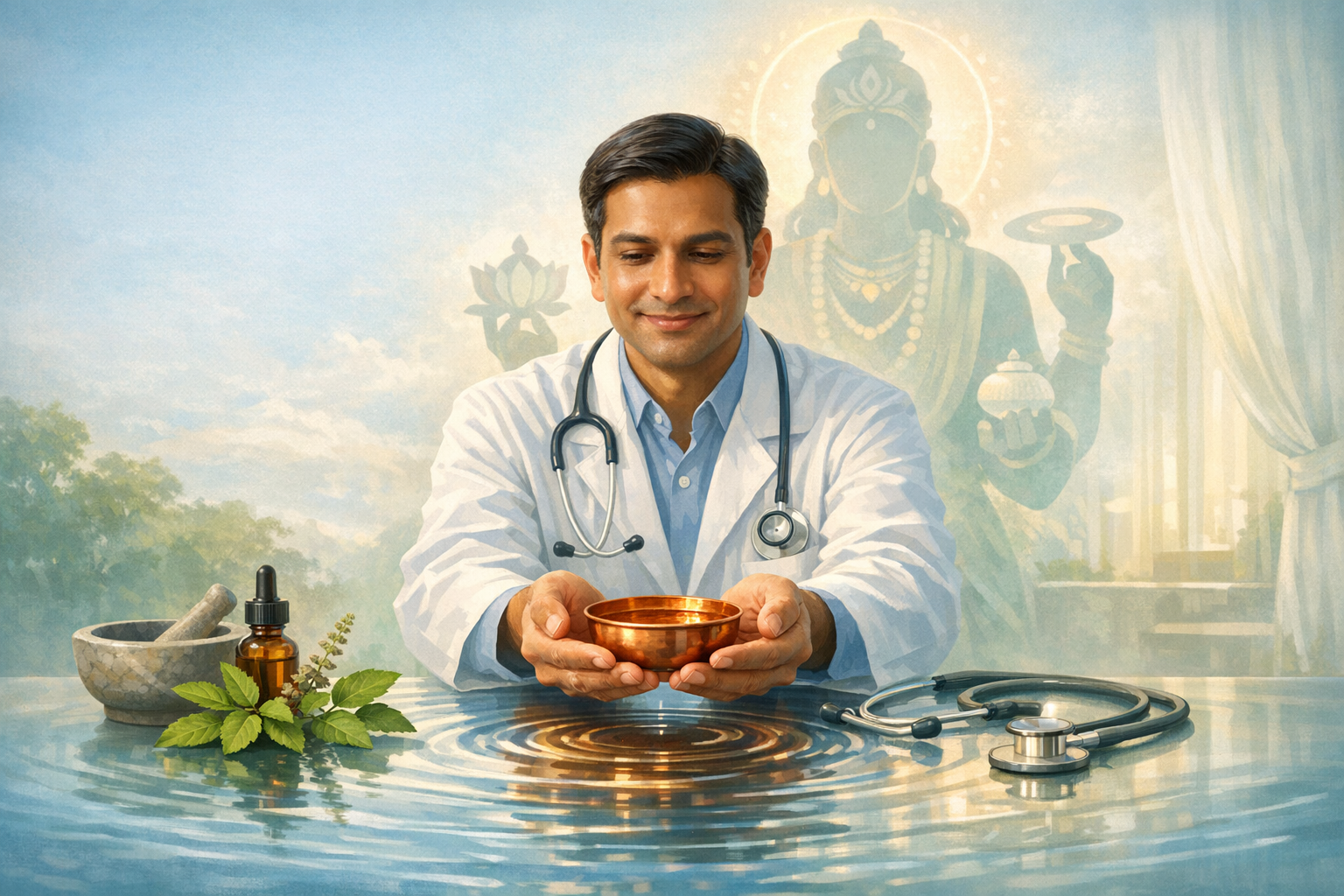
The Sanskrit invocation ‘Aushadhi Jahnavi Toyam Vaidyo Narayano Harihi’ is widely recited in Hindu households and traditional clinics before taking medicine or beginning a course of treatment. It frames healing as both a scientific and sacred undertaking: the medicine is to be received with the purity attributed to Ganga’s waters, and the physician is to be approached as an embodiment of Narayana (Hari).
Linguistically, aushadhi denotes medicine or therapeutic substance; jahnavi is the Ganga; toyam means water; vaidya is the physician; Narayana and Hari are names of Vishnu. The expression functions as a devotional equivalence rather than a literal identity, urging that aushadhi be honored like jahnavi-toyam (Ganga water) and that the healing role of the vaidya be revered as Vaidyo Narayano Harihi. In simple terms: receive medicine as something sacred, and see the healer as a channel of the Divine.
Philosophically, the equation of the healer with Narayana rests on a core Vedantic insight: the Divine pervades all beings and all functions that uphold life. Classical texts affirm that the same Consciousness operates through diverse instruments; when the function is lokasangraha (the welfare and protection of the world), it merits the highest reverence. Within this framework, the physician is not worshiped as a personal deity but recognized as a transparent channel through which Narayana’s preserving compassion reaches patients.
Classical Ayurveda reinforces this vision through the chikitsa chatushpada, the four pillars of therapybhishak (physician), dravya (medicine), upasthata (nurse/attendant), and rogi (patient). Texts such as the Charaka Samhita and the Sushruta Samhita insist that success in treatment depends on the excellence and harmonization of all four. The divinization of the healer aligns with the traditional veneration of Dhanvantari, the physician aspect of Vishnu, symbolizing the unity of medical knowledge, clinical skill, and compassionate intent.
Ritually, treating aushadhi as jahnavi-toyam sacralizes the act of ingestion, much as prasad is received with gratitude and mindfulness. This brief pause cultivates shraddha (trust) and sattva (clarity of mind), which Ayurveda regards as clinically meaningful because mind, prana, and body are interlinked. The intention (sankalpa) carried into therapy influences adherence, lifestyle discipline, and the subtle psychophysiological milieu in which medicines act.
In contemporary discourse, teachers such as Sri Sri Ravishankar Guruji have emphasized that when a remedy is taken, it should be considered sacred and the physician seen as an instrument of Narayana. This guidance does not replace diagnosis or dosage; it dignifies them, displacing fear and resistance with receptivity and gratitude. Such an attitude supports the therapeutic alliance and honors the ethical labor of caregivers.
Modern research on expectancy effects and psychoneuroimmunology offers a complementary rationale for this ancient practice. Trust in the physician and positive meaning ascribed to treatment correlate with better adherence, reduced stress reactivity, and improved patient-reported outcomes. Simple contemplative gesturesslowing the breath, silently recalling Vaidyo Narayano Harihican engage parasympathetic tone, potentially easing pain perception and anxiety while one follows evidence-based care.
The mantra also encodes an ethical charter for the healer. When the role of the vaidya is consciously related to Narayana, the profession is framed as seva (selfless service) governed by daya (compassion), ahimsa (non-harm), and integrity. Classical Ayurvedic treatises describe the ideal bhishak as learned, experienced, self-controlled, and committed to the welfare of all patients without bias; reverence from patients is matched by responsibility and humility in clinicians.
Importantly, this reverence for healing is shared across dharmic traditions, sustaining a broad ethic of compassion. In Buddhism, the archetype of Bhaisajyaguru, the Medicine Buddha, sanctifies the physician’s work and the medicines themselves; mettā (loving-kindness) and upāya (skillful means) guide caregivers in relieving suffering. Jain teachings uphold aushadha-dāna (the gift of medicine) and ahimsa, encouraging care that preserves life with minimal harm. In Sikhism, the spirit of seva and the aspiration Sarbat da bhala (the welfare of all) animate medical service; the example of Bhai Kanhaiya, who tended even the wounded enemy, mirrors the vision of seeing the Divine in all. Thus, honoring the doctor as Narayana harmonizes with a pan-dharmic ethos that venerates healers and healing.
In lived practice, many households pause before the first dose of a prescription, quietly reciting Aushadhi Jahnavi Toyam Vaidyo Narayano Harihi and receiving the medicine with the same inward courtesy shown to prasad. Parents find that this brief moment of sanctification helps children accept a bitter syrup; elders report that it steadies the mind before injections or procedures. The ritual is simple: cleanliness, a calm breath, remembrance of the line, and then precise adherence to the physician’s instructions.
This sacral approach complements, rather than substitutes for, rigorous medical judgment. The invocation does not license credulity toward unqualified practitioners or untested remedies; classical texts themselves warn against the harm caused by incompetence. The most faithful rendering of Vaidyo Narayano Harihi today is the integration of ethical, compassionate bedside care with validated therapieswhether from Ayurveda, modern biomedicine, or responsible integrative approacheschosen prudently for the specific condition.
Ultimately, the mantra answers the original questionwhy the doctor should be seen as a form of Lord Narayanaby reuniting science and spirituality in the service of healing. Medicine becomes as pure as the waters of the Ganga when received with gratitude and used with discernment; the physician becomes a face of Narayana when knowledge, skill, and compassion converge as selfless service. In honoring both, society strengthens a culture of trust, responsibility, and shared dharma that benefits all.
Inspired by this post on Hindu Pad.