What defines a true spiritual guide within the Guru-Shishya Tradition of Sanatana Dharma? Classical sources converge on two enduring qualifications: “srotriyam”—one who has heard and assimilated wisdom through an authentic parampara (disciplic succession)—and “brahma-nistham”—one who is firmly fixed in service to the Supreme Truth. This dual criterion, articulated in the Upanishads and echoed by modern acharyas, establishes a clear, time-tested standard for spiritual authority. It emphasizes fidelity to lineage and realized practice over academic credentialism, thereby safeguarding Vedic wisdom from idiosyncratic reinterpretation.
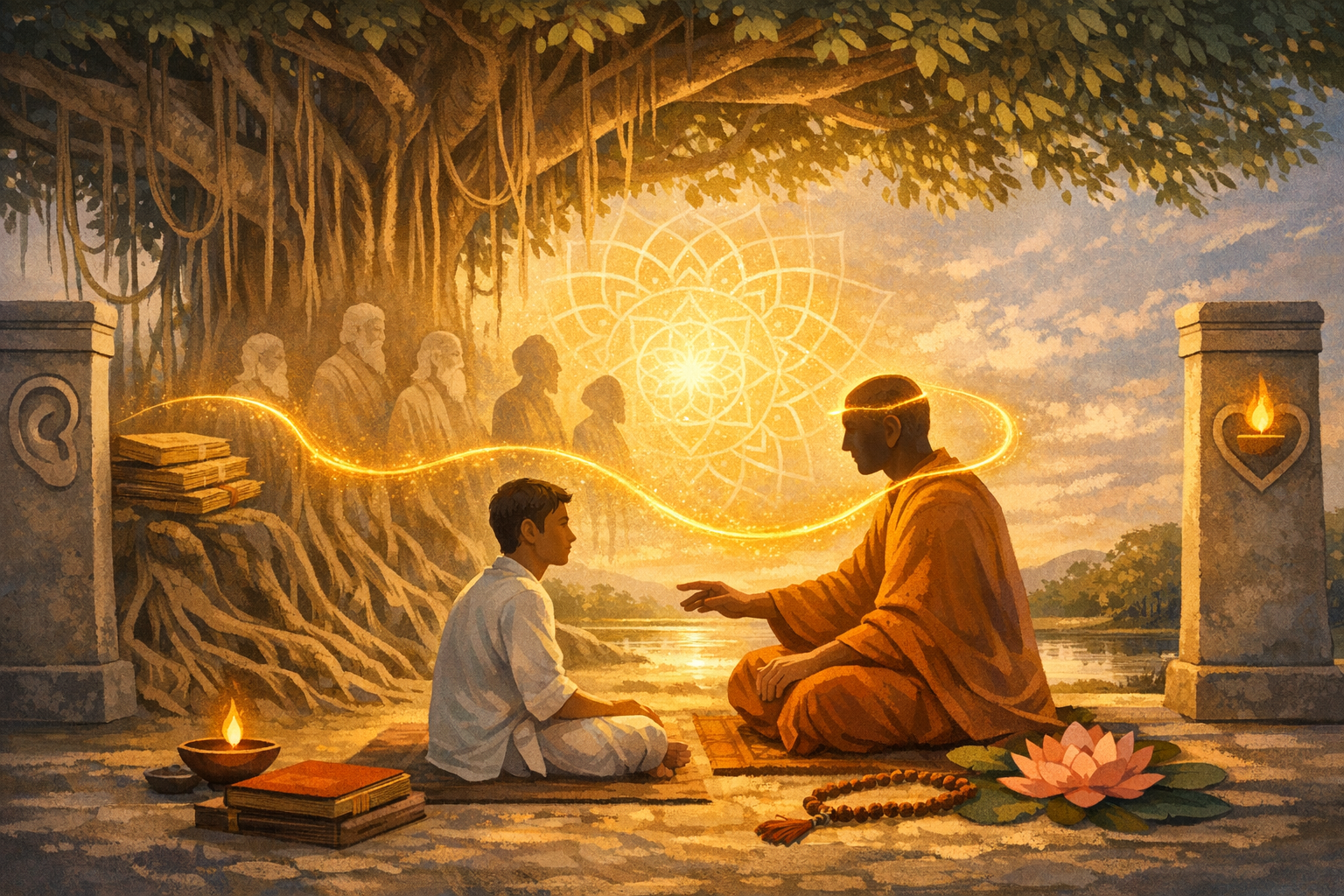
Parampara ensures continuity, coherence, and accountability. In the Bhagavad Gita (4.2), the transmission of yoga is described as a living chain sustained by realized teachers. By receiving knowledge through parampara, a teacher draws on a rigorous interpretive ecology—scripture (shruti and smriti), exemplars (sadhu), and sound reasoning—rather than solitary speculation. This shared framework allows seekers to access standard transcendental knowledge validated across generations, communities, and lived practice.
The first mark, “srotriyam,” literally denotes one who has properly heard. In practice, it means immersion in scripture under the guidance of a realized mentor, internalizing the meaning (tattva) rather than merely the words. A srotriya teacher aligns instruction with the Upanishads, the Bhagavad Gita, and allied darshanas of Hindu philosophy, while maintaining continuity with those who taught before. Such a guide can illuminate core teachings in language accessible to contemporary seekers without severing interpretive roots, thus preserving both authenticity and relevance.
The second qualification, “brahma-nistham,” points to unwavering dedication to the Supreme Reality—variously approached in Hindu traditions as Brahman or Ishvara—and expressed through steadfast sadhana and compassionate service (seva). The Gita’s portrait of steadiness—inner equanimity, humility, freedom from greed, non-enviousness, and loving-kindness (e.g., 2.55–72; 12.13–20)—maps the lived texture of brahma-nistham. A teacher established in this state does not merely describe transcendence; life and counsel consistently embody it. The result is guidance that is both doctrinally sound and existentially transformative.
Academic degrees, while valuable in their sphere, are not prerequisites for genuine spiritual authority. Traditional parampara has produced philosopher-sages of immense intellectual attainment, yet the norm it upholds is subtler: hearing from authority and living the teaching. Scholarship can illuminate; only realization stabilizes. Thus, the qualifications of a bona fide guru do not hinge on titles but on lineage-grounded comprehension and unbroken dedication to Truth.
In lived encounter, authentic teachers tend to evoke clarity rather than dependence, conscientious inquiry rather than credulity, and courage rather than fear. Seekers frequently report a felt sense of calm and moral orientation after such meetings, alongside practical encouragement toward japa, meditation, study of the Upanishads and the Bhagavad Gita, ethical observances, and selfless service. Over time, meaningful shifts—greater self-mastery, compassion, and purpose—become reliable indicators that the transmission is genuine.
The Bhagavad Gita (4.34) offers a method for approaching guidance that balances reverence with reason: draw near with humility, ask discerning questions, and engage in service. This triad counteracts two common pitfalls—blind acceptance and cynical dismissal. Humility opens the heart; inquiry clarifies doctrine; service tests teaching in action. When these interact, seekers can evaluate whether a teacher is truly “srotriyam” and “brahma-nistham” without veering into either naïveté or suspicion.
Resonances with this standard appear across the wider dharmic family, strengthening inter-traditional unity. In Buddhism, lineage (especially in Vajrayana) assures continuity of method and realization under a qualified lama, safeguarding transmission through compassionate discipline. In Jainism, acharyas maintain scriptural fidelity and rigorous conduct, exemplifying the path through vows and non-violence. In Sikhism, the line of Gurus culminates in the Guru Granth Sahib as the living Shabad Guru, with the community (Panth) embodying disciplined practice. Across these traditions, authentic guidance rests on verified transmission and ethical steadfastness, reinforcing a shared civilizational commitment to Truth and compassion.
For practical discernment, several converging signs help identify a true guru without reducing spirituality to checklists. Lineage can be traced and peers corroborate character; counsel aligns with scripture and the spirit of ahimsa, satya, and self-restraint; personal practice is steady and transparent rather than performative; instruction benefits seekers beyond mere inspiration—fostering discipline, clarity, and service; and relationships remain non-exploitative, with emphasis on inner growth over cults of personality. These signs, taken together, operationalize the Upanishadic criteria in contemporary life.
In a digital age saturated with information, parampara functions like a living peer-review system for spiritual claims. It integrates scriptural hermeneutics, realized testimony, and communal accountability—protecting seekers from transient trends and promising methods unmoored from tradition. When paired with “brahma-nistham,” it ensures that teachings do not become abstracted from the ethical and devotional center that gives them life.
Holding these two pillars—”srotriyam” and “brahma-nistham”—keeps the path both intelligible and humane. The guru’s task is not to dazzle but to deliver: to transmit Vedic wisdom faithfully, to anchor seekers in practice, and to orient them toward the liberating service of the Highest. When guidance is lineage-grounded and realization-steady, spiritual progress becomes safer, more integrated, and naturally aligned with the plural, inclusive ethos of Sanatana Dharma and its sister traditions.
Ultimately, the measure of a true guru is transformative fruit: clearer understanding of foundational texts like the Upanishads and the Bhagavad Gita; steadier character shaped by dharmic virtues; and a deepening impulse to serve, love, and realize the Supreme Truth. Such guidance unifies rather than divides, honors diversity of paths within the dharmic family, and restores the seeker to the timeless current of wisdom that has flowed—unbroken—through parampara.
Inspired by this post on Dandavats.