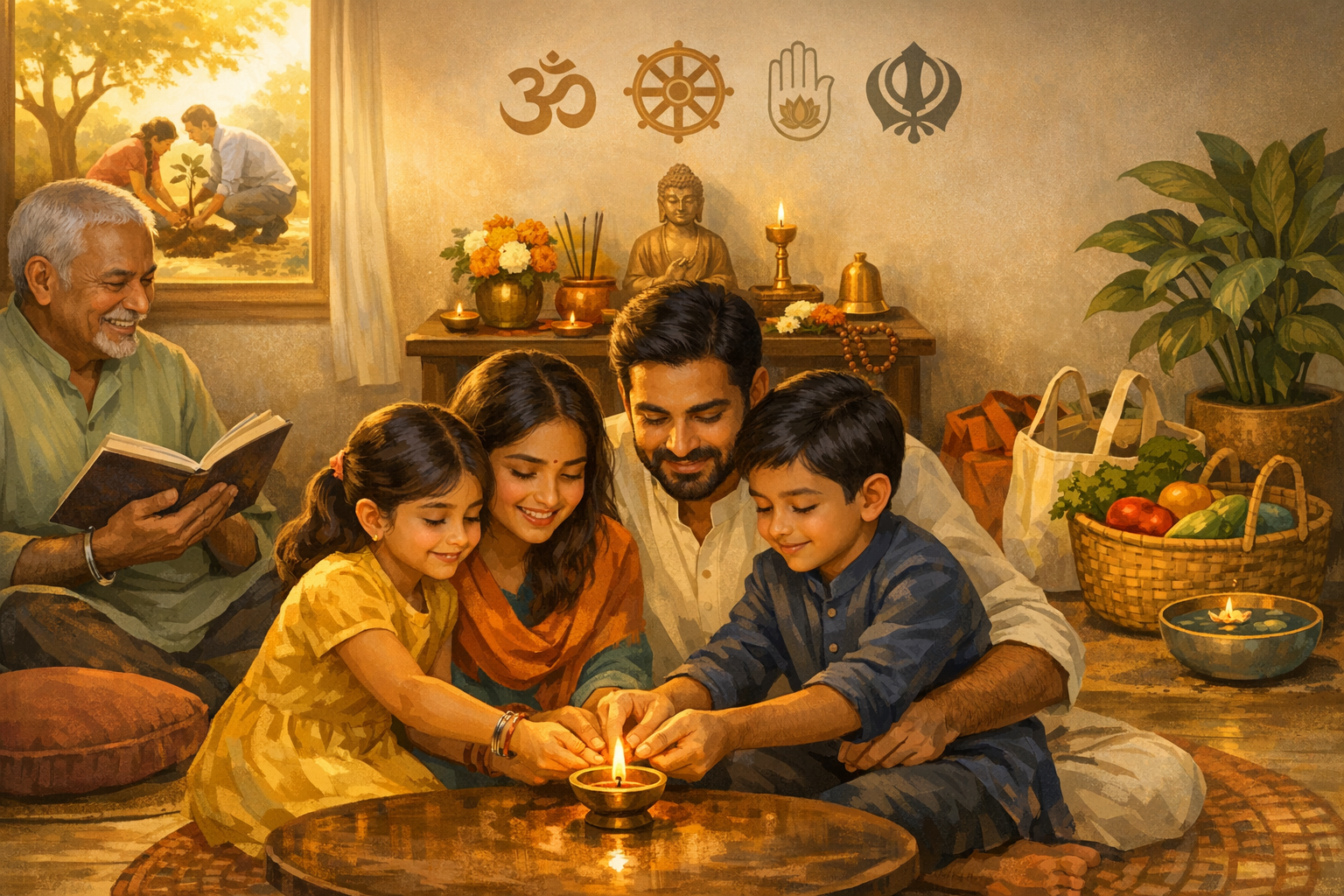
Parenting can be understood as seva and a core expression of dharma within the household, where love, guidance, and responsibility become a continuous offering to the Divine. Across the dharmic traditions of Hinduism, Buddhism, Jainism, and Sikhism, family life is a sacred arena for cultivating inner virtues, transmitting wisdom, and embodying spirituality through action. When approached in this spirit, parenting transforms from a set of tasks into a daily sadhana that nourishes both caregivers and children, aligning home life with spiritual purpose.
Developmental research consistently affirms what traditional wisdom long emphasized: children internalize what they observe. Put simply, “children learn what they live.” Social learning theory shows that role modeling is more formative than instruction alone; therefore, alignment between speech and conduct is critical. When parents and elders express compassion, integrity, restraint, and gratitude in real situations—at mealtimes, during conflicts, and in community interactions—children acquire a living template for ethical and spiritual decision-making.
God-conscious parenting is inclusive and ecumenical in a dharmic sense, affirming unity in diversity across traditions. In the Hindu way of life, grihastha-dharma honors the household as a vital stage for service and growth; in Buddhism, the family can become a training ground for mindfulness and right conduct; in Jainism, the anuvratas encourage gentle living (ahimsa) and self-mastery; in Sikhism, simran and seva integrate devotion and public service. These streams converge on a shared insight: ordinary family rhythms are extraordinary opportunities to cultivate awareness, compassion, and responsibility.
Daily practices at home anchor this vision. Short periods of prayer, mindfulness, or mantra recitation; reading or singing sacred poetry; lighting a lamp or expressing gratitude before meals; and sharing end-of-day reflections create a calm, value-rich atmosphere. Whether through puja, simran, pratikraman, or Dhamma reflection, these small but consistent acts help children link inner states with outward choices, making spirituality tangible rather than abstract.
Life-cycle rites and Samskaras, family observances, and community ceremonies provide structure and continuity. Naming rituals, first-learning milestones, coming-of-age observances, and service-focused celebrations weave culture, memory, and meaning into a child’s identity. When such milestones are coupled with age-appropriate explanations—why truthfulness matters, why non-harm guides dietary or lifestyle choices, why generosity is practiced—children understand that rituals are vehicles of value formation, not mere performances.
Core virtues translate into concrete habits. Ahimsa informs how a family speaks, eats, and resolves disputes; satya guides truth-telling even when inconvenient; aparigraha encourages mindful consumption; and seva becomes a standing family commitment to help neighbors, elders, and the environment. In practice, this may look like mindful media choices, honest conversations about mistakes, volunteering together, and careful stewardship of household resources—each reinforcing the Family Values that anchor a resilient Hindu family system while remaining resonant with the broader dharmic ethos.
Stories and songs embody ideals in accessible form. Narratives from the Ramayana, Mahabharata, Jataka tales, Jain parables, and Sikh Janam Sakhis place courage, humility, duty, friendship, and compassion in relatable contexts. When families discuss characters’ decisions, consequences, and shades of moral complexity, children become skilled at ethical reasoning rather than blind conformity. This dialogic approach strengthens a child’s inner compass and prepares them for a plural, interconnected world.
Communities are indispensable. Satsang, sangha, and sangat—alongside interfamily friendship circles—offer mentoring, accountability, and shared celebration. Truly, “It takes a village to raise a child.” In practical terms, this means seeking out other families committed to raising God-conscious children, coordinating study circles and service projects, and building supportive networks that normalize virtue and belonging over competition and status.
Intergenerational bonds amplify this learning. Grandparents and elders transmit lived history, language, and devotional mood; children offer curiosity and renewal; parents integrate both into contemporary routines. The traditional Hindu family system often excels at this exchange, but even nuclear families can foster intergenerational contact through regular calls, shared festivals, and visits, preserving continuity while adapting to modern life.
Predictable routines and responsive caregiving make spiritual ideals emotionally safe and neurologically plausible for children. Research on attachment and co-regulation shows that calm, attuned adults help stabilize a child’s nervous system, enabling attention, empathy, and self-control—the very capacities that spiritual practices seek to refine. Simple choices—unhurried mornings, technology-free meals, consistent bedtimes, and gentle transitions—create the conditions in which contemplative habits can flourish.
Digital life warrants intentionality. Role modeling healthy technology use—deliberate screen time, device-free sacred spaces, and mindful content—teaches discernment rather than fear. Family agreements that tie media privileges to responsibilities, kindness, and truthfulness align freedom with dharma, showing that autonomy and accountability can mature together.
Seva integrates inner devotion with outer responsibility. Families can adopt a local environmental area, visit elders, participate in community kitchens, support education drives, or coordinate interfaith service initiatives. Children who serve alongside adults witness that spirituality is not confined to prayer rooms or festival days; it is a commitment to the welfare of all beings and the shared world.
Pluralism within and across traditions should be embraced openly. Children naturally encounter diverse practices and beliefs; guiding them to appreciate Ishta—personal devotional preferences—alongside respect for other paths cultivates confidence without superiority. This spirit of harmony aligns with the blog’s objective to strengthen unity among Hinduism, Buddhism, Jainism, and Sikhism, celebrating shared values while honoring distinctive practices.
Because spiritual growth is subtle, families can observe practical indicators rather than attempt premature measurement. Look for increased patience with siblings, honesty after a mistake, spontaneous gratitude, willingness to help without prompting, and the capacity to repair after conflict. These small signs, noticed over time, reveal that teachings are taking root.
Common pitfalls can be avoided. Moralizing without modeling breeds cynicism; excessive rule-setting without warmth erodes trust; shaming confuses conscience with fear; and performative piety disconnects ritual from meaning. A steady balance—clear expectations delivered with compassion, consistent boundaries held with humility—keeps the household aligned with dharma while respecting each child’s temperament.
A practical blueprint helps integrate ideals into daily life. Begin with a five-minute morning practice (prayer, mindfulness, or mantra), a single family mealtime with gratitude, and a brief evening reflection on one virtue. Add weekly story-dialogue, monthly seva, and regular gatherings with like-minded families. Over time, introduce age-appropriate participation in Samskaras or community observances, ensuring that each step is understood, not merely performed.
Households vary, and principles can be adapted. Single-parent families, multi-generational homes, adoptive and blended families, and diaspora communities each carry unique strengths. What matters is coherence: a realistic routine, a supportive village, and a consistent alignment of words and deeds. Even modest practices, sustained with sincerity, can nurture God-consciousness powerfully.
In sum, parenting as service to God is a dignified, hope-filled vocation. Through role modeling, shared practices, ethical storytelling, intergenerational bonds, and community support, families can raise children who are grounded, compassionate, and spiritually aware. As homes become places where devotion, wisdom, and responsibility are lived each day, communities flourish and the broader dharmic tapestry is strengthened—one household at a time.
Inspired by this post on Dandavats.