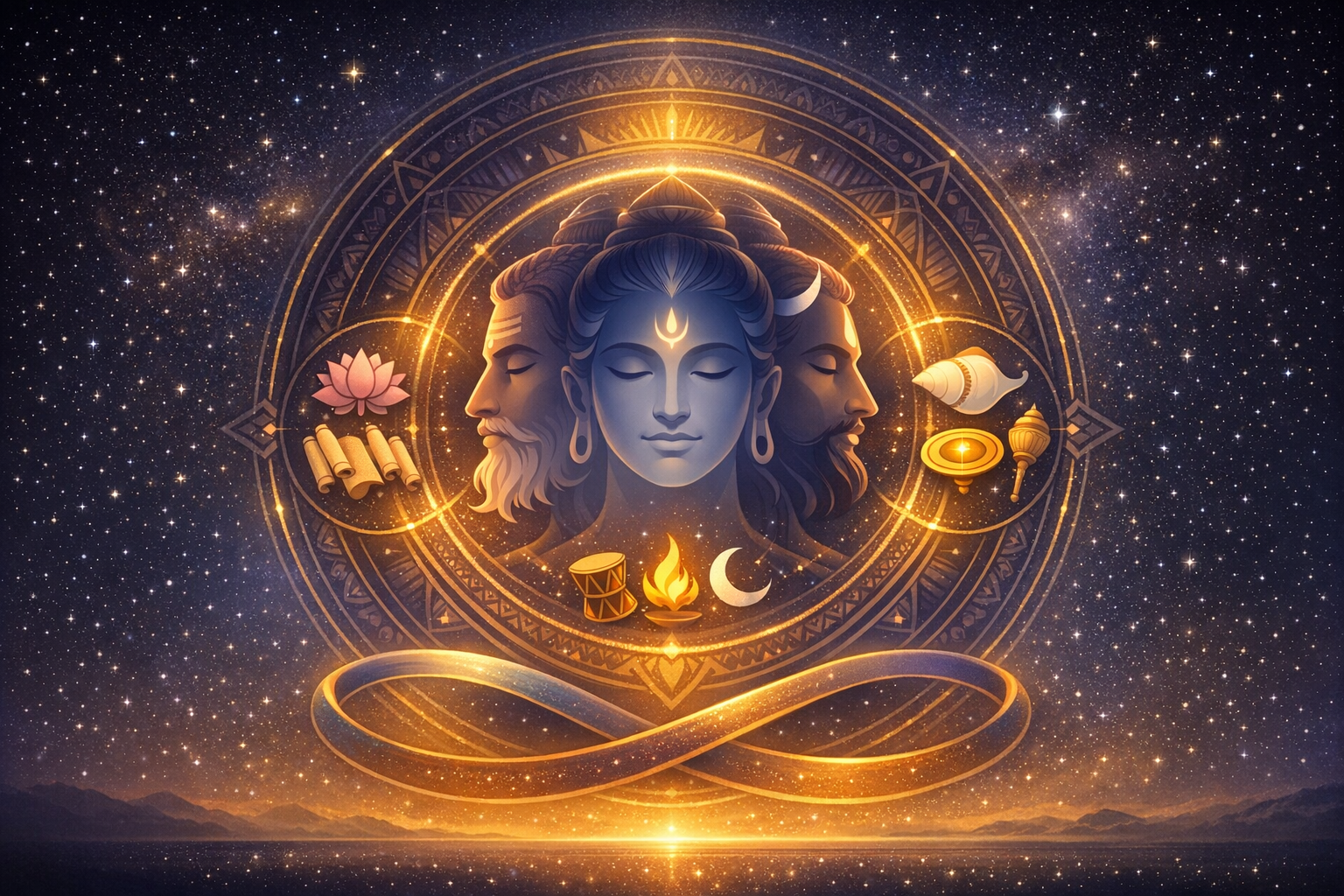
Hinduism frames a profound insight at the outset: the Supreme Reality, Brahman, is formless (nirākāra), infinite (ananta), unborn (aja), and beyond time (kāla). Yet the tradition acknowledges the human need for symbols to approach the immeasurable. In this pedagogical spirit, the TrimurtiBrahmā, Viṣṇu, and Śivaexpresses one consciousness performing three cosmic functions: creation (sṛṣṭi), preservation (sthiti), and dissolution (saṁhāra). This is not a doctrine of three competing deities, but a contemplative map for perceiving unity in apparent plurality.
Scriptural hermeneutics clarifies the relationship between the formless and the formed. The Upaniṣads describe Brahman in apophatic terms“neti, neti” (not this, not this)and yet affirm immanence with “sarvam khalvidam brahma” (all this is verily Brahman). The Ṛgveda offers a timeless axiom for plurality within unity: “Ekam sat vipra bahudha vadanti” (Truth is one; sages speak of it in many ways). The Trimurti arises within this interpretive field as a didactic lens, presenting one Supreme Consciousness (Brahman/Īśvara) as the source and sovereign of all processes in time.
In classical Vedānta, a helpful distinction is made between nirguṇa Brahman (without attributes) and saguṇa Brahman (with attributes). The first points to the absolute, non-conceptual ground of being; the second refers to the same Reality apprehended by the mind for the sake of devotion and practice. The Trimurti belongs to the realm of saguṇa contemplation, where the infinite relates compassionately to finite understanding without compromising transcendence.
Philosophically, the three functions are often correlated with the guṇasrajas (activity), sattva (equilibrium), and tamas (dissolution/ground). Brahmā embodies the creative dynamism of rajas, Viṣṇu the conserving lucidity of sattva, and Śiva the transformative release of tamas. These are not moral rankings but descriptive modalities. Each guṇa is necessary for cosmic balance, just as all three functions are essential to the integrity of one life and one universe.
This triadic insight is also microcosmic. In individual experience, moments of inspiration and emergence reflect Brahmā; periods of stability, care, and continuity echo Viṣṇu; and acts of letting go, transformation, and renewal mirror Śiva. Sincere practice (sādhana) integrates these cyclescreating, sustaining, and releasingas a single flow guided by dharma.
Time (kāla) is pivotal to the Trimurti. Hindu cosmology speaks in cycles rather than a single linear arc, situating the three functions within repeating rhythms. A mahāyuga comprises four yugas totaling 4.32 million years; seventy-one mahāyugas constitute a manvantara; fourteen manvantaras, plus transitional intervals, form one kalpa“a day of Brahmā”of 4.32 billion years. A night of Brahmā equals the day in duration, and 360 such day-night cycles make a year of Brahmā. One hundred divine years comprise Brahmā’s lifespanapproximately 311.04 trillion human yearsan image conveying the scale of cosmic time.
These numbers are not only quantitative claims; they serve a contemplative function. Cyclical time situates creation, preservation, and dissolution as ever-present. Nothing is “lost” in dissolution; rather, it is reabsorbed into a deeper equilibrium from which creation can arise anew. The Trimurti therefore narrates a universe that is processual, rhythmic, and compassionate in its order.
Iconography encodes this metaphysics. Śiva as Naṭarāja dances within a circle of fire (prabhāmaṇḍala), symbolizing the cycles of manifestation and withdrawal. The drum (ḍamaru) marks creation, the fire (agni) releases forms, the raised hand assures fearlessness (abhaya), and the foot subdues apasmāra (ignorance), inviting liberation (mokṣa) within time. As Mahākāla, Śiva is not bound by time but grounds it.
Viṣṇu’s iconography emphasizes cosmic order. The conch (śaṅkha) vibrates primordial sound; the discus (sudarśana cakra) turns as time’s wheel (kālacakra), cutting through chaos; the lotus (padma) signifies purity within becoming; and the mace (gadā) represents ethical strength. Viṣṇu reclining on Ananta (the endless serpent) with a lotus blooming from the navel (Padmanābha) depicts the effortless emergence of worlds from the ground of stillness.
Brahmā’s four faces are aligned with the four Vedas, pointing to creative intelligence that articulates order through sacred sound (śabda). As a cosmic principle, Brahmā is not a competing sovereign but the creative facet of one sovereignty. The relative rarity of Brahmā’s popular worship in later tradition signals no diminishment of role; it reflects the devotional turn toward preservation and liberation as existential aspirations.
Art history testifies to the integrative vision. The monumental image at the Elephanta Caves is often called a “Trimurti,” though scholars commonly read it as Sadāśiva with three aspects. Either way, the sculpture teaches a single, serene center holding manifold expressionsa visual metaphysics of unity in diversity that resonates with Vedic and Purāṇic theology.
Across schools of Vedānta, interpretations converge on unity while retaining distinctive insights. Advaita Vedānta reads the Trimurti as pedagogical appearances of nondual Brahman, aimed at guiding the aspirant from saguṇa devotion to nirguṇa realization. Viśiṣṭādvaita sees one infinite Brahman (Nārāyaṇa/Viṣṇu) with auspicious attributes whose will enacts creation, preservation, and dissolution. Dvaita affirms a real distinction between God and souls while recognizing divine governance of all processes. Acintyabhedābheda synthesizes simultaneous oneness and difference beyond conceptual capture. Despite doctrinal nuances, all recognize a unifying sovereignty underlying the triadic play.
Within Purāṇic and sectarian currentsVaiṣṇava, Śaiva, Śākta, and Smārtathe emphasis varies, yet the core pattern remains: one Reality, many manifestations, coordinated functions. Smārta traditions explicitly ritualize this by venerating multiple deities as facets of Brahman, cultivating a practical pluralism grounded in metaphysical unity.
Hermeneutically, these teachings invite more than literalism. Purāṇas deploy narrative, symbol, and cosmography to bridge metaphysics and devotion. Appreciating layered meaningsmythic, ethical, contemplativeprevents false dilemmas between “history” and “symbol” and keeps attention on the living question: what liberating understanding does a given image or story unlock?
Hindu epistemology (pramāṇa) also clarifies method: śruti (revelation), smṛti (tradition), yukti (reason), anubhava (direct experience), and pratyakṣa (perception) collaborate rather than compete. The Trimurti, approached through these lenses, becomes a rigorous, experiential framework for comprehending Brahman’s relation to time and change.
Practice (upāsanā) integrates philosophy with life. The Ishta–Devatā principle permits devotion to the form that speaks most deeply to one’s nature, fostering both focus and mutual respect. Bhakti (devotion), jñāna (wisdom), karma (selfless action), and rāja (meditation) yogas all converge on the same summit, each illuminating a facet of the triadic rhythm: initiating the good, sustaining the good, and releasing what hinders the good.
In daily experience, creation appears as learning new skills or envisioning fresh possibilities; preservation as nurturing relationships, institutions, and ecosystems; and dissolution as skillful renunciationclosing chapters so new ones can open without clinging. Cultivating all three with discernment (viveka) aligns personal time with cosmic time, producing clarity and compassion.
Resonances across Dharmic traditions further strengthen a vision of unity without erasing difference. Buddhism’s trikāyadharmakāya (ultimate body), sambhogakāya (bliss/vision body), and nirmāṇakāya (manifestation body)presents a threefold hermeneutic of awakened presence. While metaphysical commitments differ (for example, Buddhism’s anātman versus Vedānta’s ātman–Brahman), the structural insight that ultimate reality expresses itself across levels finds a clear echo. Jainism’s anekāntavāda (many-sidedness) offers a philosophical ethic of humility, reminding that complex truths exceed any single viewpointprecisely the posture the Trimurti cultivates. Sikhism’s “Ik Onkar” foregrounds one, formless, all-pervading Reality, grounding a life of seva (selfless service) and remembrance; this formless emphasis resonates with the Upaniṣadic intuition of nirguṇa Brahman while affirming ethical oneness in society.
These interconnections do not collapse traditions into each other; rather, they indicate a shared civilizational grammar: one truth, plural expressions; one ethical horizon, diverse disciplines. Such recognition nurtures inter-Dharmic harmony while honoring the distinctive practices that keep living lineages vibrant.
Psychologically, the Trimurti orientation toward time cultivates equanimity. Understanding that dissolution is integral to renewal helps reduce fear of change and loss. Mindfulness traditions (smṛti/sati) across the Dharmic world align with this stance, training attention to witness arising, abiding, and passing without compulsion. This is not quietism; it is a disciplined poise from which wise action (yukta karma) proceeds.
Common misunderstandings deserve correction. First, the Trimurti is not tri-theism in a competitive sense; it is a functional articulation of one Ultimate. Second, correlating deities with guṇas does not moralize the guṇas; each has a place in the cosmic economy. Third, cyclical cosmology is not fatalism; it invites ethical participation in creation, preservation, and transformation with awareness of larger rhythms.
Read in this way, the Trimurti becomes a unifying philosophy rather than a sectarian boundary: Brahmā, Viṣṇu, and Śiva are names for patterns by which the one Reality touches the world of becoming. Time itself is a sacramentan opportunity to recognize the eternal in motion and the motion within the eternal.
Ultimately, the Trimurti and the doctrine of time (kāla) invite a comprehensive spirituality: think clearly, feel deeply, act skillfully, and let go wisely. In honoring the three functions as one consciousness at work, Hinduism offers an inclusive grammar of unity in diversity that speaks not only to Hindus but to the broader Dharmic familyBuddhists, Jains, and Sikhswho likewise uphold truth, compassion, and liberation as the heart of human flourishing.
Inspired by this post on Hindu Blog.