In Śaiva theology, Dakshinamurti is the Mahaguru, the primordial teacher whose very presence discloses the nature of reality. Beyond the familiar polarity of destruction and renewal, Shiva in this form embodies the still intelligence from which the Vedas are intuited and the Upanishadic wisdom is realized. Within this luminous tradition two closely related iconographic and pedagogical idioms stand out: Vyakhyana Dakshinamurti, the mode of exposition, and Jnana Dakshinamurti, the mode of direct realization. Understanding how these forms differand why they are complementaryclarifies not only temple imagery but also the arc of sadhana from study to abiding knowledge.
The very name “Dakshinamurti” carries layered meaning. “Dakshina” points to the south, the direction of Yama and the realm of mortality, toward which Shiva uniquely faces to teach that the Self is unborn and undying. It also suggests dexterity and right-sided clarity, the unerring competence of the Guru. “Murti” signals not a limitation but a doorway: a form through which the formless intelligence communicates. As such, Dakshinamurti gathers in one image the living tradition of guru-shishya transmission revered across Hinduism and resonant with the contemplative pedagogies of Buddhism, Jainism, and Sikhism, where the teacher’s presence, scripture, and disciplined inquiry converge.
Scriptural and ritual sources for Dakshinamurti are rich. The Dakshinamurti Upanishad and verses attributed to Adi Sankaraespecially the Dakshinamurti Stotraframe the teaching as “maunavyakhya,” a paradox of silence that explains. The famous line “maunavyakhya prakatita para-brahma-tattvam” succinctly states that the highest Brahman is revealed through the Guru’s silence. Agamic manuals of Śaiva worship (such as the Kāmikāgama and Suprabhedāgama) and Śilpaśāstra texts (for example, Śilparatna and related South Indian iconographic treatises) prescribe the posture, gestures, and attributes, while allowing variations that reflect region and period.
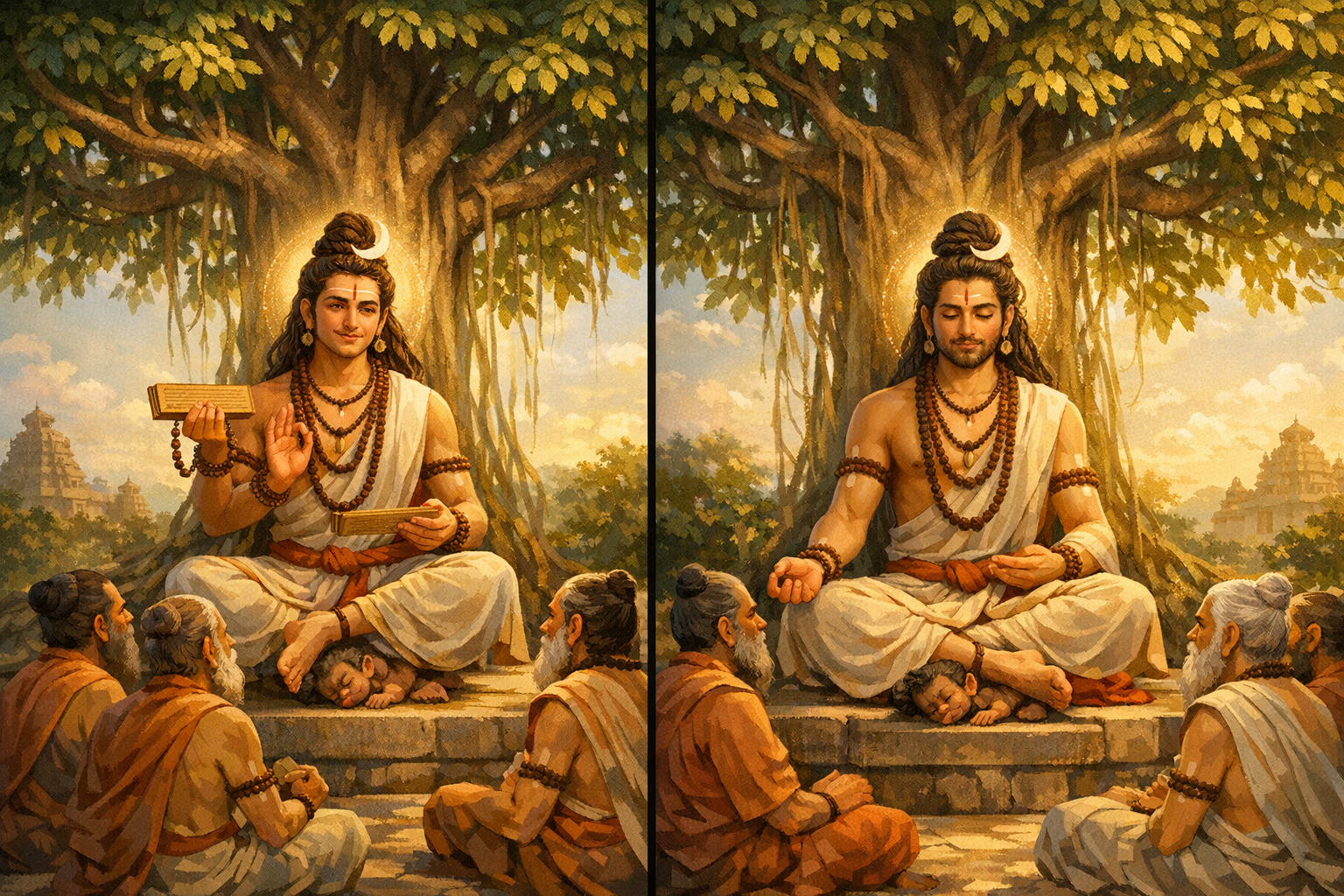
Despite subtypes, several iconographic constants define Dakshinamurti. He sits beneath the banyan (vata-vriksha), symbol of unending life and the sheltering canopy of wisdom. The youthful yet ageless Guru is seated in relaxed authoritytypically in lalitasana or padmasanahis foot subduing Apasmara, the dwarf of forgetfulness and avidya. Four sagesSanaka, Sanandana, Sanatana, and Sanatkumaraare often shown as eternal students gathered at the Teacher’s feet. Matted locks (jata-makuta), the crescent moon, and rudraksha ornaments recall the ascetic lord whose silence is fertile with meaning.
Jnana Dakshinamurti emphasizes direct, non-discursive knowledge. The most consistent marker is the chinmudra (also called jnana mudra): the lower right hand unites thumb and forefinger to signify the identity of Atman and Brahman, with the remaining three fingers suggesting the attenuated strands of individual conditioning. Upper hands often hold an akshamala (rosary, for contemplative continuity) and a pustaka (palm-leaf manuscript, the distilled wisdom of śruti), while the lower left hand may rest on the thigh in relaxed assurance or show varada, the boon-granting gesture of fearless insight. In this form, stillness is the pedagogy; the student’s “nididhyasana” (deep assimilation) ripens into recognition.
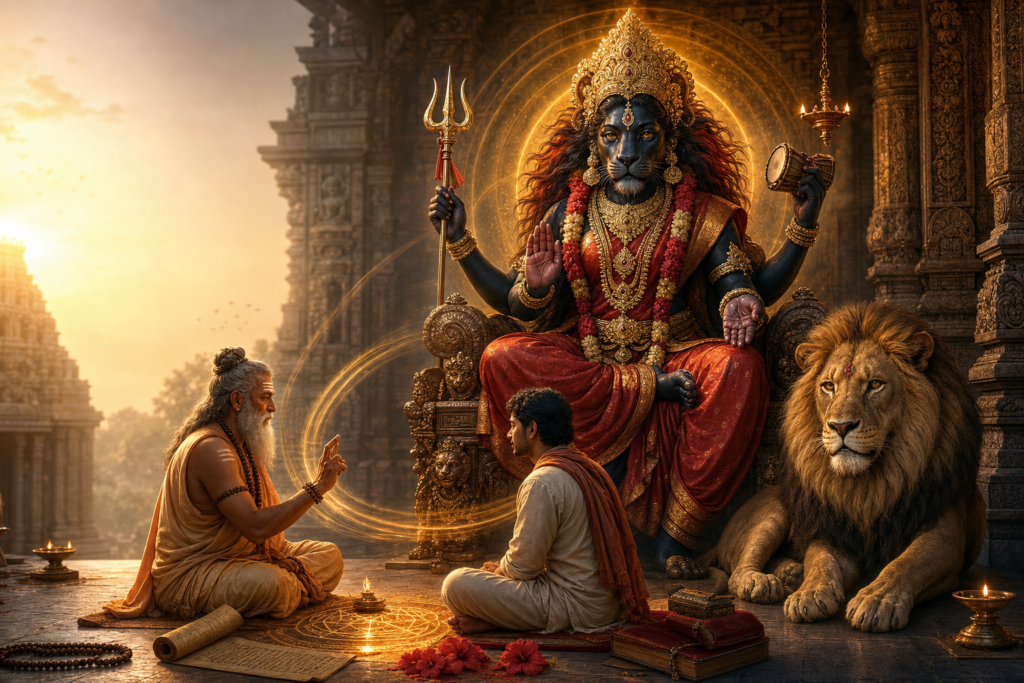
Vyakhyana Dakshinamurti highlights explanation and dialogue. Here the lower right hand commonly shows vyakhyana or vitarka mudraakin to the teaching-discourse gesturesignaling an ongoing exposition rather than completed silence. The upper hands often retain the akshamala and pustaka, but the manuscript may be more prominently displayed, and the lower left may reinforce the discourse by a complementary gesture at chest level. The body-language feels slightly more outward-facing: the Guru engages śravaṇa and manana, the listening and reflective stages in which questions are welcomed and resolved through reasoned unfolding of Vedanta.
The difference between the two mudras, though subtle, is philosophically significant. In jnana/chinmudra, the palm frequently turns inward or downward, underscoring interiorization and identity-knowledge; in vyakhyana/vitarka, the palm often turns outward at chest level, placing emphasis on communicative clarity and analytical resolution. Śilpa and Agama sources present regional and temporal variants; some Chola and Vijayanagara images, for instance, blur the boundary by combining a teaching gesture with a serene, inward gaze. In lived practice, the distinction is less about rigid iconographic policing and more about pedagogical emphasis: silent recognition versus structured exposition.
Pedagogically, Vyakhyana Dakshinamurti maps to a student’s journey through śravaṇa and mananahearing the mahavakyas, testing them by tarka (reason), and aligning insights with śruti. Jnana Dakshinamurti aligns with nididhyasana, the contemplative stabilization in which difference collapses and knowledge abides as one’s own nature. The continuum matters: rigorous exposition prevents misapprehension; contemplative silence prevents mere intellectualism. Together they safeguard the Upanishadic promise that knowledge, not ritual alone, liberates.
Ritually, both forms occupy the southern niche (dakshina) of Shaiva temples and receive comparable worship. Thursday (Guruvara) observances, recitation of the Dakshinamurti Stotra, and contemplation on the mantra of the Guru are widespread. Householders often install a contemplative image for study roomsfavoring Vyakhyana Dakshinamurti when pursuing systematic śāstra study and Jnana Dakshinamurti as a focus for meditation. In either case, devotees describe a shared experiential core: a felt quietude that sharpens attention and softens egoic reactivity, as if the presence itself were the method.
Historical images underscore these nuances. Pallava and early Chola sculptures at Kanchipuram and the south wall niches of Brihadeeswara Temple at Thanjavur present refined teaching gestures, manuscripts, and the banyan canopy. Later Vijayanagara and Nayaka depictions sometimes accentuate discursive dynamism, while Hoysala examples enrich ornament without compromising the pedagogical center. Though workshop conventions vary, the south-facing serenity, the subjugation of Apasmara, and the dialogue between silence and speech persist across centuries.
Material choices and sculptural grammar also serve the teaching. Hard granites of Tamilakam demand economy of line, which tends to emphasize mudras and gaze; soft chloritic schist in Karnataka invites intricate filigree, drawing attention to the manuscript and the sages at the feet of the Guru. In metal icons, the play of light across the akshamala and pustaka heightens thematic contrast: counting and scripture as ladders; chinmudra or vyakhyana as the summit or the ascent toward it.
The paradox of “maunavyakhya”silence that explicatesbridges both forms. In systematic study, explanation is not a detour from silence but the shaping of the mind to receive it. In consummated realization, silence is not anti-intellectual; it is what remains when every inquiry rests in its answer. Vyakhyana Dakshinamurti and Jnana Dakshinamurti therefore delineate a single, organic pedagogy: reasoned unfolding consummated in direct vision.
For contemporary practitioners, these distinctions are pragmatically helpful. When organizing a study circle on the Upanishads or Vedanta, the imagery and mantra-smarana of Vyakhyana Dakshinamurti reinforce openness to questions, careful inference, and textual fidelity. During solitary meditation, invoking Jnana Dakshinamurti or dwelling on chinmudra supports turning attention from objects to the seer. Teachers in universities and gurukulas alike attest that alternating between these emphasesdialogue and silencecultivates both clarity and depth.
Parallels across dharmic traditions deepen appreciation and unity. In Buddhist iconography, vitarka and dharmachakra mudras similarly signal discourse, while quiet sitting schools highlight wordless transmission. Jain Tirthankaras in kayotsarga teach through presence and self-mastery, and Sikh tradition venerates the Shabad Guruthe sanctified Wordas the ever-living teacher whose resonance transforms the heart. These convergences do not erase doctrinal differences; rather, they affirm a shared civilizational intuition: that wisdom blossoms in a continuum from reasoned articulation to contemplative immersion.
In sum, Vyakhyana Dakshinamurti and Jnana Dakshinamurti are not rival depictions but complementary revelations of the same Mahaguru. The former privileges articulate illuminationgrantha, gesture, and reason guiding the seeker; the latter privileges immediate recognitionmudra, stillness, and abidance sealing insight. Both stand beneath the banyan, both rest upon the quieting of Apasmara, and both beckon all who are readyfrom any dharmic pathto sit, listen, inquire, and finally see.
Inspired by this post on Hindu Blog.