
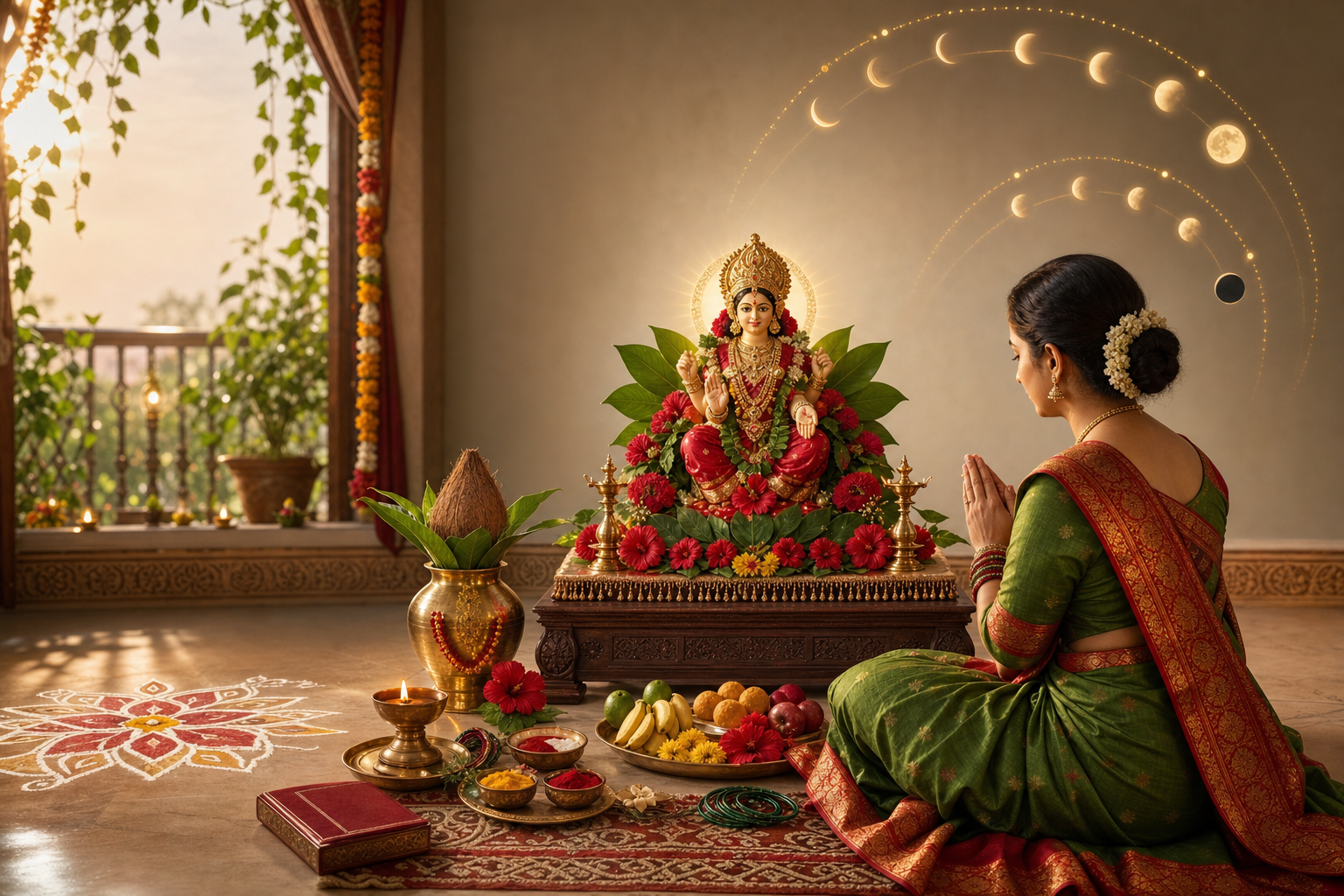
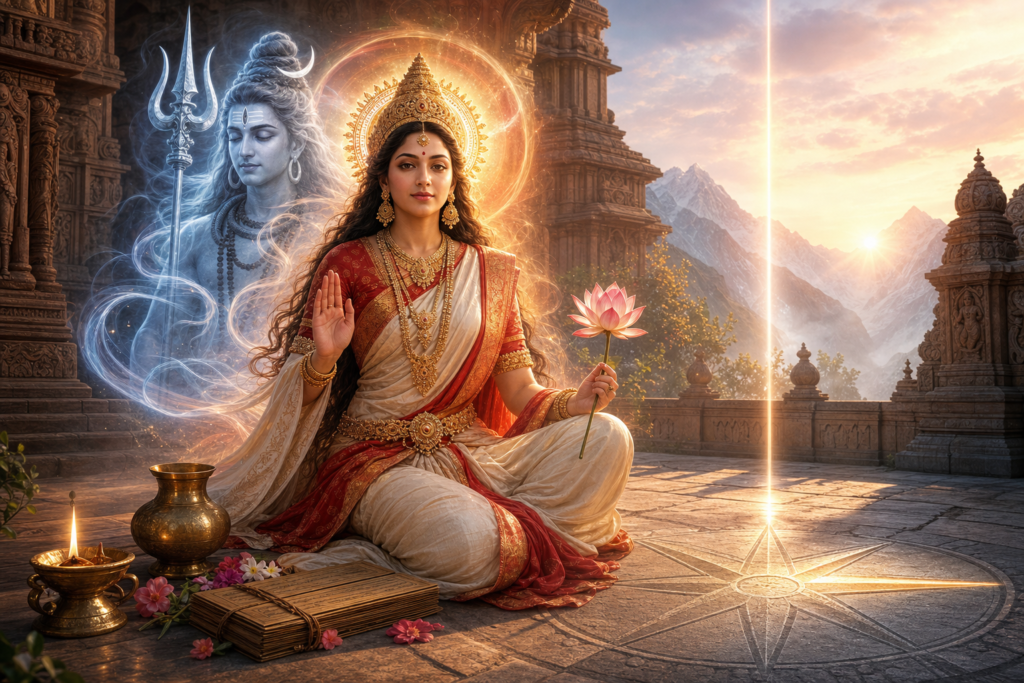
Mangala Gauri Puja 2026, also known as Mangala Gouri Puja, Mangal Gowri Vratam, Mangala Gowri Vratham and Shravan Mangalvar Vrat, is a recurring Tuesday observance dedicated to Goddess Mangala Gauri, a benevolent form of Goddess Parvati or Goddess Parvathi. The vrata is performed during the lunar month of Shravan and is especially prominent in Maharashtra, Goa, Gujarat, Karnataka, Andhra Pradesh and Telangana, although related forms are observed across northern India. Its traditional purposes include prayer for marital harmony, family well-being, longevity, prosperity and the stabilizing presence of the Sacred Feminine within household life.
The most important practical fact is that Mangala Gauri Vratham 2026 does not have one date list for every region. North Indian Purnimanta calendars identify 4, 11, 18 and 25 August as the four Shravan Tuesdays. Amanta calendars used in much of western and southern India identify 18 and 25 August, followed by 1 and 8 September. The difference is a consequence of legitimate lunar-calendar conventions, not a contradiction between traditions.
Mangala Gauri Vratham 2026 dates at a glance
Published panchanga listings for Mangala Gauri Vrat distinguish between Purnimanta and Amanta observances. The following civil dates apply to the corresponding Indian regional traditions. Devotees living outside India should still consult a panchanga calculated for their city because lunar-day boundaries and sunrise-based observance rules are location-sensitive.
Purnimanta calendar dates for northern India
First Mangala Gauri Vrat: Tuesday, 4 August 2026.
Second Mangala Gauri Vrat: Tuesday, 11 August 2026.
Third Mangala Gauri Vrat: Tuesday, 18 August 2026.
Fourth Mangala Gauri Vrat: Tuesday, 25 August 2026.
These dates are generally followed in Rajasthan, Uttar Pradesh, Madhya Pradesh, Punjab, Haryana, Himachal Pradesh, Uttarakhand, Bihar, Jharkhand and Chhattisgarh. Regional practice should nevertheless take precedence where a family, temple or sampradaya follows a different established panchanga.
Amanta calendar dates for western and southern India
First Mangala Gauri Vratham: Tuesday, 18 August 2026.
Second Mangala Gauri Vratham: Tuesday, 25 August 2026.
Third Mangala Gauri Vratham: Tuesday, 1 September 2026.
Fourth Mangala Gauri Vratham: Tuesday, 8 September 2026.
These are the principal 2026 dates in Goa and in Gujarati, Marathi, Telugu and Kannada calendars, including calendars commonly used in Maharashtra, Gujarat, Andhra Pradesh, Telangana and Karnataka. The observance is often called Sri Mangala Gowri Vratham in Telugu- and Kannada-speaking communities. The dates of 18 and 25 August occur within Shravan under both major calendar systems and are therefore shared across the two lists.
Why the two calendars produce different dates
A synodic lunar month lasts approximately 29.5 days and consists of a bright fortnight, Shukla Paksha, and a dark fortnight, Krishna Paksha. An Amanta month ends at Amavasya, the new moon, and the next named month begins immediately afterward. A Purnimanta month ends at Purnima, the full moon, so the naming of the intervening dark fortnight differs from the Amanta convention.
The systems observe the same Moon but assign parts of the lunar cycle to named months differently. In 2026, Purnimanta Shravan begins approximately fifteen days before Amanta Shravan. Consequently, 4 and 11 August belong to Shravan only in the Purnimanta reckoning, while 1 and 8 September belong to Shravan only in the Amanta reckoning. This calendar structure explains the apparent discrepancy without treating either system as more authentic.
Mangala Gauri Puja is associated with a weekday occurring within a lunar month rather than with one universally fixed tithi. For that reason, there is no single worldwide Mangala Gauri muhurta that can be copied safely from a generic chart. Local sunrise, geographic location, the applicable Shravan month and inherited ritual rules must all be considered. Morning worship after bathing is common, while some Maharashtrian social celebrations continue into the evening.
Who is Mangala Gauri?
The Sanskrit term mangala carries the meanings of auspiciousness, welfare and a favorable condition. Gauri is a celebrated name of Parvati and evokes luminosity, generative power, protection and maternal grace. Mangala Gauri may therefore be understood as the auspicious, life-sustaining form of the Goddess. The observance is not directed toward a separate deity disconnected from Parvati; it approaches Parvati through a particular devotional name and household relationship.
The vrata also participates in the theological relationship between Shiva and Shakti. Shravan Mondays commonly emphasize Shiva, while Shravan Tuesdays turn devotional attention toward Gauri. This sequence does not subordinate one to the other. It expresses a complementary religious vision in which consciousness and power, asceticism and household flourishing, and stillness and creative activity are understood together.
Tuesday is called Mangalvar, Mangalavara or MangalaVaara in different linguistic settings. The weekly rhythm allows the vrata to recur throughout Shravan, making spiritual discipline cumulative rather than confined to a single festival day. A traditional compendium published by the Kanchi Kamakoti Peetham likewise notes that Mangala Gauri Vrata is prescribed on the Tuesdays of Shravana, especially in connection with newly married householders.
What a vrata means
A vrata is best understood as a vowed religious discipline. Fasting may be one component, but the observance can also include sankalpa, worship, mantra recitation, listening to a sacred narrative, ethical restraint, hospitality, charity and mindful control of speech. Reducing Mangala Gauri Vrat to food deprivation overlooks its broader ritual technology: intention is translated into repeated bodily, verbal, social and devotional action.
Traditionally, married women perform the vrata while seeking akhand saubhagya, the continued auspiciousness of married life, along with the health and longevity of the husband, children and household. These aims should be described as devotional aspirations rather than scientifically guaranteed outcomes. The practice offers a structured language through which anxiety, hope, gratitude and responsibility can be placed before the Goddess.
In many contemporary families, the prayer is expressed more reciprocally as a wish for the well-being, integrity and mutual care of both spouses. This interpretation can preserve the historical form of the vrata while emphasizing that a flourishing household depends on shared responsibility. The observance remains centered on Gauri and women’s ritual agency, yet its ethical significance can encompass the entire family.
Who traditionally observes Mangala Gauri Vratham?
The vrata is most strongly associated with married women and, in many Maharashtrian, Kannada and Telugu families, with women in the early years of marriage. A widely followed custom continues it through the first five Shravan seasons after marriage, followed by a concluding observance known as udyapana. This duration is not universal; some households use a different count, continue the vrata for longer or perform it on selected Tuesdays.
Unmarried women and other family members sometimes participate through prayer, preparation, singing, reading the katha or attending a community gathering. Such participation should respect the household’s sampradaya rather than assume that every ritual role is interchangeable. Where inherited instructions are available, guidance from a knowledgeable elder, priest or tradition-bearer is more appropriate than a standardized internet checklist.
Mangala Gauri Puja samagri
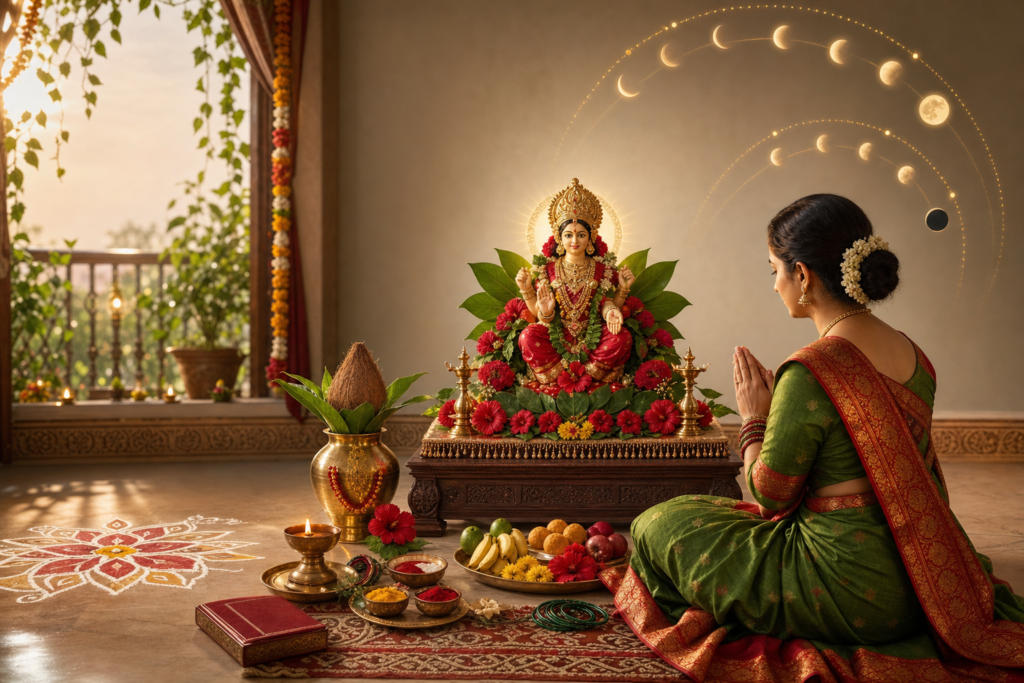
A simple home observance can use an image or suitable murti of Mangala Gauri, a stable chowki or altar, a clean cloth, water, a lamp, cotton wicks, flowers, turmeric, kumkum, sandalwood paste, akshata or unbroken rice, fruit and a modest sattvic naivedya. A bell, incense and a small vessel with a spoon may be added where customary. Cleanliness, attention and reverence are more important than an expensive display.
An extended regional arrangement may include a kalasha filled with clean water, leaves and a coconut; betel leaves and nuts; jaggery; grains; red flowers; a garland; bangles; a blouse piece or chunri; a mirror and comb; seasonal fruit; sweets; and materials used for haldi-kumkum hospitality. Some Telugu and Kannada traditions represent Gauri through a turmeric form or another inherited household icon. These alternatives should not be combined indiscriminately, because each has meaning within a specific ritual grammar.
The number sixteen is especially visible in many versions of Mangala Gauri worship. Sixteen flowers, fruits, sweets, betel nuts, bangles, knots, wicks or forms of upachara may be prescribed. This pattern is related to the broader ritual category of shodashopachara, the sixteen modes of honoring a deity, and in some communities to the imagery of complete feminine adornment. Exact lists differ, so sixteen should be treated as a meaningful regional convention rather than a universal shopping requirement.
Substitution is often possible when it is guided by the tradition’s underlying purpose. One flower offered respectfully is preferable to excessive material that will be discarded. Reusable metal vessels, locally available leaves, seasonal food and plastic-free decoration preserve the vrata’s devotional focus while reducing waste. Sacred practice and environmental responsibility need not be separated.
Mangala Gauri Puja vidhi: a careful step-by-step framework
1. Confirm the calendar and family procedure. The appropriate 2026 date should first be selected from the regional calendar. The family’s established instructions should then be reviewed, including the form of fasting, the image or kalasha arrangement, the offerings, the katha and any udyapana commitment. This preparation prevents a generalized procedure from displacing a living household tradition.
2. Prepare the worship space. The altar and surrounding room are cleaned, and the image or murti is placed securely on a cloth-covered chowki. If a kalasha is used, it is prepared according to family custom and positioned so that it cannot tip. Lamps should remain on a heat-resistant surface, away from curtains, children and loose clothing.
3. Bathe and wear clean clothing. Morning bathing and clean attire mark the transition from ordinary routine to vowed observance. Red, green or other auspicious colors are common in some regions, but they are not indispensable where unavailable. The purpose is ritual attentiveness, not competitive display.
4. Take sankalpa. The devotee states the place, date, identity of the observance and prayerful intention. A concise sankalpa may express devotion to Mangala Gauri and seek wisdom, health, harmony, ethical strength and the welfare of the household. A lineage-specific Sanskrit formula should be obtained from a reliable practitioner rather than reconstructed from uncertain fragments.
5. Invoke Ganesha where customary. Many Hindu pujas begin with remembrance of Ganesha so that obstacles may be removed and the ritual may proceed with clarity. This is followed by purification gestures, lighting the lamp and invoking the sacred presence according to the household’s practice.
6. Meditate upon and invoke Mangala Gauri. The deity is approached through dhyana and avahana. The image is not treated as decoration; it becomes the focused locus of hospitality offered to the Goddess. The widely used mantra ॐ गौर्यै नमः ॥ may be recited with attention. It means reverential salutations to Gauri.
7. Offer the upacharas. Water, sandalwood paste, turmeric, kumkum, akshata, flowers, incense, light, fruit and naivedya are presented in the inherited order. Where shodashopachara is followed, the sixteen acts symbolically welcome, honor, nourish and bid respectful farewell to the divine guest. If an abhisheka is customary, it should be performed only on a murti made from material that can safely receive liquids; water or panchamrita should never be poured over a printed image or electrical decoration.
8. Honor the regional symbolism of sixteen. Some families light a flour lamp with sixteen wicks or offer prescribed objects in sets of sixteen. Multiple flames require continuous supervision and generous spacing. A smaller, safer lamp is appropriate when the traditional arrangement cannot be managed securely, particularly in apartments, community halls or homes with children.
9. Read or hear the Mangala Gauri Vrat Katha. The narrative is an integral interpretive component of the vrata, not merely entertainment after the offerings. It places devotion, mortality, fidelity, courage and divine protection within a memorable story. Regional versions may use different names and incidents, and no single retelling should be presented as the only legitimate recension.
10. Perform prayer, arati and circumambulation. Devotional songs, names of Gauri and lineage-approved prayers may be recited. Arati brings the rite toward completion, after which respectful pranama and, where space allows, pradakshina may be performed. Attention should remain on gratitude rather than on counting acts mechanically.
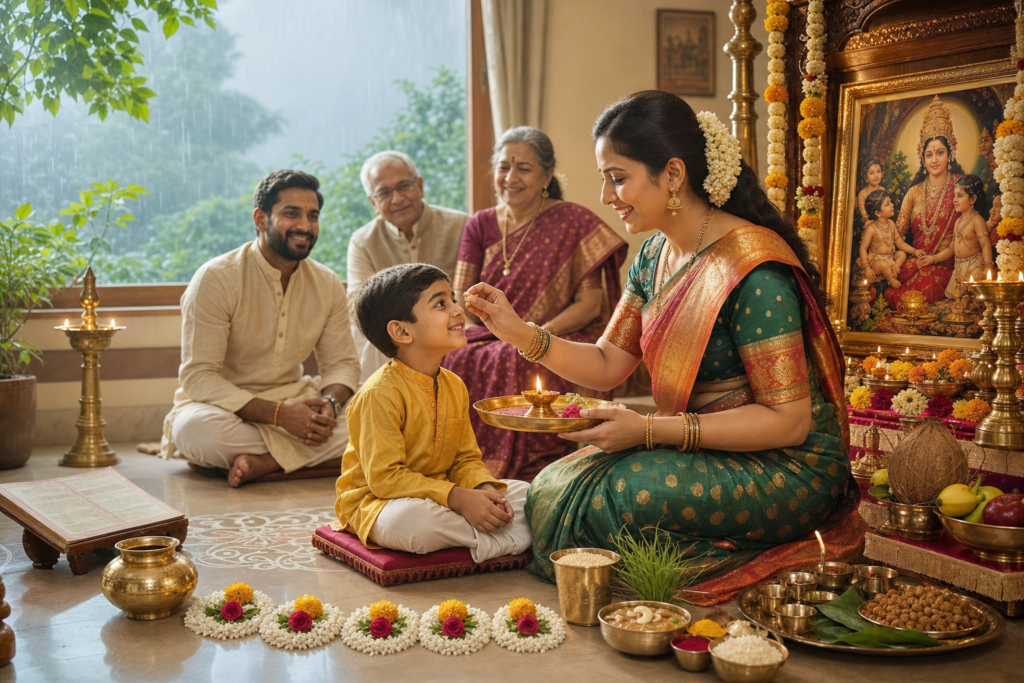
11. Offer naivedya and share prasad. The prepared food is first offered and then distributed respectfully. In traditions that invite married women, haldi, kumkum, fruit, betel leaves, cloth or another modest mangala dravya may be presented. Hospitality should remain voluntary, inclusive and proportionate to the family’s means; debt and social competition are contrary to the vrata’s disciplined character.
12. Close the worship properly. The final prayer expresses gratitude, acknowledges errors and dedicates the merit of the observance to wider well-being. Temporary ritual elements are respectfully concluded according to custom. Kalasha water may be used only in an appropriate household manner, and biodegradable offerings should be composted or returned to soil where local regulations permit rather than placed in waterways.
Fasting rules and health considerations
There is no single food rule followed by every Mangala Gauri community. Some devotees undertake a complete fast, some consume fruit and milk, some eat one sattvic meal, and others avoid particular grains or foods. The appropriate form is determined by family tradition, physical capacity and the meaning of the sankalpa. A severe fast should never be assumed to be spiritually superior.
Pregnant or breastfeeding people, children, older adults, individuals with diabetes, eating disorders or chronic illness, and anyone taking medication should not attempt restrictive fasting without qualified medical advice. A vrata may instead emphasize simple food, moderation, mantra, service, reduced consumption, patient speech or another safe discipline. Religious sincerity is not measured by preventable harm.
The ethical fast is as important as the dietary one. Restraint from anger, humiliation, gossip, waste and harsh speech gives the observance a moral dimension. When prayer for family harmony is accompanied by attentive listening, fair division of labor and compassionate conduct, the vrata becomes a lived household ethic rather than an isolated ceremony.
The Mangala Gauri Vrat Katha and its meaning
The Mangala Gauri Puja Vratha Katha survives in more than one popular form. One version concerns a royal couple devoted to Shiva who are granted a son named Chandrasekhar, but with the warning that he will live only sixteen years. As the predicted age approaches, the young man travels toward Kashi with his uncle, reflecting the narrative’s association of Kashi with liberation and the transcendence of death.
During the journey, Chandrasekhar encounters a princess who performs Mangala Gowri Vratha with deep conviction. Through an unusual chain of events, he temporarily stands in for an ill prince during her wedding ceremony and discloses his identity and foretold fate. When a snake approaches on the night he is expected to die, the princess uses consecrated grains associated with her worship, and the danger is overcome. A ring later functions as the sign through which the true marriage is recognized.
Chandrasekhar continues to Kashi and survives beyond the predicted limit. On his return, the couple is reunited after the princess recognizes him among the travelers to whom she regularly offers food. The story concludes with restored relationship, hospitality, steadfastness and life continuing where death had seemed inevitable.
Another widespread version names a merchant Dharampal and presents a devoted woman who is warned in a dream about a snake. She places sweetened milk and a vessel nearby, contains the snake and protects her husband. The names, kinship relations and mechanics vary, but the narrative structure remains recognizable: human vulnerability is met by alertness, disciplined devotion, feminine agency and divine grace.
Academically, a vrata katha is best read as a ritual narrative rather than as a chronicle requiring historical verification. Its dramatic language converts fear about mortality and uncertainty into an intelligible moral world. The woman in the story is not passive; she remembers the vow, perceives danger, acts decisively, sustains hospitality and preserves recognition across separation. These themes help explain the story’s emotional durability within domestic religious life.
The snake episode is symbolic narrative and must not be imitated with a real animal. Milk should not be offered to snakes, and an encountered snake should be handled only by trained wildlife professionals. Reverence for sacred stories is compatible with responsible treatment of living beings and public safety.
Regional expressions of Mangala Gauri
In Maharashtra, Mangalagaur is both a puja and a significant women’s cultural gathering, especially in connection with a newly married woman’s first Shravan seasons. The devotional rite may be followed by songs, rhythmic movement, ukhane and games such as phugadi, zimma or jhimma and bhendya. The Maharashtra Tourism account of Mangalagaur emphasizes this combination of Goddess worship, communal bonding, games and cultural performance.
This social dimension is not incidental. Traditional games require coordination, memory, breath, trust and collective rhythm. They give women a setting in which ritual knowledge, humor and experience can move across generations. For many households, memories of Mangalagaur are carried as much by the glow of lamps, the scent of turmeric and flowers, and shared laughter during phugadi as by a printed calendar date.
In Telugu and Kannada settings, Mangala Gowri Vratham may give greater prominence to an arranged kalasha, a turmeric representation of Gauri, prescribed sets of sixteen, a sacred thread or detailed vrata-katha recitation. Gujarati and Goan households retain their own combinations of fasting, Gauri worship and women’s hospitality. These differences demonstrate the adaptive strength of Hindu ritual culture: a common theological center is preserved through multiple regional forms.
Some regional descriptions include preparing kajal from soot produced near the ritual lamp. This is a localized custom, not an essential requirement of Mangala Gauri Puja. Homemade soot is not medically sterile and can irritate or injure the eye; symbolic observance or omission is safer where there is any uncertainty. Fire and eye safety should take precedence over reproducing an optional detail.
Cultural and social significance
Mangala Gauri Vratham illustrates how domestic ritual can function as a system of knowledge transmission. Calendar calculation, food rules, oral narrative, ritual sequencing, song, craft, hospitality and kinship etiquette converge in one observance. Much of this expertise has historically been preserved and taught by women, making the vrata an important site of religious authority within the household.
The traditional emphasis on a husband’s longevity reflects the historical social world in which married status profoundly affected a woman’s security and public identity. A factual account need not conceal that context, but it also need not reduce the vrata to submission. Its narratives and collective practices give women visible ritual agency, intergenerational networks and a public language for family hopes. Contemporary observance can foreground mutual well-being without erasing this history.
The observance belongs specifically to Hindu Shakta-Shaiva and household traditions, yet several of its ethical disciplines—self-restraint, dana, compassion, non-harm, truthful conduct and community care—are intelligible across Hindu, Buddhist, Jain and Sikh contexts. Dharmic unity is strengthened when such resonances are appreciated without claiming that distinct traditions perform the same ritual or possess identical doctrines.
A practical simplified observance
When time, health or access to materials is limited, a respectful simplified puja can include bathing, cleaning the altar, lighting one safely placed lamp, taking sankalpa, invoking Ganesha, offering water, turmeric, kumkum, one flower, fruit and naivedya, reciting ॐ गौर्यै नमः ॥, hearing the katha, performing arati and sharing prasad. Simplification should preserve the rite’s sequence and intention rather than turn it into a hurried transaction.
Diaspora families should use a calendar configured for their actual city instead of mechanically applying Indian civil dates. The most reliable workflow is to select the family’s Amanta or Purnimanta convention, check when local Shravan is in effect at sunrise on Tuesday, and then confirm the procedure with the relevant temple or tradition-bearer. Time-zone conversion alone is insufficient because a panchanga is calculated astronomically for place.
Children may participate by arranging flowers, learning one name of Gauri, listening to the katha, preparing a reusable decoration or helping distribute prasad. The experience should be safe and age-appropriate. Participation through care and curiosity transmits the tradition more effectively than fear, forced fasting or perfectionism.
If a Tuesday is missed because of illness, travel or unavoidable work, there is no single rule applicable to every lineage. Some families resume on the next Shravan Tuesday; others make a simple prayer or receive specific guidance about completion. The responsible response is to consult the custom under which the sankalpa was taken rather than invent a universal penalty.
Frequently asked questions about Mangala Gauri Puja 2026
Are the dates the same throughout India? No. Purnimanta calendars use 4, 11, 18 and 25 August 2026, while the relevant Amanta calendars use 18 and 25 August and 1 and 8 September 2026. The overlap on 18 and 25 August does not eliminate the regional difference for the other two Tuesdays.
Is there one fixed Mangala Gauri Puja muhurta? No universal clock time applies worldwide. Morning worship is customary in many households, but the local panchanga, sunrise and sampradaya determine the appropriate schedule. Community programs may occur later without changing the underlying vrata date.
Are sixteen of every offering compulsory? Not in every tradition. Sets of sixteen are central to many detailed forms of the puja, but the prescribed objects and their interpretation vary. A devotee following a simpler family procedure should not multiply offerings merely because another regional guide does so.
Must the observer remain without food or water? Not necessarily. Nirjala fasting, fruit-based fasting, one-meal observance and other forms all occur. Health requirements and inherited practice should determine the discipline, and medical safety must be respected.
Can men or unmarried people participate? The formal vrata is traditionally centered on married women, particularly newly married women, but family members may assist, pray, listen to the katha and share prasad where custom permits. Participation should support rather than appropriate women’s ritual space.
Does the vrata guarantee marriage, children, wealth or immunity from illness? Such results belong to the language of devotional hope and should not be presented as measurable guarantees. The vrata can provide spiritual discipline, communal support and a meaningful framework for prayer, but it does not replace medical care, relationship work, financial judgment or personal responsibility.
How should an udyapana be performed? Udyapana formally completes a multi-year vow in communities that prescribe one. Its date, number of invited women, offerings, food and priestly components differ substantially. It should therefore be planned from the same lineage or household instructions under which the original vrata was undertaken.
Responsible observance in 2026
A well-prepared Mangala Gauri Puja integrates calendar accuracy, inherited custom, health, environmental care and fire safety. Lamps should never be left unattended; excessive food should be avoided; flowers and biodegradable offerings should be disposed of responsibly; and plastic decoration should be minimized. Hospitality should remain within the household’s means, with no pressure to purchase elaborate kits or compete socially.
The original Mangala Gauri Puja reference page identifies the observance as a Shravan Tuesday vrata dedicated to Goddess Parvathi and highlights its distinct regional calendars. The 2026 date guide above updates that framework through comparison with published panchanga listings while preserving the source’s essential meaning and removing promotional material.
Mangala Gauri Vratham ultimately brings together precise lunar reckoning and intimate household devotion. Its recurring Tuesdays ask the devotee to return to the same values—steadiness, gratitude, courage, care and auspicious conduct—rather than seek a single dramatic moment. Whether expressed through a detailed shodashopachara puja, a modest home prayer or a Maharashtrian evening of song and phugadi, the observance honors Gauri as the sustaining power through which family and community life may be approached with greater responsibility and grace.
Inspired by this post on Hindu Pad.



Leave a Reply
You must be logged in to post a comment.