
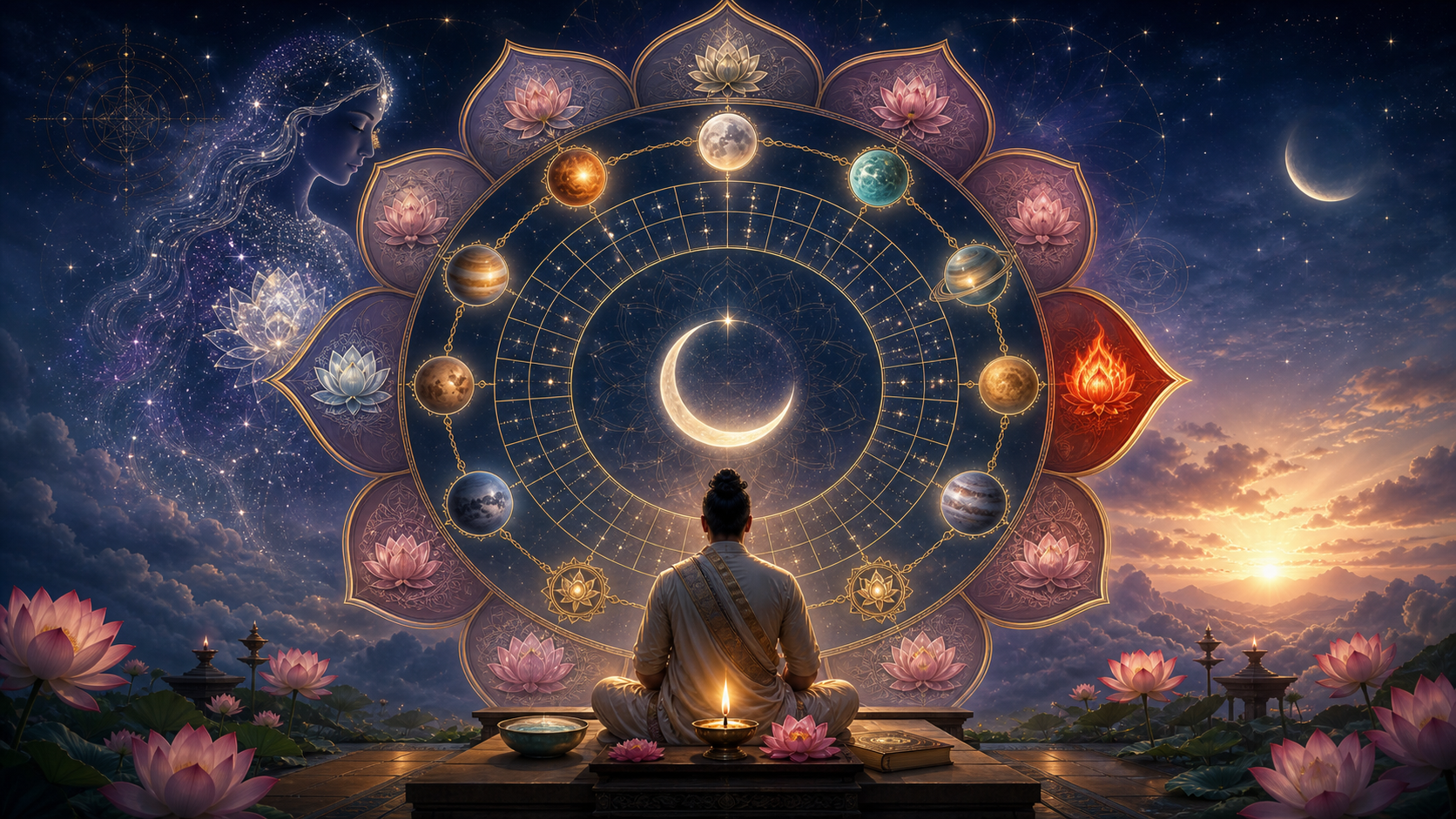
Nakshatra-based Mahavidya sadhana in context
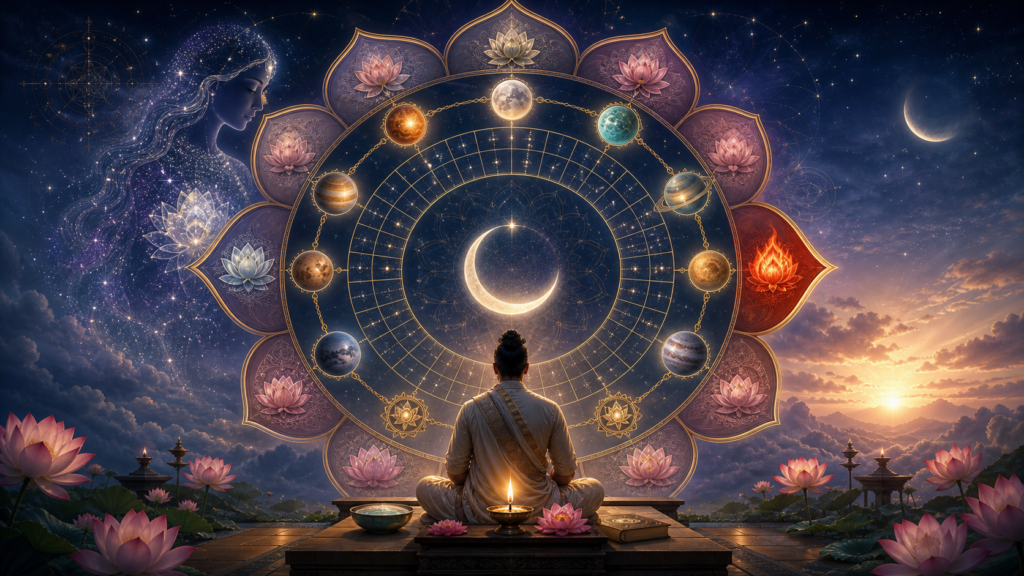
A birth star can feel like an intimate spiritual coordinate: a point in the traditional sky that connects time, temperament, memory, and religious aspiration. For that reason, nakshatra-based Mahavidya sadhana has become an appealing way to explore Shakti worship. The method promises a clear starting point, yet its real value lies less in assigning a fixed destiny than in encouraging disciplined reflection on the form of the Divine Feminine toward which a practitioner may turn.
The practical method is straightforward. A practitioner identifies the janma nakshatra occupied by the Moon at birth, finds its planetary ruler in the Vimshottari dasha system, and then consults a planetary-Mahavidya correspondence. The source correspondence pairs nine planetary rulers with nine Mahavidyas and groups the 27 nakshatras into nine sets of three.
Academic and spiritual precision is essential, however. This correspondence is a traditional-symbolic and lineage-dependent interpretive model, not an empirically established causal system or a universally binding rule of every Shakta and Jyotisha tradition. It can serve as a contemplative aid, but it cannot by itself determine initiation, guarantee spiritual results, replace a complete horoscope, or override an established relationship with a guru, kula devata, ishta devata, temple, or family tradition.
The complete nakshatra-to-Mahavidya answer
Under the system presented in the source, Krittika, Uttara Phalguni, and Uttara Ashadha are connected through the Sun to Matangi; Rohini, Hasta, and Shravana through the Moon to Bhuvaneshwari; Mrigashira, Chitra, and Dhanishtha through Mars to Bagalamukhi; Ashlesha, Jyeshtha, and Revati through Mercury to Tripura Sundari; Punarvasu, Vishakha, and Purva Bhadrapada through Jupiter to Tara; Bharani, Purva Phalguni, and Purva Ashadha through Venus to Kamala; Pushya, Anuradha, and Uttara Bhadrapada through Saturn to Kali; Ardra, Swati, and Shatabhisha through Rahu to Chinnamasta; and Ashwini, Magha, and Moola through Ketu to Dhumavati.
Bhairavi remains one of the ten Mahavidyas but receives no nakshatra group in this particular nine-graha arrangement. The arithmetic explains the structural issue: there are ten Mahavidyas but only nine rulers in the Vimshottari cycle. Her absence from the table does not make Bhairavi secondary, inaccessible, or spiritually unimportant. It simply shows that a compact astrological overlay cannot exhaust the full Dashamahavidya tradition.
What a birth nakshatra actually represents
In the commonly used 27-nakshatra framework of Jyotisha, the ecliptic is divided into 27 equal sectors of 13°20′. Each nakshatra is further divided into four padas of 3°20′. Some historical and ritual enumerations also recognize Abhijit as a twenty-eighth nakshatra, but the correspondence discussed here uses the 27-fold arrangement because 27 divides neatly into three repetitions of nine planetary rulers.
The janma nakshatra normally means the nakshatra occupied by the natal Moon, not the Sun, ascendant, or a nakshatra inferred from a name. The Moon’s exact sidereal longitude is therefore the technical basis of the calculation. A popular phrase such as being born under Rohini is shorthand for having the Moon in Rohini at the recorded time and place of birth.
A nakshatra’s Vimshottari ruler should not be confused with its presiding deity. Mrigashira, for example, is assigned to Mars in the Vimshottari sequence while its traditional devata is Soma. The planetary ruler, devata, symbol, guna, pada, zodiacal location, and associated myths are distinct interpretive layers. Reducing all of them to one planet or one goddess produces a simpler answer, but also a less complete one.
The standard Vimshottari sequence begins with Ketu for Ashwini and continues through Venus, Sun, Moon, Mars, Rahu, Jupiter, Saturn, and Mercury. The sequence then repeats from Magha and once more from Moola. Each ruler consequently governs three nakshatras, while the full planetary-period cycle totals 120 years. Classical Jyotisha literature discusses several dasha systems, so the label ruling planet in this article specifically refers to the Vimshottari arrangement rather than an unqualified ownership valid in every astrological method. An overview of the relevant dasha material appears in the Brihat Parashara Hora Shastra chapter summary.
There is also an important linguistic distinction. In Daśa Mahāvidyā, daśa means ten; in Vimshottari daśā, daśā refers to a planetary period or condition. English spellings often render both words as dasha, but the expressions are not interchangeable. Dashamahavidya therefore means the Ten Great Wisdoms, not ten astrological periods.
Accurate birth data matters most near a nakshatra boundary. A correct date, local time, birthplace, historical time-zone offset, and declared ayanamsha should be used. Different software settings can place a boundary-positioned Moon in neighboring nakshatras. When the recorded time is uncertain, it is more responsible to acknowledge the uncertainty than to build an intense spiritual regimen on a guessed result.
Who the ten Mahavidyas are
The Mahavidyas are a group of ten forms of the Divine Feminine within Shakta Tantra: Kali, Tara, Tripura Sundari or Shodashi, Bhuvaneshwari, Bhairavi, Chinnamasta, Dhumavati, Bagalamukhi, Matangi, and Kamala. Mahavidya can be understood as great knowledge, great wisdom, or a supreme form of revelatory knowledge. The group holds together goddesses whose imagery ranges from serene beauty and abundance to death, marginality, fierce restraint, radical self-transcendence, and the dissolution of ordinary identity.
Historical scholarship treats the Mahavidyas as a complex constellation of goddess traditions rather than a set of interchangeable astrological remedies. David R. Kinsley’s academic study of the ten Mahavidyas documents their different myths, ritual settings, theological meanings, and regional developments. An IGNCA-hosted archival volume likewise records the traditional tenfold enumeration, including Bhairavi as an integral member of the group.
Each Mahavidya is more than a departmental goddess assigned to a single benefit. Kali cannot be reduced to Saturn relief, Kamala to money, Bagalamukhi to winning arguments, or Tara to examination success. Such shorthand may help organize introductory material, but it can obscure theology, ethics, iconography, and the transformative demands of sadhana. Within devotional understanding, every Mahavidya can reveal the wholeness of Shakti, even when a lineage gives one form a specialized ritual function.
The nakshatra method should therefore be understood as an overlay. One traditional system supplies the 27 lunar mansions and their nine Vimshottari rulers; another supplies ten profound forms of the Goddess; a contemporary correspondence joins nine of those forms to the nine rulers. This synthesis can be meaningful without being presented as the sole or timeless rule for every practitioner.
The nine planetary groups and their spiritual themes
Sun: Krittika, Uttara Phalguni, and Uttara Ashadha — Matangi. The source associates this group with speech power, leadership, and creative expression. Matangi is widely connected with language, music, learning, artistic intelligence, and forms of wisdom that challenge rigid social boundaries. A responsible Matangi-oriented reflection emphasizes truthful speech, careful listening, disciplined study, and creative work offered for a purpose larger than personal prestige. The pairing does not mean that every native of these three nakshatras will become an artist or leader; it proposes a spiritual field in which expression can be refined into service.
Moon: Rohini, Hasta, and Shravana — Bhuvaneshwari. The source identifies emotional stability, nurturing, and family harmony as the principal themes. Bhuvaneshwari is the sovereign of the worlds and is often contemplated as the vast space within which experience arises. This symbolism can help a practitioner hold emotion without either suppressing it or being ruled by it. In daily life, the pairing may inspire hospitality, patient caregiving, emotional boundaries, and the creation of a peaceful home. Emotional stability here is a spiritual aspiration, not a clinical promise or substitute for mental-health care.
Mars: Mrigashira, Chitra, and Dhanishtha — Bagalamukhi. The source summarizes this connection through courage, protection, and victory over enemies. Bagalamukhi is especially associated with stambhana, the arresting or stilling of harmful motion, action, or speech. An ethical interpretation turns that power inward first: pausing before retaliation, restraining impulsive words, interrupting destructive habits, and maintaining composure during conflict. Treating the goddess as a mechanism for coercing opponents or securing guaranteed legal victory would reduce a sacred discipline to domination and could intensify the very aggression the practice is meant to transform.
Mercury: Ashlesha, Jyeshtha, and Revati — Tripura Sundari. The stated themes are intellect, beauty, and manifestation. Tripura Sundari, also known as Shodashi and closely associated with Sri Vidya, expresses beauty as cosmic order, consciousness, harmony, and the integration of desire with wisdom. For this group, manifestation is best understood as bringing a worthy intention into disciplined form rather than expecting wishes to materialize automatically. Study, aesthetic sensitivity, measured communication, and clarity about motives provide a grounded expression of the correspondence. Sri Vidya mantras and ritual structures remain lineage-specific and should not be reconstructed casually from internet summaries.
Jupiter: Punarvasu, Vishakha, and Purva Bhadrapada — Tara. The source emphasizes wisdom, protection, and healing from negativity. Tara’s name carries the sense of guidance and crossing, and her Shakta forms are associated with liberating knowledge, speech, and passage through danger. A practitioner may translate these themes into sustained learning, reverence for teachers, compassionate guidance, and courage during uncertainty. Healing in this setting is devotional language for integration and spiritual support; it should not be represented as a guaranteed treatment for physical or psychological illness.
Venus: Bharani, Purva Phalguni, and Purva Ashadha — Kamala. The source connects these nakshatras with prosperity, beauty, and material abundance. Kamala, the lotus goddess, is closely related to Lakshmi and represents auspiciousness, fertility, dignity, and flourishing amid the conditions of worldly life. Her symbolism becomes ethically substantial when prosperity includes honest livelihood, gratitude, generosity, ecological responsibility, and freedom from compulsive consumption. Wealth without stewardship is not the fullness of Kamala, while simplicity chosen with dignity need not be interpreted as spiritual failure.
Saturn: Pushya, Anuradha, and Uttara Bhadrapada — Kali. The source highlights discipline, karmic healing, and transformation. Kali confronts time, mortality, fear, attachment, and the dissolution of identities that can no longer support spiritual growth. Her imagery is fierce, but fierceness should not be confused with evil or nihilism. For a Saturn-linked practitioner, the correspondence may be expressed through patience, accountability, service during hardship, truthful acceptance of limits, and perseverance without self-cruelty. Karmic healing is a theological interpretation of moral and spiritual transformation, not a measurable medical procedure.
Rahu: Ardra, Swati, and Shatabhisha — Chinnamasta. Rahu is a lunar node rather than a physical planet, although Jyotisha includes it among the grahas. The source associates this group with kundalini awakening and ego dissolution. Chinnamasta’s self-decapitated iconography presents a startling conjunction of life, appetite, sacrifice, power, and transcendence. It should be contemplated symbolically rather than imitated literally. Because forceful kundalini methods, breath retention, and intense visualizations can be destabilizing, this pairing is a particularly poor basis for unsupervised experimentation. Humility, moderation, and qualified guidance are more meaningful signs of progress than dramatic sensations.
Ketu: Ashwini, Magha, and Moola — Dhumavati. Ketu is the descending lunar node and is conventionally associated with severance, inwardness, and detachment. Dhumavati’s imagery engages smoke, age, absence, disappointment, marginality, and wisdom discovered when familiar supports disappear. The source describes her focus as spiritual detachment and transcendence. This does not condemn Ketu-ruled natives to loneliness or loss. A constructive reading recognizes the ability to remain truthful in incomplete situations, release exhausted identities, respect elders and socially overlooked people, and find meaning that does not depend on constant success.
Bhairavi and the missing tenth place. Bhairavi embodies fierceness, tapas, disciplined intensity, and the transforming fire of practice. She belongs fully to the Dashamahavidya group even though the source’s nine-planet table does not assign her a set of nakshatras. Some contemporary systems resolve the numerical mismatch differently, and some practitioners approach Bhairavi through lineage, initiation, an existing devotional call, or other chart factors. No alternate allocation should be silently inserted into this table and presented as universal.
How the symbolism should be interpreted
A nakshatra-Mahavidya pairing is not a personality verdict. It does not mean that all Rohini natives are emotionally unstable, all Ardra natives require ego dissolution, or all Bharani natives are destined for wealth. A birth chart contains many interacting factors, while religious character also develops through family, education, ethical choices, social conditions, health, and sustained practice. The correspondence is most useful when it opens inquiry rather than closing identity.
The benefit terms in the source are likewise best treated as devotional orientations. Protection can mean courage and prudent boundaries; victory can mean mastery over reactive speech; abundance can mean sufficiency joined to generosity; transformation can mean relinquishing a harmful pattern; and wisdom can mean accepting correction. These interpretations preserve spiritual depth without promising supernatural control over other people or guaranteed outcomes.
Many seekers experience the fiercest Mahavidyas first as unsettling images. That discomfort can itself reveal assumptions about beauty, purity, age, power, death, and femininity. A mature study does not sensationalize the imagery or rush to reproduce esoteric rites. It asks what forms of reality have been excluded from ordinary religious imagination and how the Goddess tradition brings those realities back into a larger vision of sacred wholeness.
Three worked examples
A person whose verified lunar position falls in Mrigashira begins with Mars, the Vimshottari ruler, and reaches Bagalamukhi in this scheme. The result can suggest a contemplative emphasis on stopping scattered thought and impulsive reaction. Yet Mrigashira’s devata is Soma, and the nakshatra spans parts of Taurus and Gemini in the sidereal zodiac. A fuller interpretation must therefore preserve its lunar deity, zodiacal setting, pada, and entire natal chart rather than declaring that Bagalamukhi alone defines the individual.
A Rohini native moves through the Moon to Bhuvaneshwari. The correspondence may feel emotionally natural to someone seeking spaciousness within family responsibility. It does not require that person to abandon a longstanding devotion to Krishna, Shiva, Durga, a Jain Tirthankara, the Buddha, the Sikh Gurus, or another sacred focus. A symbolic recommendation can inform reflection without displacing an authentic religious home.
An Ashwini native reaches Dhumavati through Ketu. That result should not be read as a prediction of widowhood, deprivation, or misfortune. It can instead prompt study of impermanence, simplicity, neglected wisdom, and the capacity to begin again after certainty dissolves. If the imagery creates persistent fear rather than thoughtful reverence, a qualified teacher may recommend a different devotional entry point.
A seven-stage method for choosing responsibly
1. Verify the astronomical input. The natal Moon’s sidereal position should be calculated from reliable birth data with the ayanamsha stated. A screenshot or report should show the Moon’s degree, nakshatra, and pada. Guessing from a Western Sun sign, a Gregorian birthday, or a name syllable is not equivalent to a verified janma nakshatra.
2. Identify the Vimshottari ruler. The ruling sequence should be used consistently. Once the natal nakshatra is known, the planetary group can be located without interpreting the whole horoscope. This step identifies the source table’s proposed Mahavidya, not an automatic ritual prescription.
3. Study the complete symbolic field. Both the nakshatra and the Mahavidya deserve attention. The nakshatra’s devata, symbols, pada, and myths should be considered alongside the goddess’s theology and iconography. This prevents the planet-to-goddess shortcut from flattening two complex traditions into a slogan.
4. Respect existing commitments. Family worship, kula devata, ishta devata, sampradaya, vows, temple relationships, and prior initiation generally carry more lived religious weight than an online correspondence. A new astrological suggestion should be integrated only when it is compatible with those responsibilities.
5. Clarify the ethical purpose. A sound intention might involve truthfulness, courage, concentration, generosity, grief integration, creative discipline, or service. A wish to control a partner, silence a critic, harm an opponent, obtain guaranteed wealth, or evade lawful responsibility is not made ethical merely by placing it inside ritual language.
6. Distinguish devotion from initiated Tantra. Respectful study, temple darshan, simple prayer, and conventional offerings are not identical to mantra diksha, nyasa, yantra consecration, purashcharana, homa, or specialized kundalini practice. The second category requires competence, authorization, and attention to lineage rules.
7. Evaluate the fruit of practice. A healthy discipline should gradually strengthen honesty, steadiness, compassion, self-command, responsibility, and reverence. Obsession, grandiosity, escalating fear, contempt for other paths, or dependence on extravagant promises are reasons to pause and seek trustworthy guidance.
A safe introductory framework
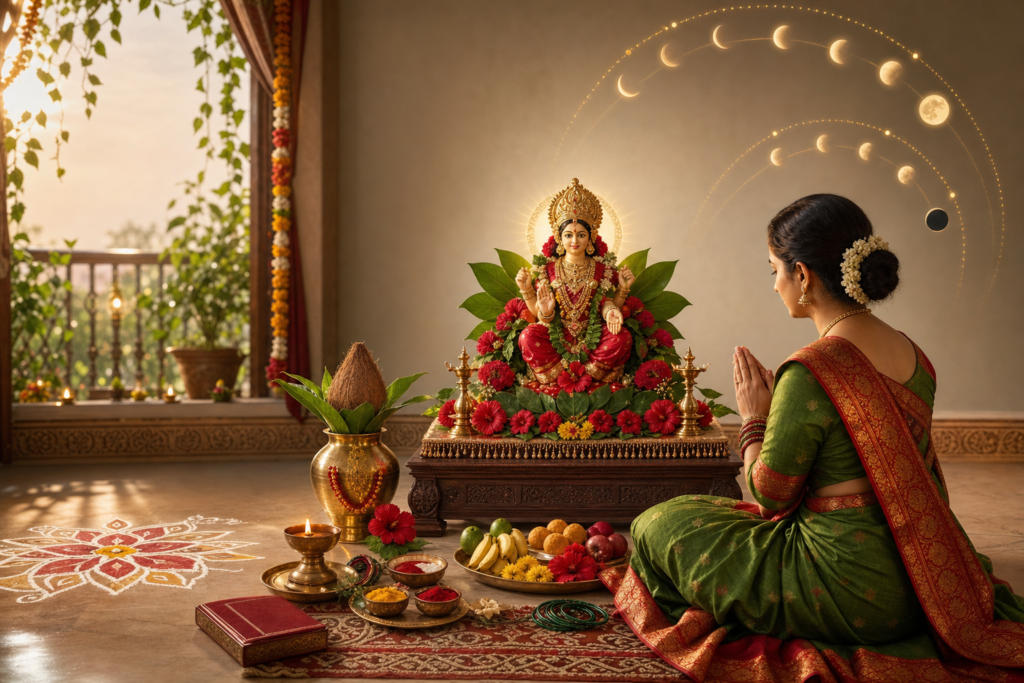
For someone without initiation, an introductory approach can remain simple: learn the goddess’s history from reliable sources, keep a clean and respectful space, offer a lamp, water, fruit, or flowers where such offerings are customary, attend established temple worship, and spend a short period contemplating the virtue associated with the chosen form. Any public prayer or name recitation should follow the norms of the practitioner’s tradition rather than being assembled from fragments found online.
A practical daily discipline may include a few minutes of calm breathing without retention, a respectful salutation approved by the tradition, silent reflection, and a concrete ethical action. A Matangi-oriented practitioner might prepare carefully before speaking; a Kamala-oriented practitioner might practice generosity; a Kali-oriented practitioner might keep a difficult but necessary commitment; and a Bagalamukhi-oriented practitioner might refrain from reactive argument. Such actions join devotion to character.
Seed mantras, mantra combinations, nyasa, mudra sequences, energized yantras, forceful pranayama, kundalini activation, transgressive offerings, and rites directed at another person should not be improvised. The Kularnava Tantra tradition gives central importance to diksha and the guru-disciple relationship; a published discussion and excerpt from the text illustrates that emphasis. This principle is especially relevant when a practice is advertised as secret, rapid, fierce, or guaranteed to produce siddhi.
A qualified guide should demonstrate a credible lineage, knowledge of the ritual system, ethical conduct, respect for consent, and freedom from coercive sexual, financial, or psychological demands. Titles, dramatic claims, social-media popularity, and expensive packages do not establish spiritual competence. Pressure to isolate from family, stop necessary medical care, surrender large sums, or obey without question is a warning sign rather than evidence of authentic Tantra.
Spiritual practice is not a replacement for medical diagnosis, psychotherapy, legal counsel, or emergency assistance. If a practice is followed by severe insomnia, panic, dissociation, dangerous impulses, or impaired daily functioning, it should be paused and discussed with an appropriate health professional as well as a responsible spiritual mentor. Religious language should never be used to shame a person for seeking care.
Frequently asked questions
Is the nakshatra-assigned Mahavidya mandatory? No. The table offers one possible point of resonance. Guru guidance, initiation, family tradition, sustained devotion, and an informed spiritual calling may lead to another Mahavidya or another form of worship altogether.
What happens when the birth time is unknown? The Moon often remains in one nakshatra for much of a day, but it can cross a boundary on the date of birth. A range of plausible times can be tested using a reliable ephemeris. If the range produces two possible nakshatras, both possibilities should remain open until better evidence or careful rectification is available.
Does the pada change the assigned Mahavidya? Not in the source table. All four padas of a nakshatra share the same Vimshottari ruler and therefore the same Mahavidya in this simplified method. The pada can still alter finer astrological interpretation, especially through navamsha placement, but that additional layer is not part of the published correspondence.
Can more than one Mahavidya be worshipped? The ten are not rival powers, and many traditions understand them as forms of one Mahadevi. Nevertheless, combining mantras and ritual systems without instruction can create confusion and violate lineage-specific rules. Broad reverence for all ten can coexist with focused practice under guidance.
Why do other websites give different planetary associations? Mahavidya correspondences vary across modern teachers, regional traditions, ritual manuals, and astrological schools. Some assign Bhairavi to a special factor; others rearrange particular planetary links or choose a goddess from an afflicted graha, Moon sign, ascendant, dasha period, or personal need. A differing table is not automatically fraudulent, but it should identify its lineage or textual rationale.
Is this exact table an ancient scriptural command? The available sources support the antiquity and importance of nakshatra systems, planetary dashas, and the ten Mahavidyas as distinct bodies of tradition. They do not establish this exact ninefold combined table as a universal ancient injunction. It is more accurate to describe the table as a contemporary interpretive synthesis unless a specific lineage supplies a traceable textual authority for it.
Is the method scientifically proven? No controlled empirical evidence establishes that a birth nakshatra causes compatibility with a particular Mahavidya or that the pairing produces predictable external outcomes. Its significance belongs to astrology, theology, ritual culture, symbolic psychology, and lived religious experience. Respect for a tradition does not require presenting its metaphysical claims as laboratory findings.
Will the practice remove a planetary problem? Jyotisha-remedial traditions may interpret worship as a means of harmonizing a difficult graha, but no outcome can be guaranteed. Ethical action, practical planning, professional assistance, and acceptance of uncertainty remain necessary. Sadhana is most defensible as a path of transformation, not a transaction that compels the cosmos.
How should Abhijit be handled? Abhijit does not appear in this 27-nakshatra, nine-ruler table. A practitioner whose lineage uses a 28-fold scheme should follow that lineage’s method rather than forcing Abhijit into a correspondence constructed around three groups of nine.
Respect across Dharmic traditions
This framework belongs specifically to a meeting point between Shakta spirituality and Jyotisha. It should not be used to rank Hindu, Buddhist, Jain, or Sikh paths, nor to suggest that every Dharmic practitioner requires astrological deity selection. Unity among traditions becomes more durable when it preserves distinct scriptures, disciplines, initiations, and understandings of liberation.
Tara offers an instructive example. Hindu Shakta traditions and Buddhist traditions both revere forms named Tara, and their histories developed amid centuries of cultural contact. Their theologies, iconographies, mantras, and initiatory settings are not therefore identical or freely interchangeable. Comparative study can honor meaningful relationships while allowing each community to define its own sacred practice.
The same principle applies more broadly. A person can appreciate the Mahavidyas while respecting Jain disciplines of nonviolence, Buddhist paths of wisdom and compassion, Sikh devotion to the One and the Guru’s teaching, and the many Vaishnava, Shaiva, Shakta, Smarta, folk, and regional traditions within Hinduism. Shared ethical commitments such as truthfulness, compassion, restraint, courage, service, and reverence provide firmer ground for unity than claims that all practices are simply identical.
Final assessment
Nakshatra-based Mahavidya sadhana is most useful as a disciplined beginning rather than a final verdict. The birth star identifies a planetary group; the group suggests a Mahavidya; and the suggestion invites deeper study of symbolism, ethics, lineage, and personal responsibility. The method becomes spiritually constructive when it reduces fear, resists fatalism, and turns promised benefits into virtues that can be practiced in ordinary life.
The wisest choice is not necessarily the goddess associated with the most dramatic promise. It is the path approached with accurate information, humility, ethical intention, competent guidance, and respect for the practitioner’s existing religious commitments. In that form, the nakshatra-Mahavidya connection can become a contemplative bridge between cosmic symbolism and the demanding, compassionate work of inner transformation.
Research note. The core planetary table and its stated focus areas have been preserved from the detailed HinduPad source page. Historical framing of the Mahavidyas draws on Kinsley’s comparative study and the IGNCA-hosted archival material; technical context for Vimshottari dasha draws on the referenced Jyotisha overview; and the caution concerning initiation reflects the traditional emphasis represented in discussions of the Kularnava Tantra. Because living lineages differ, these sources support informed comparison rather than a claim of one universal ritual rule.
Inspired by this post on Hindu Pad.






Leave a Reply
You must be logged in to post a comment.