

You may know what ahimsa asks at the dinner table and still feel lost when the same principle meets war, self-defense, opaque supply chains, or an unfertilized egg. The hard question is not whether harm is wrong. It is how you should act when every available choice carries some harm.
Jain ethics offers something stricter and more practical than a purity label: become aware, remove avoidable harm, choose the least harmful means capable of meeting a real need, and examine the passions behind your choice. The same discipline can guide a vote, a purchase, a meal, or your response to immediate danger.
Key takeaways: test the choice before defending it
Jain discipline distinguishes the Mahavrat of complete non-violence observed by monastics from the Anuvrat, or limited vows, undertaken by householders. That distinction matters. A monk’s renunciation and a householder’s responsibility for family, livelihood, and public life are not identical, but the householder does not receive a moral exemption. The obligation is to keep reducing unnecessary harm within actual circumstances.
The principle of minimum violence necessary for human survival is not permission to call every familiar convenience necessary. It asks you to distinguish survival and protection from appetite, status, anger, retaliation, and careless habit. When a lower-harm alternative is reasonably available, continuing the more harmful practice becomes harder to justify.
- Necessity: What real need, duty, or life are you protecting? Would the harm still seem necessary if convenience, social approval, and retaliation were removed from the decision?
- Awareness: Which beings are affected directly, and which harms have been pushed upstream into a farm, factory, battlefield, workplace, or ecosystem?
- Perspective: Have you considered the strongest relevant viewpoints without pretending that every claim is equally truthful? Anekantavada corrects one-sided certainty; it does not require moral indifference.
- Means: What is the least harmful option that can actually meet the need? A harmless-looking gesture that cannot protect anyone is not an adequate substitute for effective action.
- Inner cause: Is the choice being driven by anger, pride, deceit, or greed? These kashaya can turn protection into punishment and an ordinary purchase into grasping.
- Accountability: What consequences will remain, and what will you review through pratikraman? Ahimsa includes learning, correction, and repair after the decision.
This is not simple harm arithmetic. Jain ethics weighs bhava, the intention and inner state; upaya, the means; and phala, the consequences. Harm becomes ethically more serious when it is intentional, avoidable, directed toward more highly sensed beings, or intensified by kashaya. The number of beings affected matters, but so do carelessness, motive, and the alternatives you refused to consider.
In war, protect life without making violence sacred

War invites two opposite distortions. One turns ahimsa into passive surrender before oppression. The other turns self-defense into a broad moral license for militarism, vengeance, and cruelty. Jain reasoning accepts neither. War remains himsa even when political language makes it sound noble, and a defensive act does not become spiritually clean merely because it has been called just.
The Acharanga Sutra and Sutrakritang emphasize vigilant restraint and the renunciation of intentional injury. The Tattvartha Sutra connects injury rooted in passion and careless activity with obstruction of spiritual progress. For a householder, however, protecting one’s own life or another person’s life can be morally distinguishable from aggression when the danger is immediate and no non-violent option can prevent it.
When the conflict is public
Your first responsibility as a citizen, donor, voter, or social-media user is not to intensify a conflict you cannot see clearly. Verify a claim before circulating it. Distinguish criticism of a government, army, or armed group from hatred toward an entire people. You can identify aggression and defend the oppressed without denying the humanity of those on the opposing side.
Anekantavada is especially useful here. It asks what conditions, fears, interests, histories, and consequences are missing from your first view. It does not say that an aggressor and a victim are interchangeable, or that truth is whatever each side declares. Its practical purpose is to prevent partial knowledge from hardening into self-righteous cruelty.
- Begin with truthful speech. Verify what you can, correct falsehoods from your own side, and refuse language that makes civilians or whole communities disposable.
- Press for dialogue, diplomacy, de-escalation, mediation, and lawful protection before endorsing force.
- Support non-violent resistance where it can operate: truth-telling, civil disobedience, community solidarity, relief work, and restorative approaches to injustice.
- If force is claimed to be unavoidable, ask whether it is genuinely protective, proportionate to the immediate threat, and limited to the least force capable of stopping that threat.
- Continue judging consequences after the immediate crisis. A response that predictably deepens hatred, exploitation, or future violence has not completed the work of protection.
Jain statecraft is therefore larger than the question of whether a weapon may be used. The remembered relationship between Acharya Hemachandra and Kumarpala points toward peace, animal protection, and restraint of needless violence. A government practicing structural non-violence would also reduce exploitation, prevent riots, uphold the rule of law, and build interfaith trust before unrest becomes war.
This Jain position has family resemblances across dharmic traditions without becoming identical to them. Buddhist karuna directs attention toward suffering. Hindu dharma-yuddha places restraints on conflict. The Sikh kirpan represents last-resort defense of the vulnerable rather than the worship of violence. Gandhi’s satyagraha was nourished by Jain ahimsa and demonstrated how resistance can remain forceful without being founded on hatred.
When danger is immediate
If you or someone near you faces an immediate physical threat, do not interpret ahimsa as a requirement to remain within reach of harm. Create distance when possible, seek available emergency or community assistance, and help the vulnerable person reach safety. Physical intervention belongs at the narrow end of the decision path, when a threat cannot otherwise be stopped.
The moral boundaries remain exacting: act to protect rather than punish, use no more force than protection requires, stop when the danger has ended, and do not convert fear into revenge afterward. Glorifying weapons or rehearsing hatred before any necessity arises moves in the opposite direction from Jain restraint.
Pratikraman after such an event is not a declaration that the person protected should have been abandoned. It is an honest review of residual fear, rage, pride, and harm. Ask what could have been prevented earlier, whether the response exceeded necessity, what repair is now possible, and how a future danger might be met with less injury.
In consumption, investigate the harm hidden before checkout

Most purchasing decisions arrive as finished objects: a packaged meal, household product, new device, or disposable convenience. The suffering that may sit behind them has already been separated from the moment of payment. Animal use, harmful chemicals, exploitative labor, waste, and ecological damage can therefore disappear from view while the buyer still benefits from the system that produced them.
Ignorance is not ethically neutral when relevant information is accessible. At the same time, no householder can investigate every stage of every supply chain. The workable answer is bounded diligence: begin with recurring, avoidable purchases and ask enough questions to make a meaningful choice. Awareness should increase agency, not become an excuse for paralysis.
- Remove the unnecessary purchase first. Luxury, vanity, impulse, and waste are easier to address than genuinely necessary food, medicine, shelter, or safety.
- Look upstream. Check ingredients, animal involvement, production practices, labor conditions, packaging, and the transparency of sourcing where that information is available.
- Compare viable substitutes. Plant-based foods, simpler ingredients, seasonal produce, local options, and transparent producers may reduce harm, but no single label proves that every part of a supply chain is harmless.
- Do not confuse replacement with restraint. Buying a supposedly better version of something you can continue using may still express aparigraha’s opposite: unnecessary accumulation.
- Change the next recurring choice. A lower-harm staple or household item purchased repeatedly usually creates a more durable practice than an occasional symbolic purchase.
Anekantavada protects this inquiry from consumer absolutism. A product may be plant-based yet depend on harmful chemicals or exploitative labor. A local product may be transparent in one respect but troubling in another. An attractive ethical claim may address packaging while remaining silent about animal use. You are not looking for a magical label. You are comparing the real harms of the options actually available to you.
Use aparigraha as the first filter because ownership itself creates demand, maintenance, and eventual disposal. Before purchasing, ask whether you can decline, use what you have, share, repair, or choose a simpler alternative. This turns non-possession from an abstract virtue into a checkout decision.
The inner practices matter as much as product research. Samayik creates a period of equanimity in which desire can settle before action. Pratikraman lets you review what you bought, wasted, or ignored. Contemplation through the 12 bhavana can weaken the anger, pride, deceit, and greed that amplify harm. If you practice these formally, follow the discipline of your tradition; in ordinary purchasing, preserve their basic movement from impulse to awareness and from awareness to restraint.
In food, look beyond the vegetarian label
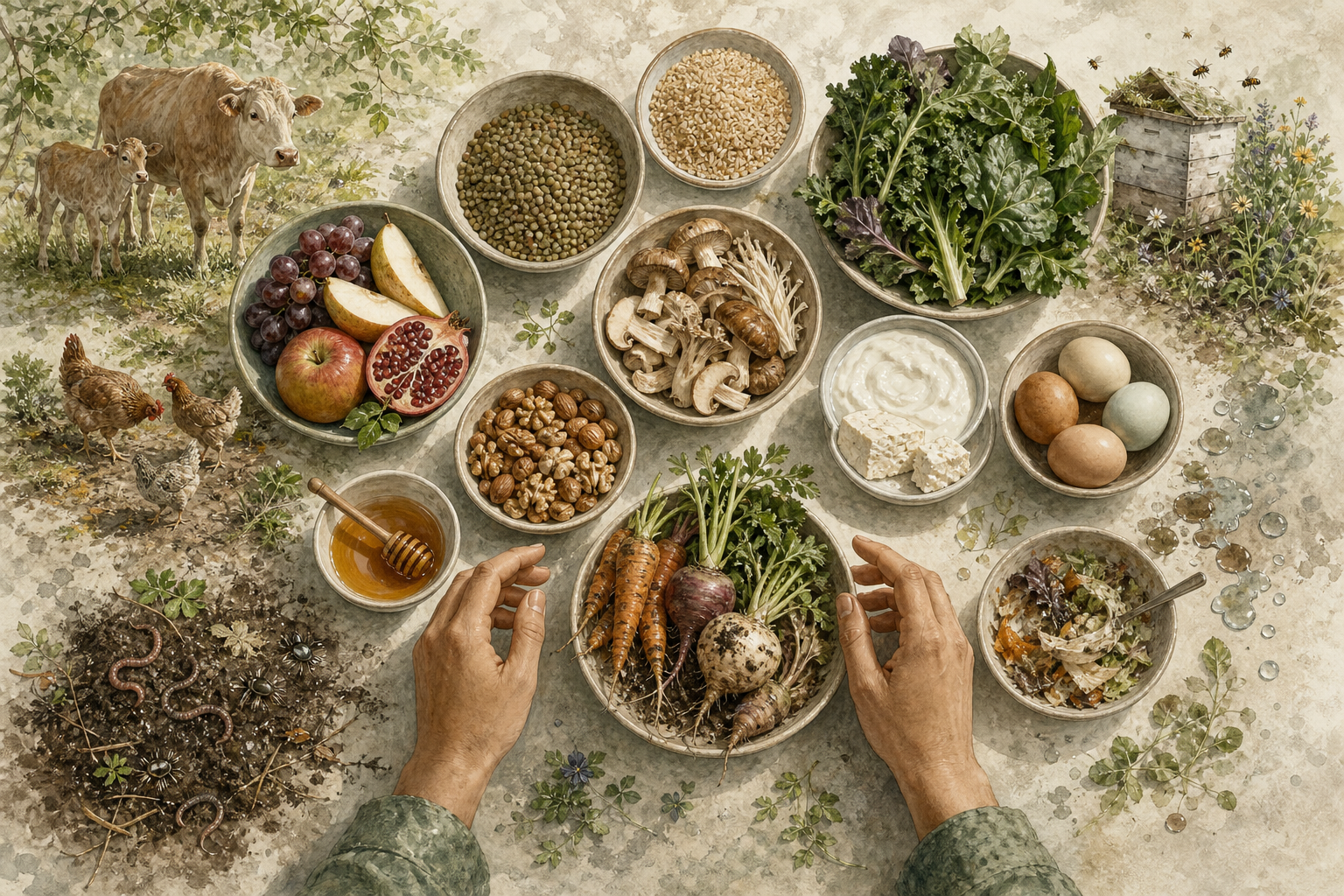
Food makes ahimsa concrete because you choose it repeatedly and place it directly into the body. Yet the labels most people rely on can settle the wrong question. Calling something vegetarian does not reveal how many beings were affected, whether an animal body produced it, how workers and ecosystems were treated, or whether the food was wanted only for appetite and then wasted.
Eggs show why the distinction matters. Most supermarket eggs are unfertilized and contain no developing embryo. Jain abstention does not depend on denying that biological fact. Eggs are still animal-origin foods connected to the reproductive life of hens and to a production system whose ethical concerns include confinement, beak trimming, the culling of male chicks, and the slaughter of hens after their productive period.
A backyard or sanctuary setting can remove some industrial harms, so it should not be described as identical to intensive commercial production. It still does not make an egg part of a conventional Jain diet. The egg remains an animal product, and consuming it maintains a habit organized around an animal’s reproductive output. The relevant question is therefore broader than whether a chick could have developed.
A workable Jain screen for a meal
- Animal origin: Does the food come from an animal body or reproductive process, even if no animal was killed to obtain that individual item?
- Production system: Did confinement, culling, slaughter, or another recurring form of sentient harm make the product commercially available?
- Life disturbed: Does harvesting the ingredient destroy a plant and disturb numerous other life forms? The observant Jain avoidance of root vegetables reflects this wider concern.
- Hidden ingredients: In baked goods and processed foods, read the ingredient and allergen information instead of relying on appearance or an informal vegetarian label.
- Necessity and nutrition: Is the choice supporting a genuine nutritional need, or is greater harm being accepted for taste, novelty, or convenience when a suitable alternative exists?
- Waste: Ordering Jain food and discarding it carelessly still fails the discipline of minimizing harm.
A practical transition begins with foods that are both familiar and nutritionally useful: pulses, dals, soy foods, nuts, and seeds can supply plant-based protein. If you remove several animal-origin foods, do not leave nutrition to guesswork. Fortified foods can be relevant sources of vitamins B12 and D, while individual needs may differ. Children, older adults, pregnant people, and anyone with a medical condition or restricted diet should obtain individualized advice from a qualified clinician or dietitian rather than treating a general religious discussion as a personal nutrition plan.
If your household accepts dairy, abstaining from eggs should not end the inquiry. Awareness can still examine how dairy and other animal-linked foods are produced and whether kinder, workable alternatives are available. The point is not to pretend that every family can make every change at once. It is to avoid freezing a customary boundary when new knowledge reveals preventable harm beyond it.
Food ethics also includes speech. Asking careful questions at a restaurant, declining eggs without embarrassment, and explaining your boundary calmly are consistent with ahimsa. Humiliating a host, attacking another diner’s character, or using diet as a badge of superiority allows pride and anger to enter a practice meant to reduce them. Firmness does not require contempt.
Make the next choice visible enough to change
Ahimsa becomes manageable when you stop trying to certify your whole life as pure and examine the decision immediately in front of you. For a charged news story, a purchase, or a meal, write a short note under these labels: the need, the beings affected, the avoidable harm, the least harmful workable option, the passion present, and the repair or review required.
Then act on the part you can change now. Do not share the unverified claim. Decline the unnecessary purchase. Check the processed-food label. Replace the recurring egg product with a suitable plant-based food. Leave the dangerous situation and seek help before force becomes necessary. Each is a limited act, but each trains the same faculty: vigilant awareness before harm becomes habit.
Return to the choice through pratikraman without inventing excuses or demanding impossible innocence. Ask what you knew, what you avoided knowing, and what lower-harm option has become possible. Your next act is where ahimsa stops being an admired principle and becomes a vow you are actually keeping.
References
- DharmaRenaissance Blog – Complete Jain Perspective on War and Justice: Discover Ahimsa, Self-Defense, and Freedom
- DharmaRenaissance Blog – Complete Guide to Ahimsa: Discover Why Awareness, Not Ignorance, Elevates Jain Living
- DharmaRenaissance Blog – Are Eggs Truly Vegetarian? The Essential Jain Perspective on Ahimsa, Fertility, and Food Ethics
