
On Ram Navami, the Ramayana opens a profound doorway into the Will of Providence. The remembrance of Lord Rama is not merely an annual festival, nor only a devotional sentiment attached to sacred memory. In the Hindu spiritual tradition, Sri Rama Navami becomes a disciplined return to the principles of dharma, surrender, service, and divine order. The worship of Lord Ramachandra with flowers, fruits, incense, prayer, and scriptural hearing places the mind within a larger sacred history, where personal emotion is refined by philosophical insight.
The Ayodhya Kanda of the Ramayana is especially powerful because it confronts the reader with a difficult spiritual truth: even noble intention, royal authority, family affection, and public anguish could not prevent Lord Rama’s exile to the forest for fourteen years. From an ordinary social viewpoint, the exile appears painful and even unjust. Yet from the perspective of dharma and divine arrangement, it reveals a deeper order. The separation from Ayodhya, the anguish of Sita, the loyalty of Lakshmana, and the grief of the citizens all stand within the vast framework often described as the Will of Providence.
This idea of the Will of Providence is not fatalism. It does not ask a human being to become passive, indifferent, or careless. Rather, it asks the practitioner to see life as a field of responsibility under divine supervision. In the Ramayana, Lord Rama does not resist dharma simply because events become painful. He accepts exile without bitterness, honors His father’s word, protects sages, confronts adharma, and upholds maryada. His life demonstrates that surrender to providence is not weakness; it is disciplined alignment with truth.
That reflection naturally leads to a central question in Krishna consciousness and wider Hindu spirituality: if Providence governs the movement of history, what is the proper response of the individual soul, the jiva? Is the deepest purpose of human life merely to protect temporary status, intellectual achievement, institutional position, or social recognition? Or is it to recover the soul’s eternal constitutional relationship with the Supreme Lord through humility, service, and realized knowledge?
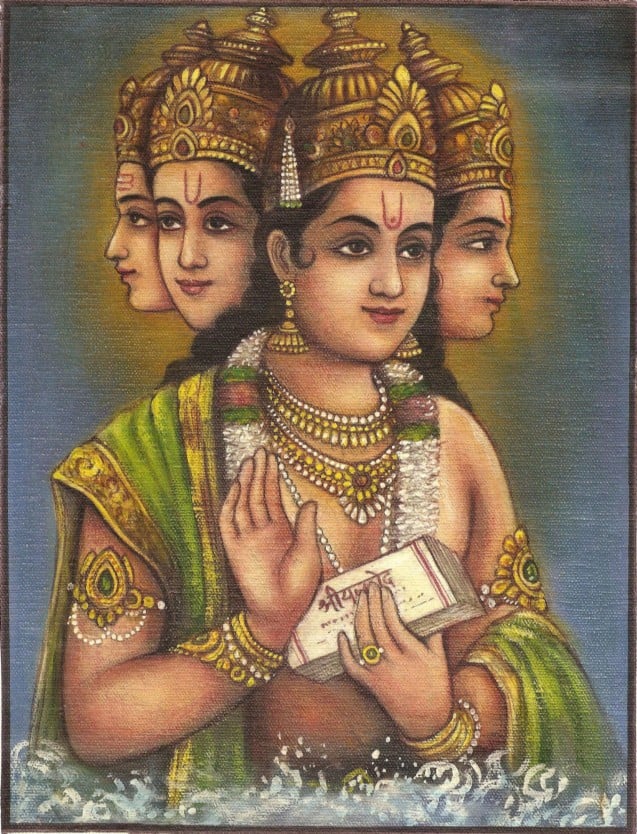
The contrast between four-headed Brahma and Srila Sanatana Goswami offers a remarkable theological lens for answering that question. Both are exalted personalities within the Vaishnava tradition. Both receive instructions from the Lord. Both are connected with immense responsibility. Yet their inner postures reveal a major difference between divine service mixed with subtle pride and divine service grounded in complete humility.
Lord Brahma is not an ordinary being. In the Bhagavata Purana and related Vaishnava literature, Brahma is the first created being within a universe and receives the responsibility of secondary creation. He performs tapasya for a vast duration, receives knowledge by divine grace, and is empowered to organize the universe according to the Lord’s plan. His position is therefore extraordinary. He is revered as a deva, a cosmic administrator, and the progenitor of great sages, including the four Kumaras.
Yet the very greatness of a position can become a test. Brahma’s responsibility as creator of a universe could easily appear absolute from within that universe. A being who receives cosmic instructions, oversees creation, and is honored by other beings may begin to identify the entrusted role with personal supremacy. This is the subtle danger of ahankara, or false ego. The role is real, the empowerment is real, and the service is real; still, the servant may forget that the power belongs to the Supreme.
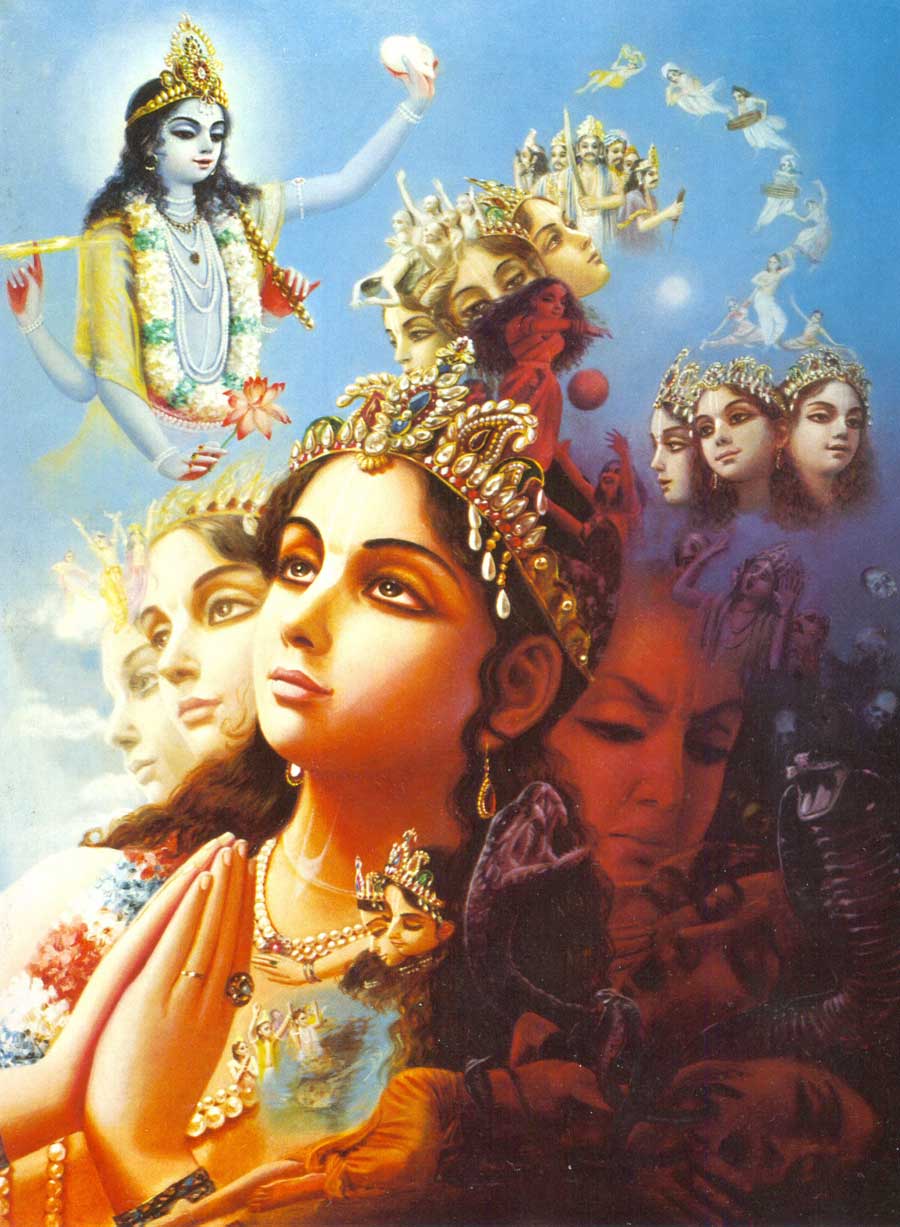
Srila Prabhupada frequently explained the episode in which Brahma visits Krishna in Dvaraka and is asked, in effect, which Brahma has come. The question astonishes the four-headed Brahma because he had assumed that there was only one Brahma. When Krishna later calls many Brahmas from many universes, some with ten heads, some with twenty, some with a hundred, and some with countless heads, the four-headed Brahma understands that his universe is not the measure of divine reality. His position, while exalted, is still contextual.
This episode is deeply philosophical. It does not diminish Brahma’s devotion or cosmic importance. Rather, it places his office within the larger theology of Krishna’s unlimited potency. The universes are many; their sizes and structures vary; their administrative needs differ; and the Brahmas appointed within them possess capacities proportionate to those worlds. The title “Brahma” is therefore a position of service, not an independent claim to ultimate sovereignty.
The lesson is especially relevant for practitioners, scholars, leaders, teachers, and caretakers of religious institutions. A role may be important without being absolute. A responsibility may be sacred without becoming a basis for pride. A person may receive instructions suited to a particular time, place, and circumstance, yet mistakenly universalize those instructions beyond their intended context. Even a great intelligence can become narrow when it is filtered through subtle self-importance.
Here the phrase “diminutive intelligence” should be understood carefully. It is not an insult to Brahma’s intellect. Brahma’s intelligence is cosmic by ordinary human standards. The limitation lies in the conditioned tendency to measure the limitless through the boundaries of one’s own experience. In that sense, even vast intelligence becomes small when it forgets the infinite nature of Bhagavan. Knowledge without humility contracts; knowledge with devotion expands.
Srila Sanatana Goswami stands on the other side of this theological comparison. In Gaudiya Vaishnava history, he is one of the principal Goswamis of Vrindavan and a direct recipient of Lord Chaitanya Mahaprabhu’s instructions. He was entrusted with immense work: to establish sambandha-jnana, write foundational texts, rediscover holy places, articulate Vaishnava practice, and guide future generations in bhakti. His contribution to Hindu scriptures, Vaishnava theology, and devotional practice is incalculable.
Yet when Lord Chaitanya instructed him, Sanatana Goswami did not respond with self-confidence rooted in status or scholarship. He did not assume that intellectual brilliance alone would allow him to carry the mission. Instead, he placed himself in the posture of radical humility. He acknowledged that the Lord’s teachings were like an ocean and that he could not even touch a drop without divine grace. He prayed for the Lord’s blessing so that those instructions would manifest within his heart.
This is one of the most important distinctions in the theology of guru, shastra, and sadhu. Instruction is not merely information. Spiritual instruction must descend into the heart, become realized, and then shape action. One may memorize teachings, quote acharyas, repeat scriptural language, and still fail to embody the meaning. Sanatana Goswami’s humility reveals that true discipleship begins when the practitioner recognizes the distance between hearing an instruction and becoming an instrument of that instruction.
Srila Prabhupada’s explanation of this principle is precise: the acharyas are authorized by higher authorities, and instruction alone does not make one expert. Unless one receives the mercy of the spiritual master and the Lord, the teachings do not fully manifest. This does not reduce the importance of study. Rather, it completes study by joining it with surrender, prayer, purity, and service. The intellect is not rejected; it is purified.
The comparison between Brahma and Sanatana Goswami is therefore not a simplistic contrast between failure and success. It is a subtle study of spiritual psychology. Brahma receives divine empowerment and briefly mistakes the scope of his office. Sanatana Goswami receives divine instruction and immediately confesses his dependence. Brahma’s episode shows how even exalted service can be clouded by the assumption of uniqueness. Sanatana Goswami’s example shows how true greatness hides itself beneath humility.
This has direct relevance for contemporary devotional life. Many practitioners participate in seva, teaching, temple management, publishing, kirtan, community work, scholarship, and public representation of Sanatana Dharma. These services are valuable. Yet the inner motive matters. If service is pursued to protect a relative position, comparison soon enters. Who is more recognized? Who is more capable? Who has authority? Who is being consulted? Such questions easily disturb the heart.
The material world is structured around relativity. A scientist may make an important discovery, only to see later researchers refine, challenge, or supersede it. A leader may hold influence for a time, only to be replaced by another. A scholar may gain recognition, yet future scholarship may revise the field. A community organizer may build something substantial, yet another person may later become more visible. None of these changes are inherently wrong; they are natural features of a temporary world. The problem arises when identity is built upon them.
Brahma’s office itself illustrates this principle. However majestic the post may be, it remains a post within time. It is connected with a particular universe and a particular cosmic cycle. The soul occupying that position is still a servant of the Supreme Lord. The position may change, but the soul’s constitutional nature as servant does not change. This distinction between temporary designation and eternal identity is central to Vedanta and bhakti philosophy.
Sanatana Goswami’s humility points toward the opposite orientation. Instead of trying to preserve temporary importance, the practitioner seeks to revive eternal identity. In that realm there is no competition. The soul’s relationship with Krishna is not duplicated by another’s relationship. One devotee’s service does not erase another’s service. One tradition’s sincere spiritual discipline need not threaten another dharmic path. Within the broader family of dharmic traditions, humility allows diversity to be honored without losing philosophical clarity.
This is important for unity among Hindu, Buddhist, Jain, and Sikh communities as well. Each dharmic tradition possesses its own vocabulary, metaphysics, practices, teachers, and disciplines. Yet all warn, in different ways, against ego, attachment, arrogance, and spiritual forgetfulness. The Vaishnava lesson of Sanatana Goswami’s humility resonates with a wider dharmic insight: knowledge must transform character, not merely decorate the mind. A learned person without humility remains incomplete; a humble seeker becomes capable of receiving deeper truth.
The Ramayana, Bhagavata Purana, Caitanya tradition, and teachings of Srila Prabhupada together present a coherent spiritual anthropology. The human being is not merely a social actor or intellectual agent. The human being is a conscious self whose highest fulfillment lies in restored relationship with the Divine. This restoration requires dharma, disciplined practice, scriptural hearing, association with saintly persons, prayer, and the gradual reduction of false ego.
The expression “Will of Providence” becomes meaningful in this context. Providence does not cancel effort; it purifies the direction of effort. Lord Rama’s exile teaches that one must serve dharma even amid suffering. Brahma’s bewilderment teaches that no position should be mistaken for ultimate identity. Sanatana Goswami’s prayer teaches that sacred instruction must be received with dependence on grace. Together, these teachings form a practical map for spiritual maturity.
For modern readers, the emotional force of this reflection lies in its familiarity. Many people know the uneasiness of being replaced, ignored, misunderstood, or measured against others. Many also know the quiet peace that arises when service is performed without demanding ownership over the outcome. The devotional path does not deny human feeling; it educates feeling. It transforms the anxiety of competition into the steadiness of seva.
Humility, in this sense, is not low self-esteem. Sanatana Goswami did not become ineffective by considering himself dependent. On the contrary, his humility made him one of the most influential acharyas in the Gaudiya Vaishnava sampradaya. His example demonstrates that humility is the highest form of spiritual realism. It sees the self accurately: small before the infinite, yet precious as a servant of the Divine.
The same principle applies to the reception of a guru’s instruction. A practitioner may think, “The instruction has been heard, therefore it has been understood.” But hearing is only the beginning. The instruction must be contemplated, prayed over, applied, tested in character, and allowed to mature. Without this inner evolution, one may outwardly claim obedience while inwardly serving ego, ambition, or insecurity. Sanatana Goswami’s prayer protects the practitioner from that danger.
Pastimes of great personalities are therefore not ornamental stories. They are diagnostic tools for the heart. Lord Brahma’s encounter with Krishna exposes the subtle pride that can remain even after tapasya and divine empowerment. Sanatana Goswami’s submission to Lord Chaitanya reveals the inner condition required for teachings to become living realization. Lord Rama’s acceptance of exile shows the dignity of surrender when Providence arranges events beyond ordinary control.
The practical conclusion is clear. Devotional life becomes steady when the practitioner stops trying to secure permanence in temporary designations and begins to cultivate the eternal identity of service. Patience, perseverance, humility, reverence, and inner peace arise naturally when the aim is constitutional restoration rather than social comparison. Even a small effort in that direction carries spiritual weight, because it is aligned with the soul’s deepest nature.
This does not make the path easy. False ego is persistent. It can enter scholarship, ritual, leadership, family life, activism, temple service, and even renunciation. Therefore prayer remains essential. Prayer asks the Lord to reduce pride, soften the heart, clarify intention, and allow the instructions of guru and shastra to develop within. As conviction deepens, action becomes less reactive and more aligned with the primary goal of pure devotion.
The enduring message is that divine instruction must be received according to one’s true position: not as an owner, competitor, or independent controller, but as a servant seeking grace. In the relative world, questions such as “which Brahma?” and “which universe?” will always arise, because roles differ and capacities vary. In the eternal relationship between the soul and the Supreme Lord, however, there is no rivalry. There is only the unique, unduplicated bond of loving service.
Thus, the contrast between four-headed Brahma and Srila Sanatana Goswami becomes a timeless teaching for Krishna consciousness, Hindu spirituality, and dharmic life more broadly. Cosmic authority without humility can still be corrected by grace. Apparent lowliness joined with surrender can become the channel for profound spiritual revelation. The Will of Providence is best followed not by claiming greatness, but by allowing sacred instruction to awaken in the heart.
Hare Krishna.
Inspired by this post on Dandavats.









Leave a Reply
You must be logged in to post a comment.