
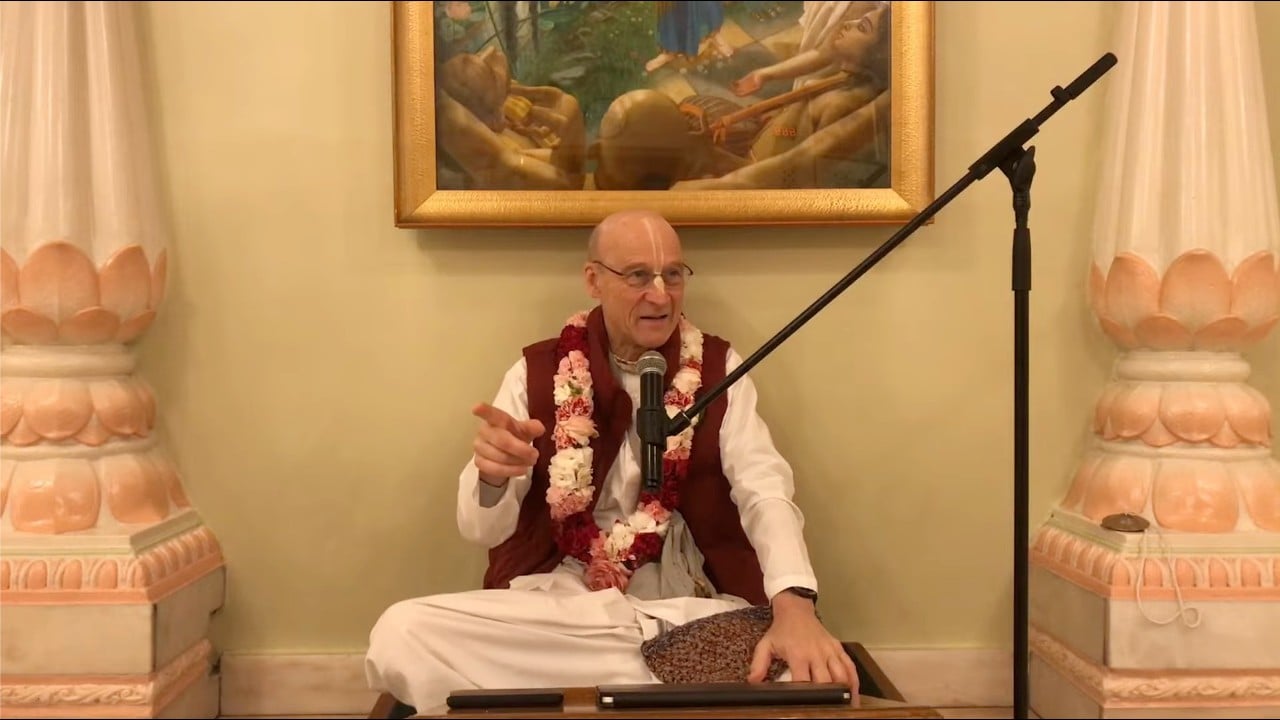
On 27 May 2026, HG Aniruddha Prabhu delivered a focused exposition on Śrīmad Bhāgavatam (SB) 10.6.10 in Melbourne, situating the verse within the Tenth Canto’s early Vraja narratives and drawing out rigorous insights relevant to contemporary practice across Dharmic traditions.
SB 10.6 centers on the Pūtanā episode, where a demoness disguises maternal care to administer poison to the infant Kṛṣṇa, only to be liberated by His touch. This chapter’s arc—domestic protection rites, sudden incursion of danger, decisive divine intervention, and communal recovery—distills the Bhāgavata’s vision of grace operating within everyday village life.
Within this dramaturgy, verse 10 functions as an early hinge, gesturing to the paradox that apparent threats cannot eclipse the protective potency of Kṛṣṇa or the efficacy of sincere rites performed by Vraja’s caregivers. The verse marks a transition from ritual safeguarding to the confrontation that tests, and ultimately verifies, that protective culture.
Gaudiya Vedānta consistently underscores that divine grace can transform even hostile contact into salvific outcome; the same embrace that neutralizes poison elevates Pūtanā beyond punitive karma. The chapter thereby complements Bhagavad-Gītā’s assurance that unwavering devotion reconfigures destiny, not by denying causality but by superimposing compassion upon it.
From a rasa perspective, vātsalya-rasa saturates the narrative. Yaśodā and the gopīs embody an uncalculated, protective tenderness, while Kṛṣṇa reciprocates in a childlike form that invites service rather than awe. The aesthetics of this love frame the metaphysics: intimacy, not intimidation, is the Bhāgavata’s chosen medium for revealing the Absolute.
Ethically, the episode invites a precise reading of intention (cetanā) and contact (saṁyoga). Buddhist ethics highlights cetanā as the engine of karma; Jain dharma insists on vigilant ahiṁsā in thought, word, and deed; Sikh tradition emphasizes nadar—grace—as a gratuitous uplift beyond strict merit. SB 10.6 holds these strands together: intention matters profoundly, yet grace can exceed and transfigure it.
Symbolically, the poisoned breast conjoins two archetypes—nourishment and harm—mirroring the ambivalence of a mind where wholesome and unwholesome impulses intermingle. Kṛṣṇa’s act of drawing out Pūtanā’s life-air can be read as bhakti’s capacity to extract the very vitality of anarthas, leaving only the substrate capable of relationship and redemption.
Vraja’s protective practices—mantras, auspicious markings, and communal vigilance—are not portrayed as magical guarantees but as participatory expressions of trust. In households today, such samskāras can be approached as culture-bearing disciplines: they stabilize attention, cultivate reverence, and align a family’s inner climate with dharma.
Classical commentators—Śrīdhara Svāmī (Bhāvārtha-dīpikā), Jīva Gosvāmī, and Viśvanātha Cakravartī—treat Pūtanā’s liberation as a canonical proof-text for the Bhāgavata’s doctrine of extraordinary mercy. Even feigned maternal service directed toward Kṛṣṇa evokes a response appropriate to true motherhood, a hermeneutic key for understanding why this chapter is repeatedly cited in the Bhakti Tradition.
Two doctrinal streams converge here: the inviolability of karma and the freedom of compassion. The first preserves moral intelligibility; the second safeguards hope. Their conjunction models a mature Sanātana Dharma that is intellectually responsible yet pastorally generous.
The villagers’ collective response to shock—assessment, ritual closure, and reaffirmation of daily duties—offers an early template for trauma-aware spirituality. The Hare Krishna Movement’s communal kīrtana and study circles operationalize this pattern today: shared remembrance, shared meaning-making, shared resilience.
Practical takeaways emphasized in the class include steady nāma-japa, cultivating a home culture of prasāda and kīrtana, and viewing difficulties as prompts for deeper shelter rather than occasions for fatalism. These disciplines are portable across settings and resonate with the broader Dharmic repertoire of meditation, ethical restraint, and service (seva).
Read in a spirit of inter-Dharmic solidarity, SB 10.6.10 affirms values cherished in Hinduism, Buddhism, Jainism, and Sikhism: compassion over cruelty, intention purified by awareness, communal care, and the readiness to see reform where once there was only fault. Such readings strengthen a shared civilizational ethic without diluting distinctiveness.
At the level of poetics, the chapter juxtaposes domestic intimacy with cosmic stakes, achieving a narrative compression that is characteristic of the Bhāgavata. The result is a story that can be told to children yet withstands the scrutiny of philosophers, a dual address that has sustained its transmission across centuries.
The Melbourne session (27 May 2026) thus presented SB 10.6.10 as both a theological keystone and a practical guide: a demonstration that divine grace is not sentimental license but transformative power; that familial love, rightly oriented, becomes yoga; and that unity across Dharmic traditions is best achieved by recognizing shared commitments to compassion, truth, and disciplined practice.
Inspired by this post on Dandavats.










Leave a Reply
You must be logged in to post a comment.