Dr. I. J. Singh is remembered as a luminous presence whose work in Sikh thought, public reasoning, and community service left an enduring imprint on the Sikh Community and the wider constellation of Dharmic traditions. His legacy is best understood as an integrated wholescholarship informed by faith, faith expressed through seva, and seva guided by intellectual rigor. In reflecting on his life, many recall the quiet discipline, ethical clarity, and warmth with which complex ideas were made accessible, and with which interfaith dialogue was made both principled and humane.
The triad scholarship, faith, and service did not merely coexist; it functioned as a coherent method. Scholarly analysis clarified practice; devotional commitments deepened inquiry; and public service tested both in the crucible of lived reality. That synthesis resonates with the Sikh vision of miri-piri, where spiritual insight and civic responsibility reinforce one another. In that sense, the legacy at hand is not only biographical; it is methodical, offering a replicable framework for community leadership across generations and geographies.
On scholarship, the distinctive contribution lay in treating Sikhism as a living knowledge tradition rather than a static archive. Close reading of concepts such as ik oankar, shabad guru, sarbat da bhala, and the discipline of Naam was paired with sociological attentiveness to diaspora life, youth formation, and institutional ethics. The method privileged hermeneutic humilityletting the text and tradition speak before theorizing about themwhile remaining alert to contemporary questions around identity, governance, and inclusion. Such work modeled how academic perspectives can serve the sangat, and how public writing can honor canons without becoming insular.
A hallmark of this approach was definitional clarity. Terms central to Sikh practiceseva, sangat, pangat, ardaswere framed with precision, historical anchoring, and a sensitivity to context. That clarity reduced needless polemics, strengthened Interfaith Dialogue, and advanced a sober understanding of what binds communities together. It also illuminated how Sikh ethics travel across time and place, shaping conduct in the family, workplace, and public square. Readers repeatedly observed that this precision never lapsed into pedantry; it was employed in the service of understanding and unity.
Equally instructive was the ethic of evidence and accountability. Arguments were advanced with transparent reasoning, charitably stating opposing views before offering critique, and foregrounding primary sources where possible. This disposition exemplified nimrata (humility) in scholarshipan antidote to the intellectual hubris that often shadows public discourse. It also modeled how the Sikh commitment to truth (sat) is not only doctrinal but procedural: the how of knowing is inseparable from the what that is known.
On faith, the through-line was practice. The teachings of the Guru Granth Sahib were not abstract ideals but guiding norms for everyday life. Naam japna, kirat karni, and vand chhakna were presented as mutually reinforcing commitments: contemplative depth, honest labor, and distributive ethics. As a result, theological reflection remained anchored in lived realitieswhat families teach their children, how professionals carry integrity to work, and why community institutions must mirror the virtues they proclaim.
The miri-piri principle emerged repeatedly as a practical design for ethical citizenship. Spiritual discipline (piri) without worldly responsibility risks quietism; worldly engagement (miri) without spiritual anchoring courts vanity and factionalism. Holding them together produces a stable center of gravity for civic life, making space for courageous speech, compassionate listening, and principled compromise. This balance was conveyed not as a slogan but as an operating system for decision-making under moral stress.
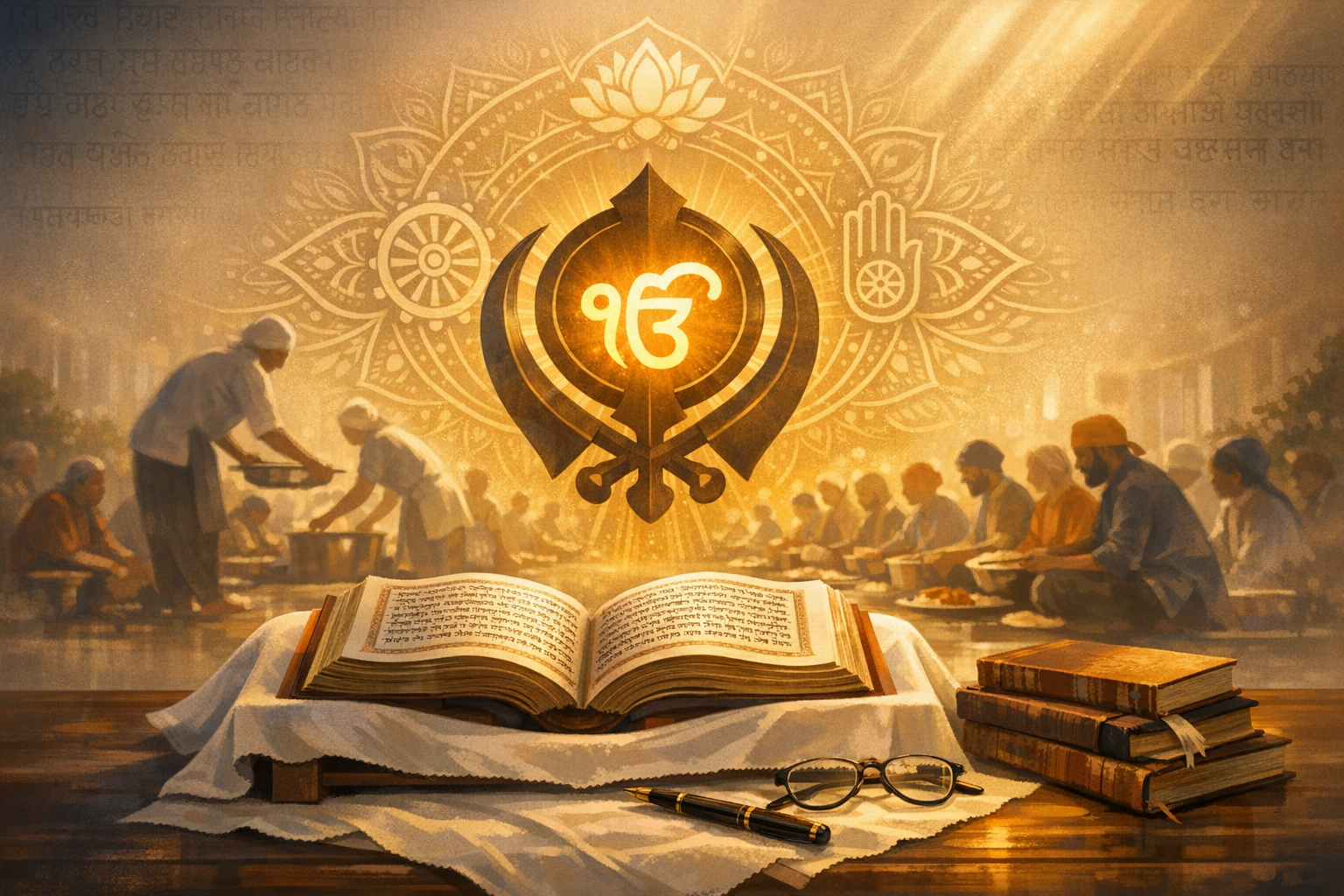
Servicesevawas treated as both sacred duty and social technology. Langar, for instance, was interpreted as applied theology: a ritualized commons that flattens hierarchy, nourishes bodies, and trains communities in mutuality. In diaspora contexts, that lens helped institutions reimagine kitchens as resilience hubs, gurdwaras as cultural schools, and volunteerism as structured pedagogy for the young. Seva was thus not an occasional act but a curriculum in belonging, responsibility, and joy.
Among the most compelling aspects of this legacy is the commitment to Dharmic unity. Without erasing difference, bridges were built across Hinduism, Buddhism, Jainism, and Sikhism around shared ethical anchorsahimsa in Jainism, karuṇā in Buddhism, seva-bhāva in Hindu traditions, and sarbat da bhala in Sikhism. Anekāntavāda’s many-sidedness helped frame respectful disagreement; Hindu conceptions of Ishta illustrated how diverse paths can be held within one civilizational family; Buddhist mindfulness practices illuminated the skill of attention; and Sikh seva tied contemplation to action. The outcome was not syncretism but consonance: a recognition that these streams, while unique, flow toward common goods.
Interfaith cooperation followed from that conviction. The stance was neither defensive nor triumphalist; it was dialogical and exacting. Good dialogue, it was argued, honors what is ultimate for each tradition while collaborating on proximate goalseducation, dignity, and justice. That view advanced Interfaith Dialogue from event-based courtesy to norm-based partnership, strengthening social trust and lowering the temperature of public debate.
A sustained concern for the Indian American Community and other global diasporas animated this vision. Migration creates both opportunity and strain: languages risk erosion, youth face hyphenated identities, and institutions must adapt while holding memory intact. Work in this area traced how Gurmukhi literacy, sabad-centered music, and generational mentorship fortify identity without isolating it. The lesson was simple and demanding: when communities invest in transmissionof language, arts, and ethicsthey unlock confidence and openness rather than fear.
Pedagogically, accessibility remained a core value. Public essays and talks embraced plain language, framed questions before answers, and favored stories that carried theory in their arc. This communicative disciplinerooted in empathy for the readerbroadened reach without thinning substance. It also gave younger Sikhs and other Dharmic readers a model of how to argue without anger and how to care for truth without contempt.
Institutional ethics received steady attention. Gurdwara governance, diaspora nonprofits, and cultural organizations thrive when they adopt transparent finances, responsive leadership, and clear succession pathways. The legacy emphasized that accountability systems are not merely managerial; they are moral. By aligning structures with values, communities preempt crises, build credibility, and liberate energy for creativity and seva.
Public health, mental well-being, and crisis response were read as arenas where Sikh ethics shine. The habit of showing upquietly, consistently, and without fanfaretranslates scriptural commitments into measurable good. In these domains, seva extends from kitchens to clinics, and from emergency relief to long-term companionship. The message remained consistent: the measure of piety is not volume but fruit.
In an age of information overload, the legacy also offered a communication ethic. Avoid outrage addiction; reward nuance; verify before amplifying. Such counsel, while simple, is rareand deeply aligned with the Sikh suspicion of haumai (ego) and the Dharmic wariness of unexamined certitude. Practiced widely, this ethic would transform digital spaces from arenas of demolition into workshops of understanding.
For communities seeking a forward path, the legacy suggests a blueprint. Cultivate scholarship that listens; design seva that scales; build institutions that teach by example; and nurture Interfaith cooperation that dignifies all. Invest in language and music, mentor the young rigorously, and keep miri-piri balanced in personal and public life. These are not slogans for commemorations; they are tasks for tomorrow morning.
What remains most moving, according to many who learned from his work, is the combination of steadiness and tenderness. There was room in the reasoning for those who doubted, time in the agenda for those who struggled, and respect in the tone for those who disagreed. That human texturepatience without passivity, conviction without crueltycontinues to teach long after words fade.
Remembering Dr. I. J. Singh, then, is to remember a way of seeing: rigorous, generous, and oriented toward sarbat da bhala. It is to affirm that Sikh scholarship can be both academic and devotional, that seva can be both compassionate and strategic, and that Dharmic unity can be both principled and practical. In carrying forward this workwithin the Sikh Community and across Hinduism, Buddhism, and Jainismfuture generations inherit not only conclusions but a craft: how to think, how to serve, and how to hope together.
Inspired by this post on SikhNet – News.