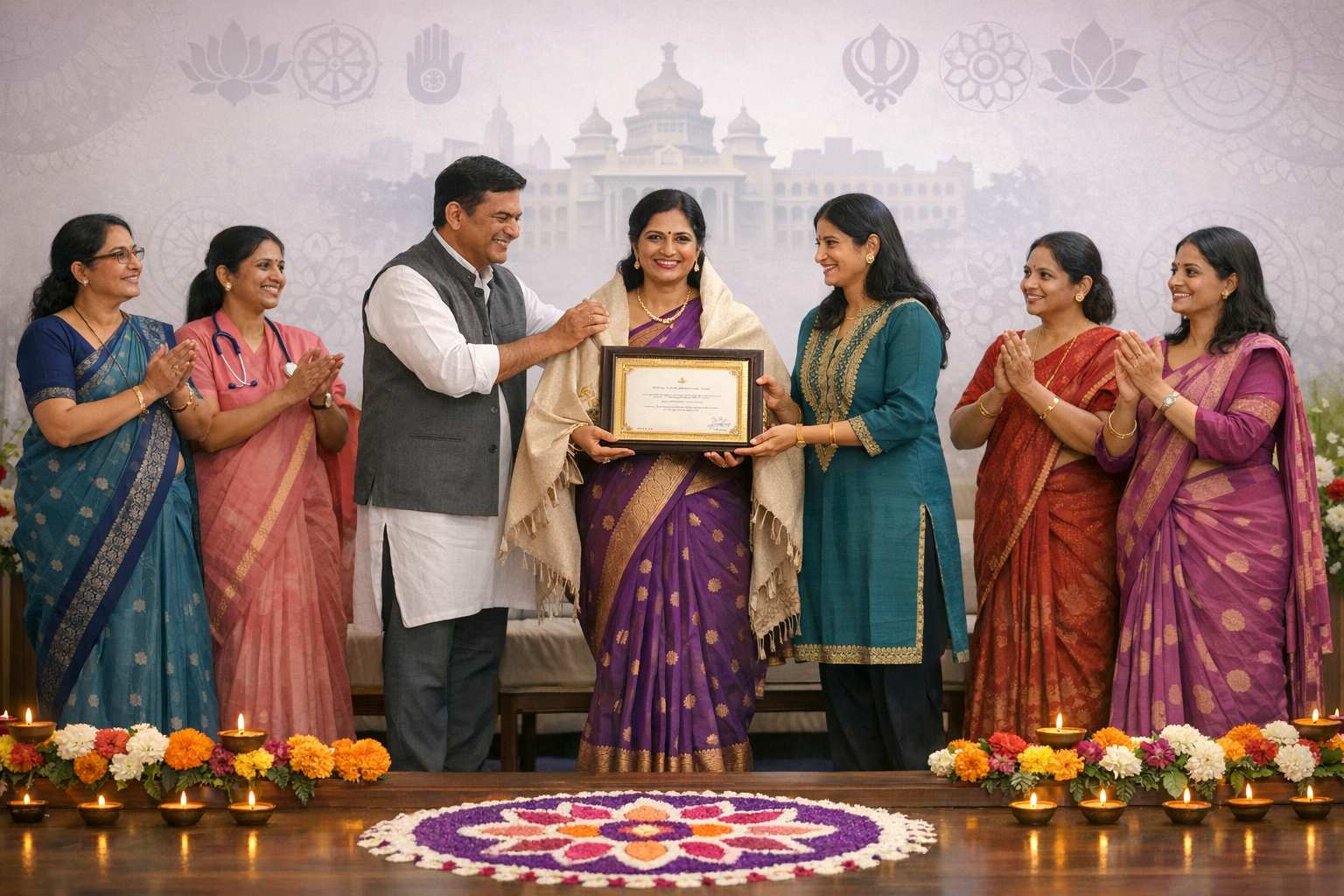
On International Women’s Day, Smt. Bhavya Gowda of the Ranrangini wing of Hindu Janajagruti Samiti (HJS) was honoured alongside 100 other women by the Upkar Welfare Association in Ullal, Bengaluru. The recognition celebrated her community-centered leadership and underscored the growing public acknowledgment of women’s contributions to civic life, cultural stewardship, and grassroots welfare in Bengaluru. By elevating a diverse cohort of local changemakers, the event highlighted how neighborhood-level institutions can catalyze societal progress and strengthen inclusive community networks.
Ranrangini, the women’s wing associated with HJS, is recognized for mobilizing volunteers around safety awareness, legal and civic literacy, family well-being, and values-based community service (seva). While specific initiatives vary by locality, the consistent emphasis is on empowering women to lead with clarity, compassion, and confidencequalities essential for sustaining community resilience in India’s rapidly urbanizing environments. The acknowledgement of Smt. Bhavya Gowda in Ullal, Bengaluru, offered a public testament to this sustained volunteerism and the wider ecosystem of support it builds.
The Upkar Welfare Association’s decision to honour 100 women in a single civic ceremony communicated a powerful message: inclusive recognition is itself a developmental tool. By celebrating educators, health workers, social volunteers, entrepreneurs, and cultural custodians in one forum, the Association strengthened intersectoral visibilitybridging individuals and institutions that often work in silos. In practical terms, such city-level recognition can seed partnerships, enable referrals, and direct attention to local priorities that benefit from collective problem-solving.
International Women’s Day has long functioned as a platform to spotlight equity, leadership, and access to opportunity. In India, it often takes on a distinctively community-grounded tone, with neighborhood organizations, welfare associations, and volunteer groups recognizing women whose work sustains the social fabric. Public acknowledgements of this kind complement policy conversations by placing emphasis on lived realitiessafety in public spaces, confidence in civic participation, and robust pathways for skill development and mentorship.
A dharmic lens enriches this recognition. Across Hinduism, Buddhism, Jainism, and Sikhism, shared ethical valuesseva (service), daya/karuṇā (compassion), satya (truth), and ahiṁsā (non-violence)converge to inform a vision of inclusive social progress. Honouring women leaders like Smt. Bhavya Gowda affirms the principle that societal well-being depends on cultivating Shakti-inspired leadership and cross-tradition solidarity. In this frame, women’s empowerment is not a discrete programmatic goal; it is integral to a harmonious, plural, and ethically grounded civic life.
From a community development perspective, initiatives aligned with Ranrangini can be understood through a simple theory-of-change logic. Inputs include volunteer time, local partnerships, and modest resource pools. Activities encompass safety workshops, legal-awareness sessions, neighborhood dialogues, cultural education, and health orientations. Outputs are measured as trained participants, neighborhood meetings held, and referrals made to support services. Over time, outcomes appear as higher confidence levels among women, improved local safety norms, expanded civic voice, and inter-household cooperationcollective gains that reinforce community trust and resilience in Bengaluru’s urban localities.
The technical value of such recognition lies in its network effects. Public acknowledgment enhances volunteer retention, increases the perceived legitimacy of community actors, and draws the attention of allied professionalshealth workers, teachers, legal advisorswhose expertise can strengthen program impact. In settings like Ullal, Bengaluru, where grassroots leadership often operates with lean resources, the social capital generated by a civic honour can translate directly into more responsive programming and better outreach to households most in need.
Leadership of this nature is intergenerational by design. It models active citizenship to adolescents and youthdemonstrating that women’s leadership in safety, education, and culture is not only possible but encouraged. It also convenes elders as repositories of memory and wisdom, linking tradition to contemporary needs. The recognition of Smt. Bhavya Gowda, therefore, signals an educational function beyond the award itself: it showcases a living syllabus of courage, care, and competence for families and neighborhoods to emulate.
Ullal, Bengaluru, illustrates the importance of place-based strategy. Urban wards contain distinct social networks and logistical constraints; what succeeds in a central business district may not directly apply to a peripheral neighborhood. Welfare associations that localize International Women’s Day celebrations help tailor solutions to contextbe it last-mile safety, public transport access, school-community engagement, or cultural programing that reaffirms shared values while remaining open and inclusive to diverse dharmic traditions.
Practically, community groups inspired by this event can adopt a replicable approach: map neighborhood actors; identify women leaders across sectors; establish transparent selection criteria; host an inclusive, secular-spirited recognition; and document outcomes for continuous improvement. This simple cycle of mapping, selection, celebration, and learning builds a reliable feedback loop that aligns with Sustainable Development Goal 5 on gender equality while keeping solutions grounded in local realities and dharmic ethics.
For Bengaluru’s civic ecosystem, the broader implication is clear. Honouring women who advance safety, education, cultural continuity, and social inclusion nurtures unity across Hindu, Buddhist, Jain, and Sikh communities. It emphasizes common ethical anchorsseva, karuṇā, ahiṁsā, and satyarather than difference. In doing so, it supports the city’s composite heritage and strengthens a shared civic vocabulary that enables collaborative action across traditions without diluting the authenticity of any one path.
In sum, the Upkar Welfare Association’s recognition of 100 women in Ullal, Bengalurufeaturing Smt. Bhavya Gowda of Ranranginidemonstrates how a thoughtfully designed, community-centered International Women’s Day observance can produce durable social value. It validates quiet excellence, activates new partnerships, and elevates a model of leadership aligned with dharmic unity. As such recognitions proliferate, they can help institutionalize women’s leadership as an everyday civic expectationconsolidating a resilient, compassionate, and inclusive public culture for Bengaluru and beyond.
Inspired by this post on Hindu Jagruti Samiti.