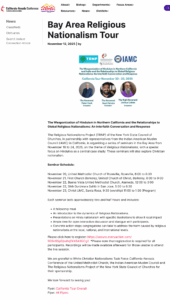
Across California, a planned tour involving the New York State Council of Churches and the Indian American Muslim Council (IAMC) has ignited debate about the boundaries of robust civic critique and the risk of stigmatizing entire faith communities. Hindu, Buddhist, Jain, and Sikh stakeholders express concern that programming presented under a #Interfaith banner may inadvertently conflate political analyses with judgements about dharmic beliefs and identities, especially at a time when reported anti-Hindu incidents are rising.
Dharmic traditions share a long record of pluralism, nonviolence, and philosophical openness. In this context, events perceived as “policing” Hindu identity or prescribing what a faith “should be” can feel exclusionary. A constructive approach respects internal diversity within Hinduism, Buddhism, Jainism, and Sikhism while distinguishing clearly between debates on contemporary politics and the lived reality of religious practice.
Available indicators underscore the need for sensitivity. The California Civil Rights Department (CRD) 2024 report documented anti-Hindu bias incidents at levels reportedly second only to #antisemitism, and advocates note that data presented in 2025 suggest four consecutive years of increases. Community organizations, including the Coalition of Hindus of North America (CoHNA), argue that this trend heightens the responsibility of interfaith partners to avoid frameworks that could fuel stereotypes or social hostility.
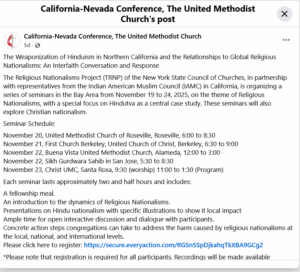
For many dharmic families, the concerns are tangible. Parents describe schoolyard bullying tied to religious symbols, students report mischaracterization of dharmic practices in classrooms, and places of worship worry about vandalism or targeted harassment. These experiences do not call for silence; they call for data-driven dialogue, careful language, and transparent methodologies that avoid essentializing any community.
Interfaith work is most impactful when it includes: (1) a broad spectrum of Hindu, Buddhist, Jain, and Sikh voices, including practitioners, scholars, and youth; (2) explicit differentiation between political ideology and religious identity; (3) community safeguards to prevent generalization; and (4) independent facilitation that prioritizes safety, accuracy, and mutual respect. When these elements are in place, #Interfaith engagement becomes a vehicle for understanding rather than a platform for suspicion.
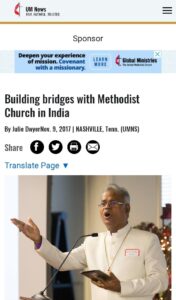
Principled pluralism also means resisting the temptation to vilify any faith. Christians and Muslims are essential partners in safeguarding civic peace, just as Jewish communities are allies in countering rising #antisemitism. A consistent ethical standardopposing bigotry against Hindus, Muslims, Christians, Jews, Sikhs, Buddhists, Jains, and others alikestrengthens the moral credibility of advocacy and protects vulnerable groups.
Practical next steps can help communities move from anxiety to agency: encourage accurate incident reporting to the CRD and local authorities; invest in data literacy to contextualize trends; build dharmic coalitions that advance shared educational resources; engage school districts to improve curricular representation; and invite churches, mosques, synagogues, and temples to co-create safety protocols for public events. These actions reduce polarization while elevating the voices of those most affected.
California can model a path forward: evidence-led dialogue, unequivocal rejection of hate, and solidarity among dharmic traditions grounded in compassion and civic responsibility. As discourse around the tour continues, the measure of success will not be rhetorical victories but the safety, dignity, and inclusion of Hindu, Buddhist, Jain, Sikh, Christian, Muslim, and Jewish neighbors alike. Stop the hateand center facts, empathy, and dharmic unity.
Inspired by this post on Hindu Human Rights Blog.