
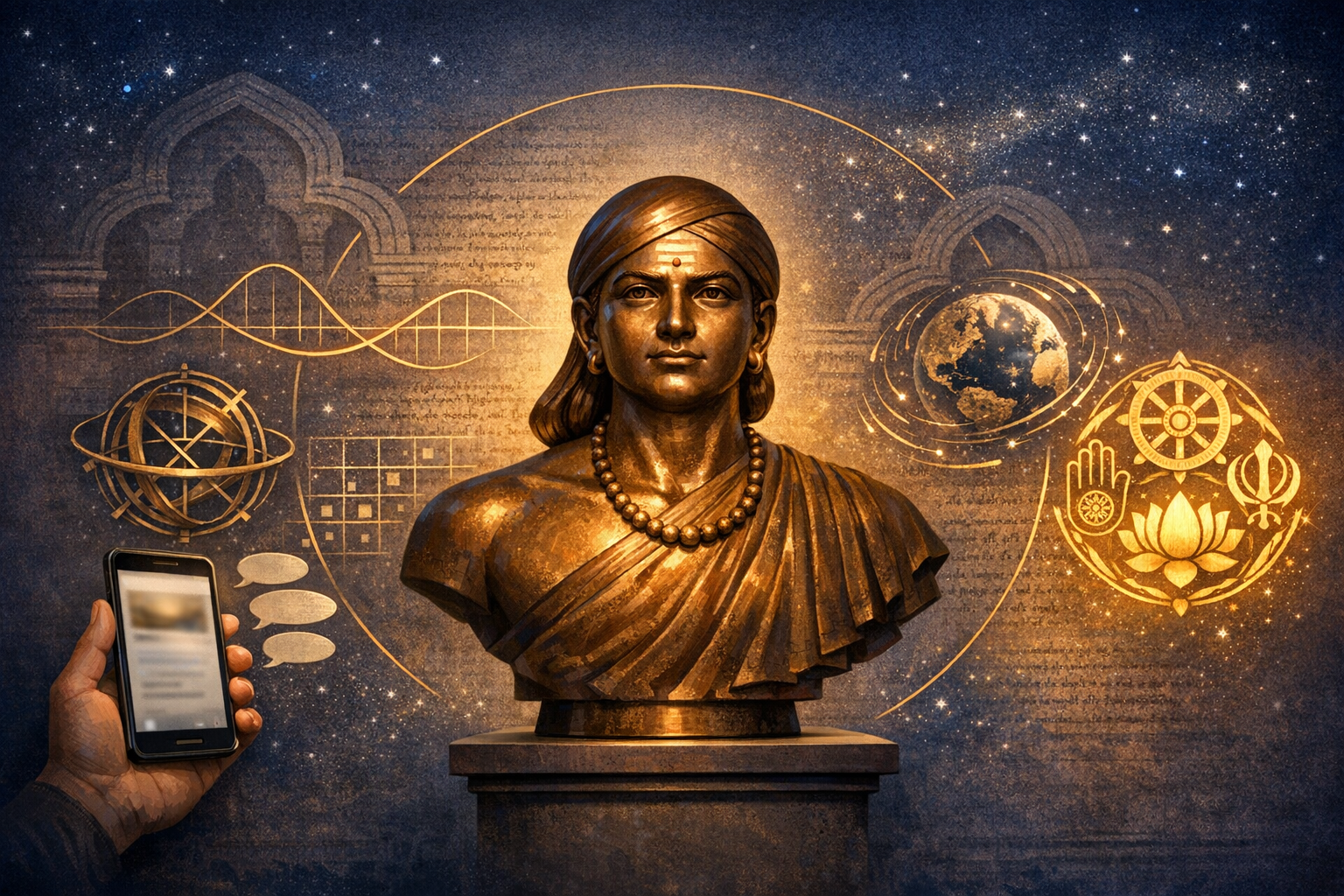
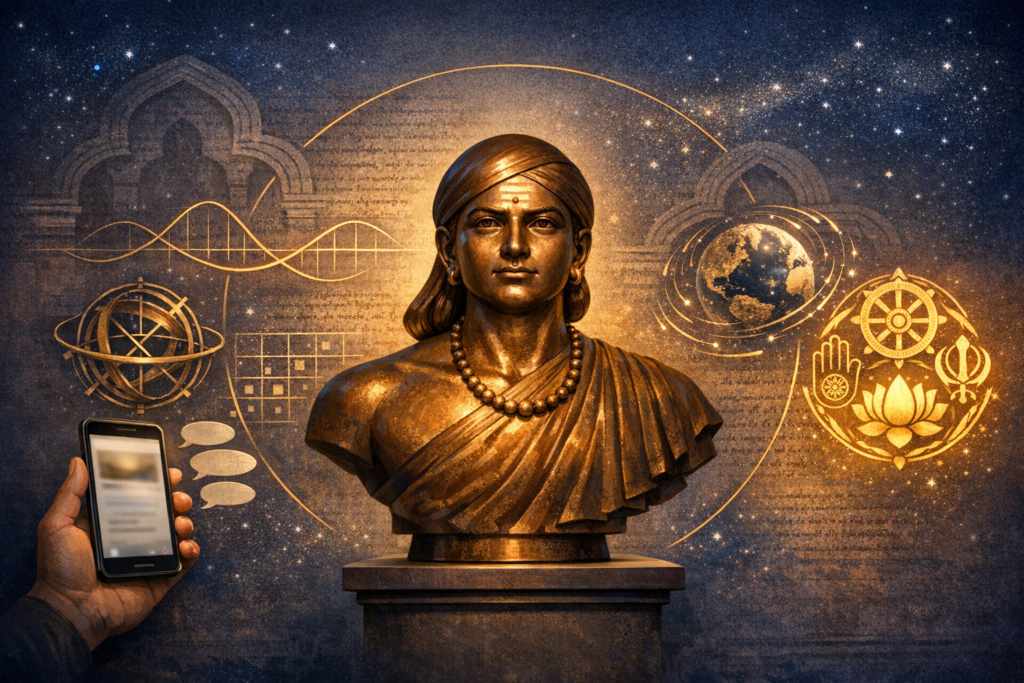
On 13 June 2026, discussion intensified online around an Amazon India advertisement that featured Aryabhata, one of the most celebrated Indian mathematicians and ancient astronomers. A section of viewers, including some Hindu groups, perceived the creative as disrespectful to India’s knowledge heritage and called for a boycott. Beyond the immediate headline, the moment invites a deeper, fact-based examination: Who was Aryabhata in the history of mathematics and astronomy, what do Indian advertising and consumer-protection norms say about cultural sensitivity, and how can India’s brands communicate in ways that honor Dharmic plurality—Hinduism, Buddhism, Jainism, and Sikhism—while engaging contemporary audiences with creativity and care?
The stakes feel personal for many. When revered figures of learning become the subject of commercial humor or simplification, students, educators, and tradition-bearers may experience the portrayal as a diminishment of a living legacy. For those who grew up encountering trigonometric tables for the first time, or discovering that the Earth’s rotation was reasoned in classical Indian astronomy long before modern textbooks, Aryabhata embodies intellectual courage, methodological rigor, and civilizational continuity. It is understandable, then, that any depiction perceived as flippant can evoke protectiveness—an impulse rooted not in outrage for its own sake, but in a desire to safeguard cultural memory and inspire future generations.
Aryabhata (c. 476–550 CE) authored the Aryabhatiya in 499 CE, a compact, verse-based treatise whose four sections—Ganita (mathematics), Kala-kriya (reckoning of time), Gola (astronomy/spherical geometry), and a prologue—shaped the trajectory of Indian mathematics and astronomy. Among Indian mathematicians, Aryabhata’s stature rests on clear advances: a near-correct value of π (pi) at approximately 3.1416; tabulation and use of jya (sine) values at fine angular intervals; and the “kuttaka” (pulverizer) method for solving linear indeterminate equations of the form ax + by = c, which anticipates systematic procedures akin to the Euclidean algorithm. In astronomy, Aryabhata articulated Earth’s daily rotation to explain the apparent motion of the stars, refined parameters for planetary periods, and estimated the length of the sidereal year with striking accuracy. His work, composed in Sanskrit verse, exemplifies how brevity and mnemonic structure can coexist with technical depth—an approach that shaped pedagogical traditions for centuries.
Public discourse often credits Aryabhata with the “invention of zero”; the scholarly picture is more nuanced. The zero symbol’s earliest securely dated epigraphic appearance in India is from the 9th century (Gwalior inscription), while manuscript evidence such as the Bakhshali manuscript (with layers carbon-dated in recent studies to early centuries CE) suggests the evolution of zero as a placeholder earlier. The leap to zero as a number with arithmetic rules is widely attributed to Brahmagupta (7th century) in the Brahmasphuṭasiddhānta. Aryabhata’s role remains foundational: he advanced positional reasoning and a sophisticated numeral culture (including syllabic numerations), laying intellectual groundwork that later coalesced into formal operations with śūnya (zero) and negative numbers in Indian mathematics. Clarifying this lineage does not diminish Aryabhata; rather, it illumines the collaborative, multi-generational nature of discovery in the history of mathematics.
Technically, the Aryabhatiya’s mathematical contributions are profound. His sine-difference tables implicitly encode trigonometric relations. By defining jya (sine) and kojya (cosine) values at intervallic steps across a quadrant, Aryabhata made trigonometric calculation feasible for astronomical applications, navigation, calendrics, and eclipse computation. The “kuttaka” (pulverizer) method systematized solutions to linear Diophantine problems—essential, for example, to modular congruences in calendar arithmetic. These methods reflect a mature understanding of algorithmic processes and iterative refinement—ideas central to modern computational thinking.
In astronomy, Aryabhata proposed that Earth’s daily rotation accounts for diurnal motion, a conceptual pivot that reduces celestial mechanics to relative frames—a cornerstone of scientific explanation. He gave refined values for synodic and sidereal periods, enabling accurate prediction of eclipses through geometric models. His estimate for the sidereal year—approximately 365 days, 6 hours, 12 minutes, and 30 seconds—lies within minutes of the modern value, achieved without telescopes or precision instrumentation. Such results testify to careful observation, error analysis, and cumulative scholarly exchange across generations of ancient astronomers in India.
Given this background, why did an advertisement provoke backlash? In India’s media landscape, brand communications that feature sacred symbols, historical figures, or practices tied to community identity can quickly become flashpoints if perceived as trivializing, commercializing, or anachronistically satirizing what communities hold dear. The line between playful evocation and perceived denigration is thin; when crossed, audiences may mobilize via online platforms with calls for accountability or boycotts. While specific creative decisions in the Amazon India spot may have been intended as humor or simplification, the response underscores an enduring axiom of advertising ethics: cultural sensitivity is not a constraint on creativity; it is a condition for trust.
India’s self-regulatory and legal environment already encodes this expectation. The Advertising Standards Council of India (ASCI) Code advises that advertisements should not deride or be likely to cause widespread offense to any race, caste, creed, or community, and should respect the beliefs and practices of consumers. The Central Consumer Protection Authority (CCPA) Guidelines (2022) strengthen accountability for misleading and objectionable advertising. Additionally, the Cable Television Networks (Regulation) framework and the Programme/Advertising Code emphasize that content must not offend religious sentiments. Criminal law, notably Section 295A of the Indian Penal Code, penalizes deliberate and malicious acts intended to outrage religious feelings; however, jurisprudence also emphasizes intent, context, and thresholds. For advertisers, the operative principle is pragmatic: build internal guardrails far upstream of any legal boundary.
Several high-visibility campaigns in recent years show how quickly sentiment can polarize when commercial storytelling intersects with tradition. This is not unique to any one brand or community; rather, it reflects rapid digital amplification, fragmented attention, and the emotional salience of identity in public life. The lesson for responsible brands is to approach civilizational icons—whether Aryabhata, Varāhamihira, Brahmagupta, Bhāskara, or figures honored across Dharmic traditions—with historical accuracy, semiotic care, and participatory listening.
Constructive resolution begins with acknowledging why Aryabhata matters beyond textbook footnotes. In Hindu, Buddhist, Jain, and Sikh milieus, the pursuit of knowledge is sacred service. Mathematics and astronomy thrived across monasteries, pathshalas, and universities such as Nalanda and Vallabhi; Jain mathematician Mahāvīra (9th century) wrote the Gaṇita Sāra Saṅgraha; later scholars like Bhāskarācārya II refined results on cyclicity, series, and astronomical constants. Sikh traditions, too, enshrine learning, inquiry, and ethical living as inseparable. Recognizing this shared Dharmic esteem for vidyā (knowledge) can help reframe grievances from zero-sum outrage to positive guardianship: the goal is not censorship but fidelity—ensuring that commerce communicates with reverence when invoking civilizational capital.
Even without adjudicating the precise storyboard of the advertisement, general semiotic pitfalls are well known. Anachronistic humor that recasts a knowledge-figure into a caricature, suggestive juxtapositions that trivialize sacred associations, or reductive taglines that confuse popular myth with scholarly consensus (for example, attributing the full formalization of zero solely to Aryabhata) can erode trust. By contrast, historically anchored references—such as Aryabhata’s sine tables, kuttaka method, or articulation of Earth’s rotation—combined with contemporary storytelling can delight audiences while strengthening cultural literacy.
To translate principle into practice, brands operating in India can adopt a seven-step respectful marketing framework for heritage-linked creatives:
1) Historical Accuracy Review: Engage independent scholars of Indian mathematics and astronomy to vet scripts and visual metaphors, with explicit sign-off on contested claims (e.g., the evolution of the zero concept).
2) Dharmic Sensitivity Council: Convene a rotating advisory panel representing Hindu, Buddhist, Jain, and Sikh perspectives to identify red flags in tone, costume, symbolism, and narrative intent, aligned with the objective of unity among Dharmic traditions.
3) Semiotic and Visual Audit: Map how props, color, typography, and soundscapes may trigger unintended associations; test alternatives that preserve humor without trivialization.
4) Pre-Launch Community Testing: Conduct multilingual, demographically diverse screenings with sentiment scoring; flag “widespread offense” risks in line with ASCI guidance.
5) Contextual Education: When invoking heritage, pair the ad with short-form explainers—e.g., a micro-video on Aryabhata’s contributions or a landing page citing sources—turning attention into learning.
6) Scenario Pre-Mortems: Apply crisis simulations—if a specific frame is clipped and circulated without context, does it still convey respect? Adjust accordingly.
7) Rapid-Response Protocol: If hurt arises, respond with empathy, publish a rationale, invite expert dialogue, and, where appropriate, recut or withdraw the asset. Pair remedies with positive action (for example, STEM scholarships or educational initiatives under the banner of India’s knowledge heritage).
Civil society and academic institutions can complement this approach. University centers for the history of mathematics and astronomy can serve as non-partisan validators for brand content that invokes historical figures. Dharmic inter-tradition forums can offer standing guidance rooted in unity and mutual respect. Media literacy programs can help audiences differentiate satire from slight and disagreements over creative choices from malice, thereby de-escalating cycles of indignation.
Measurement matters. Beyond traditional brand-lift and sales metrics, brands should track “share of respect” indicators: factual accuracy scores, cultural-sensitivity ratings from independent panels, and post-campaign public sentiment across languages and regions. Over time, these metrics can reward teams that deliver creative excellence without compromising civilizational dignity.
It is also worth remembering the constitutional and jurisprudential balance in India: robust protection for expression sits alongside the duty not to inflame communal sensitivities. Ethical advertising treats this balance not as a legal tightrope but as an invitation to create communications that are both imaginative and anchored—works that entertain while educating, and persuade without erasing complexity.
In the present case, many viewers saw the Aryabhata advertisement as a misalignment with India’s knowledge traditions. Others may have perceived it as harmless creative license. The responsible path forward is the same in either scenario: listen, learn, and, where needed, course-correct. Aryabhata’s legacy—spanning the Aryabhatiya’s mathematics and astronomy—deserves more than cursory invocation; it merits representation that inspires curiosity about Indian mathematicians, ancient astronomers, and the history of mathematics itself.
Ultimately, this moment can be reframed as an opportunity. By rooting brand storytelling in factual rigor and Dharmic unity, India’s creative industries can transform potential flashpoints into bridges—honoring Hindu, Buddhist, Jain, and Sikh reverence for vidyā while speaking a modern visual language. That is how respectful marketing safeguards knowledge heritage, strengthens social trust, and ensures that names like Aryabhata continue to ignite wonder rather than controversy.
Inspired by this post on Struggle for Hindu Existence.









Leave a Reply
You must be logged in to post a comment.