
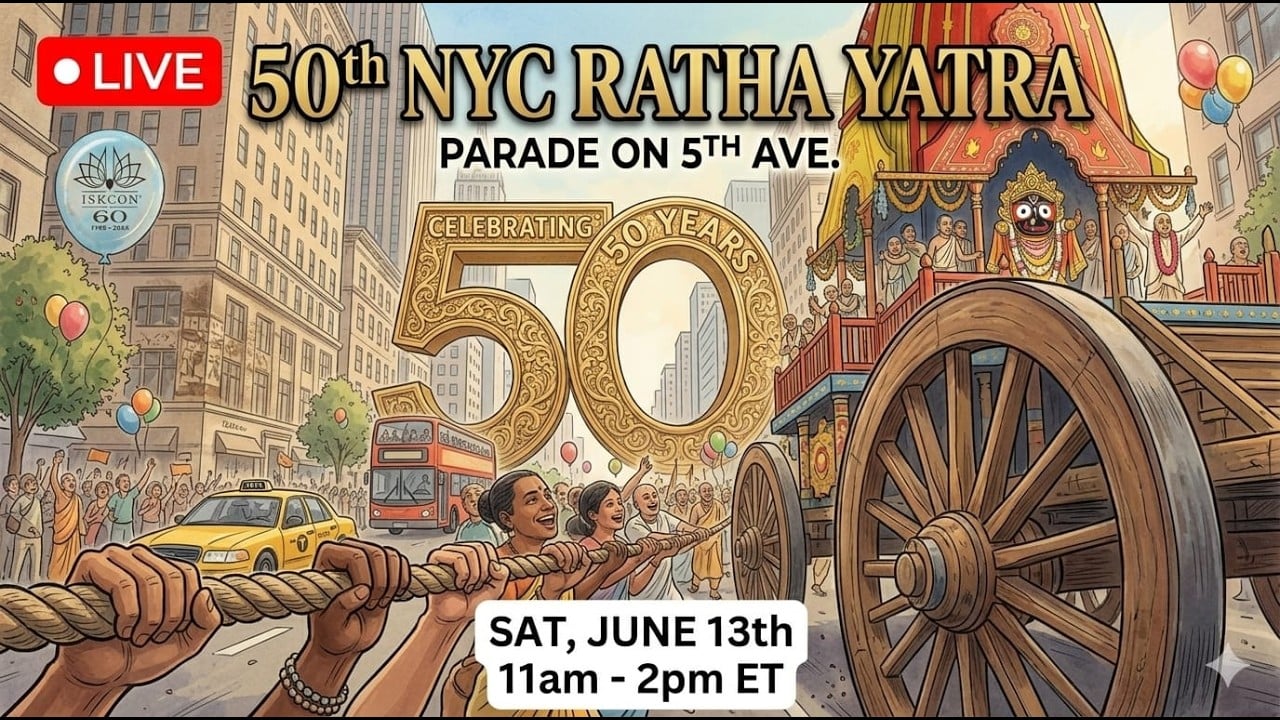
The 60th-anniversary Ratha Yatra Parade in New York City, documented by ISKCON NYC TV, offered a compelling demonstration of how a centuries-old ritualrooted in Jagannath traditions from Odishathrives in a contemporary urban setting. In marking a milestone year for ISKCON (1966–2026), the procession foregrounded cultural heritage, devotion, and civic coordination, while amplifying a unifying ethos that resonates across Dharmic communitiesHinduism, Buddhism, Jainism, and Sikhism.
Ratha Yatra (the Festival of the Chariots) historically celebrates the public procession of Lord Jagannath, Balabhadra, and Subhadra. Puranic narrativesespecially celebrated in the traditions surrounding Jagannath Puriemphasize the practice of bringing the deities out of the sanctum for darshan by the entire community. This outward movement embodies inclusion, accessibility, and the spirit of Vasudhaiva Kutumbakam, affirming that sacred presence is not confined to temple walls but shared with all.
In global contexts, ISKCON’s efforts have been pivotal in adapting and sharing Ratha Yatra. The first known public Ratha Yatra outside India was organized in San Francisco in 1967, and since then the Hare Krishna Movement has scaled the festival to major world cities. The New York iterationoften referred to as the Hare Krishna Festival of Chariotshas emerged as a flagship diaspora celebration, blending rigorous ritual integrity with the practical demands of a large, modern metropolis.
Scripturally and ceremonially, the triad of Jagannath, Balabhadra, and Subhadra is central. In Puri, the chariots are traditionally known as Nandighosha (Jagannath), Taladhwaja (Balabhadra), and Darpadalana (Subhadra), each with distinctive canopies and wheel counts. Diaspora festivals preserve this triadic symbolism while applying contemporary engineering and safety standards suited to local regulations and streetscapes.
Ritual flow at Ratha Yatra typically mirrors essential stages known in the Jagannath tradition: the alankara (ornamentation) of the deities, the ceremonial sweeping known as chhera pahanra (symbolizing humility and service), kirtan (sacred congregational chanting), and the communal act of pulling the ropes of the chariots. Each step is designed to democratize participation and uplift the atmosphere through devotion, music, and collective movement.
Technical planning is a defining strength of the New York parade. Chariot superstructures are often modular, combining timber and steel elements for strength-to-weight efficiency, with detachable components for transport and assembly. Industrial-grade ropes (usually natural fiber or polypropylene blends) provide high tensile capacity and controlled elasticity, while redundant braking mechanisms, wheel chocks, and guide crews enhance maneuverability and safety on variable street gradients.
From a civic-operations perspective, organizers conduct route risk assessments, secure permits, and coordinate with city agencies for traffic control, emergency access, and communications. Marshals are trained in crowd flow management, while wayfinding signage and rope-side buffer zones protect participants. Accessibility considerationssuch as providing visual sightlines, rest points, and seating near performance areasenable inclusive participation for elders, families, and persons with disabilities.
Acoustic design is handled with care. Kirtan ensembles and sound systems are calibrated to provide immersive music without exceeding safe sound pressure levels for long durations. Generator placement, cable routing, and emergency shutoffs follow standard event-safety protocols, while designated quiet zones along the route support attendees who prefer lower sensory intensity, ensuring a considerate, family-friendly environment.
Sustainability measures increasingly shape festival logistics. Reusable chariot components and fabric canopies, cloth banners instead of plastic, and compostable serveware for prasadam distribution reduce waste. Water refill stations and coordinated waste streams (recyclables, organics, landfill) align with city sustainability goals. The shift toward low-emission generators and shared transit guidance for attendees further lowers the event’s environmental footprint.
Cultural programming at the destination grounds typically includes kirtan, classical and folk dance (such as Odissi or Bharatanatyam), and interactive exhibits on the Jagannath tradition, ISKCON’s educational outreach, and the broader tapestry of Indian Cultural Heritage. These elements provide context that enriches the visual spectacle with historical and philosophical depth.
The food culture of the festival foregrounds sattvic, vegetarian prasadam, served without distinction of backgrounda practice closely aligned with the spirit of langar in Sikh traditions and ahimsa in Jain and Buddhist ethics. This shared ethic of service (seva) strengthens interfaith understanding and social cohesion, embodying Unity in spiritual diversity through simple, nourishing hospitality.
Participant experiences consistently highlight a sense of belonging that arises from pulling the ropes together. Families describe how the steady, synchronized tug fosters mindfulness; elders remark on the continuity of tradition across generations; first-time visitors often cite the music and the open, welcoming mood as catalysts for curiosity about the spiritual philosophy behind the celebration.
Theologically, the Jagannath tradition emphasizes inclusivity and accessibility. The public procession reaffirms that the divine is approachable and universal, not the preserve of a select few. In contemporary citieswhere pluralism is a daily realitythis message resonates strongly across Dharmic traditions and beyond, encouraging mutual respect, compassion, and shared civic pride.
For those exploring the philosophical dimensions, the Hare Krishna Movement situates Ratha Yatra within a bhakti framework that centers the heart’s intention over external markers of identity. Kirtan becomes both an aesthetic and contemplative practice; the chariot becomes a moving metaphor for carrying consciousness from the external to the internal, from division toward harmony.
Documentation by community media, including ISKCON NYC TV, plays a crucial role in education and preservation. High-quality video archives enable reflective learning, support academic study, and allow those unable to attend to witness the ceremony’s detailsfrom iconography and choreography to the operational discipline underpinning a large-scale public procession.
Practical etiquette for attendees enhances safety and reverence: maintain situational awareness around the chariots; keep a respectful distance from the deities and those guiding the ropes; seek consent before close-up photography of participants; and prioritize elders, children, and persons with disabilities when moving through dense sections of the route. Such practices preserve the event’s devotional tone while ensuring a positive experience for all.
In the context of ISKCON’s 60th year, New York’s Ratha Yatra underscores how living traditions adapt without losing their essence. The festival’s careful synthesis of ritual fidelity, urban event engineering, cultural education, and interfaith hospitality offers a replicable model for community events that aspire to be both deeply spiritual and impeccably organized.
Above all, the 60th-anniversary procession demonstrated that the Festival of the Chariots is not only a celebration of Jagannath’s enduring grace; it is a civic expression of Unity in Diversity. By aligning devotion with best-practice logistics and inclusive values, Ratha Yatra in New York City illustrates how heritage can be both preserved and renewed, inspiring shared purpose across generations and communities.
Inspired by this post on Dandavats.
