
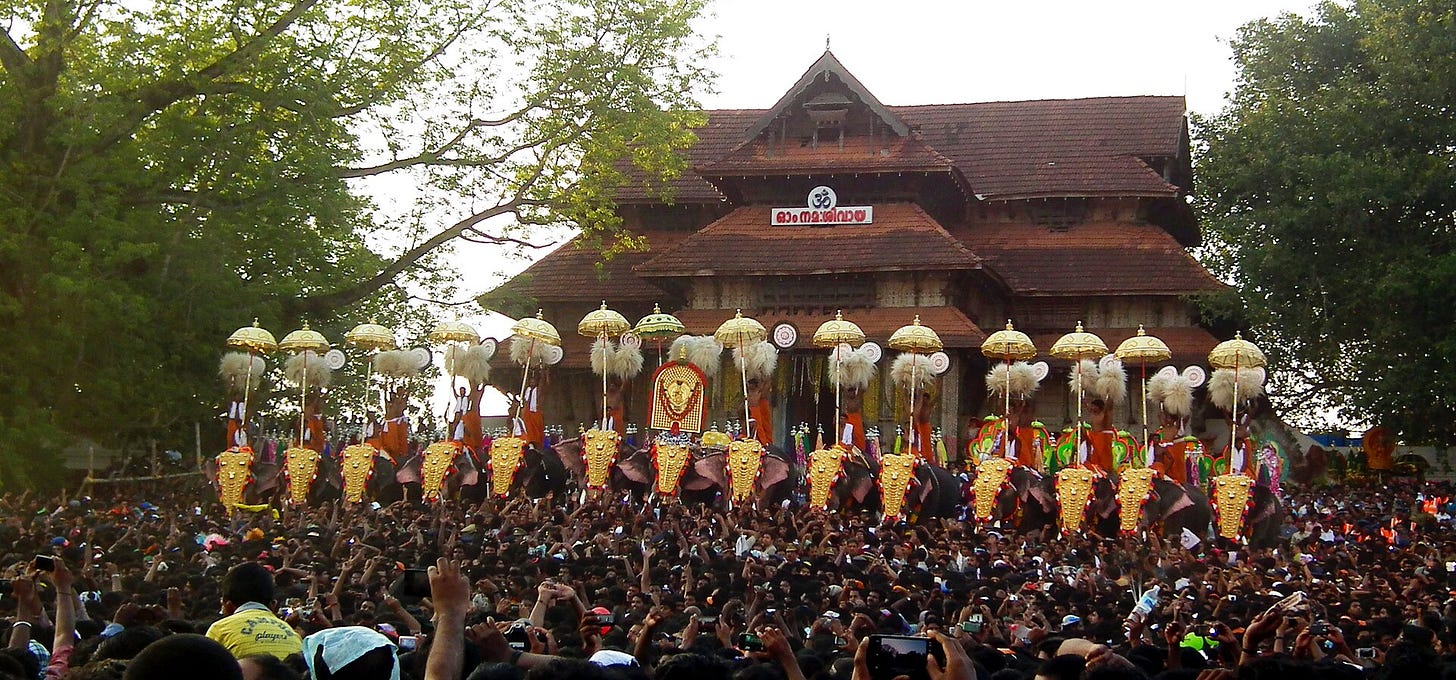
Each April–May, during the Malayalam month of Medam, the Thekkinkadu Maidan encircling the Vadakkunnathan Temple in Thrissur fills with the thunder of chenda percussion, the shimmer of parasols in rapid kudamattom exchanges, and the stately pace of caparisoned elephants at Thrissur Pooram. That spectacle of harmony and precision unfolds on ground that, in the late eighteenth century, also bore witness to siege, hunger, and the stark choices forced upon communities in Malabar. The paradoxritual joy layered over historical traumamakes the city’s annual festival a living palimpsest of Kerala’s cultural resilience.
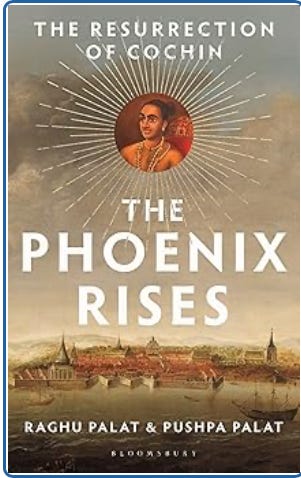
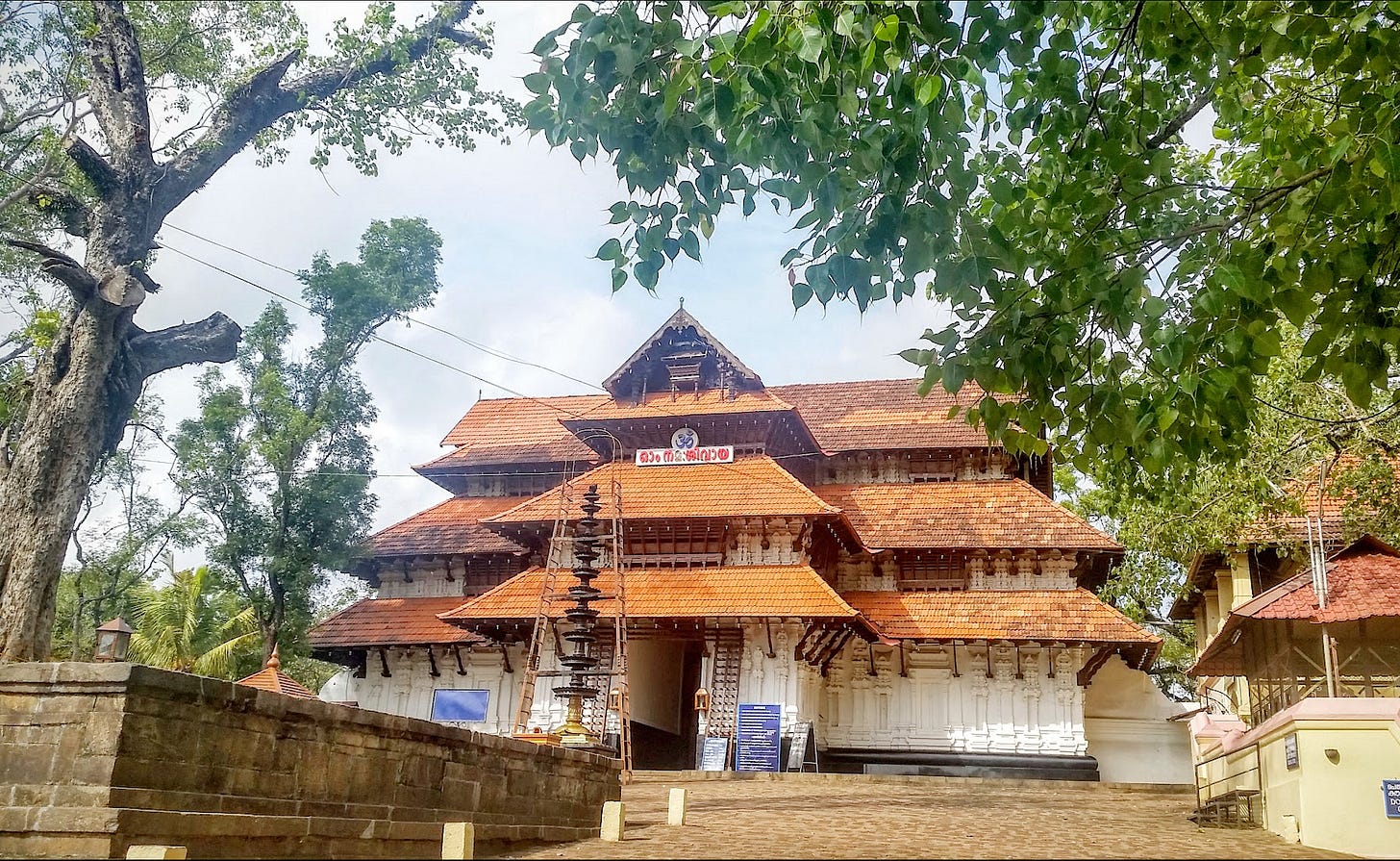
Reconstructing this fraught era through the life of Shaktan Thampuran (Rama Varma IX, 1751–1805), Raghu and Pushpa Palat’s historical narrative The Phoenix Rises: The Resurrection of Cochin illuminates how a minor coastal kingdom preserved sovereignty between expanding neighbors, intrusive European companies, and the Mysorean invasions under Hyder Ali and Tipu Sultan. The account anchors geopolitical rupture in places and practices that are still tangibletemples such as Vadakkunnathan and Guruvayoorthereby connecting archival record to contemporary memory.
Shaktan Thampuran assumed effective authority in the Kingdom of Cochin at eighteen, when the Raja entrusted him with full administrative and sovereign powers. He inherited a state squeezed by Travancore to the south, Malabar’s fractious polities to the north, and the commercial maneuverings of the Dutch and the English along the coast. With no formidable standing army and few dependable allies, he relied on clear-eyed reading of men and motives, calibrated diplomacy, and a pragmatic willingness to convert cultural capital into political leverage.
The crucible arrived in 1766, when Hyder Ali marched into Malabar. Resistance was fierce. The Zamorin of Calicut, faced with capitulation, chose self-immolation in his palace rather than submission. Subsequent Nair rebellions drew punitive reprisals; by 1773, Hyder Ali returned to enforce disarmament of the Nair nobility and to curtail their status. Contemporary records note both flight and accommodationsome converted or withdrew southward to Travancore, while others perishedreflecting the diversity of responses under duress.
During this turbulence, Shaktan Thampuran met Hyder Ali. The encounter exemplified statecraft under asymmetry: through careful courtesy and transactional clarity, he secured a brittle peace and even wrested the return of disputed tracts to Cochin. It was survival through negotiation, not capitulationa posture he would sustain, with variations, for decades.
Hyder’s strategic horizon soon widened. In 1776, seeking leverage against Travancore’s defensive lines (the Nedumkotta), he sent 10,000 men under Sirdar Khan. When Cochin delayed war contributions demanded by Mysore, the force pressed to Thrissur and encamped by the Vadakkunnathan Temple. Priests sealed sancta and fled, as was common during levies, yet the temple complex itself was spared wholesale demolition. Hyder Ali was then drawn into war against the English and died in 1782, the first act in Malabar’s ordeal closing without resolution.
Tipu Sultan’s campaigns in Malabar, beginning in 1787, diverged in tenor and intent from his father’s. Administrative measures such as the imposition of jizya appeared alongside policies that, according to contemporary testimonies, sought to secure the region through mass conversions. Nambudiris received particular attention, and when many sought refuge in Travancore, Tipu requested Dharmaraja to return theman appeal that, unanswered, hardened into a casus belli.
Before opening his southern offensive, Tipu summoned the Raja of Cochin to Palakkad. Shaktan Thampuranhitherto careful to avoid a personal audiencejudged the risks and went. The meeting, warm in its ceremonial exchange of gifts, quickly became a delicate negotiation. Tipu pressed for Cochin’s participation in war against Travancore; Shaktan, invoking the need for his suzerain’s assent, deferred and instead pledged to explore persuading the Raja of Travancore to acknowledge Mysorean suzerainty. It was a polite, strategic sidestep that obtained leave to depart without binding military commitments.
In 1789, Tipu advanced on Thrissur with an army of approximately 30,000 infantry and 5,000 cavalry. The columns left behind a trail of plunder affecting both sacred and secular lifeworlds: temples and churches suffered depredations, markets were stripped, and pepper vinesMalabar’s cash lifebloodwere cut. Primary material synthesized by Gopalan Nair from William Logan’s Malabar Manual describes the siege at Kuttipuram where about 2,000 Nairs, surrounded by 19,000 Mysorean troops with 46 field guns, capitulated under terms that stipulated conversion, underscoring the severe pressures facing local communities.
The Guruvayoor temple lay directly in Tipu’s path. Anticipating assault, temple authorities concealed the main murti in the temple tank and moved the processional idol to Ambalappuzha Sree Krishna Temple. Tipu’s men set the structure aflame, but a sudden downpour quenched the fire. The incident became part of a layered local memory in which material harm, ritual ingenuity, and climatic chance intersected.
Tipu occupied Thrissur for roughly a month, converting Vadakkunnathan’s precincts into an administrative office and housing officers in adjacent mutts. Accounts report the slaughter of cattle and the pollution of the temple’s sacred wellsa calculated symbolic blow alongside logistical encampment practices. Shortages followed, and with them, famine and disease. These events saturated the Thekkinkadu Maidan with meanings that present-day celebrants of Thrissur Pooram still, if implicitly, inherit.
Operationally, Tipu soon confronted Travancore’s Nedumkotta near Aluva. While engaged there, intelligence of a British advance on Srirangapatna forced a rapid strategic pivot. Within a decadeon 4 May 1799Tipu fell in battle, closing the fourth Anglo–Mysore War and radically redrawing power in southern India. For Cochin, this reset produced risk but also opportunity.
Having studied, placated, and outlasted both Hyder Ali and Tipu Sultan, Shaktan Thampuran reoriented Cochin’s position. He declared that Cochin would no longer be a tributary of Mysore, consolidated internal administration, and reimagined civic and sacred space as instruments of state: a synthesis of policy, ritual, and public culture aligned with dharmic continuity and social order.
An incident in 1798 catalyzed this cultural statecraft. Processional deities from Thrissur, delayed by rains en route to the then-pre-eminent Arattupuzha Pooram, were denied entry and sent backan affront that distressed priests and devotees alike. Rather than escalate conflict, Shaktan Thampuran responded by building something capacious, joyous, and enduring. In 1799, the same year Tipu was killed at Srirangapatna, the first Thrissur Pooram was convened. It replaced humiliation with shared celebration, transforming inter-temple rivalry into choreographed cooperation and creating a magnet festival that stitched together neighborhoods, castes, and guilds in a civic compact around sacred time.
In this reframing, cultural heritage was not merely nostalgic ornament; it was policy. Ritual became soft power, and the maidana commons historically used for drill, levy, and musterwas reclaimed as a stage for aesthetic excellence and dharmic concord. This is an early, instructive instance of what contemporary heritage studies might call the strategic use of intangible cultural heritage to repair a torn social fabric and to reaffirm pluralistic values intrinsic to the dharmic familyHindu, Buddhist, Jain, and Sikh traditions alike.
Today, Guruvayoor is one of Kerala’s most visited shrines, and the Vadakkunnathan Temple remains the axial heart of Thrissur. Each Pooram, the very space once pressed into bureaucratic service by an occupying army is filled instead with rhythm, color, and a city’s collective heartbeat. Remembering the Mysorean invasions through this lens does not license rancor; rather, it underscores a civilizational reflex toward renewal over revenge and towards solidarity among dharmic traditions in the face of coercive uniformity, whether imperial, ideological, or economic.
Several analytical threads emerge from Shaktan Thampuran’s navigations. First, small-state survival under great-power pressure often depends less on battlefield prowess than on an ability to read intent, delay commitments, and extract concessions through ceremony and courtesy. Second, the defense of sacred institutions can be pursued not only through fortification but also through reinvigorating their social centrality, making desecration politically and morally costly. Third, inclusive public ritualwhen curated with aesthetic rigor and fairnesscan transmute friction among communities into friendly emulation, fostering a civic identity resilient enough to absorb future shocks.
Finally, this history cautions against weaponizing memory. The same archive that records acts of coercion and desecration also records acts of sheltering, rebuilding, and reconciliation across communities. A dharmic response, in this sense, is neither amnesia nor antagonism, but remembrance oriented to protection, learning, and shared flourishing. That, too, is the legacy of Shaktan Thampuran: resilient statecraft that outlasted force and left behind a festival where power is measured not in muskets or cannon, but in rhythm, grace, and the quiet authority of coordinated hearts.
Inspired by this post on Varnam.
