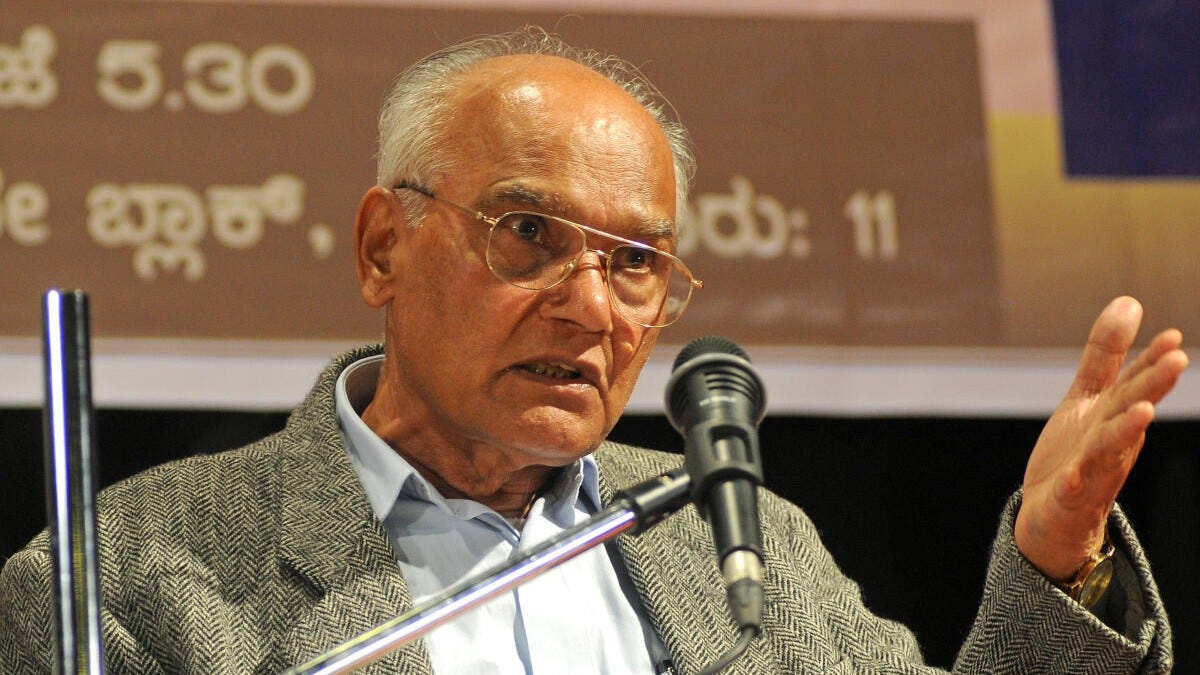
The passing of Santeshivara Lingannaiah Bhyrappa (20 August 1931 – 24 September 2025) marks a watershed moment in Indian literature. His oeuvre, written in Kannada yet pan-Indian in spirit, distilled philosophical depth, emotional intensity, and an unrivalled command over the interplay of human impulses. Across four generations, this epic sensibility defined the reception of S.L. Bhyrappa’s work.
Throughout life and craft, Bhyrappa remained steadfastly independent, pursuing a path carved by convictions. His journey fused biography with literature: a childhood and youth marked by tragedies he later chronicled in the autobiography Bhitti (Foundation), and refracted through early fiction such as Gruhabhanga (Broken Home). These formative experiences seeded a lifelong commitment to truth-seeking through the form of the novel.
Place and memory mattered deeply. Santeshivara near Hassan—a previously obscure village—entered national awareness through his achievements. Bhyrappa honored that bond tangibly by establishing a public library and spearheading rejuvenation of its lake, echoing the civic-minded ideal exemplified by figures like Sir M. Visvesvarayya. This grounded his literary vision in a lived sense of community and responsibility.
Experience remained the hallmark of his method. Even after becoming a celebrated novelist, he traveled widely and purposefully to absorb the textures of space, time, and local culture. That observational rigor, transmuted into impersonal, non-judgmental art, is palpable in Gruhabhanga, Matadaana, Daatu, Jalapaata, Tabbaliyu Neenaade Magane, and Saakshi. Readers repeatedly recognized in his characters the familiarity of kinship, work, and social life; others—such as Manjayya (Saakshi), Harishankar Prasad (Tantu), and Mohanlal (Mandra)—earned near-universal censure for their moral failures, revealing a shared ethical reflex in the audience.
Bhyrappa’s characters ultimately function as idioms, symbols, and metaphors—traits intrinsic to the epic form. In Indian literature, epics serve as civilizational memory: a living homage to beliefs, fears, hopes, and joys, with the Ramayana, Mahabharata, Puranas, and Vedanta providing enduring frameworks of meaning. While many regions of the world saw their epic traditions wane due to historical disruptions—colonial encounters, industrial-age materialism, and rigid dogmatisms—Bharatavarsha’s dharmic heritage preserved a living epic sensibility. Anchored in the Sanatana ethos, Bhyrappa revitalized these elements for modern readers, demonstrating how Indian epics remain vital sources for cultural resilience and ethical deliberation across Hindu, Buddhist, Jain, and Sikh traditions.
Two representative moments illuminate this epic power. The first occurs in Tantu (1993), on the steps of Kashi’s Harishchandra Ghat. As Hemant Honnatti contemplates blazing pyres and his illicit affair with a friend’s wife, the climactic trial of Satya Harishchandra surfaces: Chandramati arrives with her son’s corpse, pleads for a free cremation, and is recognized only when Harishchandra demands the Mangalasutra—visible, by boon, solely to her husband. The recognition compels Hemant to end the affair. This scene’s intensity exemplifies how classical Indian moral imagination can still transform contemporary lives.
The second lies in Mandra (2002), where Bhyrappa renders a meditative description of an Alaap by an accomplished Hindustani musician. The following is a loose English translation:
“The voice is not his, he is not the singer. The Raag has chosen his throat to reveal itself in its purest element. Seated in that pose with his eyes closed, he has completely surrendered himself to the Raag. He has no role in the singing. The man sitting before me is a Rishi of Swara… The absolute command he exercised over all the octaves, the ease with which he traversed from the lowest octave to the highest without a frisson in the Swara reminded me of the Matsya-Avatar. It elicited the picture of the Cosmic Fish, the very embodiment of Bhagavan. It could effortlessly leap from the oceanic depths to the earth’s surface and beyond, touching any point in the journey as if it had placed a target. But all this was just a sport for the Fish.”
Such Puranic metaphor—rooted in Rasa and refined through Hindustani classical music—reveals why Bhyrappa avoided the short form and the merely topical. His novels rarely close with definitive resolutions; instead, they mirror life’s open-endedness, where death alone constitutes a final ending. This orientation positions his canon beyond tight social, historical, or political categories, asserting the epic as a distinctive genre in modern Indian literature.
Bhyrappa’s career also unfolded amid sustained ideological criticism. In Kannada letters, the Navya (New) movement—often aligned with Left-leaning currents—challenged his work vigorously through polemics and denunciations. Nevertheless, he neither personalized nor reciprocated hostility, treating literature as Tapas, a disciplined quest for truth that elevates society without harming it. Over time, a number of former detractors acknowledged his stature, even as debates over awards and recognition persisted.
The reception of Vamsa-Vruksha is instructive. Arriving at a mid-20th-century moment when many Hindus felt conflicted about tradition—some seeking to understand their roots, others persuaded by ideologies keen to dismantle them—the novel sparked statewide seminars and debates. Its resonance signaled a renewed appetite for nuanced engagement with inherited norms, neither uncritical nor deracinated. Popular acclaim and sustained sales followed, revealing a rare alignment of critical appreciation, reader loyalty, and commercial success in a relatively small market for Kannada literature.
At the core of this reception stands a declared aim: a “quest for truth.” The novel, for Bhyrappa, was the ideal vehicle—neither a platform for fixed ideology nor a tool for social engineering. Where a topical approach might select an event such as the Babri Masjid demolition, Bhyrappa offered Aavarana, a work shaped by Rasa aesthetics and the Bharatiya ethos to probe the deeper textures of historical memory, identity, and ethics. As he once observed, what revolution can be ushered by singing Bhairavi or Todi Raag? The point is not immediate reform but lasting art—truth distilled as experience, emotion, and contemplation.
National recognition arrived late, yet decisively. By then, his voice had already formed a distinct chapter in both Kannada and Indian literature: a prose style blending life-experience, philosophical insight, intense emotion, and the collision of human impulses—woven with the discipline of Tapas. One might imitate the surface of that style, but not its inner engine.
Scholarly engagement with Bhyrappa’s legacy remains an urgent task. Rigorous, empathetic criticism—of the kind modelled by scholars such as Dr. S.R. Ramaswamy, L.V. Shantakumari, Shatavadhani Dr. Ganesh, Arjun Bharadwaj, and B.N. Shashi Kiran—offers a pathway to understanding his contribution. Meaningful honor lies in sustained study and in translating the nuances of his work into inner transformation, then transmitting that light to future generations.
Equally important is recognizing how Bhyrappa’s art nurtures unity across dharmic traditions. Concepts such as Dharma, Tapas, Rasa, compassion, non-violence, and disciplined practice resonate in Hinduism, Buddhism, Jainism, and Sikhism. His epic imagination—fed by the Ramayana, Mahabharata, Puranas, Vedanta, and the sādhanā of Hindustani music—invites cross-traditional reflection on truth, duty, and self-cultivation. In this sense, his literature becomes a shared cultural space where dharmic plurality strengthens common ethical purpose.
One term captures the man and his bequest: Ghana-Sattva—dense in being, steady in virtue, and luminous in truth.
|| Om Tat Sat ||
Inspired by this post on Dharma Dispatch.