Across global history, the Seven Years’ War is often described as “World War Zero” for its expansive geographic reach and lasting consequences. In the Indian subcontinent, its denouement at the Battle of Wandiwash (1760) near Vandavasi decisively curtailed French ambitions and reshaped colonial trajectories. This episode underscores the strategic centrality of South India and forms a useful historical preface to understanding Vandavasi’s sacred landscape and its enduring temple traditions.
Vandavasi, now within Tiruvannamalai district, lies roughly six hours by road from Bengaluru via NH‑48 and about three hours from Chennai. Historically, this corridor connected major nodes such as Sriperumbudur and Chennai, with Vandavasi forming a vital link in a larger network that included Pulicat, Ennore, Mylapore, Kelambakkam, and Mahabalipuram. The region has long functioned as both trading hub and sacred geography, dotted with caves, kshetras, and temples reflecting the timeless Sanatana heritage. Its Jain presence remains significant, illustrating the organic coexistence of dharmic traditionsHindu, Jain, and later cultural layerswithin a shared civilizational fabric.
About twenty‑five kilometres southwest of Vandavasi lies Seeyamangalam, reached by winding village roads shaded by groves and bordered by green fields. Today’s quiet evokes a reflective mood, yet the site once thrummed with cultural life under the Pallavas. As a cradle of early rock‑cut temple architecture, Seeyamangalam stands among the jewels of the Pallava tradition, its legacy deepened through successive patronage in South India.
The village’s historical name carries layered meaning: Simhavishnu Chathurvedhi Mangalam (பல்ல வி ஶ்னு சதுர்வேதிமங்கலம்) or Simhamangalam, honouring Pallava luminaries Simhavishnu and Narasimhavarman I. Such appellations situate Seeyamangalam within the Pallava Empire’s heartland, where artistic innovation and religious endowments flourished through a sustained temple‑building continuum.
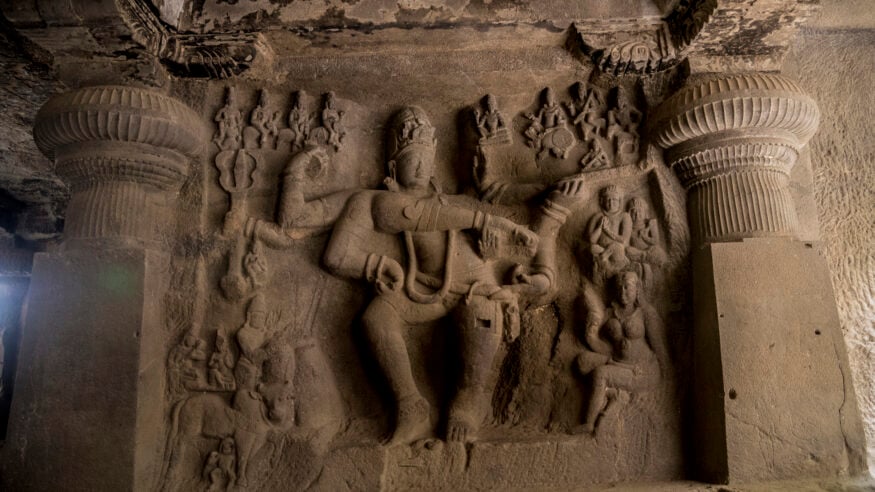
Two monuments preserve this memory with clarity: the Avanibhajana Pallaveshwara Templealso known as the Stambheshwara or Tundandar templeand the Mahavira rock‑cut cave temple. The former is a Shaiva rock‑cut shrine whose Mahima (glory, grandeur, majesty, prestige) expanded over centuries as the Cholas and later the Vijayanagara Empire enhanced it, including the three‑tiered Rajagopuram that frames the complex today. Read as a whole, the site embodies a layered history of temple architecture in Tamil Nadu and offers a lens into South Indian cultural resilience.
The sacred genesis of the Stambheshwara Temple is recorded on the right pillar at the entrance. The main rock‑cut shrine sits behind two mandapas and within a stone enclosure. The inscription reads:

ललिताङ्कुरेण राजन् अवनिभाजन पल्लवेश्वरन्नाम ।कारितं एतत् स्वेधेश्च्छाकरण्डं इव पुण्यरत्नानाम् ।
“By king Lalitankura was caused to be made this (temple) named Avanibhajana‑Pallaveshwara; His Will was the casket, and its enclosing jewels, [his] virtuous deeds.”
Scholarly consensus identifies Lalitankura as an epithet of MahendrapotarajaPallava king Mahendravarman I. The wordplay linking Lalitankura (Lalita = soft, tender; ankura = sprout, bud) and Pallava (tender leaf, sprout) is deliberate and elegant. Avanibhajana signifies “enjoyer or possessor of the earth,” a royal style comparable to titles like Avanijashraya. The temple’s name, therefore, fuses poetic resonance with royal devotion in a manner typical of Pallava epigraphy.
Mahendravarman I, who inaugurated and refined a Pallava idiom of rock‑cut architecture, laid foundations that would culminate in the famed monuments of Mahabalipuram. The Stambheshwara at Seeyamangalam precedes those iconic shore temples, revealing an early, confident phase of experimentation that built upon, extended, and beautified Gupta‑period sculptural and architectural traditions. Cultural and commercial exchanges between the Gupta and Pallava realms further nourished this aesthetic synthesis. In customary filial reverence, Mahendravarman I commemorated his father’s legacy by naming the shrine in honour of Simhavishnu, who had revived Pallava power after a long eclipse.
By the late ninth century, the Pallava polity had largely waned, yet the sanctity and renown of Stambheshwara continued to grow through local stewardship. An inscription on the left pillar, written in archaic Tamil with Grantha phrases, records the construction of a second mandapa by a local headman named Adavi, a subordinate of the Ganga‑Pallava ruler Nergutti and vassal of Vijaya‑Nandivikramavarman. Epigraphic records place Adavi near Perumbalaiyur in Urrukkattu‑kottam (derived from Urrukkaadu near Kanchipuram), situating the project within a robust administrative and devotional ecology.

The translation of the Tamil inscription captures the spirit of community endowment and filial piety:
“Hail! Prosperity! In the third year (of the reign) of king Vijaya‑Nandivikramavarman, Adavi, the headman of Tiruppalaiyur (near) Perumbalaiyur in Urrukkattu‑kottam, having made a request to (i.e., having obtained the permission of) the glorious Ganga king Nergutti Peruman, this Adavi made the Mandapam in front of the shrine for the spiritual merit of his mother, Nangani Nangai.”
Its closing sentiment is especially moving, preserving a living ethic of custodianship:
“May the feet of him [i.e., any person] who protects this divine gift of the Mandapam without destroying it, be placed upon my head.”
Read alongside the nearby Jain site, the Mahavira rock‑cut cave temple, Seeyamangalam embodies a dharmic landscape of respectful plurality, where Jain and Shaiva traditions coexist in a shared sacred ecology. Such interwoven heritage speaks to a broader ethos of mutual regard that has long characterized South Indian cultural life. For students of temple architecture, history, and epigraphywhether focusing on the Pallava dynasty, the Cholas, or the Vijayanagara EmpireStambheshwara offers a concentrated study in rock‑cut design, inscriptional poetics, and community patronage.
Situated within reach of Chennai and Bengaluru, and proximate to Mahabalipuram, the temple rewards attentive travel with a rare confluence of architectural refinement, historical memory, and devotional continuity. As a cornerstone of Tamil Nadu’s cultural heritage, the Stambheshwara Temple in Seeyamangalam invites careful observation and comparative study, illuminating how South India’s sacred spaces nurtured unity across dharmic traditions and sustained an art‑historical lineage that still inspires.
Inspired by this post on Dharma Dispatch.