Tracing the genealogy of the preface across literary history reveals how introductions evolved from brief orienting remarks into autonomous works of art. In Sanskrit literature, invocatory verses (mangalacharana) often framed a text’s philosophical horizon, while in modern print culture the preface matured into a reflective space where authors documented intent, method, and the values underlying composition. Read this way, a great preface functions as both a literary key and a civilizational lens.
Few modern examples illustrate the genre’s power better than George Bernard Shaw’s Pygmalion. His preface, widely discussed since 1916, demonstrates how an introduction can be a polemic, a philology lesson, and a social mirror at once: “The English have no respect for their language, and will not teach their children to speak it. They spell it so abominably that no man can teach himself what it sounds like. It is impossible for an Englishman to open his mouth without making some other Englishman hate or despise him. German and Spanish are accessible to foreigners: English is not accessible even to Englishmen.”
Shaw’s acerbic follow-up note extends that critique of complacency into the imaginative realm: “THE rest of the story need not be shown…and indeed, would hardly need telling if our imaginations were not so enfeebled by their lazy dependence on the ready-mades and reach-me-downs of the ragshop in which Romance keeps its stock of ‘happy endings’ to misfit all stories.” The caution endures: in an age of digital saturation, economies of attention can blunt imagination unless counterbalanced by disciplined reading, reflection, and the cultivation of inner life.
Within Indian literature, tradition holds that Maharishi Bhagavan Veda Vyasa performed Tapas and then composed the Mahabharata, dictating to Ganapati while observing strict Brahmacharya. The Vedas themselves are sung rather than merely recited, testifying to a confluence of śruti, poetry, memory, and aesthetics. This sonic ethosRishis as Kavisfinds echoes across dharmic traditions: in the recitation of Vedic mantras, the cadence of Jain stotras, the resonance of Buddhist chanting, and the surs of Sikh Gurbani. Voice, meaning, and realization intertwine.
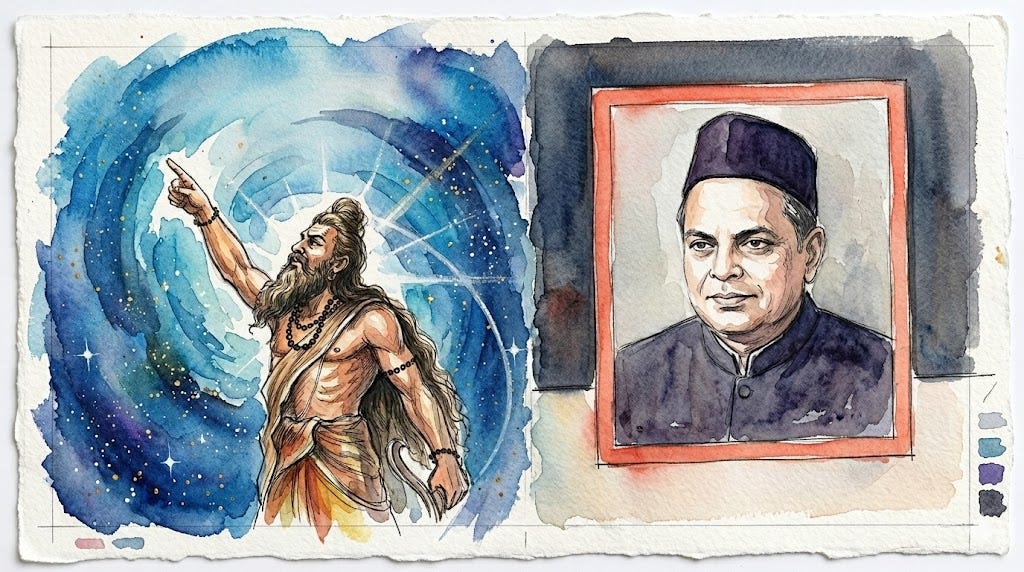
To this lineage belongs Sri Devudu Narasimha Sastri (1902–1962), a polymath in Kannada letters whose literary, pedagogical, journalistic, philosophical, spiritual, and dramatic achievements spanned four decades. Reports describe an individual of formidable presence, with a breadth that ranged from mastering Veda–Vedanta–Mimamsa–Kavya and playing the Vina to editing journals, producing theatre and film, founding a school, traveling widely, and delivering substantive lectures. Yet, among these many accomplishments, the Kannada novel Mahabrahmana (literally, The Great Brahmana) stands out as a singular civilizational statement.
Mahabrahmana’s preface warrants independent study. It is at once a meditation on composition, a testimony of sadhana, and a Vedantic primer refracted through narrative art. It can be read before the novel, after it, or on its own. In every sequence, new facets appear, suggesting that the preface performs an Upanishadic function: it turns the reader inward and upward.
The novel narrates the extraordinary journey of Emperor Kaushikahis inner revolution from Kshatra to Brahmana in the fullest sensefrom Kaushika to Viswamitra. While many first meet Viswamitra in the Ramayana, references to him occur earlier and across strata: Rg Veda, Yajur Veda, Aitareya, Kaushitaki, and Gopatha Brahmanas; and later in the Mahabharata, Vishnupurana, Harivamsha, and Yogavasistha. To the civilizational memory of Bharatavarsha, he is indelibly associated with the Gayatri Mantra, a hymn in Gayatri meter addressed to Savitr and transmitted through rishi-lineage.
Devudu records the chronology and discipline behind the work with rare candor. “The impulse to write this novel was born in 1926. By that time, I had realized the glory of Gayatri, and I decided to write the story of the first person who had not only realized Gayatri but had shared it with the world thereby performing the greatest act of benevolence. However, I felt that it was improper to embark on writing about this great Rishi without first undergoing the prerequisite training in the traditional fashion. The Arsha Rna [debt owed to our Rishis] had to be repaid first before writing such a work.”
He further notes: “By 1947, the impulse to write this work had matured, and I began penning it down. It was complete by August 1950.” As the newly independent republic drafted its constitutional architecture, a parallel meditation in Kannada shaped a spiritual constitution for the inner citizen of Bharatavarsha’s Atma, testifying to the complementary roles of polity and culture.
Mahabrahmana became an instant classic, reprinted frequently and cherished among readers of Kannada literature worldwide. The preface explains why. “[At some places in this novel], there are depictions of the Secret Knowledge of the Upanishads. Some of these are derived from my own experience, others are the experiences of other people, and some occurred as I was writing.” This claim reframes authorship as a mode of anubhava (lived realization) placed within sampradaya.
Devudu continues: “The physical manifestation of [the Deity] Rudra, the Devatas conferring with each other, these are my own experiences…Manmatha’s exposition of the growth of the ego…the blessing given by Brahmnaspati, Pusha, and others…these occurred to me in the process of writing.” The examples map a spectrum from theistic darshana to psychological insight (ahamkara’s growth), from Vedic deities to mantra-shakti, and from narrative episode to metaphysical teaching.
This, in a word, is Tapascreative austerity aligned with śraddha, guided by Guru Kripa, and disciplined by śastra. The preface articulates a phenomenology of composition that many serious authors will recognize: a movement from the narrow “I” to a wider intelligence culminating in fullness that seeks form.
Devudu’s statement is unambiguous: “Those who have written great works will realize a fundamental truth in their experience: the Jiva within each of us, which is incessantly writhing and yelling, ‘Me!’ ‘Me!’ ‘I!’ ‘I!’ will discard its pettiness and fly high like a shell and attain a new insight hitherto unavailable to it. It will then fill the heart with this insight and that fullness will emerge in the form of a literary work.” The description corresponds to a shift from vyavaharika self-reference toward a contemplative center.
He then aligns this with canonical sources: “It is this insight that the Purushasukta says, lies beyond the ‘ten fingers.’ This is the same divine Darshana of the Gita! This is the Unmanibhava of Mantra Yoga! This is what is meant by Guru Kripa, Guru Prasada! The Upanishads call this as the Devapyaya.” The allusion to “atyatisthad dasangulam” (Purusha Sukta) signals transcendence; “Unmanibhava” names a no-mind equipoise in mantra-yoga; Guru Kripa and Prasada emphasize grace; and “Devapyaya” encapsulates the return to the divine ground.
The Vedantic anchor is explicit: “Indeed, it is difficult to understand this until one experiences the full meaning of the Bhagavad Gita verse, ‘sarvasya caham hrdi sannivistah | mattah smrtir jnanam apohanam ca |’ within himself.” The Gita 15.15 declarationsource of memory, knowledge, and their withdrawalbecomes the cognitive-ethical axis for the author’s aesthetics.
Such passages routinely leave attentive readers silent, not from obscurity but from the clarity of recognition. In effect, the preface models how a literary proem can also be a sadhana-manual for reception: it invites śravaṇa, encourages manana, and points toward nididhyāsana.
Devudu also addresses a recurrent literary question: why foreground a figure like Viswamitra in a time when many champion the “common man” as literary subject? His reply is diagnostic rather than dismissive: “Today, literature is working towards portraying the life of the proverbial common man. Because one cannot obtain a coconut from the Thumbe plant, people have busied themselves in planting coconut groves…But then, it is gems that are polished on the grinding stone, and not ordinary stones.” The analogy distinguishes between democratization of subject-matter and the uncompromising craft required to refine enduring ideals.
Anticipating skepticism toward Vedic culture in certain modern discourses, Devudu reframes purpose: illumination belongs precisely where confusion abounds; support and resistance have always co-existed; nourishment serves the genuinely hungry. In this spirit, the work seeks to offer Vidya rather than polemic, a stance that harmonizes with the broader dharmic commitment to dialogue, inquiry, and compassion across paths.
The preface culminates in a civilizational claim about inner resilience and literary purpose. “The Atma of Bharatavarsha has been pictured in this work…it is the inner strength of Bharatiyas that has enabled it to withstand continuous alien assaults for hundreds of years and not descend into chaos…” Rendered more generally, the novel seeks to portray the spiritual resources that have sustained the subcontinent’s plural fabric through historical pressures, aligning literature with Lokasangraha (the uplift of the social order).
Devudu adds a hermeneutic charter: “There are still people in India who have attained and are capable of attaining the Siddhis that Viswamitra attained in this book. Therefore, for those who think that this is just a story, it is just a story; for those who regard it as a Sastra, it is a Sastra; for those who regard it as Vidya, it is Vidya.” This polyvalencekavya as narrative, śastra as doctrine, vidya as realizationrecalls a classic Indic idea: the fruit of a text depends on the adhikara (preparedness) of the reader.
The preface even documents method: “Thus, having read a lot of random things on random topics, having listened to various people, having earned other things through personal experience, and placing all of them in a crucible by the grace of Guru, this book has emerged as smelted toy.” The metallurgy metaphor emphasizes synthesis: learning, experience, and grace refined into a single alloy.
Finally, the humility of reception: “This work has come to some random person from some random impulse and from an unknown place. This writer is merely the recipient of the fruit. Therefore, in order to be faithful to its authorship, he is grateful to all those who have given it to him.” This is Rishi-Rna lived through literaturethe conscious repayment of debt to teachers and traditions by creating responsibly, with gratitude.
Framed within broader dharmic unity, the preface’s values are shared across Hinduism, Buddhism, Jainism, and Sikhism. Tapas (disciplined practice), Guru-bhakti (reverence for the teacher or shabad-guru), compassion, truth-seeking, and ethical self-mastery are common commitments that animate inner transformation. Though the vocabulary here is primarily Vedic and Vedantic, the aspirationa civilization of awakened, responsible personsremains ecumenical and inclusive.
Technically, the preface performs three moves. First, it grounds authorship in sadhana, aligning aesthetic creation with spiritual praxis. Second, it integrates textual lineagesRg Veda, Brahmanas, Upanishads, Mahabharatawithout collapsing genres: śruti (revealed), smriti (remembered), purana (narrative), and kavya (poetry) remain distinct yet converse. Third, it endows the reader with a hermeneutic: receive the narrative as story, śastra, or vidya based on readiness, thereby turning reading into a contemplative discipline.
Placed within Kannada literature of the early–mid twentieth century, Mahabrahmana exemplifies how regional languages carry pan-Indic philosophy with high artistry. Its diction, pacing, and symbolic economy situate it among Kannada novels that bridge modern narrative technique with Sanskritic intertexts, rendering Vedanta and Upanishadic motifs accessible without dilution.
As a contribution to Vedanta and Vedic literature studies, the preface can be read alongside commentarial traditions that elucidate Purushasukta, the psychology of ahamkara, and the Bhagavad Gita’s epistemology of memory and knowledge. It also invites comparative dharma inquiry: for example, how the soteriological aim of interior freedom appears in Jain ascetic discipline, Buddhist meditation on non-clinging, and Sikh emphasis on Naam and sevaall converging on ethical clarity and inner poise.
Readers will find that Mahabrahmana’s preface changes with each revisit. Read before the novel, it prepares the mind; after the novel, it supplies a grammar for what has been experienced in story-form; read by itself, it stands as a compact, luminous essay on authorship, sadhana, and civilizational memory. In every case, it restores imagination to its rightful dignity by anchoring it in disciplined insight rather than “ready-mades.”
In sum, Devudu Narasimha Sastri’s Mahabrahmanaand especially its prefacedemonstrates how a literary work can become a site for recovering the Atma of Bharatavarsha: not as an abstraction, but as a living ethical and contemplative inheritance open to all. It exemplifies how literature, philosophy, and spiritual practice converge to strengthen unity across dharmic traditions while enriching Kannada letters and the larger stream of Indian literature.
Inspired by this post on Dharma Dispatch.