The Ramayana is often approached as a sacred epic charged with profound ethical inquiry, yet its performance traditions also cultivate a calibrated sense of humor. Among the most widely cherished moments of comic relief is the waking of Kumbhakarna, Ravana’s colossal brother. In folk Ramayanas from the subcontinent to Southeast Asia, this scene is expanded into an exuberant interlude where laughter coexists with moral seriousness, sustaining audience attention while deepening the epic’s ethical resonance.
The narrative kernel is straightforward. Blessed and burdened by an unusual boon, Kumbhakarna sleeps for extended cyclesfamously for monthsuntil a crisis in Lanka compels Ravana to rouse him as the war with Rama intensifies. Classical sources such as the Yuddha Kanda frame the awakening as a political necessity; folk and performative retellings, however, elaborate the moment into a comic crescendo, using exaggeration, slapstick, and witty dialogue to animate the challenge of raising a being described as “mountain-like.”
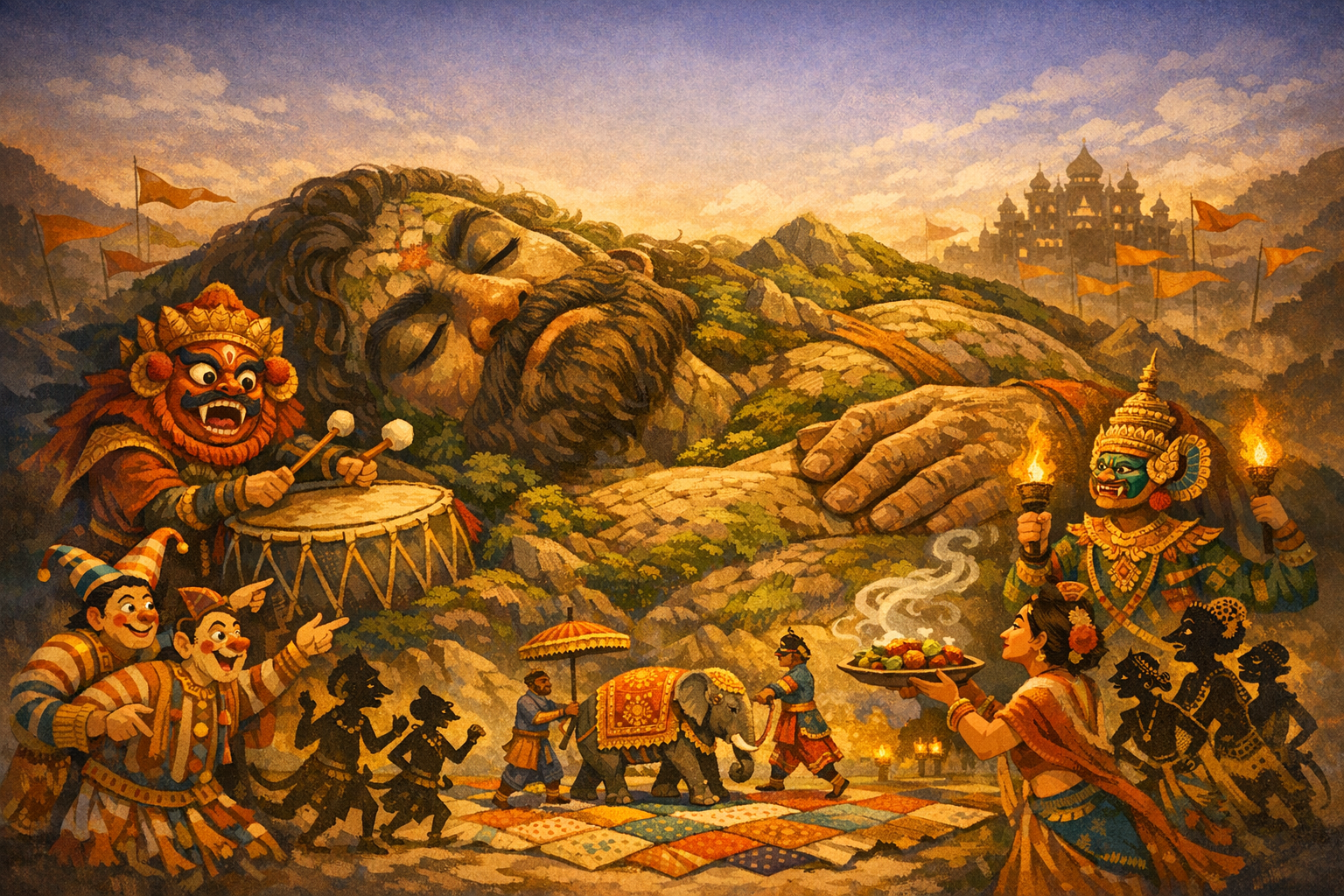
From an aesthetic perspective, the episode exemplifies hasya rasa within a larger orchestration of affect governed by the Natyashastra. The comic energy is strategically placed between raudra (wrath) and vīra (heroic) moods, creating a pressure valve that both heightens anticipation and maintains narrative “aucitya” (propriety). Poetic devices such as atiśayokti (hyperbole), upamā (simile), and śleṣa (wordplay) magnify scale and absurdity: attendants drum on cavernous chests, elephants are led across a snoring giant, and palatial kitchens unleash feasts as “olfactory alarms,” all at once expanding spectacle and signaling the gravity of the battle to come.
In North Indian Ramlila traditions, the “Kumbhakarna uthāo” sequence routinely becomes a communal highlight. Staging leans into proportion and sound: paper-mâché or cloth forms emphasize vast girth, amplified snores mark rhythm, and choreographed chaos erupts as aides tryoften in escalatingly ludicrous waysto wake the sleeper. Banter among jesters, satirical asides on courtly incompetence, and domestic analogies (the difficulty of rousing a heavy sleeper) generate immediate recognition. The laughter that follows is not merely diversion; it tightens the audience’s bond with the narrative while reinforcing the moral arc that soon pivots back to duty and war.
Dialogic patterns in these performances frequently mirror everyday life. Household imagerywafting the aroma of fresh food, lamenting delayed chores, or likening the task to waking an obstinate elderinvites viewers to map epic scale onto familiar routines. This domestication of the extraordinary nurtures empathy even for a rakshasa, inviting reflection on human foibles such as lethargy and denial in moments that demand clarity and courage.
South Indian traditions present distinct color. In the Kamba Ramayanam’s orbit, Kumbhakarna is often cast as valorous yet tragically aligned, and folk forms such as Terukoothu and Villupaatu expand the awakening into a performative essay on loyalty, counsel, and fate. The humor softens edges and opens space for ethical conversation: Kumbhakarna may rebuke Ravana for the abduction of Sita, only to uphold fraternal loyalty when war is inevitable. The comic frame allows audiences to hold together admonition and allegiance without caricature.
Kerala’s classical stage drills further into technique. In Kathakali, Kumbhakarna is frequently rendered with the chuvanna thadi (red-beard) visage reserved for ferocious characters, yet humor persists through timing, percussion cycles, and interaction with mediating figures. In Koodiyattam and Chakyar Koothu, the vidūṣaka’s metatheatrical commentary converts the waking into an exegesis-on-the-go, puncturing pomposity while clarifying dharma for contemporary listeners. Here, hasya rasa does philosophical work by translating battlefield abstractions into intelligible civic ethics.
Yakshagana in coastal Karnataka offers another vivid template. The prasaṅga known as Kumbhakarna Kalaga showcases the hasyagaras (comic characters) who spar verbally with courtiers and soldiers tasked with rousing the giant. Drums (chende), cymbals, and call-and-response singing produce an acoustic “architecture” of awakening in which rhythm itself becomes an alarm. Improvised jokes, regional idioms, and topical references continually refresh the scene, ensuring that canonical content remains locally alive.
In the east, Bengali Jatra and village theatre shaped by the Krittivasi Ramayana frequently amplify the awakening with musical play and clowning duos. Masked dance forms like Chhau, where Ramayana episodes are popular repertoire, emphasize kinetic exaggerationhuge strides, explosive stretches, and stylized yawnsto dramatize the translation from sleep to duty. The resulting laughter is bodily and immediate, a kinetic prelude to impending combat.
Beyond South Asia, the comedic dimension travels well. In Javanese wayang kulit, the punakawan clownsSemar, Gareng, Petruk, and Bagongregularly punctuate epic arcs with wise humor and social critique; when inserted into Ramayana cycles, they can refract scenes like Kumbhakarna’s waking into commentary on power and folly. Thailand’s Ramakien retains the grandeur of Lanka’s court while allowing courtly jest and masked mime to warm the approach to its own version of Kumbhakarna (often rendered as Kumphakan). Such adaptations demonstrate how the dharmic narrative complex accommodates regionally inflected humor without losing ethical center.
A symbolic reading clarifies the durability of this comic node. Kumbhakarna’s sleep can allegorize moha (delusion) and tamas (inertia), while his rousing evokes viveka (discernment) and kṣatra-dharma (the duty to uphold order). The laughter that attends the transition functions pedagogically: it lowers defenses, invites self-recognition, and prepares audiences to confront the sobering consequences of war with steadier insight.
Importantly, many folk Ramayanas preserve Kumbhakarna’s ethical complexity. He is neither ridiculed into irrelevance nor villainized into abstraction. Rather, the comic frame coexists with scenes where he questions Ravana’s judgment yet embraces battle out of fraternal obligation. This tensionhumor beside honorprevents moral flattening and encourages spectators to reflect on competing duties, an enduring concern across dharmic traditions.
Rhetorically, the awakening scene is a laboratory of style. Atiśayokti inflates appetite and scale; upamā maps the body onto landscape (valleys of the ribs, windstorm snores); and śleṣa binds double meanings in playful barbs. Sensory design is central: the clamor of conches and drums, the choreography of torches, and even staged “scents” of ghee and roasting fare in some Ramlilas compose a multi-sensory alarm clock for a sleeping colossus. The comic pleasure arises as much from this craft as from content.
Stagecraft principles are transferable across forms. Exaggerated props communicate scale instantly; sound design regulates comic escalation; and choreographed attemptsfrom tickling toes to parading elephantsfollow the classic rule of threes, with repetition breeding anticipation before a switch delivers the laugh. Such dramaturgy unites village squares and proscenium stages, reaffirming that humor is a technique as well as a mood.
For audiences, the sequence functions as a social adhesive. Generations recall the communal thrill of seeing a “mountain” stirred by the ordinary tools of human lifedrums, food, banter, and persistence. This intergenerational recognizability is a hallmark of the folk Ramayana: it invites children into the epic through laughter and retains adults through layered ethical cues, thereby sustaining a living heritage.
The unity of dharmic traditions becomes visible in this method of teaching through joy. Buddhist Jataka storytelling, Jain retellings such as the Paumacariya, and Sikh katha all harness gentle humor to render ethical reflection accessible without diminishing seriousness. In that wider context, the waking of Kumbhakarna is not an isolated gag but a signature instance of pedagogy through hasyaone that keeps community, compassion, and critical thought in creative balance.
In diasporic settingsfrom North America to Southeast Asiadirectors and educators use the episode to open conversations about responsibility, counsel, and allegiance. Workshops often foreground the scene to demonstrate how rasa theory animates performance, why comic beats matter for memory, and how respectful humor can invite participation across linguistic and religious lines. The result is an inclusive cultural practice that honors scripture while welcoming diverse audiences.
For researchers, the scene offers a comparative hinge between text and performance. It reveals how folk Ramayanas elaborate a brief classical cue into an extended dramaturgical arc; how regional performance ecologiesRamlila, Yakshagana, Kathakali, Jatra, wayangshape the same narrative moment; and how hasya sustains long-form storytelling without trivializing dharma. Mapping these variations clarifies the reciprocal life of scripture and stage.
Ultimately, “awakening a mountain” is more than a memorable sight gag. It is a carefully engineered moment where craft, ethics, and community converge. By making audiences laugh just before they are asked to think, the folk Ramayanas model a pedagogy as old as the epics themselves: joy as a portal to truth. In that sense, the comic brilliance surrounding Kumbhakarna’s waking continues to do vital cultural workbridging solemnity and delight, and keeping a shared civilizational story vibrantly human.
Inspired by this post on Hindu Blog.