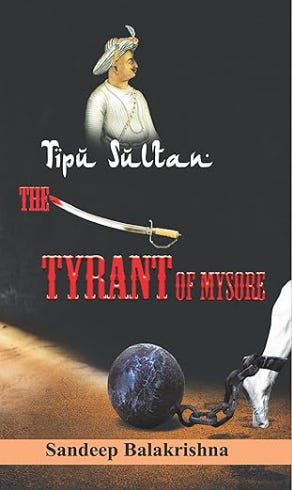
Sandeep Balakrishna’s work, Tipu SultanThe Tyrant of Mysore, undertakes a rigorous reassessment of widely circulated claims about Tipu Sultan by returning to primary materials, administrative records, and contemporaneous testimony. The analysis tests the popular portrayals of Tipuas freedom fighter, enlightened reformer, and tolerant ruleragainst verifiable evidence from the Mysore Sultanate and Kerala. At stake is more than a single legacy: the study exposes how narratives are constructed in Indian historiography and underscores a dharmic obligation to uphold satya (truth) while steadfastly resisting the instrumentalization of the past for sectarian antagonism.
In A. Sreedhara Menon’s A Survey of Kerala History, Tipu’s campaigns in Malabar are framed as introducing “modern and progressive” measures, notably direct tax collection from peasants and road-building that knit together remote tracts of Kerala. Menon also suggests that Tipu’s assaults on Brahmins, Kshatriyas, and Nairs catalyzed a social transformation by lowering the status of the Nairs and thereby, paradoxically, elevating the standing of subaltern castes. Even in this account, however, the catastrophic economic consequences are acknowledged: the wars halted black pepper cultivation, emptied ports, and strangled a millennium-old trade, precipitating a collapse in foreign currency inflows and widespread impoverishment.
Balancing these claims against administrative and economic history invites careful scrutiny. Direct extraction from peasants can be read as “modernization,” yet in late eighteenth-century South India it often meant bypassing mediating institutions to fund sustained warfare. New roads certainly improved mobility, but the record indicates that these arteries primarily served military logistics, not civil welfare. Calling such measures progressive without engaging their coercive underpinnings risks conflating state capacity with public good.
Balakrishna’s evaluation of Tipu’s Malabar operations foregrounds the human and cultural costs recorded across colonial, courtly, and local sources. Accounts of the march through Calicut describe indiscriminate executions, systematic desecration of temples and churches, and forced marriages of women to Muslim men. Tipu’s own correspondence, as cited in the study, documents pride in mass conversions and congratulatory notes to commanders for circumcising captives and compelling others to embrace Islam. These letters, when triangulated with regional chronicles and institutional records, materially challenge hagiographic representations.
As Tipu advanced toward Travancore, burning towns and villages are noted across multiple reports. The Nairs ultimately checked his progress, but not before large-scale displacement transformed Malabar’s demography. The resultant refugee flows, coupled with the sudden shock to pepper cultivation and maritime commerce, align with Menon’s acknowledgment of economic devastationevidence that undermines a simple “progressive reform” frame for the period.
Another tenacious myth assessed in the book is the claim that Tipu Sultan was a freedom fighter merely because he fought the British East India Company. The extant documentary trail shows a more complex calculus. In letters to the French, Tipu advocated concert with allied Muslim rulers and promised Paris a sharereportedly halfof territories seized from the British. His overtures extended to Napoleon Bonaparte, the Caliph, Zaman Shah of Afghanistan, and other foreign powers, inviting coordinated campaigns against the “infidels.” In modern terms, this pattern reads less like proto-nationalist resistance and more like strategic realpolitik aimed at replacing one imperial patronage network with another.
Balakrishna also situates these findings within the longue durée of narrative-making. Earlier court poets and chroniclers, incentivized by royal bakshish, created panegyrics that have since been re-circulated by modern cultural figures and political partisans. Celebrated dramatists and novelistsGirish Karnad and Bhagwan Gidwani among themhave amplified a heroic, humanist projection of Tipu that the primary record does not consistently support. The result is an edifice of memory built on selective citation, euphemism, and omission.
The larger historiographical concern is not merely interpretive disagreement but the institutional curation of the past. The book highlights a revealing exchange between the novelist S. L. Bhyrappa and G. Parthasarathy, who led a committee on national integration through education. Parthasarathy purportedly argued that curricular candor about the iconoclasm of figures like Aurangzeb and Mahmud of Ghazni would “poison minds,” offend minorities, and fracture societyhence the need for “maturity and discrimination” in choosing what to teach. As a principle of pedagogy, sensitivity is laudable; as a method of historical redaction, it invites distrust and perpetuates myth over truth.
Public scholarship from the late 2000ssuch as a 2009 Pragati essaywarned of this drift and recommended broadening participation in historical discourse beyond professional historians. While legal action, protests, and civic activism have roles, democratizing access to primary sources, fostering public reading groups, and encouraging clear, evidence-based syntheses are equally crucial. The evolution of the Aryan invasion hypothesis into migration models and then “trickle-down” formulations illustrates how scholarly paradigms shift over time; making such debates accessible can inoculate society against politicized misreadings.
Methodologically, a sound approach to Tipu Sultan’s era entails triangulating Persian, Kannada, and Malayalam documents; British and French archival material; court and temple records; revenue accounts; travelogues; and local oral histories. Cross-verification across hostile and friendly sources reduces single-source bias. Attention to economic indicatorspepper exports, port traffic, coin hoards, land-revenue remissionsadds quantitative texture to qualitative claims about welfare, coercion, and state performance.
Equally important is a dharmic ethic of remembrance. Hindu, Buddhist, Jain, and Sikh traditions converge on reverence for truth, pluralism, and the dignity of worship. Acknowledging the historical destruction of temples and coerced conversions in Malabar does not license animus against present-day communities; rather, it calls for collective resolve to prevent recurrence, protect cultural heritage, and model interfaith respect. Healing begins when facts are neither sensationalized nor suppressed.
Viewed through this lens, Tipu SultanThe Tyrant of Mysore is less a polemic than a corrective: it asks readers to privilege evidence over aura and to decouple anti-colonial resistance from modern nationhood when the documentary record points elsewhere. By contesting embellished narrativesold courtly myths reborn in contemporary culturethe study helps reclaim historical clarity and strengthens a shared civilizational commitment to satya and ahimsa.
The broader benefit of such work is integrative. Honest accounting of Kerala’s trauma under late-eighteenth-century Mysore rule, the collapse of the Malabar pepper economy, and the refugee crisis around Travancore enriches Indian history while reinforcing unity among dharmic traditions. A society that can face difficult truths with empathy and methodological rigor is better positioned to preserve cultural heritage, resist communal polarization, and foster the scholarly humility that genuine national integration requires.
In sum, Balakrishna’s book is a vital step toward restoring proportion and evidence to discussions of Tipu Sultan, Kerala history, and Indian historiography. It invites readers to engage sources directly, weigh competing claims carefully, and uphold a plural, dharmic ethos in how the past is taught, remembered, and transmitted.
Inspired by this post on Varnam.