
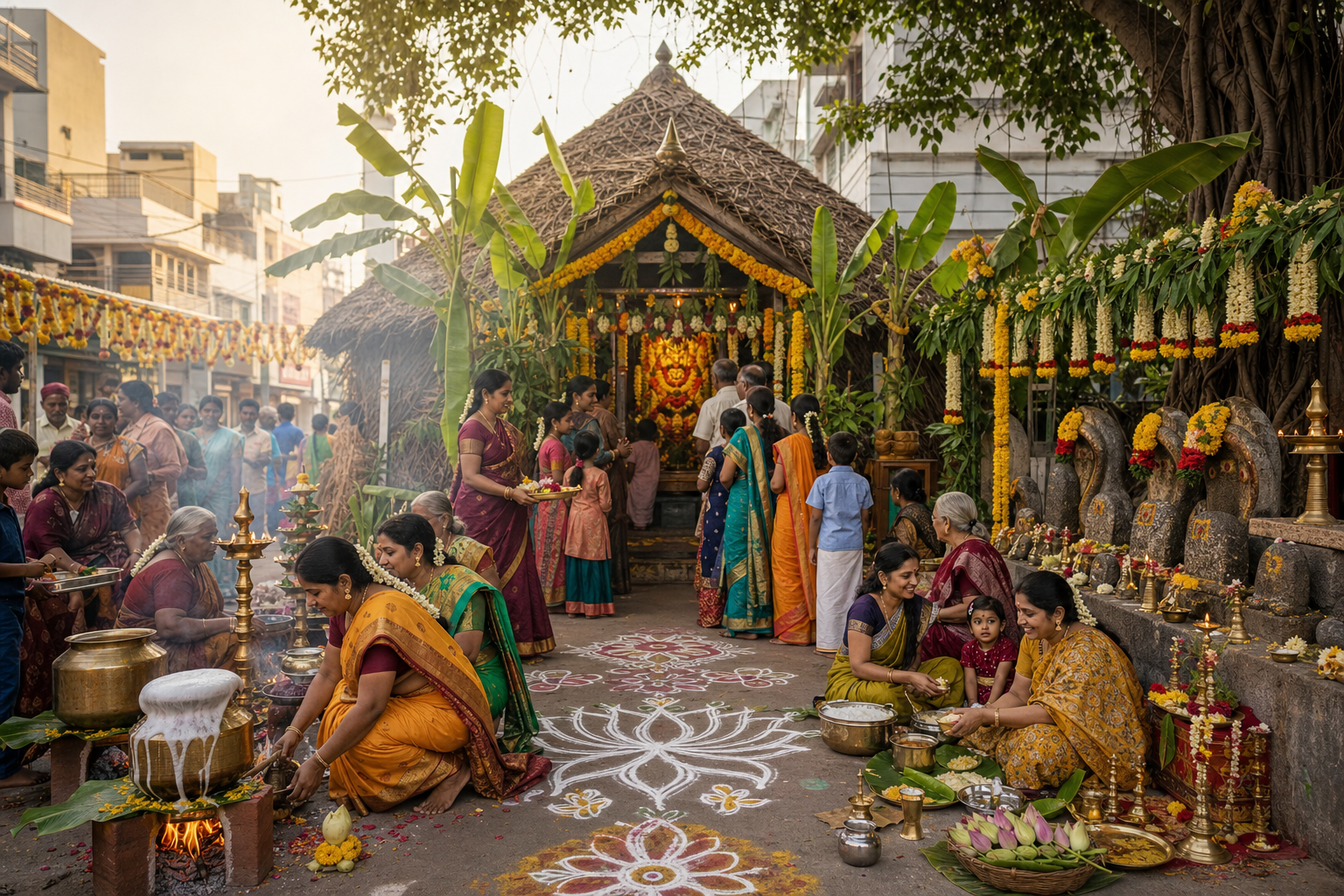
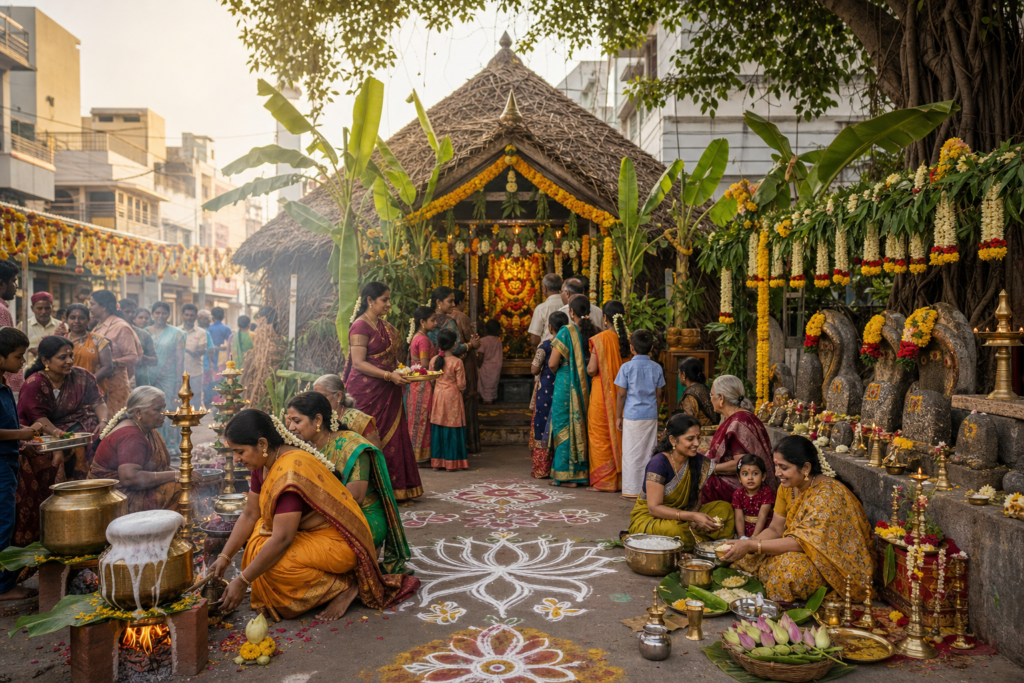
On an Aadi Friday, Mundagakanniamman Koil Street in Mylapore becomes an extension of the shrine itself. Flower decorations, banana stems, lamps, turmeric, kumkum and vessels of freshly prepared Pongal transform an urban lane into a ritual landscape. Families arrive from across Chennai, long-standing devotees renew vows, and the fragrance of food offerings mingles with the sounds of bells and prayer. This combination of temple worship, domestic devotion and public participation gives the Mylapore Mundaka Kanni Amman Temple Aadi Velli celebrations their distinctive emotional force.
Aadi Velli is more than a sequence of crowded Fridays. It brings together the Tamil solar calendar, Shakta theology, Mariamman worship, local guardian-deity traditions, food sharing and the social memory of Mylapore. The festival can therefore be studied at several levels: as worship of the Divine Mother, as a calendrical observance, as a community event and as an example of how an old sacred site continues to shape life in a modern metropolis.
A living Shakti shrine in Mylapore
The Mundaka Kanni Amman Temple stands on Mundagakanniamman Koil Street, north of the Kapaleeswarar Temple and west of the Madhava Perumal Temple. Its location places it within Mylapore’s unusually dense sacred geography, where major institutional temples coexist with smaller Amman shrines, household traditions and neighbourhood processional routes. The temple is not merely a monument visited on isolated festival days; it remains embedded in the routines, vows and family histories of the surrounding community.
English sources use several spellings, including Mundaka Kanni Amman, Mundakanni Amman and Mundagakanni Amman. These variations arise from transliteration and do not indicate different deities or temples. The official Tamil Nadu Hindu Religious and Charitable Endowments Department records the institution as Arulmigu Mundgakanni Amman Temple. Retaining the spelling used by a particular source is helpful, but visitors searching for directions should recognize all of these forms.
The presiding goddess is understood primarily as a manifestation of Shakti. The source account identifies her with Mundaka Kanni Amman, Mariamman and Renukadevi, and also places her among the Saptakannis, or Seven Maidens. Other local accounts associate her with Saraswati and the blessing of learning and artistic accomplishment. These identities need not be treated as mutually exclusive. Tamil goddess traditions frequently allow a local deity to be understood through several theological relationships while retaining her specific name, icon, place and ritual character.
The principal form is described as a swayambhu, meaning a sacred presence regarded as self-manifested rather than conventionally sculpted. According to the official temple history, its upper portion resembles a lotus bud and bears a trident motif. The same account connects the name with mundakam, a term for the lotus. A report on Mylapore’s goddess shrines describes a small conical stone over which a face is formed with sandal paste for worship. The icon is therefore encountered through natural form, ritual adornment and theological interpretation rather than through a fully anthropomorphic stone image.
Temple tradition assigns the shrine an antiquity of approximately 1,300 years, a claim also presented by the Tamil Nadu HR&CE Department. Academic caution is nevertheless necessary when discussing this chronology. A local architectural account notes that the frequently repeated age is not presently supported by published inscriptional evidence. The responsible conclusion is that the shrine possesses a deep and continuous local tradition, while its precise foundation date remains a matter of sacred memory rather than securely established epigraphy.
One of the temple’s most striking features is the thatched covering above the sanctum. Oral tradition explains that the goddess chose to remain beneath a roof of natural material so that the space would stay cool and open to the naga believed to worship her. Architecturally, this thatch preserves the visual language of a village Amman shrine inside metropolitan Chennai. Its simplicity also creates a powerful contrast with the monumental stone towers commonly associated with Tamil temple architecture.
Behind the principal shrine are a banyan tree and an anthill associated with naga worship. The belief that a serpent visits the goddess belongs to the temple’s oral and devotional tradition; it should not be presented as a zoologically verified event. The religious importance of the site lies in the relationship among the goddess, the tree, the earth and naga imagery. Devotees seeking relief from what astrological traditions call naga dosha may worship at the designated naga shrine or anthill according to temple practice.
Understanding Aadi Velli in the Tamil calendar
Aadi is a month of the Tamil solar calendar, generally extending from mid-July to mid-August. Its first day is associated with the Sun’s transition into the zodiacal sector corresponding to Cancer and with the traditional beginning of Dakshinayana, the southward solar course. Because it is a solar month, Aadi does not begin on the same Gregorian date every year. Aadi Velli consequently refers not to one fixed annual date but to every Friday that falls within that Tamil month.
Fridays are widely associated with worship of the goddess, especially in forms connected with prosperity, protection, fertility, health and household well-being. During Aadi, this weekly observance becomes more intense at Amman temples throughout Tamil Nadu. At Mundaka Kanni Amman Temple, devotees approach the goddess as a protective maternal presence who can absorb distress, restore confidence and sustain the family. Such benefits are expressions of faith and should be described as devotional expectations rather than scientifically measurable guarantees.
The source account presented a five-Friday devotional sequence for 2025: July 18, July 25, August 1, August 8 and August 15. Those dates form a historical schedule and must not be copied into another year’s calendar. Depending on the alignment of weekdays with Aadi, a year may contain four or five Aadi Fridays. Anyone planning a visit should consult the current Tamil calendar and confirm the programme with the temple.
Within the five-Friday interpretation given by the source, the first Friday honours Swarnambika, a form of Parvati associated with prosperity and abundance. The second is linked with Angala Amman, whose worship emphasizes protection from adversity and destructive influences. These associations show how a single festival cycle can invoke several names of the Divine Mother without fragmenting the underlying Shakti theology.
The third Friday is associated with Kalikambal and prayers for health, courage and the strength to confront difficulty. The fourth invokes Kamakshi Amman in relation to harmonious relationships and the removal of obstacles. When a fifth Friday occurs, it is dedicated to Lakshmi and the wider idea of prosperity, which includes material security, auspiciousness and household stability. The source gives particular importance to the first and third Fridays, although all Fridays of Aadi remain sacred within the broader observance.
This sequence is best understood as a devotional framework rather than a universally binding rule for every Amman temple. Festival calendars, goddess names and ritual emphases can vary by locality, lineage and temple administration. Such variation is a characteristic strength of Hindu practice: a shared reverence for Shakti can be expressed through multiple regional forms without requiring rigid uniformity.
How an Aadi Friday unfolds at the temple
The observance begins early. Devotees often arrive in the morning to avoid the heaviest crowds and to participate in abhishekam, archana or darshan. The fixed principal presence, or moolavar, becomes the focus of repeated cycles of ritual service. The increased attendance is not simply a matter of festival spectacle; many families return because the shrine is connected with a vow, an answered prayer or a custom maintained across generations.
Abhishekam is the ceremonial bathing of a deity or sacred icon with ritually approved substances. A documented Aadi Velli celebration in Mylapore reported milk abhishekam for Amman through the day. The rite is followed by cleansing, dressing and decoration, allowing devotees to encounter the deity in a renewed visual form. Its meaning is ritual and relational: devotees offer materials with reverence, while the completed worship communicates purity, care and divine presence.
Turmeric has an especially visible role. During manjal kaapu alankaram, the goddess is covered or adorned with turmeric preparation, producing a vivid yellow appearance associated with auspiciousness, protection and the embodied power of Amman. Kumkum, flowers, cloth and lamps complete the visual field. The transformation from abhishekam to alankaram is technically significant because ritual bathing and ritual adornment are distinct stages rather than interchangeable acts.
Outside the shrine, sections of the street may be regulated so that women and families can prepare Pongal safely. The 2019 neighbourhood report described flower pandals, banana-tree decorations and barricades restricting traffic while devotees cooked along Mundagakanniamman Koil Street. This arrangement turns the street into a temporary ritual commons. Domestic cooking leaves the private kitchen, enters public sacred space and becomes a collective offering before the food is shared.
Pongal may be prepared in sweet or savoury forms according to the vow and temple instructions. The source also records offerings of koozh and curd rice. Koozh is a porridge commonly made with millet, including ragi, and has long been associated with Amman festivals in Tamil Nadu. Devotional accounts describe it as cooling and refreshing during the warm Aadi season. That description should be understood as a cultural and experiential classification, not as a substitute for individualized nutritional or medical advice.
The movement from cooking to distribution follows an important ritual logic. Food is first prepared under appropriate conditions, presented to the goddess as naivedya and then received as prasada. The offering is not treated as an ordinary meal once it enters this sequence; it acquires relational significance through dedication and sharing. Distribution also ensures that the festival’s blessings are experienced socially rather than retained by the sponsoring household alone.
Devotees also worship the installed naga devatas with milk, turmeric and kumkum and may light a Maa Vilakku, or maavilakku, traditionally formed from rice flour and sweetening ingredients. Naga worship should remain within the areas and procedures designated by the temple. Milk abhishekam performed for a consecrated naga image is a symbolic ritual act and should not be confused with feeding a living snake. Visitors should never approach wildlife, disturb an active habitat or pour substances independently into an anthill.
The mantra preserved in the source expresses the devotional centre of the celebration: “OM SRI AADIVELLI AMMAIYE NAMO NAMAHA”. Its repetition directs attention toward the Mother worshipped on Aadi Friday. As with any mantra received through a temple or family tradition, pronunciation and repetition are best approached respectfully, without reducing the formula to a decorative slogan.
Household custom, charity and community memory
In many Tamil households, Aadi is devoted more strongly to goddess worship than to launching new domestic ventures. Weddings, grihapravesam ceremonies and some business beginnings may be deferred until another month. This is a customary pattern rather than an absolute religious prohibition, and practices vary among communities and families. The apparent pause in household auspicious ceremonies does not make Aadi inauspicious; instead, ritual attention is redirected toward Amman, ancestral continuity, seasonal worship and acts of giving.
Food distribution and charity are therefore central rather than incidental. Preparing koozh, Pongal or curd rice requires labour, coordination and expenditure, but the completed offering is shared beyond the immediate family. Donations of food or resources to charitable institutions similarly extend worship into social responsibility. The festival presents prosperity not only as private accumulation but also as the capacity to nourish others.
Women have a particularly visible role in the public preparation of Pongal, the maintenance of vows and the transmission of household ritual knowledge. This participation should not be romanticized as effortless tradition: it involves organization, culinary expertise, time and often years of disciplined repetition. Long-term devotees interviewed during earlier celebrations described returning before important family functions and sustaining the same offering for decades. Their practice turns individual memory into community heritage.
The temple also demonstrates how sacred space can expand and contract. On an ordinary day, worship is concentrated within the compound. On Aadi Velli, queues, cooking areas, flower structures and traffic controls extend the festival into the neighbourhood. The street does not permanently cease to be urban infrastructure, but for several hours it serves religious, culinary and social functions simultaneously. This temporary reorganization is a technically important feature of living heritage.
The most affecting element is often not grandeur but continuity. A modest thatched sanctum, an aniconic lotus-like form and a vessel of millet porridge can carry meanings accumulated through many generations. For a first-time visitor, this intimacy may be more memorable than monumental architecture. For a returning devotee, the same elements can evoke family history, protection and the reassuring persistence of place.
Practical guidance for an Aadi Velli visit
The date should be checked before travel because Aadi Velli changes annually. Festival-day programmes, crowd-control arrangements and special services may also change at short notice. The most reliable procedure is to compare a current Tamil calendar with a notice from the temple or the Tamil Nadu HR&CE Department. Older web pages are valuable records of previous celebrations but are not current schedules.
The official contact page lists the address as 42, Mundagakanniamman Koil Street, Mylapore, Chennai 600004, and provides the telephone number 044-24981893. The official worship information gives regular opening periods of 6:00 a.m. to 12:00 p.m. and 4:00 p.m. to 9:00 p.m., with the midday closure from noon to 4:00 p.m. Uchikkala puja is listed from 11:30 a.m. to noon. Festival timings should still be confirmed directly.
Visitors should wear respectful clothing, leave footwear in the designated place and follow the queue established by temple staff. Photography should never be assumed to be permissible, especially near the sanctum, ritual bathing or people fulfilling private vows. Flowers, turmeric, milk and prepared food should be offered only through approved procedures. A polite inquiry at the temple is more reliable than copying another devotee’s actions without understanding their context.
Early arrival can reduce exposure to the largest queues, but popular Fridays may remain crowded throughout the day. Mylapore’s inner streets are narrow, and temporary barriers may alter vehicle access. Visitors should carry drinking water for personal use, protect themselves from heat and rain, and avoid blocking cooking or distribution areas. Families accompanying children, older adults or people with mobility limitations should ask in advance about the least congested entrance and available assistance.
Participation does not require performing every available rite. Quiet darshan, respectful observation or receiving prasada can be meaningful forms of engagement. Those unfamiliar with Tamil Shakta practice should allow the temple’s own rhythm to guide them. The goal is not to reproduce an idealized checklist but to enter a living religious environment with attention, patience and humility.
Reading the festival with both faith and historical care
An academic account must distinguish among institutional records, observed practice and devotional belief. The temple’s address and opening hours can be verified administratively. Street cooking, milk abhishekam and manjal kaapu have been documented during previous festivals. The self-manifestation of the goddess, the antiquity assigned by tradition and the nightly worship of a naga belong to sacred history and oral memory. Identifying these categories does not belittle faith; it prevents unlike forms of evidence from being confused.
The temple’s layered goddess identities similarly require interpretive care. Mundaka Kanni Amman may be related to Mariamman, Renukadevi, Saraswati, Parvati and the Saptakannis in different devotional accounts. These relationships illustrate a networked Shakta theology in which local specificity and wider divine unity coexist. The goddess is not made less local by being identified with Shakti, nor is the wider tradition weakened by her distinctive Mylapore form.
The festival also offers a constructive point of connection within the broader Dharmic family. Its theology and rituals remain distinctly Hindu and Shakta, yet its emphasis on disciplined observance, compassion, hospitality, food sharing and reverence for life can encourage respectful dialogue with Buddhist, Jain and Sikh traditions. Unity is strongest when it preserves genuine differences while recognizing shared ethical commitments.
Aadi Velli at Mylapore’s Mundaka Kanni Amman Temple ultimately reveals how a tradition survives through repetition, adaptation and community care. The swayambhu form, thatched sanctum, banyan tree, naga shrine, turmeric adornment and shared food each contribute a different layer of meaning. Together they create a celebration in which sacred geography, maternal divinity and neighbourhood life remain inseparable.
For devotees, the day culminates in darshan and the assurance of the Mother’s presence. For cultural observers, it provides a rich study of Tamil calendrical practice and living heritage. For the wider community, it demonstrates that worship can become service when an offering prepared by one household is shared with many. That union of devotion, memory and generosity is the enduring significance of the Mylapore Mundaka Kanni Amman Temple Aadi Velli celebrations.
Inspired by this post on Hindu Pad.








Leave a Reply
You must be logged in to post a comment.