
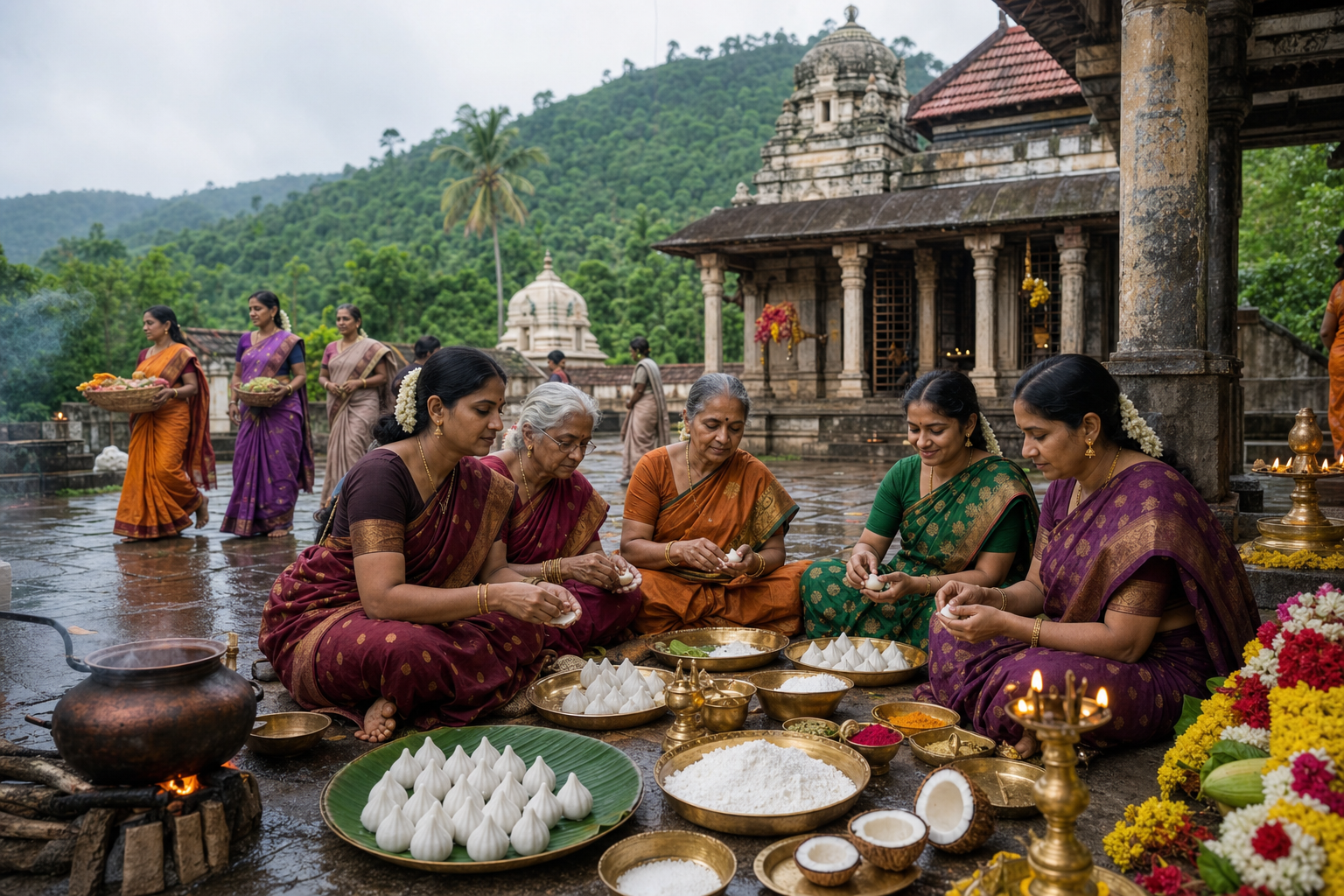
The Aadi Festival 2026 at Avvaiyar Amman Temple near Nagercoil is best understood as a devotional cycle rather than a single-day event. The Tamil month of Aadi begins on Friday, July 17, 2026, in the calendar followed for this guide, while the temple’s characteristic Aadi Chevvai observance begins on the first Tuesday, July 21. Throughout the month, worship, food offerings and women-led vows transform this comparatively small shrine into an important centre of Tamil religious and cultural life.
The distinction between July 17 and July 21 is important. July 17 marks the beginning of Aadi and is also the first Aadi Velli, or Friday of Aadi. July 21 is the first Aadi Chevvai, or Tuesday of Aadi, and therefore the opening of the weekly observance most closely associated with Avvaiyar Amman Temple. Describing the festival as month-long and identifying the first Tuesday as its principal beginning are consequently complementary statements, not conflicting dates.
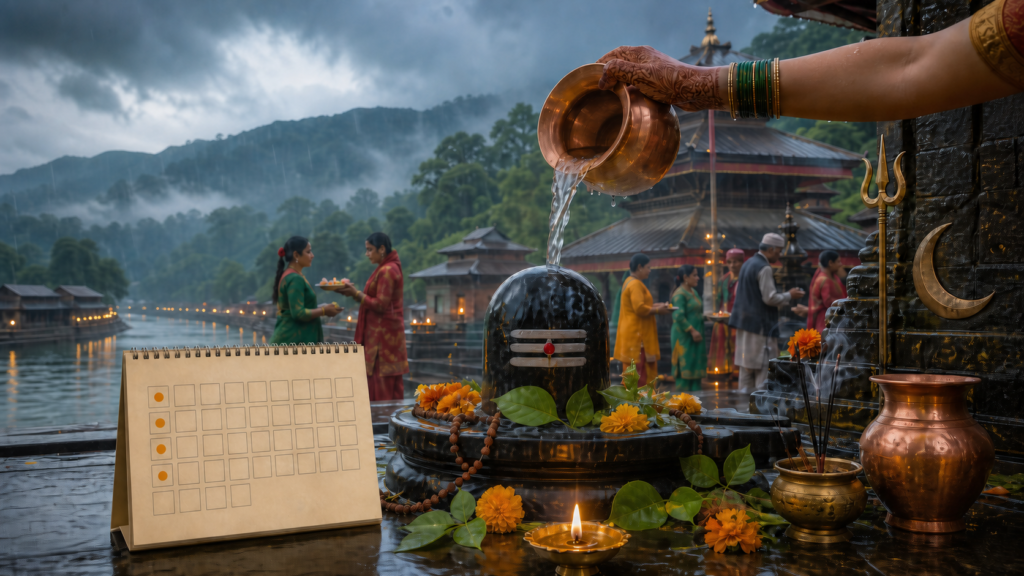
Aadi Festival 2026 dates at a glance
The 2026 Aadi calendar used by the source publication places Aadi from July 17 through August 17, 2026. An independent Tamil date sequence for Aadi 2026 likewise assigns Aadi 1 to July 17. Tamil months are solar, but local almanacs may apply sunrise and solar-ingress conventions differently at a month boundary. The temple’s own notice or locally followed panchang should therefore remain authoritative for ritual timings.
Aadi Chevvai dates: The four Tuesdays falling within this 2026 Aadi sequence are July 21, July 28, August 4 and August 11. These are the dates most relevant to the traditional women-led worship at Avvaiyar Amman Temple. The first Tuesday, July 21, is expected to carry particular significance because historical accounts describe the first Aadi Chevvai as the formal opening of the temple’s special observances.
Aadi Velli dates: The Fridays are July 17, July 24, July 31, August 7 and August 14. Fridays throughout Aadi are widely associated with worship of Amman and other forms of the Divine Feminine in Tamil Nadu. They belong to the broader sacred rhythm of the month, although visitors should not assume that the Avvaiyar Amman Temple programme on a Friday will be identical to its better-documented Tuesday observance.
Other well-known occasions within Aadi include Aadi Perukku, Aadi Krithigai, Aadi Amavasai and Aadi Pooram. Their presence helps explain why Aadi is one of the busiest devotional periods in the Tamil calendar. These wider observances, however, should not be presented as confirmed events at Avvaiyar Amman Temple unless they appear in the temple’s current programme. A calendar date and a temple-specific schedule are two different forms of information.
Where Avvaiyar Amman Temple is located
Although the shrine is frequently described online as the Nagercoil Avvaiyar Amman Temple, Nagercoil functions as the nearest major urban reference point. The temple is near Thazhakudy, also written Thalakudy, in Kanniyakumari district. Published descriptions place it roughly 12 to 14 kilometres from Nagercoil, near the Thazhakudy–Shenbagaramanputhur road. The spelling variation is worth noting when searching maps, transport services or local notices.
Thazhakudy belongs to the historically rich Nanjil Nadu landscape and is described as lying between the Puthanaar and Palaiyaar waterways. The setting connects the shrine to a region shaped by river systems, agriculture, the Western Ghats and long interaction between Tamil Nadu and neighbouring Kerala. Reports that the Aadi gathering attracts devotees from both states are therefore geographically plausible and culturally significant.
The location should be entered specifically as Avvaiyar Amman Temple near Thazhakudy rather than merely as an Avvaiyar shrine in Kanniyakumari district. More than one local sacred site is associated with Avvaiyar traditions, including a shrine in the Muppandhal area. Confirming the village and road before departure prevents a common navigational mistake.
Who is Avvaiyar Amman?
Avvaiyar occupies an exceptional place at the meeting point of Tamil literature, ethical teaching, folklore and devotion. The name is not as historically simple as popular retellings sometimes suggest. Tamil Virtual Academy learning material explains that Avvaiyar means an elderly or respected woman and that several women poets known by this title lived in different periods. Academic discussion therefore distinguishes the Sangam poet from later devotional and didactic figures whose memories gradually became intertwined.
This distinction matters because familiar stories, moral verses and devotional legends need not all describe one biographical individual. The Sangam-era Avvaiyar associated with chieftains such as Athiyaman and the later Avvaiyar connected with concise ethical instruction belong to different literary chronologies. Popular tradition often gathers these figures into a single wise elder, while historical study separates textual layers and dates. Both processes are culturally meaningful, but they answer different questions.
Avvaiyar’s association with the wider region is not purely modern. The Kanniyakumari district historical chronology lists Avvaiyar among the Sangam poets who praised Nanjil Porunan, a ruler of part of Nanjil Nadu. This provides an important regional literary connection. It does not, by itself, prove that the present temple existed in the Sangam period or establish which Avvaiyar is represented by its current devotional identity.
At the shrine, Avvaiyar is venerated as Avvaiyar Amman: a revered woman of wisdom remembered through the sacred language of motherhood and divine protection. The Tamil word Amman carries the sense of mother and commonly identifies forms of the Goddess or locally revered female sacred powers. The temple thus does more than commemorate a poet. It shows how literary memory can become embodied in ritual, image, place, food and intergenerational devotion.
History, tradition and architectural evidence
Popular accounts frequently describe Avvaiyar Amman Temple as approximately 300 years old. A detailed 2010 report on its Aadi observance recorded this local estimate while also acknowledging that documentary evidence for the foundation narrative was not known to the report. The age should therefore be presented as community tradition rather than as a date securely established by an inscription or archaeological excavation.
A 2025 heritage-walk field account provisionally associates the building with the sixteenth- or seventeenth-century Vijayanagara-Nayaka cultural horizon. It records a south-facing temple, a sanctum, an ardha mandapa, a mukha mandapa and a small vimana. It also notes female guardians at the sanctum entrance, figures interpreted as Nayaka patrons in anjali posture, images of Vinayagar and nagas, and a Murugan shrine in the precinct.
That architectural estimate and the approximately 300-year local date do not align perfectly, but the difference need not be forced into a false certainty. Temples often pass through several phases of construction, enlargement, repair and reconsecration. A sacred tradition can also predate the masonry that presently houses it. Until a systematic architectural and epigraphic study is available, the most responsible conclusion is that the temple is historically layered and that precise dating remains provisional.
The 2025 field account observed renovation work in parts of the precinct. Visitors should consequently expect that finishes, access paths or visible architectural details may differ from older photographs. Renovation also raises a wider heritage question: improvements needed for active worship must be balanced with the preservation of older masonry, sculpture and surface evidence. Living temples are simultaneously sacred institutions, community spaces and historical records.
Why the Tamil month of Aadi is important
Aadi is the fourth month of the Tamil solar calendar. Its beginning is associated with the Sun’s movement into Karkataka, or Cancer, from Mithuna, or Gemini, in the sidereal calendrical system. This solar basis distinguishes the Tamil month from a purely lunar month. Tithi- and nakshatra-based observances within Aadi may require additional local calculations, whereas the identification of Tuesdays and Fridays follows the civil weekdays once the month boundary has been fixed.
Aadi falls during a major seasonal transition in South India. Its festivals connect domestic devotion, goddess worship, water, fertility, agriculture and community protection. No single explanation captures the entire month. Its significance has accumulated through temple liturgies, agrarian rhythms, women’s vows and local custom, demonstrating how Tamil religious time integrates cosmology with the lived environment.
Popular custom sometimes discourages weddings or selected household beginnings during Aadi, but describing the whole month as inauspicious is misleading. Aadi is exceptionally active in Amman temples, where Tuesdays and Fridays carry intense devotional value. The month is better understood as one in which attention shifts toward the Divine Feminine, protective worship, vows and communal offerings.
Within customary interpretation, Aadi Chevvai emphasizes the power of Tuesday worship, while Aadi Velli joins the sacred character of Friday with devotion to Amman and other forms of Shakti. These meanings are not uniform across every temple. Avvaiyar Amman Temple is distinctive because the month’s broader goddess tradition is joined to reverence for a Tamil woman remembered as poet, elder, teacher and sacred mother.
Avvai Nonbu and the women-led ritual tradition
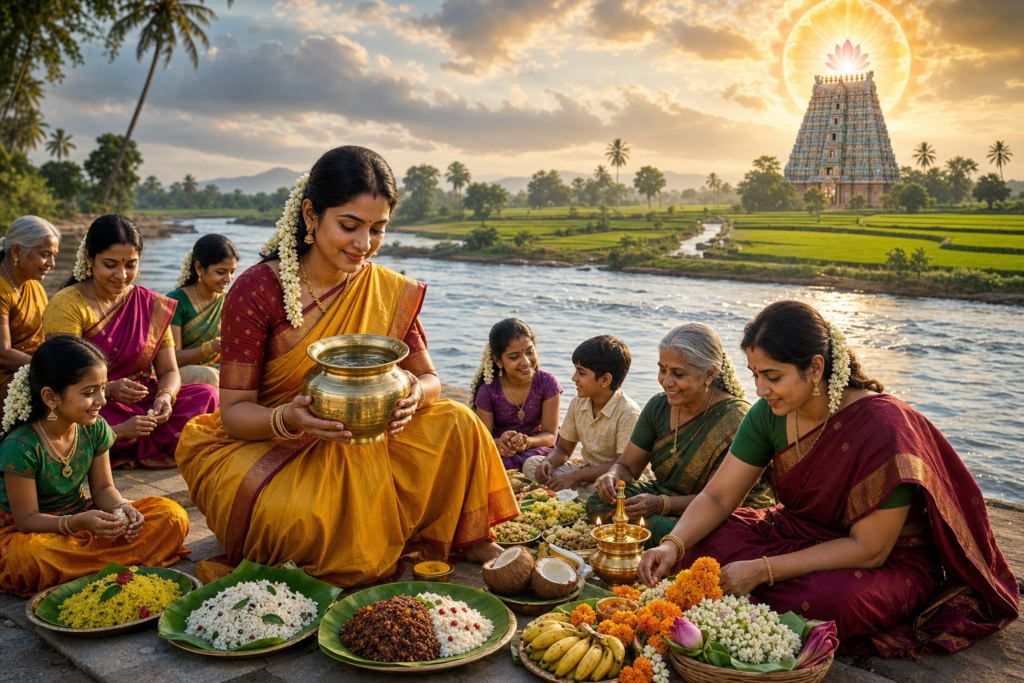
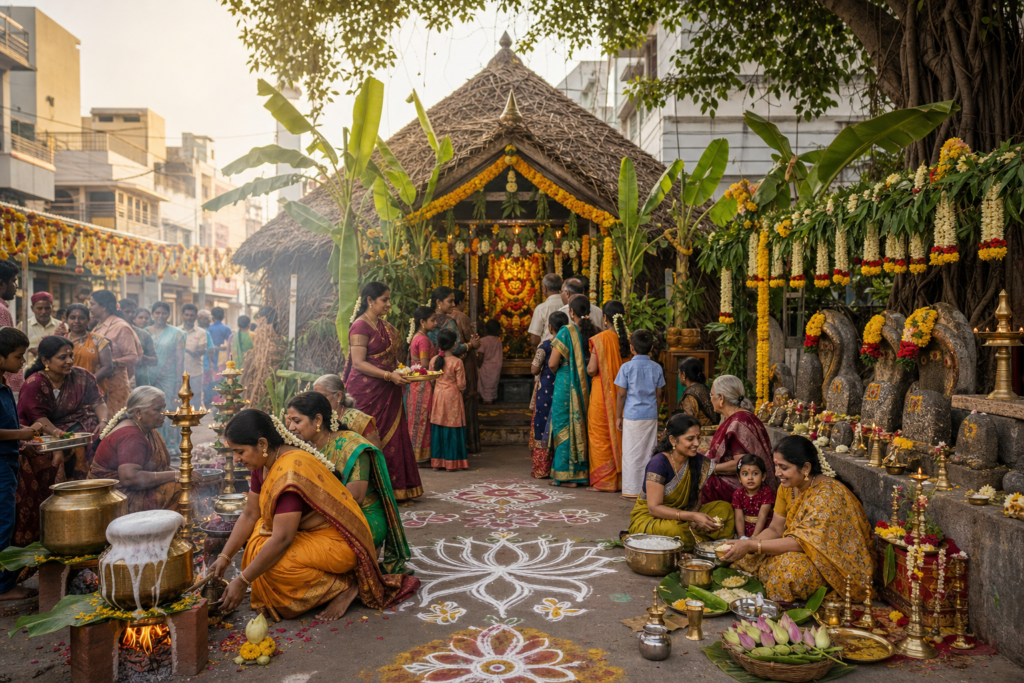
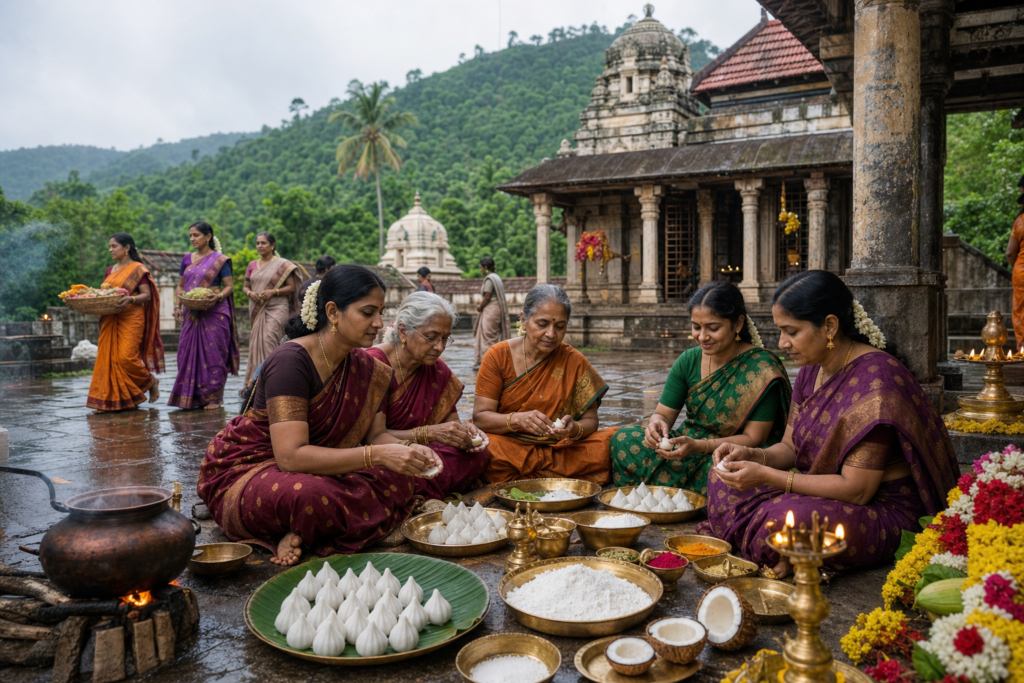
Local worship of Avvaiyar is often described as Avvai Nonbu or Avvai Viratham. Nonbu and vrata refer to disciplined religious observances that may combine prayer, dietary practice, preparation of offerings and a stated devotional intention. At Thazhakudy, the tradition is especially associated with women gathering on Aadi Tuesdays to prepare food and pray to Avvaiyar Amman.
Historical descriptions identify several customary petitions. Unmarried women pray for a suitable marriage, while married women and couples may seek the blessing of children, family welfare and marital well-being. Some accounts frame the prayer in terms of a husband’s longevity. These are traditional expressions of hope within the language of devotion; they are not empirical guarantees, medical treatments or standards by which any woman’s worth should be measured.
The central food offering is kozhukattai, a steamed preparation based on rice flour. The 2010 local report records a version made with raw rice flour, sugar, coconut, dry ginger and cardamom, shaped into portions and steamed. Family recipes can vary, and another sweetener or a different proportion of ingredients may be used. Visitors should not treat one published recipe as a universal temple rule.
The same report documents koozh, a cooked gruel or porridge, alongside the dumplings. A 2017 account of the first Aadi Tuesday describes women preparing several kinds of kozhukattai and also offering payasam. Read together, these reports show a living culinary tradition with a stable ritual core and room for household variation.
An older remembered form of the observance involved small salt-free kozhukattai prepared and shared only among women. This detail is valuable as evidence of a gender-specific ritual variant, but it should not be converted into an unverified instruction for 2026. Living practices change, and the temple’s present guidance should determine who may prepare offerings, where cooking is permitted and how the food enters the ritual sequence.
The offering acquires meaning through process as much as through ingredients. Rice is cleaned and milled, flour is combined with coconut and aromatic ingredients, portions are shaped, and steam transforms the mixture into food that can be presented and shared. Domestic culinary knowledge is thereby carried into a collective sacred setting. Labour, memory and devotion become inseparable.
Once offered, food may be received as prasadam, carrying the emotional significance of grace and shared belonging. The movement from household ingredients to communal preparation and finally to distribution gives the ritual a social dimension. It creates an occasion for relatives, neighbours and unfamiliar devotees to work beside one another, exchange knowledge and renew relationships.
Historical festival reporting also mentions special puja on the first Tuesday, followed by daytime alankara deepa aradhana and an evening lamp offering. Those details help reconstruct the established ritual pattern but do not constitute a confirmed 2026 timetable. Opening hours, puja slots, queue arrangements and the permitted period for food preparation should be checked shortly before the intended visit.
Avvaiyar, Murugan and sacred storytelling
A Murugan shrine is associated with the Avvaiyar Amman complex, and older reporting places Kumara Gurubara Swami at Mayiladum Kundru above the temple. Devotees visiting Avvaiyar Amman have traditionally also sought Murugan’s darshan. This pairing evokes the celebrated story in which Murugan, appearing as a young herdsman, gently challenges Avvaiyar’s learning through a playful question about fruit.
Local tradition may identify the surrounding landscape with that encounter, but legend and documentary history should remain analytically distinct. The story communicates humility: even a person honoured for wisdom can still learn, and insight may arrive through an unexpected teacher. Whether or not the episode can be tied to one physical site, its ethical force helps explain why Avvaiyar and Murugan are remembered together.
The narrative also prevents the shrine from becoming a monument to achievement alone. Avvaiyar’s greatness is expressed through receptiveness, disciplined speech and the willingness to recognize knowledge beyond the self. For students familiar with Avvaiyar primarily through moral instruction, the festival reveals how literary ethics can continue through ritual practice rather than remaining confined to a classroom text.
The emotional and social experience of Aadi Chevvai
For a first-time visitor, the most affecting feature may be continuity rather than spectacle. Familiar ingredients are measured by experienced hands, recipes remembered from elders are repeated, and prayers concerning deeply personal hopes are carried into a public gathering. The atmosphere can hold celebration, anxiety, gratitude and expectation at the same time. That emotional complexity is one reason the observance cannot be reduced to a calendar entry.
The 2017 report records long queues and women preparing varied offerings, while earlier descriptions note attendance from across Kanniyakumari district and Kerala. Such gatherings create temporary networks of mutual assistance: one person may help shape dumplings, another may tend a cooking vessel, and another may guide a newcomer through local procedure. The ritual space becomes a practical community as well as a devotional one.
Women’s central role should not be interpreted only through marriage and childbirth. The observance also preserves culinary skill, religious vocabulary, route knowledge, family memory and authority over the performance of a vow. Women appear not merely as recipients of blessings but as organizers, ritual specialists within the household tradition and transmitters of cultural knowledge.
Avvaiyar Amman Temple is therefore a significant example of how Tamil culture remembers intellectual and spiritual female authority. A revered poet is not treated as a distant literary figure. She becomes Amman, approached through food, vows, lamps and prayer. The shrine turns cultural memory into a relationship that can be renewed each year.
The festival is distinctly rooted in Tamil Hindu practice, yet its ethical themes can be appreciated across the wider family of Dharmic traditions. Disciplined observance, reverence for wisdom, generosity through food and care for community resonate in different forms within Hindu, Buddhist, Jain and Sikh traditions. Recognizing such affinities supports unity without erasing the history, theology or ritual individuality of any path.
Planning a respectful visit in 2026
The most direct approach is generally by road from Nagercoil toward Thazhakudy and Shenbagaramanputhur. Published estimates place the temple approximately 12 to 14 kilometres from Nagercoil and about 6 to 8 kilometres from Aralvaimozhi, depending on the route and measurement point. Nagercoil and Aralvaimozhi are both useful rail references, although the better option depends on the traveller’s train and onward transport.
Historical reports describe special buses operating from Nagercoil on crowded Aadi Tuesdays, including services through Eratchakulam, Shenbagaramanputhur and Thazhakudy. That precedent should not be treated as confirmation of the 2026 service plan. Travellers should verify current routes with the Tamil Nadu State Transport Corporation, the local bus station or temple administration before relying on a special service.
Arriving early is prudent on every Aadi Tuesday, especially July 21. Extra time may be required for traffic, parking, footwear storage, security checks, the darshan queue and any supervised offering process. Families travelling with older adults, young children or people with limited mobility should ask in advance about vehicle access, seating, toilets and the condition of paths around the shrine.
Kanniyakumari district can receive monsoon rain during July and August. A compact umbrella or rain covering, water-resistant storage for essential items and footwear with a secure grip can make the journey safer. Since footwear must normally be removed before entering a temple’s sacred area, visitors should also be prepared for wet surfaces and should follow local directions rather than leaving shoes where they obstruct movement.
Anyone intending to prepare kozhukattai or another offering should first confirm the current rules. The temple may regulate ingredients, cooking fuel, vessels, preparation areas, timing and waste disposal during a large gathering. Bringing a complete cooking arrangement without authorization could create safety or crowd-management problems. A simple purchased offering or participation in a family’s established vow may be more appropriate for a newcomer.
Food allergies and dietary restrictions require attention even when food is sacredly offered. Rice flour and coconut are common ingredients, but sweeteners, spices, dairy, nuts or cross-contact can vary by preparation. Prasadam should be accepted respectfully, yet no one should be pressured to consume food that may cause harm. Parents should supervise young children around hot steam, boiling vessels and crowded cooking areas.
Modest, comfortable clothing suited to a temple and humid weather is advisable. Photography should never be assumed to be permissible, particularly near the sanctum or while women are performing a private vow. Consent is essential before photographing individuals, cooking groups or children. A religious gathering is not simply a visual attraction; it contains moments of vulnerability that deserve privacy.
Queue discipline, patient communication and attention to temple volunteers are especially important on the first Tuesday. Visitors should avoid blocking ritual areas, touching images or vessels without permission, or attempting to bypass an established sequence. Those unfamiliar with a custom can ask quietly and observe before acting. Respectful uncertainty is preferable to confident disruption.
Environmental care is also part of responsible pilgrimage. Reusable water containers where permitted, minimal packaging and careful disposal of leaf plates, flowers and food waste help protect the temple landscape. Ritual materials should be placed only in designated locations; sacred intention does not make discarded plastic or unmanaged organic waste environmentally harmless.
Frequently clarified points
Does the festival begin on July 17 or July 21? Aadi begins on July 17 in the calendar followed here. The temple’s distinctive Tuesday series begins on July 21. July 17 is therefore the month opening and first Aadi Friday, while July 21 is the first Aadi Tuesday.
How many Aadi Tuesdays occur in 2026? Four Tuesdays fall within the stated Aadi period: July 21, July 28, August 4 and August 11. There are also five Aadi Fridays: July 17, July 24, July 31, August 7 and August 14.
Is the temple inside Nagercoil? It is commonly identified with Nagercoil for regional convenience, but the shrine is near Thazhakudy in Kanniyakumari district, approximately 12 to 14 kilometres from the city. Route searches should include Thazhakudy or Thalakudy.
Is the observance exclusively for women? Women are unquestionably central to the documented Aadi ritual, and an older account preserves the memory of a women-only form of the vow. That historical detail should not be used to declare a current entry restriction. Men and other visitors should follow the temple’s present rules and avoid intruding upon women-led preparation or prayer.
What is the principal offering? Kozhukattai made from rice flour is the best-documented offering, with coconut, sweetener and aromatic ingredients appearing in reported recipes. Koozh and payasam have also been recorded. The required form, if any, should be confirmed locally because household custom and temple procedure can differ.
Is the temple definitively 300 years old? Approximately 300 years is a widely repeated local estimate. A recent field interpretation suggests possible sixteenth- or seventeenth-century Nayaka architectural features, while the older news report notes an absence of known documentary proof for the foundation story. The safest academic description is that the temple is historic but not securely dated in the currently accessible evidence.
Does the shrine represent one historically identifiable Avvaiyar? Devotional tradition venerates Avvaiyar Amman as a unified sacred personality. Literary scholarship, however, recognizes several poets called Avvaiyar across different periods. The temple’s religious identity and the academic reconstruction of Tamil literary history should be respected without treating them as interchangeable forms of proof.
Why the Aadi Festival remains powerful in 2026
The enduring strength of the Aadi Festival at Avvaiyar Amman Temple lies in its ability to unite calendar, landscape, women’s knowledge, Tamil literature and living devotion. Its most memorable symbol is not an object of luxury but a steamed rice-flour offering shaped by hand. That simplicity carries considerable cultural depth: ordinary food becomes prayer, inherited knowledge becomes public practice, and a poet remembered for wisdom becomes a sacred mother approached with trust.
For 2026, July 21 is the principal date to remember, followed by July 28, August 4 and August 11. Yet the festival’s meaning extends beyond attendance on one crowded Tuesday. It asks visitors to understand how a community preserves memory, how women sustain ritual authority, and how humility, generosity and shared food can turn a local temple into a place of far-reaching emotional significance.
Inspired by this post on Hindu Pad.





Leave a Reply
You must be logged in to post a comment.