

The king who vanished into a flower
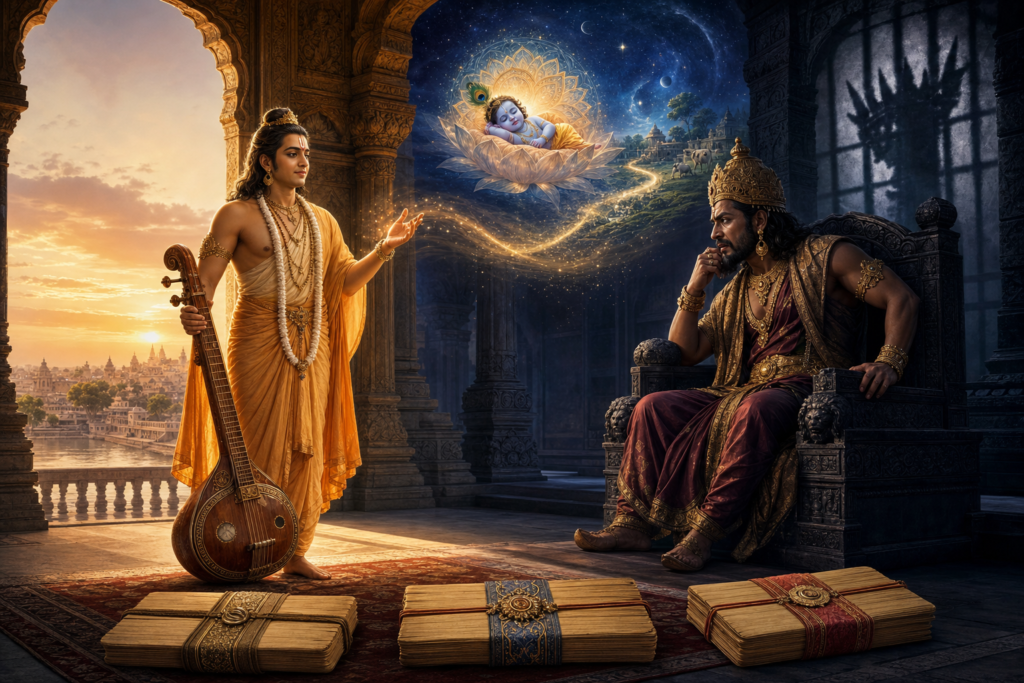
The image is among the most striking reversals in the Mahabharata: Indra, sovereign of the Devas and wielder of the thunderbolt, withdraws from the visible worlds and contracts into the hidden interior of a lotus stalk. A deity associated with rain, authority, and public victory becomes minute, silent, and inaccessible. The episode is therefore more than a tale about concealment. It is an inquiry into what happens when fear distorts judgment, violence generates consequences, and a ruler can no longer inhabit the office he holds.
Sachi Devi’s search gives the story its emotional and ethical center. She does not merely wait for Indra to return, nor does she deny the gravity of the events that drove him into hiding. She seeks protection, resists coercion, asks for time, invokes sacred guidance, crosses a symbolic landscape, and finally reaches the lotus in which her husband has disappeared. Her devotion is expressed through discernment and action. The resulting narrative connects guilt, fidelity, political legitimacy, ritual expiation, and redemption without reducing any of them to a simple moral slogan.
Textual setting: Chapter 14 and its surrounding narrative
Sachi Devi’s discovery of Indra is commonly located in the Mahabharata’s Udyoga Parva, Chapter or Section 14, depending on the edition and translation being consulted. Chapter numbering is not uniform across Sanskrit editions, regional recensions, and English translations. A responsible reading therefore identifies both the Udyoga Parva and the larger Indra–Sachi–Nahusha sequence. Chapter 14 contains the crucial encounter in the lotus, but its meaning depends on the events narrated in the surrounding chapters.
The account appears within a larger discourse associated with Shalya and Yudhishtira during the diplomatic preparations preceding the Kurukshetra war. Its placement is significant. The Udyoga Parva is deeply concerned with authority, dispossession, negotiation, loyalty, and the dangerous transformation of power into entitlement. The earlier fall and restoration of Indra consequently functions as more than an isolated myth. It offers an epic precedent for understanding how sovereignty may be lost through misconduct, seized by an unworthy successor, and eventually restored through a difficult process rather than an effortless reversal of fortune.
From fear of Trishira to the death of Vritra
The causal sequence begins with Trishira, the three-headed son of Tvashta. Trishira’s austerities generate extraordinary spiritual power, and Indra becomes afraid that the ascetic may eventually threaten his sovereignty. The epic repeatedly portrays tapas as a force capable of altering the balance between human beings, sages, Devas, and rulers. Spiritual discipline is therefore not private in its consequences: accumulated ascetic energy can become a form of cosmic and political potency.
Indra initially attempts to interrupt Trishira’s austerities, but those efforts fail. He then kills the ascetic with the thunderbolt. The ethical problem is established before Vritra enters the story. Trishira has become powerful, but fear of what he might do is not the same as evidence of an accomplished attack. Indra’s action is pre-emptive, driven by insecurity about a possible rival. The Mahabharata thus refuses to treat royal anxiety as self-validating. A ruler’s capacity to destroy a perceived threat does not by itself make that destruction righteous.
Tvashta responds to his son’s death by creating Vritra through sacrificial and ascetic power. This retaliation reveals one of the episode’s most important structural insights: violence intended to eliminate danger can produce a greater danger. Indra kills Trishira to preserve stability, but the act generates the adversary who will bring the cosmic order closer to collapse. The story does not present cause and consequence as abstract propositions. It dramatizes them through a chain in which fear becomes violence, violence becomes vengeance, and vengeance becomes a crisis encompassing the three worlds.
Vritra proves difficult to defeat. A compact is arranged under conditions intended to protect him: he is not to be killed by what is dry or wet, by an ordinary weapon, or at a time that is clearly day or night, among the conditions preserved in the epic account. Indra eventually attacks at twilight, when the moment is neither straightforwardly day nor night, using foam, which is classified as neither conventionally dry nor wet. Divine assistance makes the unusual weapon effective. The victory is tactically ingenious, yet the exploitation of the compact leaves it ethically shadowed.
This chronology corrects a common compression of the story. Indra does not enter the lotus immediately after killing Trishira. Trishira’s death begins the chain of consequences; Tvashta’s creation of Vritra intensifies it; and the morally fraught killing of Vritra precipitates Indra’s disappearance. The distinction matters because the lotus episode concerns accumulated responsibility. Indra is burdened not by one isolated moment alone but by a sequence in which fear, excessive violence, retaliation, and equivocal victory become inseparable.
What brahmahatya means in this episode
The Mahabharata describes Indra as afflicted or pursued by brahmahatya, a term associated with the gravest transgression of killing a Brahmana or a being invested with comparable sacred status. Within epic imagination, brahmahatya is not merely an internal feeling. It can appear as an active, personified moral force and as a condition of ritual pollution that disrupts the offender’s relationship with society and the cosmos. Translating it simply as guilt is useful for accessibility, but incomplete.
Modern psychological language helps illuminate part of Indra’s withdrawal. He has committed acts incompatible with the protective responsibilities of his office, and he can no longer appear before the worlds as though nothing has happened. Yet the epic’s framework extends beyond private emotion. His transgression has objective consequences, requires purification, and affects the order governed by his kingship. Brahmahatya therefore joins subjective anguish to religious, social, and cosmic accountability.
Indra’s hiding also resembles the movement from guilt into shame. Guilt remains attached to an action, whereas shame can engulf the entire identity of the person who acted. The king of the Devas does not merely abandon the battlefield; he makes himself almost impossibly small. The narrative does not offer a clinical diagnosis, and it should not be forced into one. Nevertheless, the contrast between his former magnificence and his minute concealed condition gives literary form to the experience of an identity collapsing beneath the weight of its own conduct.
His absence is not harmless. Indra’s office is connected with rain, vitality, protection, and the regulated functioning of the worlds. When he disappears, the resulting vacancy contributes to disorder. Withdrawal may shield him temporarily from exposure, but it transfers costs to others. This is one reason the story remains relatable: avoidance can feel private to the person hiding, while its consequences spread through families, institutions, and communities that depend upon responsibilities left unfulfilled.
The vacancy in heaven and Nahusha’s rise
The Devas and sages cannot leave the celestial throne empty. They elevate Nahusha, a distinguished king of human lineage, to the position formerly occupied by Indra. In the Mahabharata’s telling, Nahusha does not acquire supreme power solely through personal achievement. Divine beings and sages contribute their energies so that he can perform the work of the office. His authority is delegated and relational, a fact that makes his later conduct especially revealing.
Nahusha initially appears capable of bearing responsibility, but accumulated power changes his orientation. He becomes intoxicated by status, increasingly treats celestial beings as instruments of his desire, and eventually claims Sachi Devi. The transition is not presented as a technical administrative failure. It is a moral failure of self-government. Nahusha can command others, yet he cannot govern appetite, pride, or the assumption that possession of an office entitles him to everything associated with its predecessor.
His demand for Sachi is both personal coercion and political appropriation. He acts as though becoming king of the Devas automatically transfers Indra’s wife to him. Sachi’s refusal challenges that premise. She is not an accessory attached to a throne, and marriage cannot be reassigned by a change in government. The episode is narrated within an ancient royal and marital framework, but its rejection of coercive entitlement remains unmistakable.
Sachi Devi’s resistance: refuge, delay, and truth
Sachi first seeks refuge with Brihaspati, the preceptor of the Devas. Brihaspati refuses to surrender a person who has come to him for protection. This moment establishes an institutional boundary against Nahusha’s power. Even the celestial sovereign may not rightfully seize someone from sanctuary. The duty to protect a supplicant becomes stronger, not weaker, when the threat comes from a ruler.
Because open confrontation is not yet possible, Sachi uses delay. She asks for time to determine whether Indra is alive and whether he may return. Delay in this setting is not indecision or passive submission. It is a disciplined strategy that creates room for inquiry while withholding consent. The episode recognizes that resistance under unequal power often requires intelligence, timing, trusted counsel, and language that prevents immediate violence.
Sachi then invokes Upashruti, a feminine personification associated in translations with sacred report, revealed knowledge, or truth that has been heard. Interpretations of the name vary, but the narrative function is clear: Sachi’s search is guided by a form of knowledge capable of reaching what political authority cannot see. Nahusha occupies the throne and commands the public realm, yet he does not know where Indra is. Sachi’s prayer opens a different path to truth.
Upashruti leads Sachi across an expansive landscape of mountains, waters, remote regions, and a great lotus-covered lake. The geography operates on both narrative and symbolic levels. It marks the distance between ordinary celestial life and Indra’s chosen concealment, while also turning Sachi’s search into a passage from public crisis toward a hidden moral center. She must move beyond the court, the throne, and the visible signs of power to find the person whose actions created the vacancy.
How Sachi Devi found Indra in the lotus stalk
At the lake, Sachi reaches an immense lotus and enters its stalk or filament. There she finds Indra in an exceedingly subtle and diminished form. Translations variously refer to a lotus stalk, fibre, filament, or reed-like interior. Each expression attempts to convey the same remarkable reversal: the public sovereign of the Devas is concealed within one of the plant’s narrowest and least visible structures.
The contrast in scale is deliberate. Indra once filled the worlds with the force of thunder and royal command; now Sachi must penetrate the interior of a plant to see him. Physical minuteness becomes an image of lost confidence, diminished glory, and suspended sovereignty. At the same time, the lotus protects life rather than sealing a tomb. Indra is absent but not annihilated, accountable but not beyond recovery.
Sachi explains the crisis created by Nahusha and asks Indra to act. Indra does not immediately emerge in heroic triumph. He recognizes that Nahusha has accumulated immense power and that direct confrontation would be dangerous. He therefore proposes an indirect strategy. This detail prevents the reunion from becoming a sentimental conclusion. Finding the hidden king is only the beginning; the conditions that made his return impossible must still be changed.
Sachi’s devotion should consequently be distinguished from uncritical loyalty. She does not erase Indra’s responsibility, declare his violence harmless, or pretend that the cosmic disruption never occurred. Her fidelity consists in seeking the truth about him, preserving herself from coercion, and helping create the conditions under which concealed responsibility can re-enter the public world. Devotion here combines affection with courage, practical intelligence, and moral steadiness.
The strategy that exposed Nahusha
Indra advises Sachi to tell Nahusha that she will receive him if he approaches her in a conveyance unlike any previously used by the Devas: a palanquin borne by great sages. The proposal appeals directly to Nahusha’s desire for exceptional status. Instead of moderating his pride, he embraces the opportunity to display it. The scheme works because it does not manufacture a new defect in him; it gives an existing defect room to reveal itself.
Nahusha compels revered sages to carry him. Sacred authority, which helped create and sustain his kingship, is reduced to a vehicle for personal gratification. When the palanquin does not move according to his impatient demands, his contempt culminates in an insult or kick directed at Agastya. The sage curses him to lose celestial sovereignty and fall into serpent form. Nahusha’s collapse therefore follows not from desire alone but from a broader corruption in which delegated power becomes domination and reverence gives way to instrumentalization.
Popular retellings often emphasize wordplay involving sarpa, linking an impatient command to move quickly with Nahusha’s transformation into a serpent. The precise wording and emphasis vary among retellings and textual presentations. The ethical architecture does not depend on that wordplay. Nahusha falls because arrogance has made him violate the very relationships and limits that gave his authority legitimacy.
Why reunion was not yet redemption
Sachi’s discovery resolves the mystery of Indra’s location, and Nahusha’s fall removes the immediate usurper. Neither event alone purifies Indra. The wider narrative moves from private reunion toward public restoration. Gods, sages, sacred knowledge, and ritual processes all participate in bringing him back into a role whose consequences extend far beyond his marriage. The structure makes an important distinction between being loved, being found, and being restored to legitimate authority.
The surrounding Udyoga Parva sequence associates Indra’s return with expiatory action and renewed recognition by the cosmic community. Sacrificial purification, including traditions connected with the Ashvamedha, addresses the burden represented by brahmahatya. Accounts of how that burden is removed or distributed differ across epic recensions, translations, and related Puranic narratives. Those variations belong to the reception history of the episode and should not be merged indiscriminately into Chapter 14.
Redemption is a useful English description, but it should not imply that the Mahabharata is presenting one exact equivalent of a later theological doctrine. The epic works through restoration, purification, renewed relationship, and the re-establishment of dharma. Its logic resembles prāyaścitta in requiring that grave disorder be answered by more than regret. The past is not declared unreal; a path is created by which the offender may cease hiding and resume responsibility.
Indra’s restoration also remains morally complex. The same deity who acted from fear eventually returns to the throne. The narrative does not require readers to imagine that he has become incapable of future error. Instead, it presents kingship as recoverable when misconduct is acknowledged through consequence, expiation, counsel, and reintegration. Redemption is therefore neither impunity nor permanent exclusion. It is a disciplined return to duty after the destructive limits of power have been exposed.
The lotus as refuge, concealment, and threshold
The lotus carries a rich range of meanings in Hindu art, ritual, and sacred literature. It can signify beauty arising from water, purity amid difficult conditions, divine manifestation, and the unfolding of consciousness. The Mahabharata does not stop to provide a symbolic glossary for Indra’s lotus, so any interpretation must distinguish textual description from later reflection. Even so, placing the fallen king inside a lotus creates a productive tension between purity and concealment.
The narrow stalk is especially significant. Indra does not sit openly upon the flower, where the lotus might function as a visible throne. He hides within its fibre, below the plane of display. The plant becomes both sanctuary and enclosure. It preserves him while making continued withdrawal possible. In ethical terms, a refuge can protect a person during crisis, but protection becomes incomplete if it never leads back toward truth, repair, and responsibility.
Water and vegetation also make the location liminal. Indra is neither reigning nor dead, neither fully present nor entirely absent. He waits between a disordered past and a possible restoration. The lotus can consequently be read as a threshold or gestational space in which identity is suspended before re-emergence. That reading is interpretive rather than an explicit statement by the epic, but it closely follows the narrative’s movement from contraction to return.
The lotus does not cleanse Indra automatically. Its purity cannot be borrowed as a substitute for expiation. This prevents a sentimental interpretation in which hiding in a sacred object becomes redemption by itself. The plant shelters him until Sachi, truth-bearing guidance, and the larger community can reconnect concealment with accountable action.
Sachi’s devotion as disciplined moral agency
Sachi is often described primarily through marital fidelity, but the sequence gives that fidelity an active form. She evaluates danger, seeks sanctuary, consults Brihaspati, negotiates for time, performs an invocation, follows Upashruti, enters the lotus, communicates a political crisis, and carries a strategy back into Nahusha’s court. The plot cannot reach its resolution without her sustained judgment. She is the connective figure between a hidden past, a coercive present, and a restored future.
Her agency remains situated within the social and theological world of the epic. Treating her as an uncomplicated modern individualist would be anachronistic, just as describing her as merely passive would be inaccurate. She acts through the resources available within her world: refuge, counsel, vows, sacred invocation, marital commitment, and strategic speech. The result is a form of constrained but consequential agency.
Sachi also demonstrates that care need not erase accountability. She searches for Indra because the relationship matters, but finding him does not turn his actions into dharma. The distinction is valuable in any relationship affected by serious wrongdoing. Loyalty can preserve the possibility of repair without becoming denial, while compassion can accompany boundaries and truth rather than replacing them.
A contemporary reading may also notice an asymmetry: Sachi carries much of the emotional and strategic labor required to address a crisis generated by male rulers. Recognizing that burden need not diminish her achievement or impose modern categories mechanically on the text. It clarifies the cost of restoration and prevents devotion from being romanticized as effortless sacrifice. Her courage is meaningful partly because the situation is dangerous and the burden is substantial.
Dharma above office: the theological and political argument
One of the Mahabharata episode’s strongest theological claims is that divine rank does not place a being outside dharma. Indra is king of the Devas, but his status does not transform every fearful or expedient act into righteousness. He can incur grave consequences, lose access to his office, require assistance, and undergo purification. The story therefore portrays a morally ordered cosmos rather than a universe in which power itself defines the good.
Indra should not be read as an omnipotent creator whose conduct determines morality by definition. Within the epic, he is a powerful deva occupying a cosmic kingship, subject to rivalry, fear, counsel, merit, ritual law, and dharma. This distinction helps readers avoid importing theological expectations that do not fit the narrative. His vulnerability is not an accidental embarrassment; it allows the epic to examine the responsibilities of rulership on a cosmic scale.
Nahusha’s history develops the same principle from another direction. A legitimate appointment does not guarantee legitimate conduct. He receives power through collective support, yet acts as though it were self-created and unlimited. When he turns sages into instruments and Sachi into an entitlement, he severs authority from the relationships that sustain it. His fall demonstrates that office may be lawful in origin and corrupt in exercise.
The narrative consequently offers a compact theory of political legitimacy. Fear can drive a ruler toward unlawful pre-emption; disappearance can create an institutional vacuum; collective delegation can install a successor; unchecked privilege can corrupt that successor; sanctuary and counsel can limit coercion; and moral authority can withdraw legitimacy from power that has become abusive. These patterns remain recognizable even though the story’s world is mythic and its institutions are not identical to modern ones.
Modern analogies should be used with restraint, but the episode clearly rewards institutional reading. A system that depends entirely on one powerful individual becomes vulnerable both to that individual’s misconduct and to the ambitions of a replacement. Brihaspati’s sanctuary, Sachi’s capacity to delay, the sages’ moral authority, and the requirement of public restoration together suggest that legitimate order depends on relationships and limits beyond the throne.
A psychologically recognizable pattern of guilt and repair
At a human level, Indra’s concealment evokes the impulse to become invisible after an irreversible error. Withdrawal may begin as an attempt to stop further harm or escape overwhelming exposure. Over time, however, it can prevent confession, repair, and the resumption of neglected duties. The lotus stalk captures both sides of retreat: it is a necessary refuge during collapse and an insufficient destination for a responsible life.
The story suggests a sequence of repair without reducing it to a modern self-help formula. The causal chain must first become visible. The offender must cease treating fear as justification, accept that private anguish does not repair public harm, receive guidance, submit to limits, and participate in practices that restore damaged relationships. Reintegration then follows through community recognition rather than self-declaration alone.
Sachi’s role adds an equally important relational insight. Another person may search for someone overwhelmed by guilt, protect the possibility of return, and communicate the truth that hiding has obscured. That person cannot perform another’s expiation or make misconduct disappear. Healthy devotion keeps the door to responsibility open; it does not remove the threshold that responsibility must cross.
The contrast between Indra and Nahusha also distinguishes two reactions to moral limits. Indra collapses beneath consequence and hides, while Nahusha expands his sense of entitlement until he recognizes no limit at all. One becomes too small to act; the other imagines himself too great to be restrained. Dharma corrects both distortions by reconnecting power with proportion, duty, counsel, and accountability.
A respectful dharmic dialogue
The episode belongs specifically to the Hindu epic tradition and should first be understood on those terms. It can nevertheless support respectful dialogue among dharmic traditions without pretending that Hinduism, Buddhism, Jainism, and Sikhism possess identical scriptures or doctrines. Each tradition has developed distinctive ways of discussing intention, moral consequence, disciplined self-examination, humility, restraint, and the restoration of right conduct.
Hindu reflection can approach the story through dharma, karma, purification, and prāyaścitta-like restoration. Buddhist teachings offer careful analysis of intention, consequence, and the abandonment of unwholesome patterns without requiring permanent identification with a past act. Jain traditions emphasize ahimsa, rigorous accountability, and practices such as pratikraman that join recollection with repentance and renewed restraint. Sikh teachings challenge haumai, or ego-centeredness, while connecting humility with seva and responsible action. These are comparative lenses, not claims that one tradition borrowed this episode from another.
The shared ethical conversation is therefore not based on erasing difference. It arises from a common willingness to ask how power should be restrained, how harmful action bears consequences, and how a person may return to right relationship without denying the past. The story of Indra in the lotus stalk can contribute to unity precisely when it is read with accuracy, humility, and respect for the integrity of each dharmic path.
How to read the episode without flattening it
A careful interpretation distinguishes at least three levels. The first is the narrated event: Trishira is killed, Vritra is created and slain, brahmahatya afflicts Indra, Nahusha rises, Sachi searches, and sovereignty is restored. The second is the epic’s moral architecture, which links fear, violence, pride, devotion, and expiation. The third consists of later symbolic, psychological, political, and comparative readings. Those later readings can be illuminating when they are identified as interpretations rather than presented as explicit statements from the Sanskrit text.
Names also vary across editions. Trishira may appear as Trisiras or Triśiras; Tvashta as Tvaṣṭṛ or Twashta; Sachi Devi as Sachi, Śacī, or Indrani; and Vritra as Vṛtra or Vritrasura. These differences usually reflect transliteration and textual convention rather than entirely different characters. Preserving the forms used in a source while recognizing common variants helps readers compare translations without assuming that every spelling difference signals a separate tradition.
The causal arc can be stated concisely. Indra fears Trishira’s growing power and kills him. Tvashta creates Vritra in response. Indra defeats Vritra through an ethically ambiguous stratagem and is overwhelmed by brahmahatya. His disappearance creates a vacancy filled by Nahusha, whose pride turns delegated authority into coercion. Sachi resists, seeks truth, finds Indra in the lotus, and helps expose Nahusha. Nahusha falls, while Indra’s return proceeds through purification and renewed recognition. Every stage grows from the one before it.
Conclusion: restoration through truth and restraint
Indra’s redemption is compelling because it is neither easy nor absolute. The Mahabharata does not offer a spotless hero who briefly loses his way and returns unchanged. It presents a powerful being whose fear produces destructive action, whose victory deepens moral disorder, and whose withdrawal harms the world he was meant to govern. His recovery becomes possible only when concealment is penetrated by truth, coercive power exposes itself, and private survival is followed by public accountability.
Sachi Devi is indispensable to that movement. Her devotion does not consist of excusing violence or submitting to a new ruler. It takes the form of refuge, patience, prayer, investigation, courageous travel, strategic speech, and fidelity to dharma. She finds Indra at his smallest and helps create the possibility that he may again become capable of responsibility. The emotional force of the episode lies in that combination of clear sight and enduring commitment.
The lotus stalk finally becomes an image of moral suspension: a place where a fallen ruler is protected but cannot remain forever. Dharma neither abandons him within the flower nor permits the flower to conceal him without end. Through consequence, devotion, restraint, expiation, and communal restoration, the hidden king returns. The story’s enduring lesson is that redemption begins not when wrongdoing is forgotten, but when fear no longer controls action and responsibility becomes possible again.
Textual basis
The primary textual anchor is the Mahabharata, Udyoga Parva, Chapter or Section 14 in commonly circulated arrangements, read together with the surrounding chapters concerning Trishira, Vritra, Indra’s disappearance, Nahusha’s celestial kingship, Sachi Devi’s search, and Indra’s restoration. Details drawn from other Vedic, epic, or Puranic versions should be identified separately because parallel traditions do not narrate every stage in precisely the same way.
Inspired by this post on Hindu Blog.






Leave a Reply
You must be logged in to post a comment.