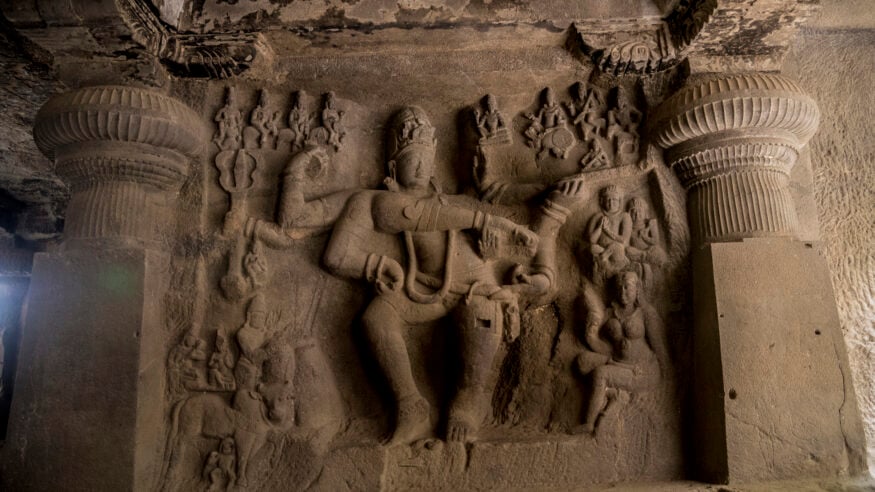
This teaching narrative from the Mahabharata tradition presents Sri Krishna, Arjuna, and Satyaki journeying through Bharata and confronting a phenomenon that reveals how attention amplifies anxiety. Set within a forest night watch, the episode demonstratesthrough precise, symbolic imageryhow fear can expand when fed and dissolve when withdrawn, offering a practical framework for emotional regulation grounded in dharmic wisdom.
As dusk settled over a dense, fragrant forest, the three companions sought shelter in a dry cave concealed by vines. They arranged a disciplined guard: Satyaki would keep the first watch, followed by Arjuna, with Sri Krishna concluding before dawn. The stillness of the night sharpened perception. Before Satyaki, a small black insect appearedno larger than a grain of rice. What seemed trivial soon transformed into a study of attention, perception, and fear.
Initially neglected, the insect began to grow. Satyaki watched as it doubled to the size of a fly, then a mouse, then a cat, and then a dog. Each increase mirrored the force of sustained attention. With escalating apprehension, he reached for his sword, yet hesitated, transfixed by the spectacle. When the creature attained human size, Satyaki woke Arjuna, whose renowned courage led him to confront the anomaly directly.
Outside the cave, the form had become colossaltowering above trees, chitin gleaming in moonlight. Even a warrior of Arjuna’s caliber stood momentarily still before its magnitude. Recognizing the gravity of the moment, they awakened Sri Krishna. He walked outward in composed assurance and, after a short interval, the forest fell utterly quiet.
When Satyaki and Arjuna emerged, Sri Krishna sat in serene stillness upon the forest floor. The monstrous apparition had vanished. The explanation was precise and transformative: the creature had no independent reality; it was a projection magnified by attention, a manifestation of anxiety. By feeding fearthrough fixation and repeated mental rehearsalan insignificant stimulus had grown to monstrous proportions. By withdrawing attention, the form dissolved.
This episode provides an analytical lens for understanding anxiety management. It illustrates an attentional mechanism recognized across dharmic traditions: what the mind repeatedly attends to acquires salience, emotional weight, and apparent reality. Conversely, deliberate non-fixation diminishes reactivity and restores proportion. The lesson aligns with the Bhagavad Gita’s emphasis on steadiness of mind, mastery of the senses, and one-pointed focus (ekāgratā) oriented toward dharma.
Read in a broader dharmic frame, the teaching resonates across traditions. In Buddhism, mindful awareness and non-clinging reduce the proliferation of mental constructs that drive dukkha. In Jainism, aparigraha (non-possessiveness) and restraint of reactive impulses mitigate fear and distortion. In Sikhism, simran and chardi kala cultivate remembrance and resilient optimism, weakening anxiety’s hold. The unity of these insights underscores a shared civilizational understanding: attention, guided by ethical discernment, shapes inner experience and conduct.
Applied to contemporary life, the parable becomes pragmatic guidance. Minor concerns can expand into overwhelming narratives when ruminated upon, especially amid uncertainty. Re-centering attentionaway from speculative catastrophizing and toward purposeful actionrestores clarity. Training the mind to observe without amplification, to assess proportion accurately, and to reorient focus toward meaningful duty embodies dharmic practice in everyday contexts.
In this light, Sri Krishna’s intervention is neither magical nor evasive; it is methodological. By not feeding the apparition with fear, he withdraws the energy that sustains it. The method is transferable: regulate attention, evaluate significance, act in alignment with dharma, and allow unhelpful projections to dissipate. The result is not denial of challenge but refinement of response.
As dawn breaks in the story, the travelers proceed with lighter hearts and clearer minds. The intellectual and practical takeaway remains stable: the mind can magnify the insignificant or restore the proportional; the discipline of attention determines which outcome prevails. This is a dharmic, cross-traditional insight with enduring relevance for emotional balance and peace of mind.
(Based on a teaching attributed to Swami Avdheshanand Giri.)
Inspired by this post on Varnam.