Madurai’s Meenakshi Sundareshwarar Temple stands as a living convergence of legend, ritual practice, urban design, and Dravidian architecture. The Sthala Puranam of this sacred geography (sacred geography) narrates how divine grace shaped Kadambavanam into Madurai and how Meenakshi and Sundareshwarar embody the inseparable unity of Śakti and Śiva. Read alongside the principles of karma and reincarnation that are central to Hindu thought, these narratives illuminate an ethical and cosmological framework shared, in spirit, across Dharmic traditions.
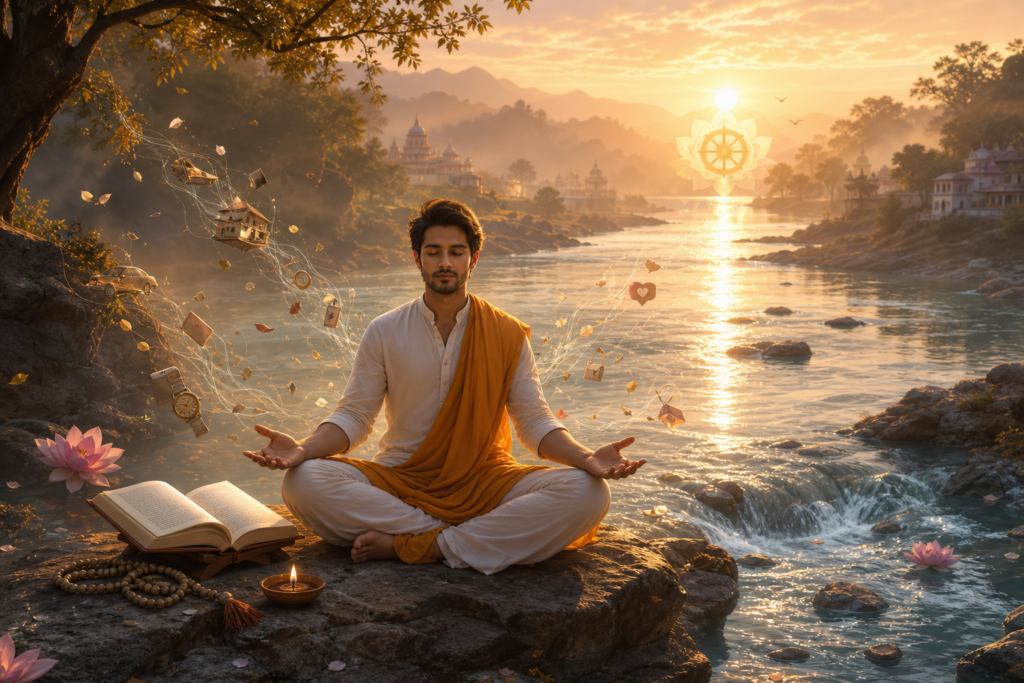
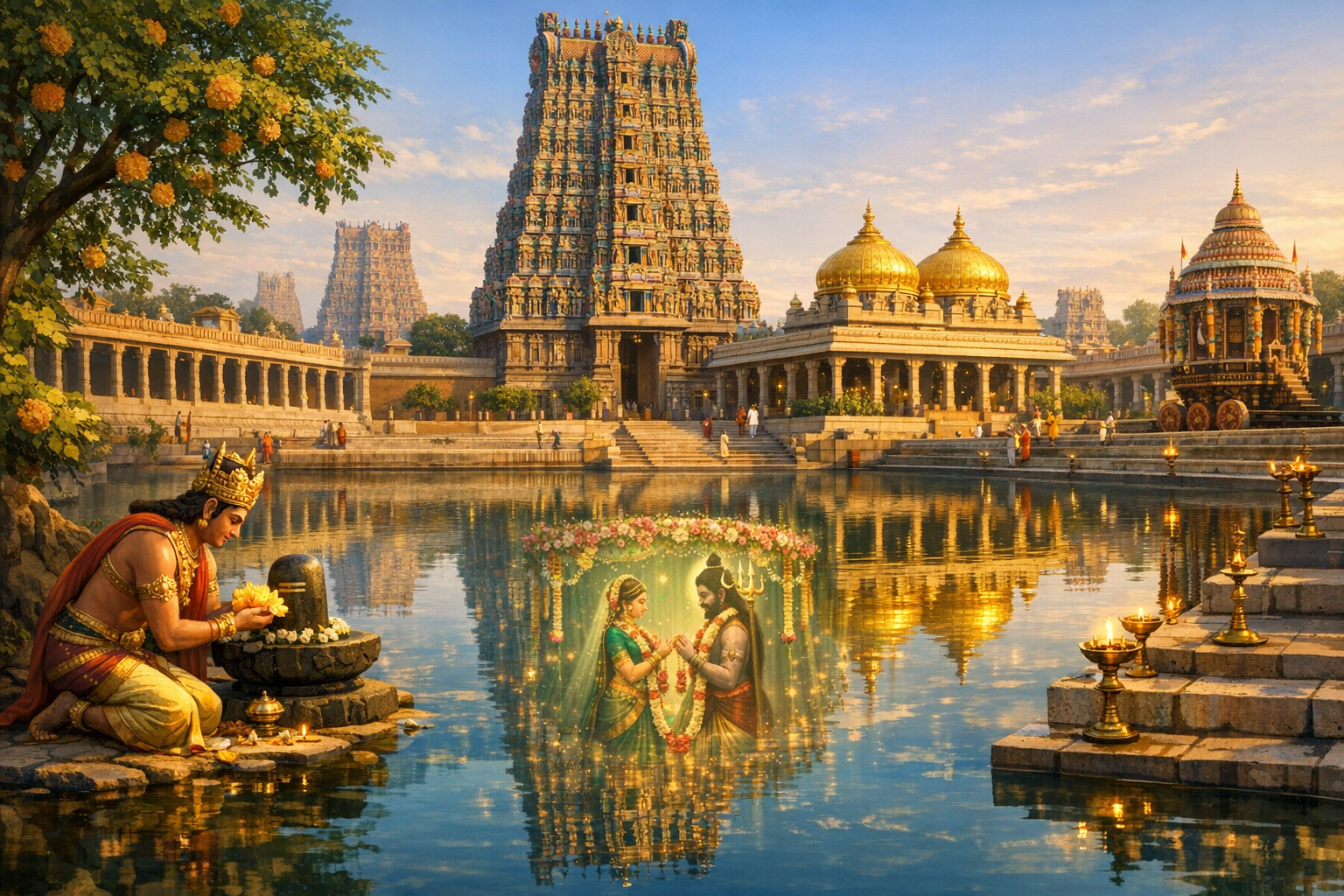
One of the foundational episodes, often summarized as the effacing of Indra’s sin, situates the origins of the site in an act of atonement. Having accrued grave demerit, Indra wandered in search of purification and arrived at a sylvan expanse dominated by a kadamba tree. There, beneath the tree, he encountered a liṅga and performed worship using golden lotuses from a nearby tank. This act of devotion dissolved the burden of guilt, revealing the place as divinely chosen. The kadamba grove and the Golden Lotus Tank remain essential coordinates in the temple’s sacred map.
The temple tank, Pottamarai Kulam (Golden Lotus Tank), still anchors ritual life and memory. Its reflective waters serve as a ceremonial threshold: a space where devotees symbolically leave behind impurity before approaching the inner shrines. In the wider lore of Madurai, Pottamarai Kulam also recalls assemblies of learning, linking the sanctum’s spiritual authority with the city’s deep literary culture.
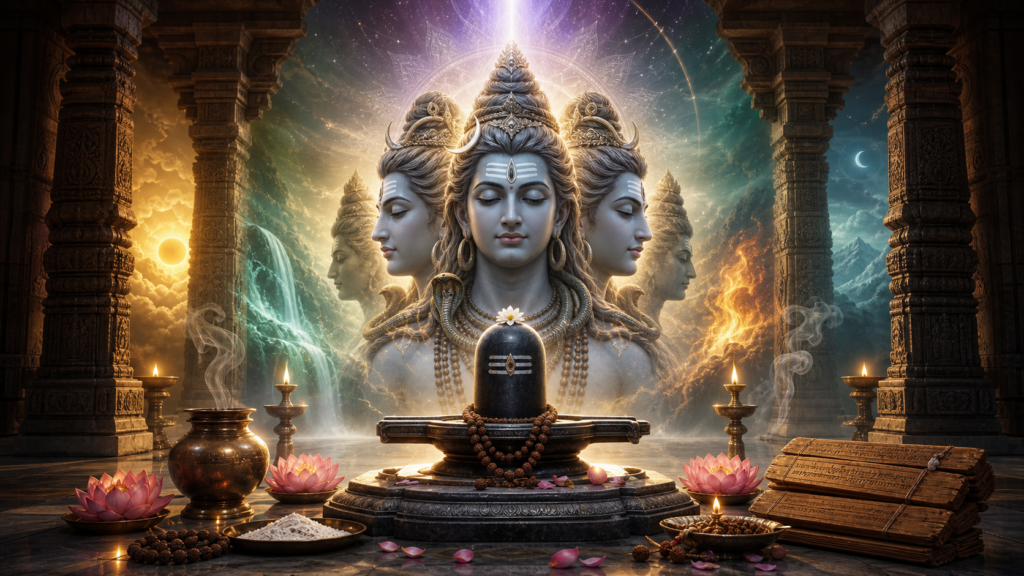
Etymologies woven through the Sthala Puranam portray Madurai as Madhurapuri, “the sweet city,” sanctified by divine nectar said to have fallen from Śiva’s matted locks. Meenakshietymologically “fish-eyed,” from meen (fish) and akshi (eyes)is revered for all-seeing compassion and protective watchfulness. Sundareshwarar (the “Beautiful Lord”) signifies the aesthetic and ethical perfection of Śiva, whose presence orders both cosmos and city.
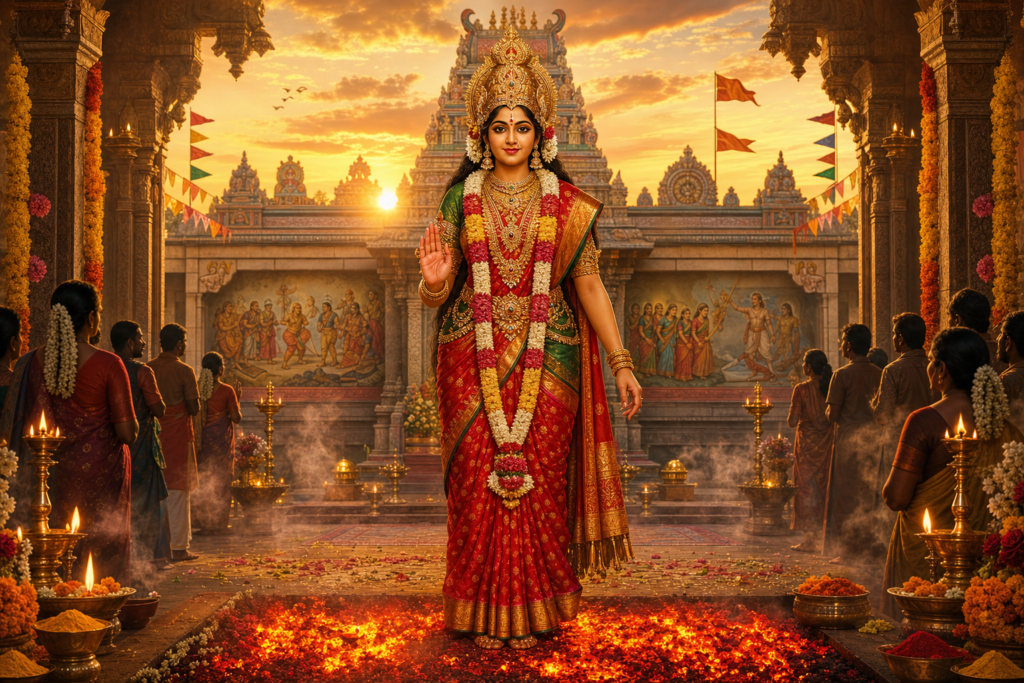
The royal narrative begins with the Pandya sovereign Malayadhwaja and queen Kanchanamala performing a yajña for a child. From the sacrificial fire emerged a radiant goddess with three breastsMeenakshiaccompanied by a prophecy: the extra breast would vanish when she beheld her destined consort. Raised as a warrior-queen, she mastered arts, statecraft, and arms, extending Pandya sovereignty in all directions.
In a climactic ascent, Meenakshi set out toward Kailāsa to confront and test Śiva. The moment their gazes met, the third breast disappeared, fulfilling the oracle and revealing mutual recognition. With the contest resolved in grace rather than combat, the narrative shifts from sovereignty to sacred union: a return to Madurai for the Meenakshi–Sundareshwarar Thirukalyanam (divine wedding), establishing the city as the seat of harmonized Śakti–Śiva presence.
Festival practice carries this union into the rhythms of civic life. During Chithirai Thiruvizha, processions, music, and ritual theater re-enact the divine marriage, reaffirming bonds between temple, river, neighborhoods (veedhis), and surrounding shrines. The storied role of Kallazhagar (Vishnu at Azhagar Kovil), honored as Meenakshi’s brother, weaves Vaishnava and Shaiva devotion into a complementary tapestry of interrelated paths, spotlighting the city’s long habit of devotional coexistence.
Equally formative is the corpus known as Tiruvilayadal Puranam, recounting sixty-four ThiruvilaiyadalsSundareshwarar’s “divine plays” in Madurai. Through poetic debates, mercies, trials, and unexpected reversals, Sundareshwarar tests and instructs kings, poets, artisans, and ordinary townspeople. These accounts transmit layered lessons on dharma, humility, learning, and compassion, infusing Tamil literary culture with theology and ethics while demonstrating how the divine engages the civic world through wisdom rather than coercion.
Across these narratives, the moral grammar of karma and reincarnation is explicit: human action has consequences across lifetimes, and sincere atonement, service, and devotion transform destiny. This worldview resonates with broader Dharmic reflections in Buddhism (kamma), Jainism (karman), and Sikh thought on action and remembrance, encouraging mutual recognition among traditions that prize self-cultivation, restraint, and compassion.
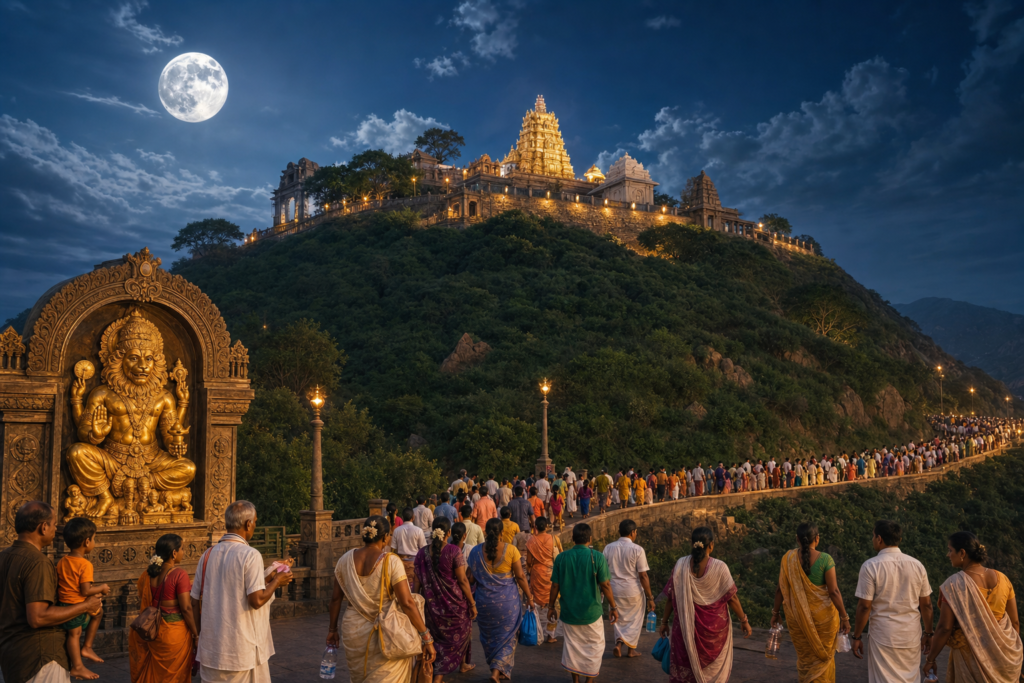
Ritual life at the Meenakshi Sundareswarar Koil follows Shaiva Agamic protocols with six daily pujas (shatkala-puja) marked by abhishekam, alankaram, naivedyam, and deepa aradhana. Devotees often align visits with Pradosham for Śiva or observances for Devi, while major calendrical highlights include Chithirai Thiruvizha and the Avani Moola festival associated with the Tiruvilaiyadals. Processional routes along concentric streets are not incidental; they are liturgical paths through which the deities circulate blessings and the city renews its vow to virtuous order.
Architecturally, the temple complex exemplifies mature Dravidian architecture. Within roughly fourteen acres rise multiple gopurams (gateway towers), their facades dense with stucco figures narrating episodes from Puranic lore and local legend. Two golden-vimana caps crown the principal sanctums of Meenakshi and Sundareshwarar, signaling dual sovereignty within a single sacred polity.
The famed Aayiram Kaal Mandapam (Thousand-Pillared Hall) illustrates the Nayaka-era genius for stone craftsmanship and spatial drama. Its columns, sculptures, and rhythmic bays were engineered to choreograph movement and attention, mediating between the public world of processions and the interior densities of mantra and mudra. Nearby colonnades, pillared courts, and subsidiary shrines stage encounters with Ganesha, Subrahmanya, and other deities, integrating household devotions with temple-centered liturgy.
Epigraphic and stylistic evidence point to sustained Pandya patronage, subsequent turbulence in the early 14th century, and major reconstructions and expansions under Vijayanagara–Nayaka stewardship in the 16th–17th centuries. The result is a layered monument: early foundations harmonized with later superstructures, all integrated into a coherent iconographic program that privileges Meenakshi’s sovereignty and Sundareshwarar’s grace.
Madurai’s urban plan renders theology into city form. Concentric veedhis encircle the sanctum, aligned to accommodate festival chariots and ritual circumambulation on a civic scale. Markets, crafts, and guilds historically clustered along processional routes, binding economic life to temple time. The sthalavrikshathe kadambaanchors mythic memory, while Pottamarai Kulam mediates entry, reflecting the sky, gopurams, and pilgrim bodies into a shared field of meaning.
For many visitors, the temple’s affective power unfolds in intensely personal registers: the coolness of granite underfoot at dawn; the fragrance of tulasi and bilva; the sudden hush near the sanctum as lamps rise; and the contemplative pause by the tank where the water holds a mirror to one’s own seeking. Such moments, familiar to countless pilgrims, allow theology to become experiencean ethical call to clarity, patience, and care for others.
As a living heritage site, Meenakshi Sundareshwarar Temple balances conservation with vibrant ritual use. Sculptural polychromy on gopurams requires periodic renewal; stone surfaces demand sensitive maintenance; and crowd management must preserve both safety and sanctity. Heritage management here is not merely technical; it is ethical and communalsafeguarding a public good that nurtures learning, livelihood, and spiritual practice.
Taken together, the Sthala Puranam of Madurai and the temple’s historical record articulate a single thesis: divine order is not abstract but relationalbinding deities, rulers, citizens, and guests through vows of reciprocity. Indra’s atonement, Meenakshi’s coronation, Sundareshwarar’s playful instruction, and the city’s festivals all converge on this insight. Madurai remains, therefore, not only an exquisite Dravidian temple but a school of dharma in motion, inviting every visitor into a larger, compassionate kinship that Dharmic traditions celebrate in diverse ways.
Inspired by this post on Hindu Pad.