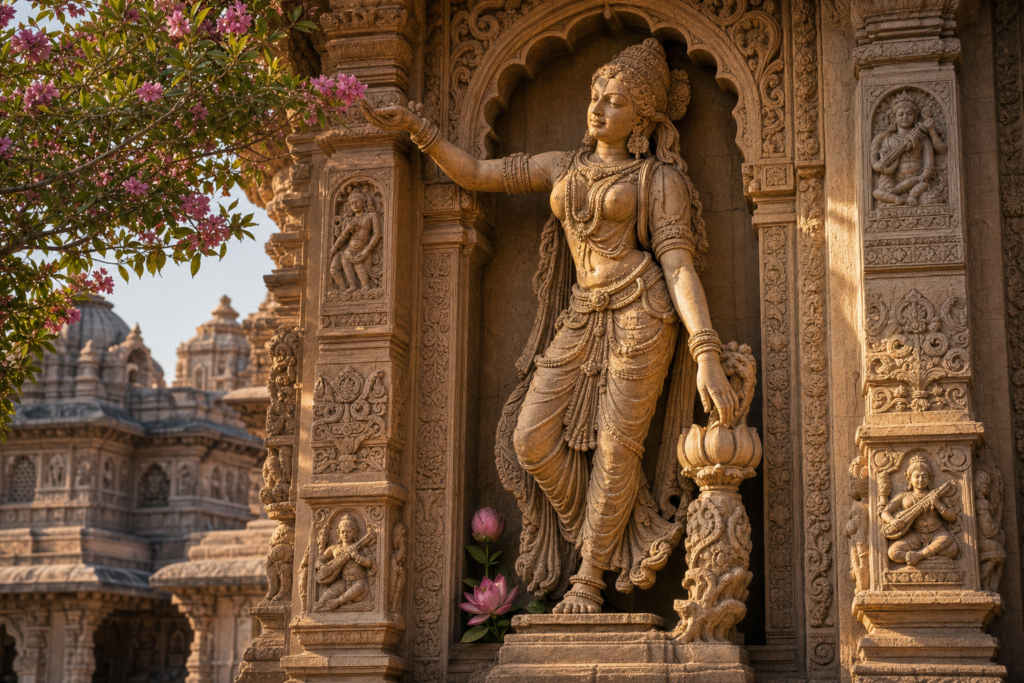
Across civilizations, water deities encode how communities understand life, purity, power, and the cosmos. A comparative study of the Hindu Goddess Ganga and Amphitrite from Greek mythology illuminates two distinct yet resonant visions of sacred waters: one anchored in a living river with profound soteriological significance, the other enthroned as queen of the sea within a maritime pantheon. Examined together through textual sources, iconography, ritual uses of water, and sacred geography, these figures reveal how Hindu and Greek traditions shape ethical life, cultural memory, and religious practice.
Methodologically, the comparison draws on Sanskrit sources such as the Mahabharata and Puranas (notably the Bhagavata Purana and Skanda Purana) alongside Greek literary attestations from Hesiod’s Theogony and later mythographic traditions. It also considers visual programs (temple sculpture in South Asia; Hellenistic and Roman mosaics) and the lived religious practices that embed water within pilgrimage, social ethics, and communal identity. This framework foregrounds both shared archetypes and culturally specific developments in Hinduism and Greek polytheism.
In Hindu mythic cosmology, Ganga (Gaṅgā) is Tripathagā, the river that courses through three realmsheaven, earth, and the netherworldthereby linking cosmic order with terrestrial life. Purāṇic narratives describe her celestial origin as the sacred current that washes the foot of Viṣṇu and descends through Śiva’s matted locks to temper her force before revitalizing the earth. This theogony situates Ganga as both cosmic principle and earthly presence, merging metaphysical symbolism with hydrological reality.
Mythic episodes elaborate moral and ritual meanings. The Bhagiratha narrativewhere the king’s austerities bring Ganga to earth to lift the curse of Sagara’s sonsframes the river as a purifier whose grace dissolves sin and karmic burden. The Jahnu episode, in which the sage swallows and releases her, yields the epithet Jāhnavī and underscores the river’s capacity to be ritually contained and redirected without losing sanctity. In the Mahabharata, Ganga’s marriage to King Śantanu and the birth of Devavrata (Bhīṣma) entwine the deity with royal dharma, vows, and the ethics of lineage.
Ganga’s religious function is at once ethical and soteriological. Ritual bathing (snāna) in the Ganges at sacred ghatsfrom Haridwar to Varanasi and Prayagrajenacts purification, while festivals such as Kumbh Mela amplify the river’s collective, merit-giving power (puṇya). In theological terms, Gaṅgā is not merely a personified river; she is a living tirtha, a crossing-place where the mortal and the divine touch. Her waters are repositories of śakti and conduits of moksha, with funeral rites along her banks expressing hope for auspicious rebirth or liberation.
Iconographically, Ganga is portrayed with a kalaśa (water pot), lotus, and a makara (crocodile) as vāhana. She often appears in dynamic relation to Śivaflowing from his jaṭāencoding theological interdependence between ascetic control and life-giving abundance. Temple reliefs and portable icons preserve a stable grammar of symbols: vegetation, flow, the makara’s liminality between river and sea, and the dignified posture of a mother and benefactor of worlds (lokamātā).
In Greek tradition, Amphitrite belongs to the Nereid cohortdaughters of Nereus and Dorisyet stands apart as queen consort of Poseidon, ruler of the sea. Hesiod lists Amphitrite among divine genealogies, and later sources narrate her union with Poseidon after the dolphin Delphin mediates a sea-wedding. Amphitrite’s most persistent mythic role is regal: she confirms, stabilizes, and adorns Poseidon’s thalassic sovereignty and mothers figures such as Triton (and, in some accounts, Rhode and Benthesikyme).
Greek poetry often uses “Amphitrite” metonymically for the sea itself, emphasizing breadth and power rather than a specific riverine locale. Narrative vignettes occasionally grant her direct agency: when King Minos tests Theseus by casting a ring into the sea, later traditions recount that Amphitrite receives the hero hospitably, returning the ring and bestowing a crownan emblem of acceptance within the marine realm. Nevertheless, the cultic prominence of Poseidon eclipses Amphitrite, whose attestations are richer in art than in independent sanctuary cult.
Visual culture in the Hellenistic and Roman Mediterranean frequently depicts Amphitrite in the marine thiasos, a pageant with Poseidon (Neptune), Tritons, Nereids, hippocamps, and dolphins. She appears enthroned or borne across waves, diademed, veiled like sea foam, wreathed in seaweed, or accompanied by shells. These images, found in mosaics and wall paintings from Italy to North Africa, encode a courtly grammar of oceanic order, beauty, and abundance rather than personal soteriology.
Comparatively, ontology and scope diverge markedly. Ganga is the sanctified presence of a named, navigable river whose physical waters and spiritual merits are inseparable; Amphitrite is a trans-local queenly abstraction that encompasses the open sea and maritime sovereignty. The Hindu frame locates salvation-inflected ritual in the immediate substance of water; the Greek frame prioritizes a cosmopolitical symbolism of the sea within an Olympian hierarchy where civic cults and regional sanctuaries focus more on polis life than individual liberation.
Cosmology and sacred geography likewise differ. Ganga’s course is mapped onto the Indic sacred landscapeghats, confluences (Triveṇī), pilgrimage circuitsand even into the sky, where her celestial current mirrors the Milky Way. Amphitrite’s geography is maritime and expansive, aligning with seafaring states and empires; her domain is the thalassa girdling lands and linking harbors, fleets, and trade. Consequently, Hindu sacred cartography encourages place-based pilgrimage, while Greek imaginaries of Amphitrite evoke mobility, navigation, and the integrity of maritime order.
Ethical and soteriological functions reflect these cosmologies. With Ganga, the ritual bath, vow (vrata), and ancestral rites articulate a path toward inner and social purification, karmic remediation, and, ultimately, moksha. Amphitrite embodies a protective, legitimizing aura for mariners and rulers of the sea; purification in Greek religion appears more diffusely through civic rites and mystery traditions. Notably, Greek initiates at Eleusis undertook a sea-bathing rite (the halade mystai), a cultural memory that resonates with the sea’s cleansing symbolism, yet it remains distinct from Ganga’s direct, salvific agency.
Gender and agency also diverge in emphasis. Ganga acts with pronounced autonomychoosing, testing, and transforming destinies (as in the Śantanu and Bhīṣma narratives)even when participating in conjugal or filial plots. Amphitrite’s agency is more collegial and courtly: as Poseidon’s consort, she affirms stable kingship over the sea and mediates favor to heroes without becoming a primary locus of cultic salvation.
Iconographic grammars encode each tradition’s priorities. Ganga’s makara suggests liminality between currents, while the kalaśa and lotus announce auspicious fertility and ritual abundance; her emergence from Śiva’s jaṭā symbolizes disciplined descent of grace. Amphitrite’s retinueTritons, dolphins, shellsforegrounds processional power and maritime aesthetics. Where Hindu images invite tactile devotion linked to the immediate medium (water drawn, poured, and bathed in), Greco-Roman art projects a grand, panoramic theater of the sea.
Ritual life follows accordingly. Hindu practice situates Ganga at the heart of household rites, public festivals, and life-cycle ceremonies; water is drawn, offered, and entered in acts that bind family, lineage, and community to the sacred. Greek practice offers libations and sacrifices to sea deities before voyages and at coastal sanctuaries, but Amphitrite rarely functions as a standalone cultic center; Poseidon dominates formal worship, while Amphitrite’s presence adorns and legitimizes the marine sphere.
Despite these differences, cross-cultural archetypes are clear. Both traditions intuit water as origin, boundary, and renewal. They personify aquatic domains to imagine ethical orderHinduism through purification and crossing (tirtha), Greek religion through sovereignty and safe passage. Both embed water symbolism in art, poetry, and ritual choreography that teach communities how to live with the forces that sustain and imperil them.
Within the wider Dharmic familyHinduism, Buddhism, Jainism, and Sikhismwater remains a unifying sacred medium. Buddhist lustration rites and the abhiṣeka of images symbolize clarity of mind and transmission of wisdom; Jain snatra pūjā bathes the Jina to express purity and restraint; Sikh tradition venerates Amrit and the sarovars surrounding gurdwaras, embodying humility, seva, and spiritual rebirth. This shared reverence reinforces a civilizational ethos that honors plurality while affirming a common grammar of sanctity, harmony, and ethical renewal.
The comparison also clarifies how ecology and ethics interlock. Ganga’s sacrality has long underwritten duties of custodianship toward rivers and watersheds; Amphitrite’s maritime kingship evokes obligations to safe sailing, harbor integrity, and the stewardship of sea lanes. In contemporary contextsfrom river restoration to ocean conservationthese mythic templates can inspire cooperative care for shared planetary waters.
In sum, Goddess Ganga and Amphitrite crystallize two complementary visions of sacred water. Ganga is the maternal, purifying current whose touch reforms karma and binds earth to heaven through tangible rites and sacred geography. Amphitrite is the regal sea, framing sovereignty, beauty, and maritime order within a pantheon oriented to civic and cosmic balance. Read together, they enrich comparative mythology, deepen appreciation of Hindu and Greek cultural heritage, and invite a unified, Dharmic spirit of respect for diverse paths that all flow, ultimately, toward wisdom and the common good.
Inspired by this post on Hindu Blog.