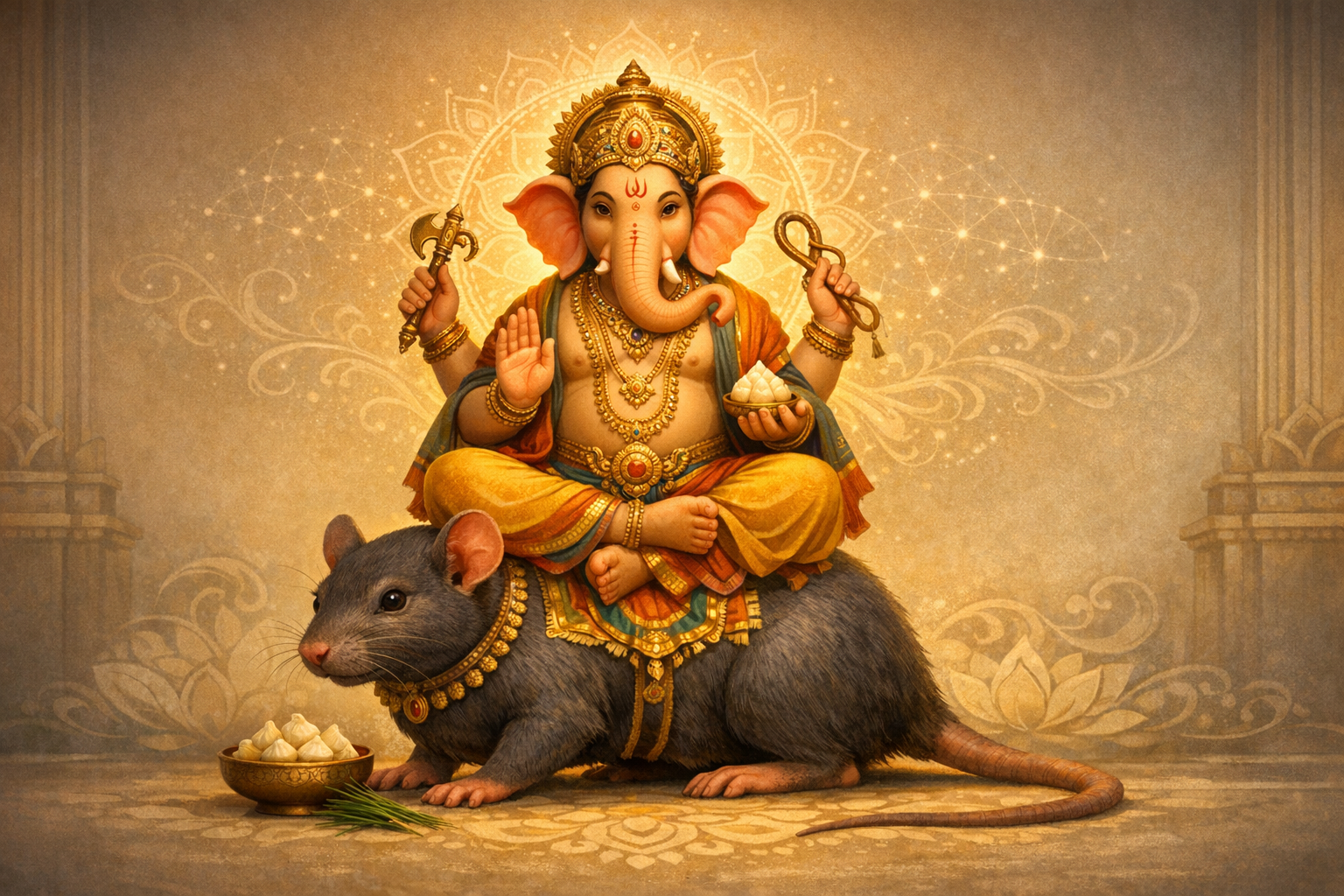
Across the Indic world, one of the most compelling images in Hindu iconography is the serene figure of Śrī Gaṇeśa seated upon a tiny mouse. At first glance the juxtaposition appears paradoxical: a vast, elephant-headed embodiment of wisdom and auspicious beginnings enthroned on a small, furtive creature. Yet this visual pairing encodes a precise psychology of spiritual practice. Read as a didactic emblem, Gaṇeśa atop the mouse teaches how stable intelligence brings the ceaselessly restless mind under compassionate, steady controla lesson that resonates across the dharmic traditions of Hinduism, Buddhism, Jainism, and Sikhism.
In classical Indian art and theology, a deity’s vehicle (vāhana) is never a mere conveyance. It is an index of the energies, instincts, and cognitive tendencies that the deity governs and harmonizes. For Gaṇeśavighneśvara, the lord who resolves inner and outer impedimentsthe mouse (mūṣika or mūṣaka) functions as a precise symbol for the subtle, quick, and easily distracted mental activity that, when unchecked, steals attention from purposeful awareness and from dharma-aligned action.
Philologically, mūṣika is derived from the Sanskrit verbal root muṣ, “to steal.” Traditional commentators often draw a psychological parallel: just as a mouse stealthily nibbles at stored grain, the untrained mind pilfers claritygnawing at intention, siphoning energy through worry, craving, and aversion. This correlation aligns with the wider dharmic discourse that treats mind (manas), intellect (buddhi), and ego-sense (ahaṃkāra) as distinct yet interdependent functions. In this triad, Gaṇeśa symbolizes the primacy of discriminating intelligence (buddhi) and integrative awareness, while the mouse signifies the scurrying, acquisitive reflexes of manas when it is captivated by the senses (indriyas).
Purāṇic and Āgamic sources reinforce the iconographic program. The Gaṇeśa Purāṇa and the Mudgala Purāṇa are particularly attentive to Gaṇeśa’s attributes and functions. Mudgala Purāṇa describes eight forms of Gaṇeśa (aṣṭa-mūrti), some of which retain the mouse as vāhana while others vary, indicating that specific spiritual emphases admit multiple symbolic vehicles. These textual variations do not dilute the mouse’s meaning; rather, they highlight the polyvalence of Gaṇeśa’s iconography and the many pedagogical routes available for taming mental agitation.
The striking size disparity between the elephant-headed deity and the diminutive mouse communicates a layered lesson. First, it dramatizes how the gravity of awakened intelligence can effortlessly guide subtle impulses. Second, it conveys that spiritual mastery does not annihilate instinct; it gently harnesses and repurposes it. The mouse remains presentalive, alert, and capablebut willingly bears the stabilizing weight of wisdom. The interplay here is integration rather than suppression.
Ethologically, the mouse is apt. It is nocturnal and subterranean, operating in hidden channels analogous to subconscious habit-tracks (saṃskāras). It gnaws, pierces, and infiltrates, much like the repetitive thought-loops and cravings that erode resolve. It multiplies rapidly, echoing how proliferating ideation (papañca) magnifies restlessness. By placing the mind’s mouse beneath the poised presence of Gaṇeśa, the image suggests that skillful oversightnot forcecalms reactivity and yields inward quietude.
Other attributes in Gaṇeśa’s iconography further refine this psychology. The goad (aṅkuśa) and noose (pāśa) symbolize directive clarity and gentle restrainttools for steering attention and reining in distraction. The sweet modaka signifies the bliss of concentrated absorption and the inward reward of restraint. The single tusk (ekadanta) marks the sacrifice required for one-pointedness (ekāgratā). His large ears counsel deep listening; the supple trunk models adaptable intelligence that can lift the heaviest log or pluck the lightest blade of grass. Read together with the mouse-vāhana, these symbols compose a complete sādhanā-map for mastering the restless mind.
Parallels across dharmic traditions reveal a shared commitment to mental discipline with compassionate intent. In classical Yoga, the entire path is succinctly defined as “yogaś citta-vṛtti-nirodhaḥ”the settling of mental fluctuationsachieved through practice (abhyāsa) and non-grasping (vairāgya). This mirrors the goad-and-noose logic: sustained effort conjoined with gentle release. Buddhism describes the “monkey mind” that incessantly leaps among sense-objects; mindfulness (sati), right concentration (samādhi), and breath awareness (ānāpānasati) calm this volatility without aggression. Jainism emphasizes gupti (restraint) of body, speech, and mind, and ahimsa-directed self-discipline, aligning closely with the ethos of steering the mouse without harming it. Sikh teachings address haumai (ego-centeredness) and the churn of chanchal man (the fickle mind) through nām simran (remembrance of the Divine Name) and seva (selfless service), harmonizing instinct with higher purpose. In each stream, the goal is convergence: the mouse of impulse becomes the servant of wisdom rather than its saboteur.
Contemporary psychology and neuroscience lend further language to this traditional insight. Habit loops form in cortico-striatal circuits; reward prediction errors bias attention toward novelty and short-term gains. The default mode network correlates with self-referential rumination, while task-positive networks support sustained goal-directed activity. Gaṇeśa’s towering composure may be likened to top-down executive regulation (prefrontal guidance), whereas the mouse represents bottom-up salience and habit energies. Stable attention, trained by breath awareness and mantra, rebalances these systemsreducing perseveration and improving cognitive flexibilityprecisely the benefits that dharmic sources attribute to concentrated practice (dhyāna).
Ritual and contemplative disciplines historically associated with Gaṇeśa operationalize this framework. Practitioners often begin with a clear intention (saṅkalpa) and an invocation that entrains attention toward steadiness: “Vakratuṇḍa Mahākāya Sūryakoṭi-samaprabha, Nirvighnaṁ kuru me deva sarva-kāryeṣu sarvadā.” Breath-centric practicesespecially nāḍī-śodhana (alternate nostril breathing) and gentle diaphragmatic regulationquiet sympathetic arousal and prepare the nervous system for focused awareness. In this settled state, japa of the mantra “ॐ गं गणपतये नमः (Om Gam Ganapataye Namaha)” cultivates rhythmic attention and anchors cognition to a single, wholesome object.
Visualization deepens the lesson encoded by the icon. With the in-breath, awareness can be guided by the aṅkuśa (goad) to gather scattered energy; with the out-breath, the pāśa (noose) softens clinging and releases grasping. The mouse is then imagined as willing, steady, and light beneath Gaṇeśaimpulses owned, befriended, and redirected. Such contemplations render the symbol kinesthetic, establishing new attentional habits that reduce reactivity and cultivate equanimity (upekṣā).
Ethical commitments stabilize these gains. Ahimsa tempers the urge to force; satya, asteya, and aparigraha reorder value priorities away from compulsion and toward clarity. In practical terms, disciplined digital hygiene, mindful speech, and structured routines function as everyday pāśa-and-aṅkuśagentle constraints that protect attention. As the mind’s mouse learns consistency, bursts of craving and avoidance lose their persuasive power, revealing the modaka-like sweetness of contentment (santoṣa).
Ritual observances similarly embody the psychology of restraint, redirection, and joy. Offerings of durvā grasshardy, regenerative, and coolingsymbolize resilience and the soothing of mental heat (tapas) generated by agitation. During Gaṇeśa Caturthī and daily pūjā alike, the steady sequence of ārati, mantra, and silent contemplation enacts the very transition the icon suggests: from scattered attention to gathered presence. The mouse at Gaṇeśa’s feet is no longer a thief of awareness but a humble ally.
Iconographic variations across regions further demonstrate the symbol’s adaptability. South Asian and Southeast Asian sculptures (including those in Cambodia and beyond) present Gaṇeśa with diverse hand-gestures, implements, and in some recensions, alternate vāhanas for specific forms. This plurality underscores a pedagogy rooted in inclusivity: multiple legitimate pathways can lead to inward composure and outward benevolence. In keeping with the shared ethos of the dharmic family, the symbolism invites cooperation rather than competition among methods.
The image also cautions against two extremes common in spiritual life. One is indulgence, where the mouse runs rampantattention is frittered away in novelty seeking, envy, and digital distraction. The other is suppression, where instinct is harshly deniedleading to rigidity or rebound craving. Gaṇeśa’s posture models the middle path: dignified oversight, affectionate firmness, and a readiness to transmute impulse into insight. In this sense, the vāhana is an ethical statement: genuine mastery expresses itself as care.
Because the mouse is mobile, subterranean, and quick, it also symbolizes the capacity to navigate liminal spacesprecisely where obstacles are likely to arise. When tutored by wisdom, that capacity becomes infrastructural: the mind can move through complexity without losing balance. Socially, such poise translates to dialogue conducted with patience, interfaith and inter-tradition respect, and the practical solidarity that the dharmic traditions encourage in the service of shared well-being.
Taken together, the icon of Gaṇeśa on the mouse offers a compact syllabus in contemplative science: a taxonomy of mental functions, an ethic of compassionate restraint, a toolkit of breath, mantra, and visualization, and a vision of unity in diversity. Its enduring relevance lies in how precisely it speaks to contemporary challenges of attentionendless notifications, engineered temptations, and a culture of hurrywithout abandoning gentleness. The mouse is not discarded; it is befriended and guided. The mind is not coerced; it is clarified.
As practitioners across Hinduism, Buddhism, Jainism, and Sikhism continue to refine inner composure through mindfulness, japa, pratyāhāra, dhyāna, nām simran, ahiṃsā, and seva, Gaṇeśa’s mouse remains a shared reminder: impulses that once stole attention can be yoked to the work of liberation. The symbol thus ceases to be only an object of reverence; it becomes a living method for mastering the restless mind with wisdom and care.
Inspired by this post on Hindu Blog.