
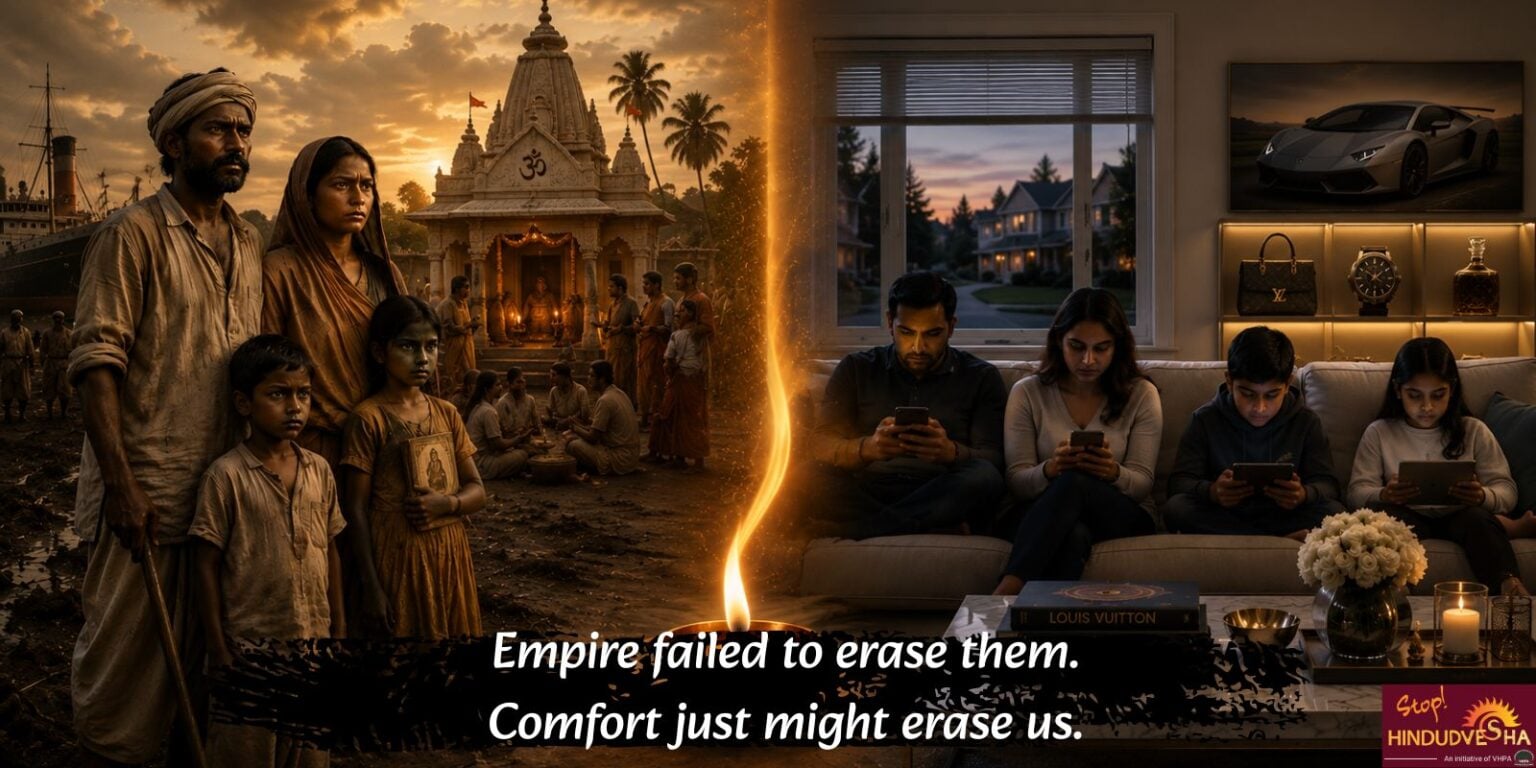
The history of the Girmitiyas offers one of the most powerful case studies in Hindu resilience, diaspora formation, and cultural preservation under conditions of severe displacement. Across Fiji, Guyana, Trinidad, Suriname, Mauritius, South Africa, and other plantation societies, Indian indentured laborers arrived with little material security, limited legal protection, and a deep rupture from ancestral geography. Yet many carried with them a civilizational inheritance that could not be packed into trunks: deities remembered by name, fragments of Ramayana and Mahabharata recitation, bhajans, seasonal vrata traditions, family samskaras, reverence for Bharat, and a living commitment to Sanatan Dharma.
The term Girmitiya itself is historically significant. It emerged from the colonial word “agreement,” rendered in the speech of Indian laborers as “girmit.” This “agreement” was often less a freely chosen contract than a structure of economic compulsion, misinformation, and imperial labor extraction. After the abolition of slavery, European plantation economies required new sources of cheap labor, and more than a million Indians were transported across the oceans under systems of indenture. Many went to sugar plantations in the Caribbean, the Pacific, and the Indian Ocean world. Their lives were shaped by long work hours, plantation discipline, cramped housing, racial hierarchy, gender imbalance, and the pain of permanent separation from home.
For Hindu history, the Girmitiya experience is not merely a labor history. It is also a history of civilizational survival. These migrants crossed the kala pani, a journey that carried social, ritual, and psychological meanings far beyond geography. They left behind villages, caste networks, pilgrimage routes, family elders, local dialects, and the ordinary rhythms of temple bells and festival calendars. In the plantation colonies, they entered societies that valued their labor but rarely cared for their civilizational continuity. The fact that Hindu Dharma survived at all in these settings is therefore not incidental; it is evidence of disciplined memory, collective will, and religious creativity.
The early Girmitiya communities did not possess institutional abundance. They did not begin with grand mandirs, endowed seminaries, established Sanskrit schools, or professional clergy in sufficient numbers. What they had was more fragile and, in some ways, more demanding: oral memory, household worship, improvised ritual spaces, and the authority of elders who preserved what they could. A small murti, a worn text, a remembered chaupai, a village melody, or a story of Rama, Krishna, Shiva, Devi, Hanuman, or the Guru could become the seed of continuity. From these modest beginnings, mandirs rose, festivals returned to public life, and community practices acquired a renewed social function.
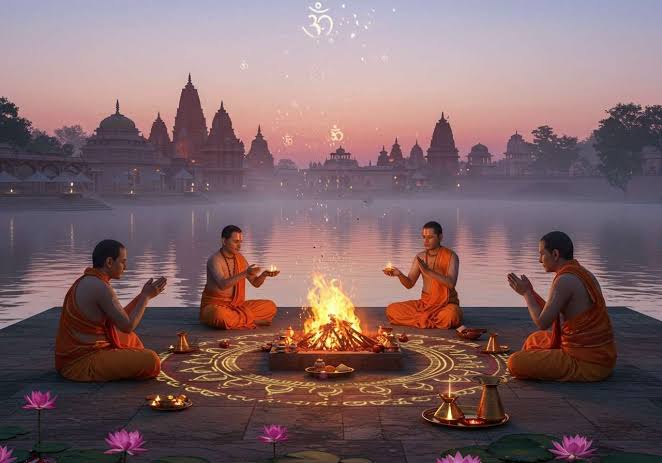
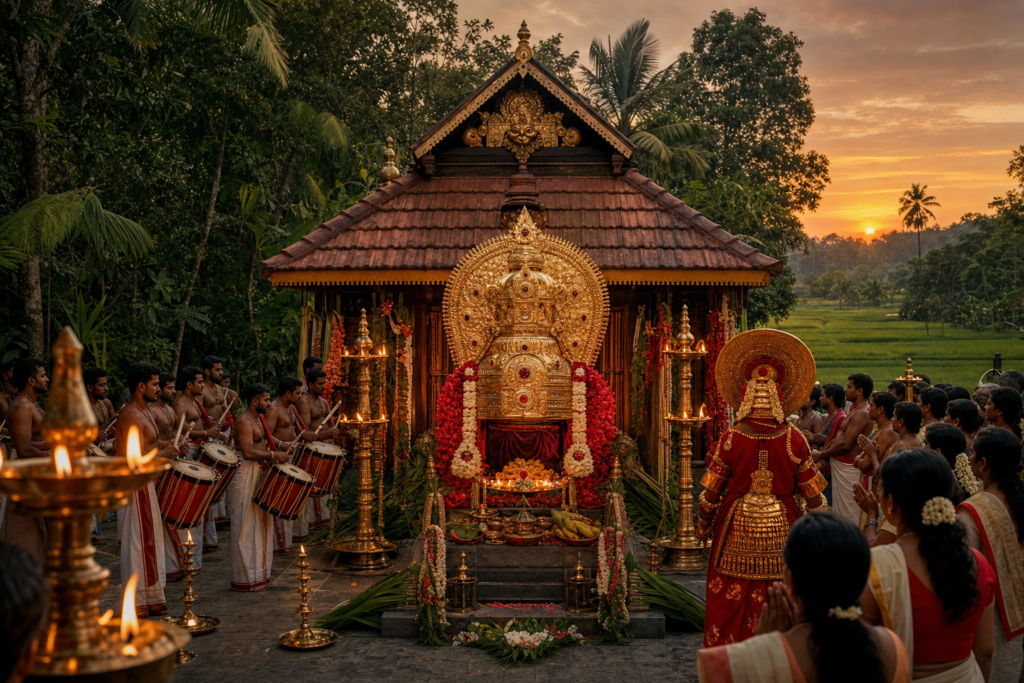
Diwali, Ramleela, Holi, Phagwa, Navaratri, Kartik observances, Satyanarayan puja, katha gatherings, bhajans, and communal feasts became more than religious events. They became instruments of social repair. In plantation societies where families had been scattered and older structures had been broken, festivals helped recreate a moral universe. Ramleela, especially in Trinidad and Guyana, became a public school of memory, drama, ethics, language, and community identity. Diwali became both worship and declaration: even in alien soil, light could be renewed.
The Girmitiya achievement should not be romanticized in a simplistic way. Indenture produced trauma, poverty, violence, and cultural loss. Languages weakened. Lineages were broken. Ritual knowledge was sometimes compressed, simplified, or lost altogether. Yet the essential point remains: Dharma endured not because the environment was favorable, but because ordinary people treated inheritance as a responsibility. They understood that survival required repetition, embodiment, and transmission. Religion was not reduced to private belief; it was practiced through family, food, song, festival, obligation, and collective discipline.
This history presents a sharp question for Hindu Americans and the wider Indian diaspora in the United States: if Girmitiya communities could preserve Dharma under poverty, coercion, and displacement, can prosperous Hindu families preserve it amid comfort, mobility, and social success? The question is uncomfortable because it challenges a common assumption. Material success is often treated as proof of community strength. High income, elite education, professional achievement, and public visibility can create the impression that a diaspora is secure. Cultural history suggests otherwise. Prosperity can protect a community materially while weakening it spiritually, linguistically, and institutionally.
The danger facing many Hindu American families is not plantation violence or colonial contract labor. It is a quieter erosion: the loss of language, the thinning of ritual literacy, the outsourcing of Dharma to occasional temple visits, the reduction of festivals to photography, and the weakening of intergenerational transmission. A community can become affluent and still become culturally brittle. It can donate generously to temples and still fail to produce children who understand why a mandir matters. It can celebrate Diwali publicly and still lose the daily practices that make Diwali intelligible.
In sociological terms, the issue is institutional thickness. A tradition survives when it is supported by overlapping structures: family practice, religious education, language learning, youth mentorship, community service, arts, pilgrimage, intellectual training, and public advocacy. When those structures are weak, identity becomes decorative. Children may inherit a surname, a cuisine, and a festival calendar, but not a worldview. They may know that they are Hindu, Jain, Buddhist, or Sikh by background, yet lack the vocabulary to explain dharma, karma, moksha, seva, ahimsa, sangha, guru-shishya parampara, or the ethical disciplines embedded in Dharmic traditions.
The Girmitiyas demonstrate that institutions do not need to begin as large or wealthy to be effective. They need seriousness, continuity, and communal ownership. A mandir built from limited resources can transmit more than an expensive complex if it is woven into daily life. A modest weekly class can shape identity more deeply than an annual gala if it teaches children to chant, reason, serve, question, and belong. A grandmother’s story, a father’s morning puja, a mother’s insistence on attending satsang, or a community elder’s patient explanation of Ramayana can become more consequential than prestige philanthropy.
For Hindu Americans, the test of prosperity is whether wealth will be converted into durable cultural capital. This requires more than building temples as architectural markers. It requires training teachers, supporting priests and scholars, funding curriculum, creating libraries, preserving languages, developing youth leadership, and building institutions that can withstand social pressure. It also requires a shift from event-centered religiosity to formation-centered religiosity. Festivals are essential, but festivals alone cannot carry a civilization. They must be connected to study, discipline, family practice, and ethical life.
Language is central to this challenge. Many Girmitiya descendants preserved Bhojpuri, Awadhi, Fiji Hindi, Caribbean Hindustani, and related speech forms in altered but meaningful ways. These languages carried memory, humor, ritual vocabulary, kinship, and song. In the United States, many Indian languages face rapid decline by the second and third generation. Sanskrit vocabulary is often encountered only through isolated mantras, while regional languages may be reduced to affectionate phrases. Without language, communities can still preserve values, but the texture of inheritance becomes thinner. Terms such as dharma, shraddha, seva, tapas, prasad, darshan, and satsang carry meanings that are not fully captured by English substitutes.
The challenge is not to reject English or modern American life. Hindu American identity will naturally develop in English, in American institutions, and within a plural society. The question is whether English-speaking Hindu life can remain intellectually serious and ritually grounded. This requires high-quality educational materials, trained teachers, and confidence in explaining Hindu philosophy without flattening it into either exotic spirituality or vague multicultural symbolism. Children and young adults deserve more than slogans. They need access to the Upanishads, Bhagavad Gita, Itihasa-Purana traditions, temple theology, yoga philosophy, bhakti literature, ethical debates, and the diversity of sampradayas.

Dharmic unity is especially important in this context. Hindu, Buddhist, Jain, and Sikh traditions are not identical, and their differences should be studied with respect rather than erased. Yet they share deep civilizational concerns: disciplined practice, liberation from ignorance, reverence for teachers, ethical self-cultivation, non-reductionist views of human life, and resistance to purely material definitions of success. In diaspora, these traditions benefit when they recognize one another as civilizational relatives rather than competitors. A mature community can preserve distinct identities while cooperating on education, religious literacy, civil rights, heritage protection, and youth formation.
The erosion of Dharma is often described as inevitable modernization, but that explanation is too passive. Cultural decline is not automatic; it follows from decisions, incentives, and neglected responsibilities. When parents treat religious education as optional but test preparation as mandatory, children absorb the hierarchy. When temples prioritize fundraising over teaching, they reveal their institutional priorities. When community elites seek acceptance from external institutions while remaining hesitant to defend their own heritage, younger generations learn embarrassment rather than confidence. Assimilation is not only something that happens to a community; it is also something a community may unintentionally organize for itself.
At the same time, the answer cannot be nostalgia alone. The Girmitiya past cannot simply be copied into the American present. Hindu Americans face different conditions: suburban dispersion, demanding professional schedules, interfaith and intercultural marriages, digital distraction, university environments, public debates about caste and identity, and the pressure to translate ancient traditions into modern civic language. These realities require creative institutional design. Weekend schools, online learning, youth retreats, campus networks, family satsangs, Sanskrit and regional language programs, seva projects, arts training, and public scholarship must work together rather than remain isolated efforts.
A serious Hindu American future will also require intellectual courage. Young Hindus often encounter simplified or hostile descriptions of their traditions in classrooms, media, and activist spaces. Some critiques are worth engaging honestly, especially when they concern social reform, historical complexity, or ethical self-examination. But inherited traditions should not be approached only through frameworks that presume guilt, superstition, or backwardness. A confident community must teach its children how to distinguish scholarship from polemic, reform from deracination, and humility from civilizational self-erasure.
The Girmitiya example also highlights the role of women in cultural survival. In many diaspora settings, mothers, grandmothers, sisters, and community aunties preserved songs, foodways, vows, stories, and domestic rituals even when formal institutions were weak. This labor is often underacknowledged because it occurs in kitchens, courtyards, living rooms, and informal gatherings rather than on public stages. Any serious plan for Hindu cultural continuity must recognize household ritual and women’s knowledge as institutional assets, not merely private sentiment. The home remains the first mandir, the first school, and the first archive.
Men also bear a responsibility that cannot be delegated. In many prosperous diaspora families, fathers may support cultural life financially while remaining ritually passive. This creates a silent lesson: Dharma is something women maintain and men sponsor. A healthier model requires fathers and sons to participate visibly in prayer, study, seva, temple work, and ethical leadership. Children notice who lights the lamp, who explains the story, who attends the class, who serves food, who chants, and who makes time. Transmission depends less on lectures than on embodied priorities.
Prosperity can become a threat when it produces comfort without obligation. It can also become a blessing when it is disciplined by dharma. Hindu Americans possess resources that Girmitiya communities could scarcely imagine: education, professional networks, legal rights, digital tools, philanthropy, publishing platforms, and access to global teachers. The central issue is whether these resources will be used to build durable institutions or consumed in status competition. A community that can fund luxury weddings and elite tutoring can also fund teacher training, temple archives, youth fellowships, translation projects, and serious scholarship.
The technical problem of transmission can be summarized through four linked domains: knowledge, practice, belonging, and public confidence. Knowledge requires structured learning rather than occasional inspiration. Practice requires repetition through puja, meditation, japa, seva, vrata, pilgrimage, music, and ethical discipline. Belonging requires friendships, mentors, elders, and institutions where children feel seen rather than merely instructed. Public confidence requires the ability to articulate Hindu identity in schools, workplaces, universities, and civic life without aggression or apology. If any one of these domains collapses, the others become weaker.
There is also a need to distinguish cultural preservation from isolation. The Girmitiyas did not preserve Dharma by living in a museum; they adapted under pressure. Their descendants created new musical forms, public festivals, local mandir traditions, and distinctive Indo-Caribbean and Indo-Fijian identities. Similarly, Hindu Americans will produce new forms of Hindu life shaped by American civic culture. Adaptation is not failure. The danger lies in adaptation without memory, pluralism without rootedness, and success without transmission.
For the wider Dharmic community, the lesson is clear. Hindu heritage cannot be sustained by sentiment alone. Buddhist, Jain, Sikh, and Hindu institutions in the diaspora all face versions of the same question: how can ancient traditions form stable, ethical, intellectually alive communities in a fast-moving modern society? The answer will require cooperation across mandirs, gurdwaras, Jain centers, Buddhist viharas, campus groups, family networks, and cultural organizations. Shared civilizational literacy can strengthen each tradition without dissolving its distinctiveness.
The Girmitiyas survived because they refused to let rupture become final. Their descendants inherited not only trauma but also a disciplined model of resilience. They show that Dharma can travel across oceans, survive plantation regimes, rebuild mandirs from poverty, and turn festivals into collective memory. Their story now places a moral demand on prosperous Hindu Americans. The question is not whether the community can succeed in America; it already has, in many measurable ways. The deeper question is whether success will remain connected to Sanatan Dharma, Hindu identity, cultural continuity, and responsibility toward future generations.
The survival of Dharma in prosperity will depend on deliberate choices made in ordinary homes and institutions. It will depend on whether children hear sacred stories before they hear stereotypes, whether temples teach as much as they celebrate, whether parents model practice rather than outsource it, whether youth are trusted with leadership, and whether wealth is turned toward civilizational renewal. The Girmitiya past is not a distant memory. It is a mirror. It asks whether a community that has gained comfort can still preserve courage, whether a diaspora that has gained visibility can still preserve depth, and whether inheritance will be admired from afar or carried forward with discipline.
Inspired by this post on Hindu Post.


Leave a Reply
You must be logged in to post a comment.