K. Viswanath’s cinema offers a complete aesthetic grammar in which art, the artist, and artistry are fused into a single, luminous experience. A poignant example appears in Sagara Sangamam: a drunk and hungry Kamal Haasan, mindful of Sri Krishna Janmashtami, refuses to step into his friend’s home out of reverence for the devotional footprints of Bala Krishna. The scene unfolds to a flute rendition of Vyasatirtha’s Kannada lyric, Krishna nee begane baaro. The protagonist’s name, Balakrishna, and the fluteKrishna’s own instrumentproduce a meticulous unity of meaning, emotion, and symbol.
This sequence exemplifies the classical Indian aesthetic triad of auchitya (aptness), rasa (aesthetic relish), and dhwani (suggestion). It demonstrates how Viswanath consistently attains sincerity in conception, design, and performance, allowing emotional depth to emerge without overt exposition. Viewers experience not only a story beat but also a fully integrated aesthetic vision in which music, devotion, and character converge.
Across his oeuvre, characterization safeguards the intrinsic temperament of individuals. While idealization and typefication appear as artistic devices, they function as means to achieve moral and spiritual clarity rather than as ends in themselves. Viswanath avoids declamatory statements common to certain “social” films of the period, favoring quiet layering that lets values reveal themselves through action, milieu, and consequence.
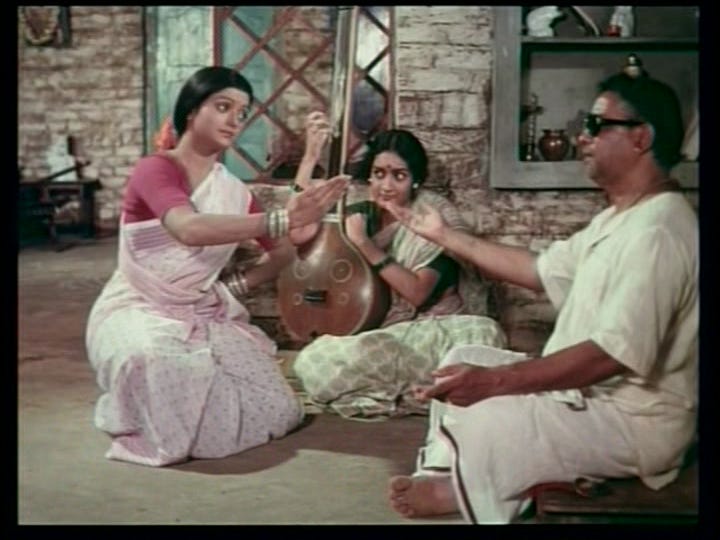
By selecting a concentrated slice of societyGuru, Purohita, singer, dancerhe examines how ideals are lived, transmitted, and sometimes lost. With measured subtlety, the films articulate the prerequisites of nobility, magnanimity, and disciplined conduct expected of artistic and cultural custodians, while also tracing the decline that follows when those virtues are absent.
A signature method is the indirect revelation of protagonists through third-person insight, blending art and self-critique within the same cinematic frame. This approach allows characters to be illuminated by the regard, memory, and testimony of others without intrusive commentary.
The character of Sankara Sastry in Sankarabharanam stands as the most prominent instance. His devotion to Indian classical music is a lifelong tapas that endures both status and penury, even at the cost of familial prospects. The friend, played by Allu Ramalingaiah, captures this ethos in a single, incisive description: “…in an era when music has become shrieks, howls, moans, and sighs, because of which Sankara lost the earlier reverence his music commanded, this man has regarded the four walls of his home as the stage, the insects as his audience, and pursued his music Sadhana…” Tulasi’s unwavering reverence for his music operates as a persistent subtext, revealing Sankara Sastry’s character by the depth of devotion he inspires.
A related structure appears in Swarna Kamalam through Seshendra Sharma, the Kuchipudi Guru. His daughter, resistant to the dancer’s discipline, comes to understand his stature when a legion of students offers their homage on Guru Purnima. The social world of the artits teachers, students, and rites of gratitudethus becomes the lens through which character and merit are seen.
Viswanath also examines the peril of misplaced priorities in performance. Sagara Sangamam opens with a danseuse pausing mid-performance to savor applause; in Swarnakamalam, a similar hunger surfaces in the obsession with photographs. In both, the persona risks eclipsing the person, and the artist risks believing she stands above the art that dignifies her.
The more dangerous trajectory is moral and spiritual decay. In Shruti Layalu, three gifted but naive brothers arrive in a metropolis and are quickly lured by vice. In Sagara Sangamam, the protagonist’s refuge in alcoholrooted in unmastered emotional swingsmarks the abandonment of art’s sustaining discipline.
Idealization in Viswanath’s films is balanced by pragmatism. In Sutradharulu, adherence to ideals requires strategy rather than blind rigidity, exemplified by the refusal to partake in corrupt charitydramatically cast into the Godavarias a measured defense of integrity. Principles, the films suggest, must be lived with discernment when circumstances are adverse.
A profound strand in this cinematic world is disabilitycongenital or circumstantialand the psychological, social, and emotional turbulence it entails. Rather than treating disability as a transactional matter of rights alone, Viswanath foregrounds acceptance, dignity, and inner strength, aligning with the dharmic insight that the deepest solutions arise from the plane of the spirit.
Sirivennela offers a consummate articulation of this dharmic sensibility. The protagonistsHari Prasad, a blind flutist, and Suhasini, a mute painterembody art as breath and being. In an evocative moment, she paints his nose as a flute, intimating that music is his very prana.
The celebrated lyric Adi Bhikshuvu, cast as a Nindastuti to Shiva, amplifies this aesthetic philosophy. The blind flutist declares the futility of asking anything from Shiva, “who is himself a beggar,” and for whom ash is the only gift. Read as metaphor, the song argues for composure and inward acceptance over restless agitationa state that Indian aesthetics recognizes as fertile ground for rasa. Such composure invites transformation without the volatility that can manifest as social violence.
Formally and emotionally, the Adi Bhikshuvu sequence introduces Hari Prasad with a density of suggestion comparable to the Krishna nee begane baaro moment in Sagara Sangamam. Both sequences affirm the sovereignty of rasa in Indian art, where the finest cinema allows music, symbol, and story to ripen into a unified experience.
Collectively, these films constitute a living primer in Indian aesthetics and cultural ethics. Art, artist, and artistry are fused through disciplined practice, humility before tradition, and compassionate realism. These values resonate across the dharmic familyHinduism, Buddhism, Jainism, and Sikhismin their shared emphasis on inner steadiness, ethical restraint, service, and non-violence. For artists and audiences alike, Viswanath’s cinema offers a proven pathway to transform performance into sadhana and spectatorship into insight.
Inspired by this post on Dharma Dispatch.