Tag: Swami Vivekananda

  • Hard Realities of the Bengali Bhadralok: From British Raj Brokers to Mamata Banerjee’s West Bengal

    Hard Realities of the Bengali Bhadralok: From British Raj Brokers to Mamata Banerjee’s West Bengal

    This long-form analysis offers a rigorous, non-polemical history of the Bengali Bhadralok from the late colonial period to the Trinamool era. It defines the Bhadralok as an intermediary elite shaped by British institutions yet rooted in a rich civilizational matrix, and explains why Marxist ideas resonated in Bengal’s post-famine and post-Partition moral economy. Readers gain…

  • Neo‑Vedanta Unveiled: A Powerful Modern Synthesis Bridging Dharmic Wisdom and Pluralism

    Neo‑Vedanta Unveiled: A Powerful Modern Synthesis Bridging Dharmic Wisdom and Pluralism

    This article examines Neo‑Vedanta as a rigorous, modern synthesis of Vedāntic wisdom grounded in the Prasthanatraya (Upanishads, Bhagavad Gita, Brahmasutras). It traces historical catalysts in nineteenth‑century India and explains how Sri Ramakrishna and Swami Vivekananda anchored a plural, practice‑oriented vision. Readers gain a clear understanding of Ishta as a principle of respectful diversity and see…

  • Timeless Union: The Transformative Power of Jnana and Yoga for Moksha in Hindu Philosophy

    Timeless Union: The Transformative Power of Jnana and Yoga for Moksha in Hindu Philosophy

    This long-form exploration shows how Jnana and Yoga converge in Hindu philosophy to deliver both liberating knowledge and lived stability. It clarifies Vedantic epistemology alongside Patanjali’s practical method, demonstrating why insight requires disciplined cultivation. It maps ethical foundations shared across Hinduism, Buddhism, Jainism, and Sikhism, highlighting a profound unity among dharmic traditions. It offers a…

  • Seattle Unveils Swami Vivekananda Statue: A Historic Milestone for Dharmic Unity and U.S.–India Ties

    Seattle Unveils Swami Vivekananda Statue: A Historic Milestone for Dharmic Unity and U.S.–India Ties

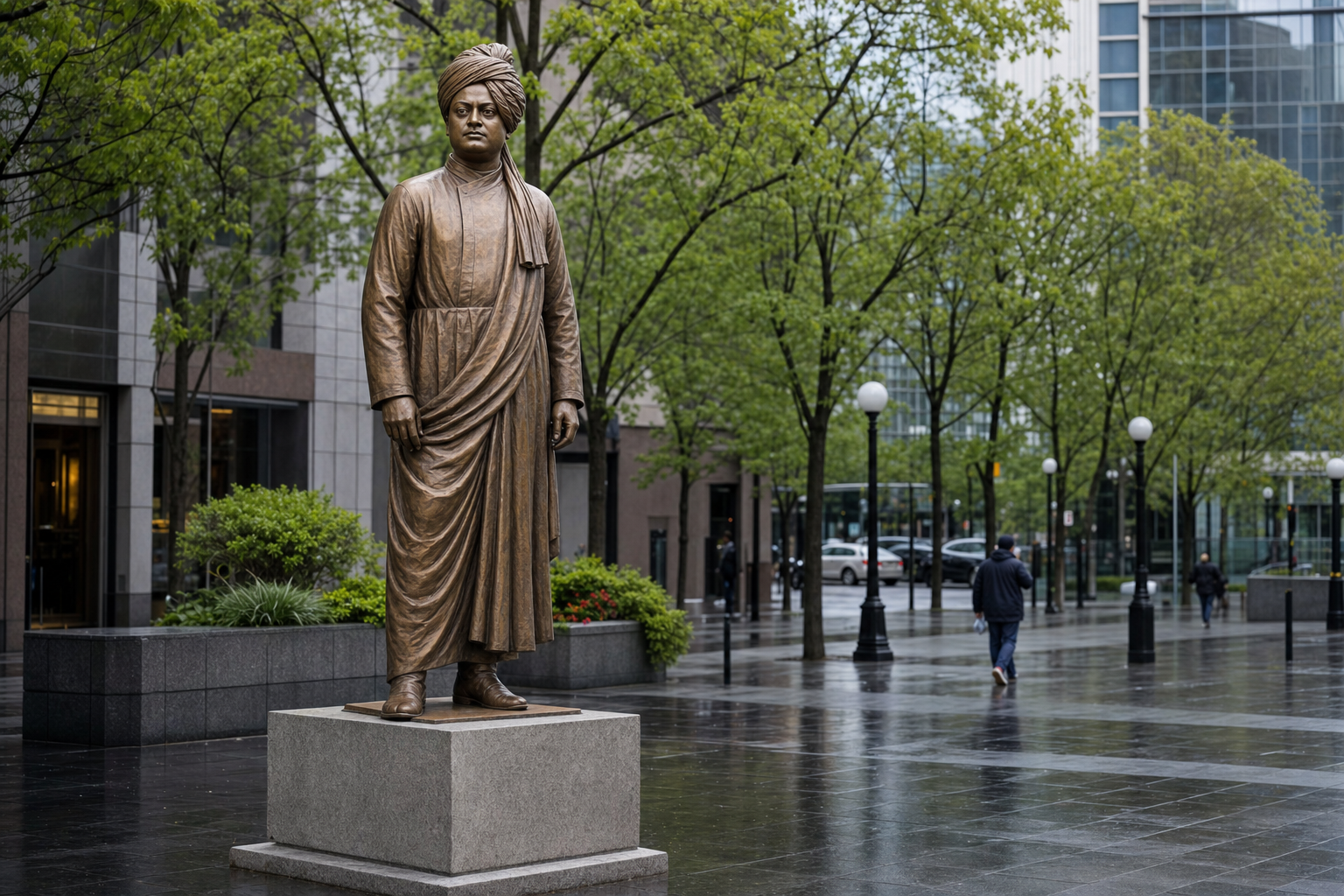
    Seattle has installed the first U.S. city-government-hosted life-size statue of Swami Vivekananda at Westlake Square, unveiled by the city’s mayor and Consul General of India in Seattle, Prakash Gupta. Gifted by the Indian Council for Cultural Relations (ICCR), the bronze monument strengthens cultural diplomacy and people-to-people ties between India and the U.S. Pacific Northwest. The…

  • Affection Without Weakness: Timeless Dharmic Wisdom for Compassionate, Courageous Living

    Affection Without Weakness: Timeless Dharmic Wisdom for Compassionate, Courageous Living

    This article reframes affection as a resilient strength when aligned with discernment, boundaries, and ethical purpose across Hinduism, Buddhism, Jainism, and Sikhism. Drawing on the Bhagavad Gita, Vidura-niti, the Brahmavihāras, Anekāntavāda, and the Sikh Sant-Sipahi ideal, it shows how compassion matures with wisdom and becomes courage in action. Readers gain a practical decision process rooted…

  • From Humble Beginnings to Enduring Eminence: Scholarship, Faith, and Dharmic Unity

    From Humble Beginnings to Enduring Eminence: Scholarship, Faith, and Dharmic Unity

    This essay maps the path from humble beginnings to enduring eminence through the dharmic lenses of scholarship, faith, struggle, legacy, and inspiration. It shows how the Guru-Shishya Tradition, Nalanda-style scholastic cultures, Jain Anekantavada, Sikh Seva, and vedantic inquiry create complementary routes to excellence. Readers gain a pragmatic five-vector blueprint—Vidya, Sadhana, Seva, Sangha, and Shraddha—for integrating…

  • Judge by Their Ideals: Swami Vivekananda’s Transformative Call to Empathy and Dharmic Unity

    Judge by Their Ideals: Swami Vivekananda’s Transformative Call to Empathy and Dharmic Unity

    Swami Vivekananda’s teaching urges a shift from judging others by personal standards to understanding them by their own ideals, fostering empathy and fairness. Rooted in dharmic pluralism, this principle resonates with Ishta in Hinduism, compassion in Buddhism, Anekantavada in Jainism, and seva in Sikhism. Applied to work, family, and public discourse, it reduces polarization and…

  • Chinchwad’s Hindu Rashtra-Jagruti Sabha Energizes Youth, Fostering Dharmic Unity

    Chinchwad’s Hindu Rashtra-Jagruti Sabha Energizes Youth, Fostering Dharmic Unity

    A Hindu Rashtra-Jagruti Sabha in Chinchwad attracted over 200 attendees with exceptional youth participation, reflecting rising civic-spiritual engagement. The active involvement of former Deputy Mayor Mr Sachin Chinchawade highlighted constructive cooperation between civic leadership and community initiatives. Members of the Swami Vivekanand Society anchored the event in character-building and service, aligning with Swami Vivekananda’s vision.…

  • Galvanizing Youth: Dhanashri Kelshikar on Vivekananda’s Ideals at NKES, Wadala

    A lecture at NKES, Wadala on Swami Vivekananda’s birth anniversary, led by Smt. Dhanashri Kelshikar of the Hindu Janajagruti Samiti, emphasized turning ideals into action for nation-building. The address framed youth empowerment through discipline, service, and fearlessness as practical tools for civic responsibility. It highlighted actionable pathways—ethical conduct, academic excellence, physical vigor, and responsible digital…

  • Shiv-era Self-Defence Camp Unites Chhatrapati Sambhajinagar, Honouring Jijamata & Vivekananda

    Shiv-era Self-Defence Camp Unites Chhatrapati Sambhajinagar, Honouring Jijamata & Vivekananda

    An eight-day ‘Shiv-era Self-Defence Training Camp’ concluded in Chhatrapati Sambhajinagar, jointly organised by Hindu Janajagruti Samiti (HJS), Rashtriya Dharma Raksha Gurukul, and Dharmayoddha Sangh. Timed with the birth anniversaries of Veermata Jijamata and Swami Vivekananda, the camp emphasized disciplined training, ethical responsibility, and community service. Participants reported improved confidence, situational awareness, and teamwork. The program…

  • Rakhi Israni’s Congressional Bid: Dharmic Values to Heal American Politics and Renew Civility

    Rakhi Israni’s Congressional Bid: Dharmic Values to Heal American Politics and Renew Civility

    American politics faces deep polarization, prompting renewed interest in Dharma as a framework for truth, responsibility, and harmony. In California, a state with a robust Dharmic heritage—from Paramahansa Yogananda’s Lake Shrine to Vedanta Square honoring Swami Vivekananda, and Sathya Sai Baba-inspired seva—Rakhi Israni’s congressional bid highlights how civic life can be guided by ethical principles.…

  • Swamiji’s 163rd Jayanti: Prajashakti Party’s Debut Reframes West Bengal’s 2026 Contest

    Swamiji’s 163rd Jayanti: Prajashakti Party’s Debut Reframes West Bengal’s 2026 Contest

    A new political stakeholder has emerged in West Bengal as the Prajashakti Party (Samadarshi) debuted on Swamiji’s 163rd birth anniversary. The timing invokes Swami Vivekananda’s legacy of ethical leadership, service, and unity, resonating widely across Bengal. Positioned for the 2026 Assembly elections, the party signals an attempt to blend cultural memory with democratic participation. Analysts…

  • From Curiosity to Courage: Swami Vivekananda’s Living Legacy for Confident Hindu American Youth

    From Curiosity to Courage: Swami Vivekananda’s Living Legacy for Confident Hindu American Youth

    Swami Vivekananda’s legacy offers a rigorous, modern roadmap for Hindu American youth: transform curiosity into disciplined learning, and learning into compassionate seva. His 1893 Chicago address reframed Hinduism as rational and pluralistic, a vision now activated through advocacy and education in groups such as CoHNA. This approach strengthens unity in diversity and aligns with the…

  • Swami Vivekananda Jayanti 2026: Exact Dates, Tithi Puja, and Heartfelt Ways to Honor His Legacy

    Swami Vivekananda Jayanti 2026: Exact Dates, Tithi Puja, and Heartfelt Ways to Honor His Legacy

    Swami Vivekananda Jayanti 2026 is observed on 12 January (Gregorian) and 10 January (Hindu calendar), with Tithi Puja on 21 January (Krishna Paksha Saptami, Poush Month). This 163rd birth anniversary highlights his enduring message of character, service, and spiritual strength, celebrated nationwide as National Youth Day. The post clarifies the calendar distinctions to help plan…

  • Essential Blueprint to Safeguard Dharma: Discover a Complete Strategy for Cultural Renewal

    Essential Blueprint to Safeguard Dharma: Discover a Complete Strategy for Cultural Renewal

    This essay presents an essential, academically grounded blueprint to strengthen dharmic unity and cultural confidence across Hinduism, Buddhism, Jainism, and Sikhism. It reframes Ghar-Wapsi (Parāvartana) as a voluntary, dignified reconnection within a broader strategy that includes lawful responses to coercive proselytisation, restoration of family-centered practices, and a forward-looking, entrepreneurial mindset. Drawing on P. V. Kane’s…

  • Essential Ghar-Wapsi: Discover a Proven Dharma Revival

    Essential Ghar-Wapsi: Discover a Proven Dharma Revival

    I reflect on why a Dharma-centred foundation is essential for civilizational resilience—and why Ghar-Wapsi, strong families, and temple-centered institution-building must advance together. Discover a grounded, lawful, and compassionate fourfold plan to counter proselytisation, restore confidence, and revive our living tradition.

  • Ishta – Swami Vivekananda on why Hindu sects don’t quarrel

    Ishta – Swami Vivekananda on why Hindu sects don’t quarrel

    Swami Vivekananda’s teachings on the concept of “Ishta” highlight the profound wisdom behind the harmonious coexistence of diverse Hindu sects and spiritual paths in India. He emphasizes the importance of recognizing that individuals have different natures, requiring various methods of worship and spirituality. This acceptance of diversity is contrasted with certain missionary efforts that seek…

  • Swami Vivekananda on the Ahistoricity of Hinduism

    Swami Vivekananda on the Ahistoricity of Hinduism

    This insightful blog post explores Swami Vivekananda’s perspective on the universality of Vedanta as a religion, contrasting it with Christianity and other religions that revolve around historical founders. Swami Vivekananda emphasizes the ahistoricity of the Vedas and the eternal principles they embody, which allows Hinduism to remain unshaken even if the historicity of its prophets…

  • Portraits of the Deracinated Indian Education System

    Portraits of the Deracinated Indian Education System

    In this thought-provoking blog post, the urgent need for the decolonization of India’s education system is explored. The article delves into the persisting impact of mental colonization, particularly evident in the modern Indian population’s inclination to embrace Western culture, values, and ideals, often prioritizing them over their own heritage. Through historical context and powerful quotes…

  • Swami Vivekananda on why Hindus don’t say “My god is true and yours is not”

    Swami Vivekananda on why Hindus don’t say “My god is true and yours is not”

    “That which exists is One; sages call It by various names.” Swamiji says, this is the lesson that Hindus can teach the world. Swamiji starts by telling the history of the Middle East and the evolution of religion there. In the world of tribes, each tribe had its own god. If the tribes were allied…