Global Sikh communities increasingly serve as cohesive custodians of Sikh heritage, combining conservation science, digital archiving, and living traditions to ensure that Sikhi remains vibrant for future generations. From Amritsar to Vancouver, Singapore to Nairobi, this stewardship is grounded in seva, sangat, and the resilient ethos of Chardi Kala.
Sikh heritage encompasses both tangible assets and intangible practices. Built heritage such as historic gurdwaras, forts at Anandpur Sahib associated with Guru Gobind Singh, manuscripts, paintings, instruments, and artifacts require specialized preservation. Intangible heritage includes Gurbani kirtan in traditional raags, Punjabi language and Gurmukhi literacy, martial practice such as gatka, daily Nitnem, Amrit Sanchar, and the community ethic of langar and seva. Treating these domains as a single, interdependent ecosystem is central to effective preservation.
Historically, preservation began with the Gurus themselves: Gurmukhi was standardized under Guru Angad; the Adi Granth was compiled under Guru Arjan in 1604; institutions of sangat and pangat sustained social memory; and the Khalsa forged by Guru Gobind Singh codified discipline and identity. Today, global Sikhs extend these legacies through contemporary tools while honoring the Sikh Rehat Maryada and the panthic ethos of collective responsibility.
The Sikh diaspora’s geographic spread has multiplied both opportunity and risk. Migration created transnational hubs of expertise and funding that support archives, museums, teaching centers, conservation labs, and data platforms. At the same time, dispersion heightens challenges of language shift, loss of context for artifacts, and uneven conservation capacity. Addressing these realities requires coordinated, standards-based approaches that travel well across borders.
Built heritage conservation benefits from methods widely used in architectural preservation. Sensitive repair of masonry and lime plasters, reversible consolidation of wall paintings, non-invasive cleaning of stone and wood, and respect for original materials and craft lineages are essential. Introducing modern amenities in historic gurdwarasseismic reinforcement, fire detection, and accessibility upgradesworks best when guided by conservation plans that prioritize minimal intervention, reversibility, and documentation.
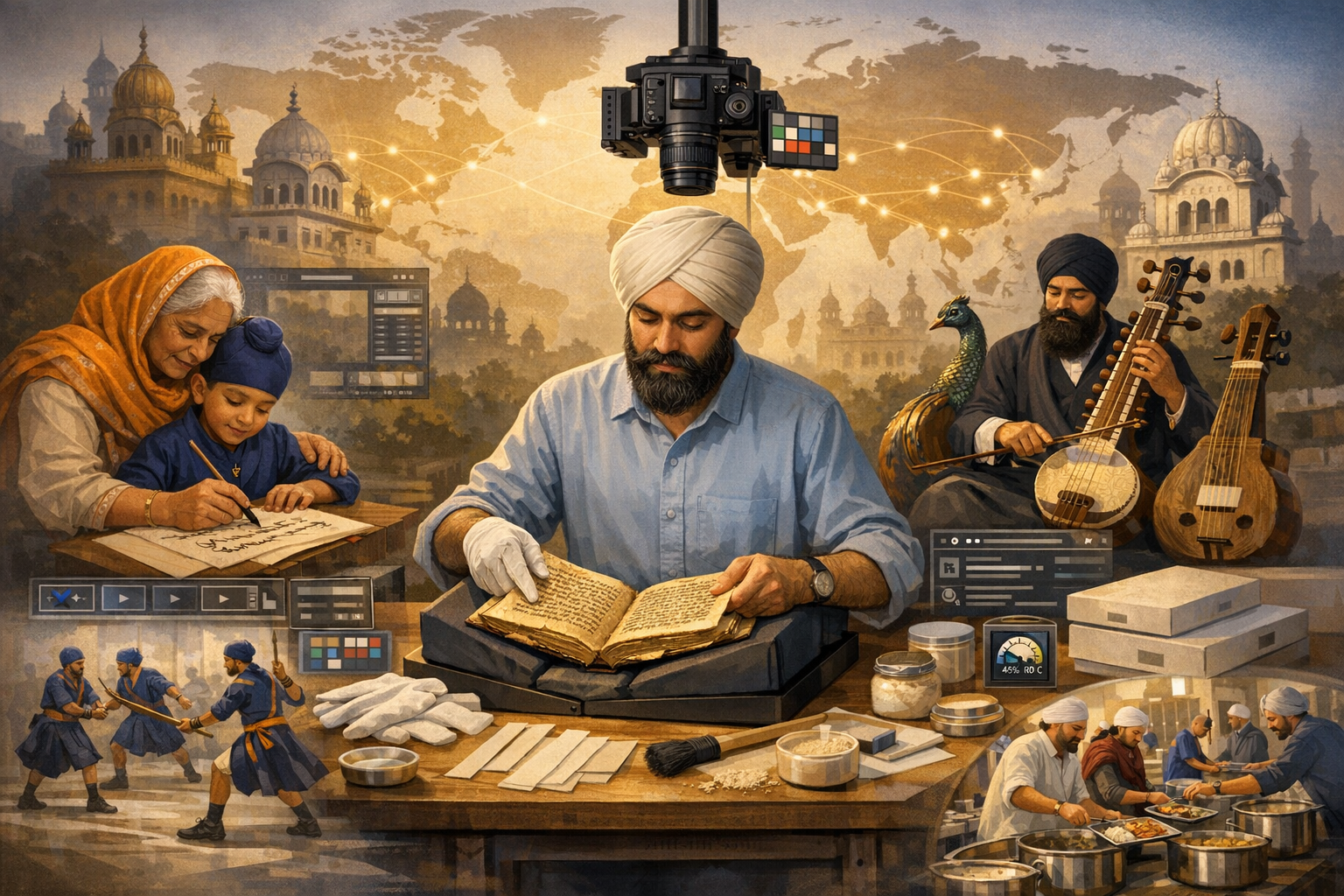
Manuscripts and early printed materialspothis, gutkas, janamsakhis, hukamnamas, and community registersrequire stable storage at controlled temperature and relative humidity, buffered by acid-free enclosures. Conservators typically favor reversible mending with Japanese kozo tissues and wheat-starch paste, gentle dry-surface cleaning, and custom housings that avoid mechanical stress on fragile bindings. Where inks are unstable, humidity control and light management become critical risk mitigations.
Digital archiving multiplies access while reducing handling risk. High-resolution image capture (e.g., 600 dpi, 24-bit color with calibrated targets), non-compressed or lossless masters (TIFF) with derivative access formats (JPEG, JP2, or PDF/A), and preservation metadata (PREMIS, checksums, fixity schedules) form a robust backbone. Descriptive metadata using Dublin Core, controlled vocabularies (e.g., Getty AAT), and authority files preserves discoverability. Interoperability via IIIF facilitates scholarly sharing and long-term platform agility.
Gurmukhi text processing benefits from Unicode-compliant fonts, clear normalization policies, and consistent transliteration schemes when transliteration is needed. Optical Character Recognition for Punjabi in Gurmukhi, while improving, demands careful post-correction and provenance notes indicating confidence levels. Aligning segmented text with images through METS/ALTO or TEI enriches research value and transparency.
Responsible access policies safeguard sanctity and community norms. Gurbani requires respectful handling, accurate transcription, and clear indication of source lineage. Non-commercial licenses, tiered access for sensitive materials, and watermarking of derivative images protect community trust without unduly restricting educational use. Public-facing portals should include contextual essays that explain historical setting, genre, script features, and devotional significance.
Gurmat Sangeet is a cornerstone of intangible heritage. Revitalization efforts prioritize training in raag-based kirtan, attention to prescribed raags, and continuity of indigenous instruments such as taus, rabab, saranda, and dilruba alongside contemporary harmonium practice. Diaspora academies, summer schools, and mentorship networks link young ragis with lineage holders, strengthening both musical literacy and devotional depth.
Martial and performative traditions like gatka embody discipline, ethics, and community resilience. Preservation combines codified pedagogy, documented lineages, safe training protocols, and historically informed equipment. Competitions and demonstrations can support visibility, but continuity is best secured by apprenticeship models, accessible local classes, and documentation that captures footwork, weapon forms, and pedagogy.
Langar and seva transmit values that are simultaneously spiritual and organizational. Heritage-informed practice documents recipes, food safety, and supply-chain ethics; captures oral histories of langar kitchens; and shares replicable models for sustainable operations and zero-waste practices. These living archives demonstrate how Sikh ethics animate community health, disaster relief, and intercultural solidarity.
Language continuity underpins every domain. Heritage Punjabi and Gurmukhi literacy programsweekend schools, summer camps, and digital learning appswork best when they integrate orthography, calligraphy, scripture recitation, and everyday conversation. Clear curricular progression from letter acquisition to reading compositions in Gurbani and Punjabi prose helps learners cross the threshold from ritual familiarity to genuine fluency.
Community oral history captures nuance that formal archives can miss. Interview projects thrive when they practice informed consent, anonymization options, secure storage, and culturally sensitive questioning. Indexing interviews with time-stamped summaries and themes (emigration, seva, kirtan training, 20th-century community life) increases searchability and research impact.
Governance strengthens when gurdwaras and heritage trusts adopt transparent policies: published collections registers, accession and deaccession procedures, periodic condition assessments, and audited reports on conservation and digitization. Volunteer stewardship aligned with professional oversightcurators, conservators, archivistsensures that seva and technical rigor reinforce each other.
Risk management reduces preventable loss. Priority actions include disaster-preparedness plans, environmental monitoring, integrated pest management, secure storage with object-level tracking, and redundant digital backups across multiple geographic locations. Simple measuressmoke detection, water leak sensors, emergency evacuation routesoften provide the most immediate risk reduction.
Provenance and ethics protect communities and scholarship alike. Due diligence for acquisitions, compliance with international norms such as the Object ID standard, and community-based restitution pathways for displaced artifacts all uphold integrity. Transparent provenance histories increase research value and reduce exposure to trafficking risks.
Youth engagement converts preservation into purpose. Fellowships, hackathons for Gurmukhi OCR improvements, crowdsourced transcription drives, creative media projects on Anandpur Sahib or Guru Gobind Singh’s legacy, and internships at community archives give students pathways to apply skills in computer science, conservation, music, and public history.
Intercultural and interfaith collaboration broadens resources and deepens mutual respect. In alignment with the dharmic familyHinduism, Buddhism, and Jainismjoint preservation workshops, shared conservation labs, and co-curated exhibitions highlight both distinctiveness and convergence in ethics, craft, and devotion. Religious pluralism and interfaith dialogue become lived practices through technical cooperation and shared custodianship.
Clear metrics guide progress. Meaningful indicators include the number of folios digitized with full metadata; condition scores improved by preventive conservation; youth completing Gurmukhi literacy tracks; ragis certified in raag-based kirtan; documented gatka lineages; and engagement analytics for digital portals. Publishing dashboards encourages accountability and peer learning across the global Sikh community.
A practical roadmap has emerged from community experience: conduct a whole-collection survey; stabilize environmental conditions; digitize high-value and at-risk items first; document and publish metadata; implement redundant digital preservation; establish training pipelines for conservators, catalogers, ragis, and instructors; build partnerships with universities and museums; invite peer reviews from conservation professionals; practice transparent governance; and regularly communicate outcomes to the sangat.
Everyday scenes capture the heart of preservation: a grandmother in Toronto guiding a child’s first Gurmukhi letters; young volunteers in Kuala Lumpur carefully turning the pages of a fragile pothi; a sangat in Nairobi commissioning conservation-grade housings; a ragi in Birmingham restoring a taus; a langar team in Melbourne adopting sustainable practices. These moments translate values into durable structures of memory.
Global Sikhs are demonstrating that safeguarding heritage is not only about objects and archives; it is a living vow to sustain wisdom, service, and unity. By integrating conservation standards with devotional practice, digital access with reverence, and local leadership with transnational collaboration, the community advances Sikhi with confidence and humility. In the spirit of Chardi Kala and Vasudhaiva Kutumbakam, this shared work strengthens bonds within the panth and across the wider dharmic traditions, ensuring that the light of Sikhi continues to guide, include, and inspire.
Inspired by this post on SikhNet – News.