The defense of Punjabi is, in practical and philosophical terms, the defense of Punjab’s civilizational identity. In Punjab and across its global diaspora, Punjabi carries the memory of rivers, fields, shrines, songs, and shared customs; it encodes the ethics of seva, sangat, and a lived pluralism that has historically bridged Hindu, Buddhist, Jain, and Sikh traditions. Protecting Punjabiits speech communities, its scripts, and its knowledge ecosystemstherefore safeguards not only a mode of communication but a civilizational archive and a living ethos.
Punjab’s cultural arc is among South Asia’s oldest. From the Vedic Sapta Sindhu to the Buddhist and Jain footprints across the northwest and the later flourishing of Sikh tradition, the region’s civilizational character has been dialogic, resilient, and integrative. Punjabi as a language absorbed, reframed, and transmitted this plural inheritance. In everyday vocabulary, in the moral texture of proverbs, and in the cadences of kirtan and qisse, Punjabi has served as a vessel for shared dharmic values such as compassion (daya), non‑hoarding (aparigraha), and righteous courage (kshatra) that resonate across Hinduism, Buddhism, Jainism, and Sikhism.
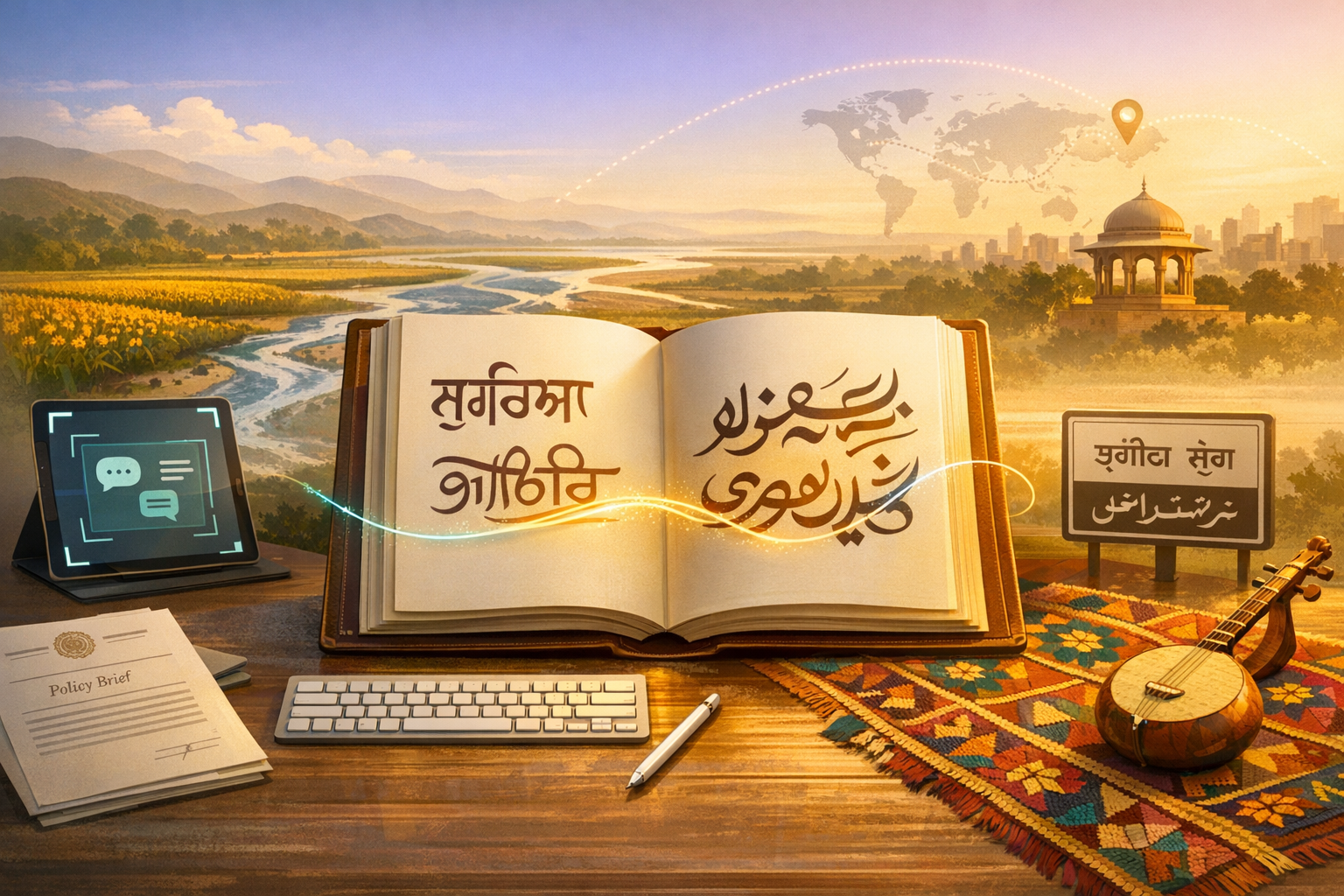
Script is the visible body of this voice. Gurmukhi, systematized in the Sikh tradition and consolidated for pedagogy and liturgy, became a durable vehicle for Gurbani and the literary canon. Shahmukhi, the Perso‑Arabic orthography used widely in the western Punjab, reflects another arc of Punjabi’s history and cultural exchange. A civilizationally confident approach recognizes both as expressions of a single linguistic continuum and seeks scholarly and technological bridges across them, rather than binaries that fragment a shared heritage.
Historically, Punjabi’s public standing has been shaped by policy choices as much as by literary vitality. Under late pre‑modern and colonial regimes, administrative preferences for Persian and then Urdu often displaced Punjabi from formal domainseven as printing, education, and reform movements strengthened Gurmukhi literacy and community institutions. The mid‑20th‑century reorganization culminating in the creation of a Punjabi‑speaking state and the Punjab Official Language Act, 1967, restored Punjabi to the core of provincial identity and governance, though implementation gaps have periodically limited its reach in administration, signage, and public service delivery.
The constitutional and policy architecture in India now offers a robust foundation. Punjabi is in the Eighth Schedule, enabling central support for its development; Article 29 safeguards cultural and linguistic rights; and Article 350A underscores the importance of mother‑tongue instruction at the primary stage. The National Education Policy (NEP) 2020 further emphasizes foundational literacy in home languages. Together, these instruments enable a comprehensive agenda: Punjabi as a medium of learning and thought in early grades, as a civic language in governance, and as a knowledge language in higher education and research.
Demographically, Punjabi is a world language. In India, tens of millions identify Punjabi as a mother tongue; in Pakistan, Punjabi speakers constitute the largest linguistic community; globally, Punjabi has become a leading non‑official language in countries such as Canada and the United Kingdom. This scale makes Punjabi strategically significant for cultural diplomacy, trade, and the creative economy, and it demands a cross‑border scholarly ecosystem that treats Punjabi literature and folklore in Gurmukhi and Shahmukhi as complementary facets of a single civilizational stream.
Education research consistently shows that early learning in the mother tongue improves comprehension, long‑term academic performance, and socio‑emotional development. For Punjabi, this means a structured bilingual pathway: Punjabi‑medium foundations in literacy and numeracy; additive proficiency in Hindi and English for inter‑regional and global mobility; and discipline‑specific academic Punjabi to anchor conceptual learning in the sciences, social sciences, and arts. Such a model builds cognitive depth without sacrificing opportunity.
A central technical challenge is terminology and corpus development. Punjabi needs standardized, field‑tested glossaries in STEM, law, public administration, and the social sciences. A pragmatic approach can synthesize Sanskritic coinages that align with Indic conceptual frameworks, living vernacular formations that ensure accessibility, and internationally harmonized terms where necessary for interoperability. Iterative classroom pilots, teacher feedback loops, and open‑access publication will stabilize usage and speed adoption.
Digital infrastructure is now decisive for language vitality. Gurmukhi has full Unicode coverage, widely used fonts, and standard keyboard layouts; however, Punjabi still requires stronger tooling across the stack. Priority actions include high‑accuracy optical character recognition for scans and manuscripts, robust text‑to‑speech and speech‑to‑text engines tuned to regional accents, spelling and grammar tools integrated into major platforms, and cross‑script transliteration pipelines between Gurmukhi and Shahmukhi. Open corporabalanced by domain, register, and dialectwill power these tools and enable natural language processing advances. Collaborative efforts with open‑source projects and Indic NLP initiatives can accelerate progress while ensuring academic rigor and community oversight.
Governance is another lever. Citizen‑facing services, forms, and grievance portals should offer first‑class Punjabi interfaces, not as translations of last resort but as default options. Translation‑memory systems and terminology databases can ensure accuracy and consistency across departments. Evidence‑based policy design also favors Punjabi in public health messaging, agriculture advisories, and disaster communicationdomains where clarity, trust, and speed save lives and livelihoods.
Punjabi’s creative industriesmusic, film, theatre, and publishingare powerful carriers of language prestige. Strategic investments in original Punjabi content for children and adolescents, documentary filmmaking on heritage sites and crafts, and support for literary translation (into and from Punjabi) can expand the audience, modernize narratives, and create dignified livelihoods. Partnerships that bring together universities, broadcasters, and cultural institutions will widen reach and maintain standards.
From a civilizational perspective, Punjabi encodes an ethic of shared humanity. Concepts central to Sikh thoughtsangat, langar, and the invocation of Ik Onkarharmonize with Indic values of ahimsa, karuna, and shraddha across dharmic lineages. The language’s defense is thus not oppositional but integrative: it strengthens a unifying framework in which communities participate as peers, preserving memory while advancing modern aspirations.
Public discourse often frames language debates as zero‑sum. A civilizational approach rejects that frame. When Punjabi thrives, so do the bonds linking the region’s dharmic traditions, its rural and urban ecologies, and its domestic and diasporic communities. Strong linguistic identity is associated with higher civic participation, better educational outcomes, and greater economic resilience; it also inoculates society against reductive narrativeswhether sectarian or separatistthat mistake diversity for division.
A strategic blueprint for Punjabi can be articulated as a practical, time‑bound agenda aligned with constitutional principles and contemporary evidence. The following priorities balance cultural depth with modern capability, placing Punjabi where it belongs: at the center of Punjab’s public life and as a confident voice in India and the world.
1) Foundational learning: universal Punjabi‑medium instruction in early grades with additive, not substitutive, bilingualism; graded readers, phonics‑sensitive materials, and culturally contextual storybooks that reflect Punjab’s landscapes and values.
2) Teacher pipeline: scholarships for Punjabi‑medium educators in STEM and social sciences; continuous professional development; open repositories of lesson plans and assessments; incentives for rural and underserved postings.
3) Terminology and standards: permanent commissions for academic Punjabi across disciplines; annual updates to glossaries; open licensing for adoption by schools, universities, and the media.
4) Administrative usage: Punjabi‑first interfaces for e‑governance; legally enforceable bilingual signage standards; procurement guidelines that require Punjabi localization for public‑facing technologies.
5) Judiciary and access to justice: certified Punjabi translations of key statutes and citizen charters; court e‑filing support; interpreter pools trained in legal terminology to ensure fairness for Punjabi‑dominant litigants.
6) Digital ecosystem: investment in OCR, ASR (automatic speech recognition), TTS (text‑to‑speech), spell‑checkers, grammar tools, and cross‑script transliteration; curated corpora representing Gurmukhi and Shahmukhi; hackathons and research grants to seed innovation.
7) Heritage and archives: digitization of manuscripts, folk ballads, and oral histories; critical editions of classics spanning Sufi, Sikh, and vernacular canons; community‑led documentation of crafts, music, and performative traditions.
8) Diaspora partnerships: Punjabi chairs and fellowships at leading universities; student exchanges; incubation for Punjabi ed‑tech and media start‑ups; co‑production agreements for film and documentary content.
9) Public media and children’s content: dedicated slots for Punjabi educational programming; contests for original children’s literature and animation; reading clubs and mobile libraries to build habits of lifelong reading.
10) Monitoring and evaluation: annual language vitality reports tracking school enrollment by medium, public‑service language availability, content production metrics, and digital tool adoption; outcome‑linked funding to reward successful models.
Technically, Punjabi development benefits from detailed attention to orthography and phonology. Standardization of nasalization markers (bindi, tippi), consistent treatment of gemination, and careful handling of borrowings improve readability and machine processing. In NLP settings, tokenization must account for clitics and compound morphology; speech technologies need region‑specific acoustic models; and cross‑script mapping should preserve phonemic integrity, not merely visual resemblance. These are solvable engineering problems when guided by linguists and community reviewers.
Policy alignment with the NEP 2020 can further normalize Punjabi in higher education. Bilingual or trilingual degree pathways, where core conceptual instruction is available in Punjabi alongside English and Hindi, will expand access without diluting standards. Research output in Punjabisupported by abstracts and keywords in English for discoverabilitywill enlarge the domain of academic discourse, enabling sophisticated argument in the home language while maintaining global linkages.
Economically, language is infrastructure. Farmers reading climate advisories in Punjabi act sooner; small businesses using Punjabi interfaces navigate compliance with less friction; artists creating in Punjabi retain more value in regional markets. Multipliers appear when language is present at every node: learning, working, creating, and governing.
Socially, Punjabi nurtures cohesion. Elders pass down lullabies and folktales; youth remix formsfrom qisse to hip‑hopinto new, confident expressions; interfaith service in langar halls models dignity and mutual care. These lived practices consolidate a civic identity stronger than the sum of its parts and truer to Punjab’s civilizational character.
Ultimately, the defense of Punjabi is not about retreat; it is about reach. It is an invitation to imagine a future where Punjabi children learn science with conceptual precision in their mother tongue, where public services speak the language of the people by default, where scholars read across Gurmukhi and Shahmukhi without friction, and where diaspora communities remain seamlessly connected to the source. Such a future strengthens unity across dharmic traditions and equips Punjab to contribute distinctively to India’s cultural heritage and to global conversations.
In this civilizational view, language is both memory and possibility. Safeguarding Punjabithrough education, technology, governance, and culturefortifies the values that have long defined Punjab: courage anchored in compassion, prosperity tempered by generosity, and diversity held together by an unshakeable sense of shared belonging.
Inspired by this post on SikhNet – News.