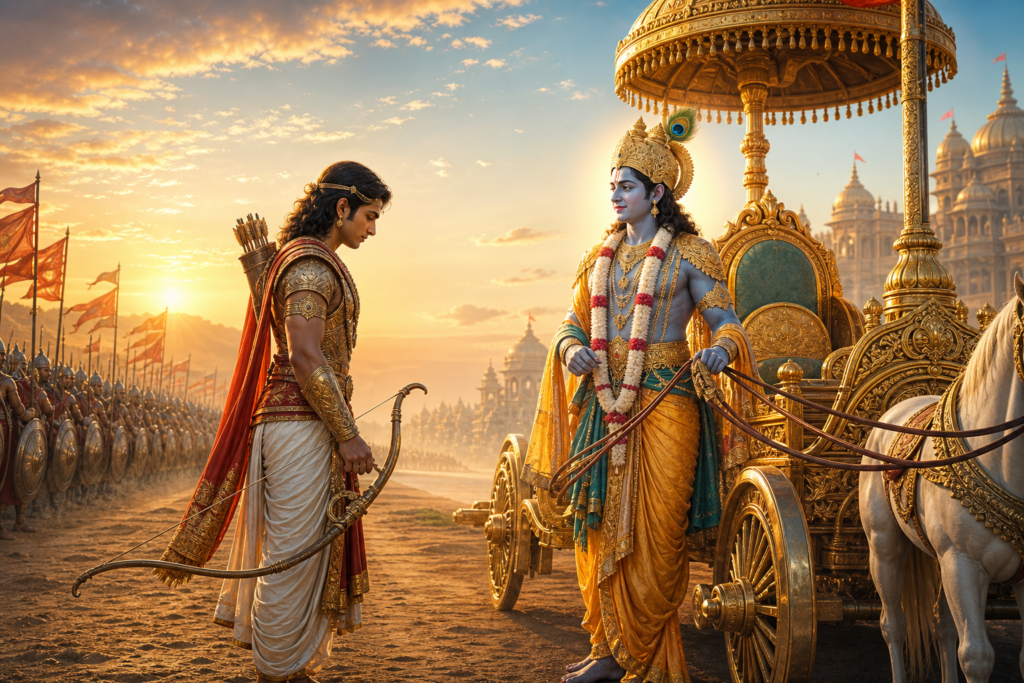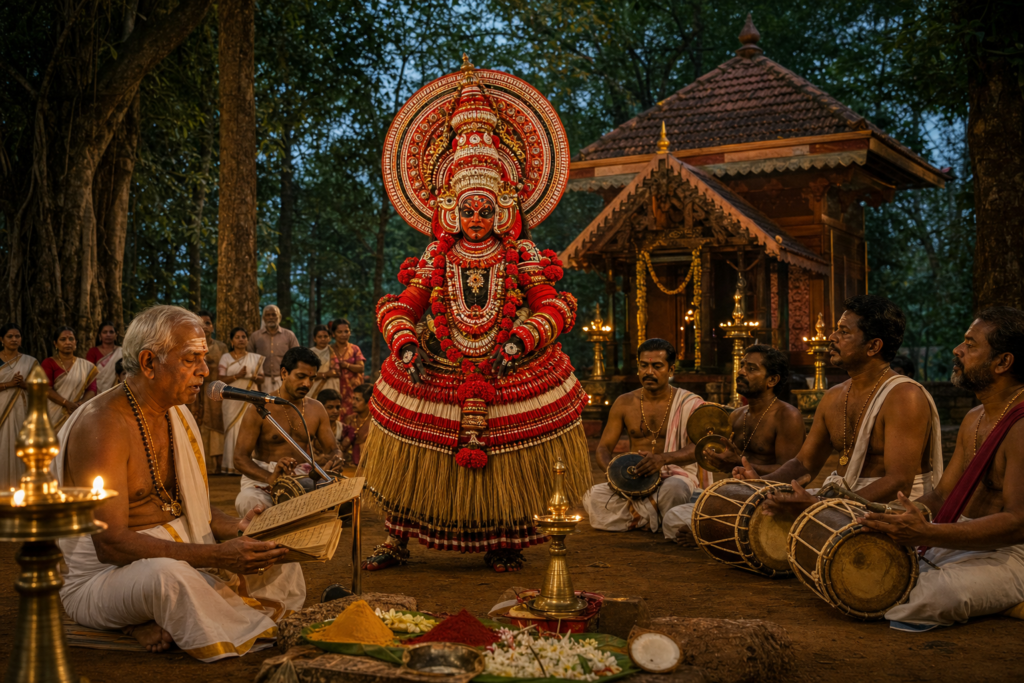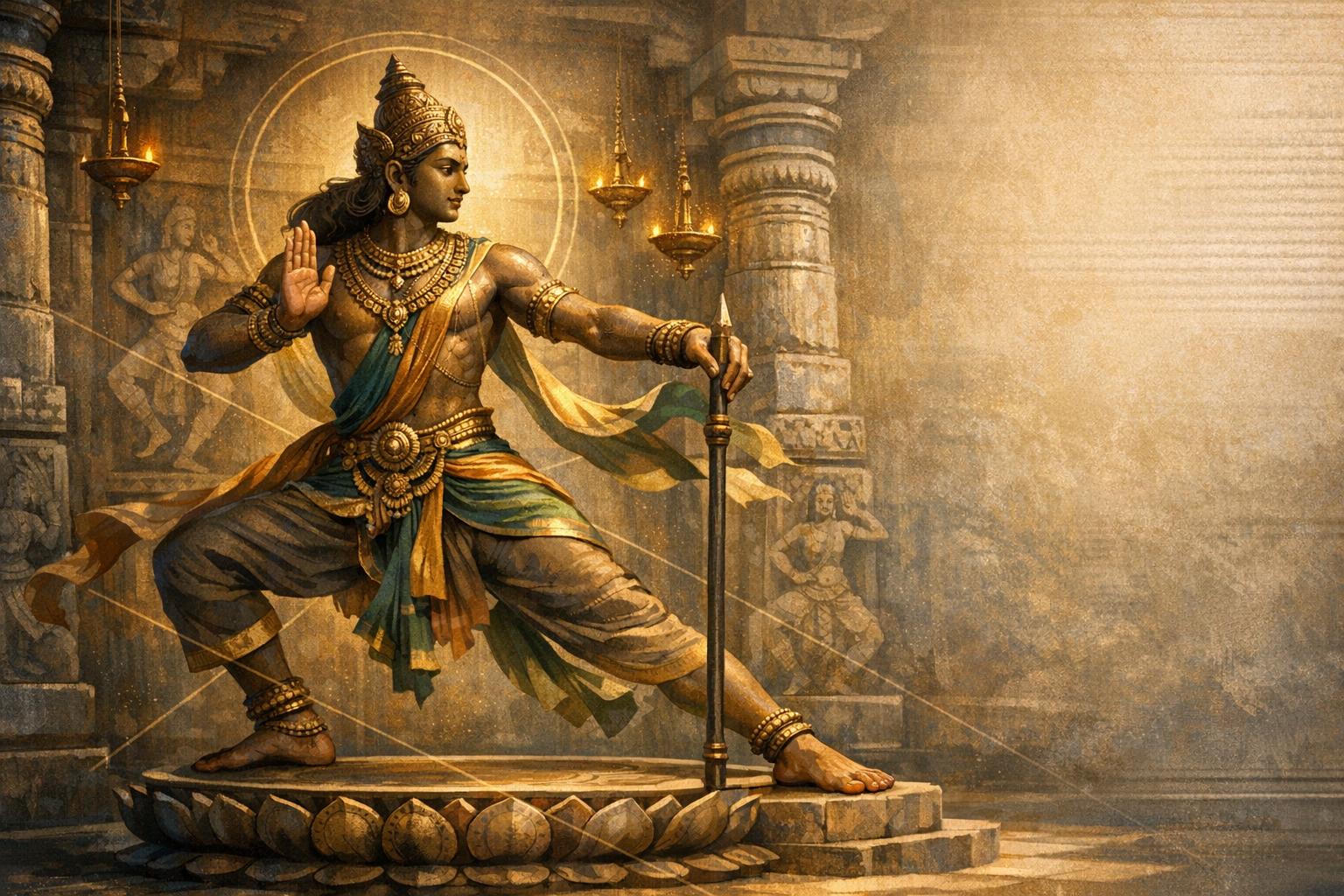
In Hindu iconography and worship, posture is a precise visual grammar through which deities communicate cosmic functions and ethical ideals. Among these codified attitudes, the ālīḍha (Alidha) stance stands out for its charged stillness: the right leg steps forward with conviction while the left leg draws back, anchoring energy. This dynamic alignment simultaneously signals movement and stability, a poise of vigilant readiness that recurs across Shaiva, Shakta, and Vaishnava sculpture and painting. The effect is unmistakabledivine power held in reserve, primed to protect and restore dharma without excess or hesitation.
The term ālīḍha is attested in foundational aesthetic and technical traditions. The Nāṭyaśāstra associates it with the broader corpus of karaṇas that encode dance, drama, and combat motifs, while later manuals such as the Abhinaya Darpana transmit its performance nuances. Shilpa-śāstra texts (for instance, the Mānasāra, Mayamata, and Śilparatna) instruct sculptors on when this stance should be applied to convey vīra (heroic) and raudra (fierce) aspects. Parallel vocabulary appears in martial literature (Dhanurveda) where ālīḍha is the classic archer’s poise. Iconographers also recognize pratyālīḍha (or pratilīḍha) as the complementary variant that reverses the legs. Regional ateliers vary in convention; in many South Indian traditions, ālīḍha is commonly shown with the right leg firm and forward, the left leg set back to stabilize the frame.
Technically, the stance organizes the body as a kinetic whole. The front knee bends to absorb force, the back leg extends and roots the heel, and the pelvis aligns to keep the spine elongated. Weight distribution tends toward the forward leg without collapsing the torso, allowing the shoulders and arms to deploy weapons, mudrās, or attributes with clarity. Sculptors and dancers accent subtle counter-rotation along the thoracic spine so that the head can face the narrative action while the hips channel drive into the ground. This poised asymmetry keeps the center of gravity low and stable, supplying the elasticity needed for the next beat of movementwhat the Nāṭyaśāstra repeatedly values as controlled dynamism.
Symbolically, ālīḍha unites two conditions that devotional aesthetics seeks to reconcile: sthira (stability) and cala (motion). The forward leg manifests intent and compassion in action; the rear leg preserves discernment and restraint. In yogic-anatomical readings, the stance grounds awareness through mūlādhāra while igniting will and courage through maṇipūra; rajas (kinetic force) is gathered, refined, and directed by sattva (lucid purpose). Thus, ālīḍha is not mere aggression; it is ethical momentumenergy harnessed by wisdom, aligned to protect, restore, and uphold dharma.
Many deities employ ālīḍha to cue specific narratives and rasas. Śiva as Tripurāntaka, drawing the bow against the three cities of adharma, often stands in an emphatically archer-like ālīḍha that clarifies trajectory and aim. In Natarāja iconography, even within the dance’s circular flow, variants of the stance help articulate accent beats where cosmic rhythms compress into decisive moments. Durgā as Mahiṣāsuramardinī anchors the demon underfoot while stepping forward to embody vīra and raudra without losing maternal serenity in the face. Skanda/Kārttikeya similarly appears with a confident stride that telegraphs martial leadership, while Narasiṃha’s forward surge channels protective ferocity tempered by righteousness. Across these examples, the legs narrate as surely as the hands and face.
Temple architecture preserves and amplifies this visual language. The celebrated karaṇa panels at Chidambaram encode ālīḍha among allied movements that sculpt cosmic dance into stone. Hoysala friezes at Belur and Halebidu animate warriors and deities in striding attitudes that behave like ālīḍha in function if not always in formal name. South Indian bronzes leverage the stance’s torque to keep slim silhouettes stable while projecting presence in circumambulatory processions. Farther afield, Khmer ateliers at Angkor Wat adopted and adapted Indian iconographic grammars; striding deities there reveal the persuasive portability of this posture across the broader Indic cultural sphere.
Aesthetically, ālīḍha helps summon the twin rasas of vīra (heroic resolve) and raudra (righteous indignation) without tipping into excess. Bharatanatyam performers introduce it to stage battle, guardianship, and protective intercession; Odissi modulates similar weight shifts through bhāṅgas, while Chhau expands the stride into vigorous arcs for martial tableaux. The stance’s clean directional vectors clarify narrative intent on stage and in sculpture, guiding a viewer’s eye toward the action’s focusbe it demon, devotee, or cosmic target.
The martial substratum of ālīḍha is unmistakable. Dhanurvedic descriptions make it an archer’s home base, and living South Asian arts such as Kalaripayattu retain similar lunges that coordinate breath, gaze, and ground force. The same principles appear in Sikh shastra-vidyā and Gatka drills where forward-weighted readiness aligns with restraint and ethical use of force. In these allied traditions, posture teaches responsibility: strength must be governed by clarity, and movement must serve protection rather than domination.
The stance also resonates across dharmic iconographies beyond Hinduism. In Vajrayāna and other Buddhist traditions, wrathful deities such as Vajrapāṇi frequently stand in ālīḍha-āsana to symbolize compassionate ferocity that subdues obstacles to awakening. Jain sacred images center serenity through padmāsana and kāyotsarga, yet attendant yakṣas and protective guardians are sometimes rendered in striding postures functionally akin to ālīḍha, underscoring vigilance around non-violent ideals. Read together, these convergences highlight a shared civilizational ethic: firmness without cruelty, motion without loss of balance, and power harnessed in the service of liberation and care.
For students of iconography and visitors to temples or museums, distinguishing ālīḍha from pratyālīḍha is diagnostic. When the right leg is forward and the left drawn back, the figure typically directs force toward the viewer’s left; reversed legs usually reverse that narrative vector. Artists coordinate this with the line of sight, the placement of antagonists or devotees, and the orientation of weapons. Observing how the feet lock into the base, where the torso turns, and how the gaze aligns can reveal the sculptor’s choreographic plan in a seemingly frozen scene.
Comparative stances enrich interpretation. Samapāda signals equipoise; abhanga and tribhaṅga distribute gentle contrapposto for grace; lalitāsana reclines one leg in relaxed sovereignty. By contrast, ālīḍha commits to action without sacrificing decorum. When these attitudes appear in sequence on a temple wall or in a performative suite, they trace a cycle: intention, preparation, action, and returnan ethical arc as much as a kinetic one.
Modern viewers often describe a visceral response to ālīḍha: a felt sense that the deity is about to move. That intuitive reading is close to the posture’s aim. It condenses narrative time so that vigilance and compassion appear as a single gesture. Practitioners in dance and yoga can explore this by carefully entering a forward lunge with grounded heel, steady breath, and a lucid drishti (gaze), noticing how stability and intention amplify each otheran embodied lesson in responsibility and care that resonates across Hinduism, Buddhism, Jainism, and Sikhism.
In sum, the ālīḍha stance is a disciplined architecture of meaning. It encodes dharma-readiness in the legs, compassion in the torso’s openness, and clarity in the face and eyes. As a “Hindu symbol” deeply woven into temple architecture, classical dance, and martial pedagogy, it models how power should be held: not as spectacle, but as promiseenergy gathered, intention purified, and action released only when it serves the welfare of all beings.
Inspired by this post on Hindu Blog.